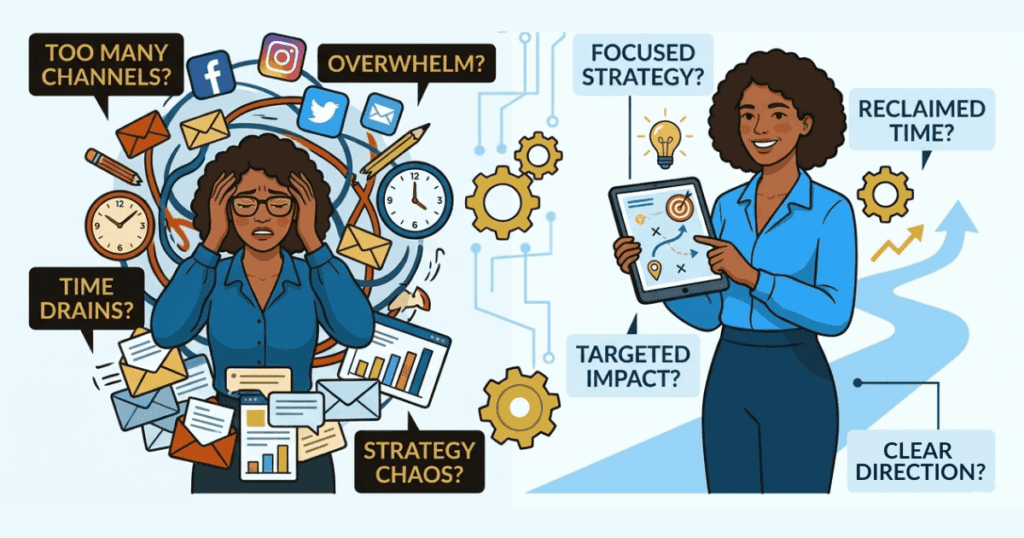
The 99% Problem (You Are SOOO Not Alone)
Ninety-nine percent of freelancers now say marketing is a challenge. Not 60%. Ninety-nine (99%!!). According to the Mighty Marketer’s 2025 survey of 267 freelancers, only 1% said marketing isn’t a problem for them.
That’s, like, EVERYONE.
When virtually everyone finds something difficult, it’s not a YOU problem. Something structural is broken. These solopreneur marketing challenges are systemic, not personal. And in client work over the past 25+ years, I’ve watched the same pattern play out: smart, experienced business owners who are great at what they do, and absolutely stuck on marketing.
It’s gotten measurably worse in the past few years (pairing perfectly with the rise of marketing complexity). In 2021, 83% of freelancers called marketing a challenge. By 2023, it was 93%. Now it’s 99%, with 75% calling it their biggest or a major challenge.
That’s a 20-point jump in two years. The advice ecosystem got louder, the channels got more crowded, AI flooded everything with content, and you still have the same 24-hour day to fit life and business.
Let’s talk about is why it’s this hard, where solopreneurs get stuck, and the one thing the people who aren’t stuck have in common.
Liked this? You'll like our events even more.
Our live workshops and webinars are the easiest way to get a feel for the Women Conquer Business approach — practical marketing you can use that week, no hype, no pressure. Catch the next one live, or watch a past session on your own schedule.
See Upcoming & Past Events → Prefer to jump in? Let's goooooThe Numbers Behind Marketing Overwhelm
In 2024, VistaPrint and Wix surveyed 1,000 small business owners and found a consistent set of pain points:
- 53% struggle to stand out from competition
- 49% cite budget constraints
- 47% don’t know which tactics to choose
- 46% can’t tell if their marketing is working
No wonder you feel so much resistance. Nearly half of small business owners are spending time and money on marketing with no idea whether it’s helping. The cherry on top? The same report found that 71% of businesses do all of their marketing themselves.
Let’s break this down for a second.
You’re choosing the tactics, creating the content, running the campaigns, measuring the results (or trying to), and making every single decision about what to do next. All while delivering client work, managing admin, and keeping your business running.
I’m exhausted just writing it.
According to Founderreports’ 2026 solopreneur data, 41% of solopreneurs say time management is their biggest overall challenge. There’s no time for marketing to get its own time block. It competes with everything else for whatever bandwidth you have left at the end of the week.
Is it any wonder 34% cite marketing or customer acquisition as their top business challenge?
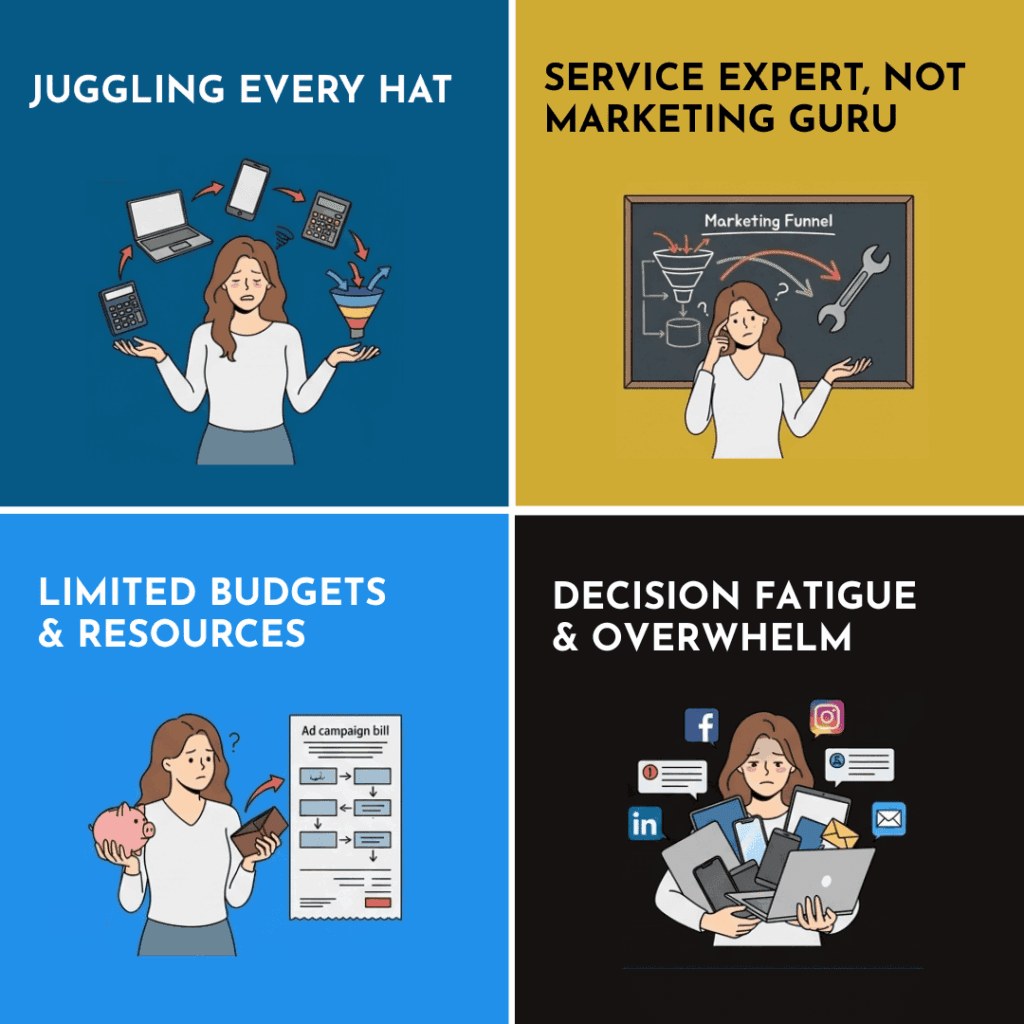
Decision Fatigue: The 1,000 Pound Problem
The hard part isn’t learning SEO or figuring out Instagram Reels. The hard part is deciding.
Which platform.
What to post.
How often.
Whether to invest in ads.
Whether email is better than social.
Whether your website needs a redesign or your copy needs work.
Whether you should try that thing the podcast host recommended, or the thing your colleague mentioned, or the thing you read about at 11pm when you should have been sleeping.
Every single one of those decisions lands on you, between client calls, while you’re also trying to remember whether you paid that invoice (no the other one).
I wrote about this extensively in The Solopreneur Loneliness Loop because even if you don’t feel lonely, the decision load is still there. Decision fatigue leads to avoidance. Avoidance leads to the start-stop cycle where you go hard for two weeks, client work buries you, and by the time you come back to marketing, you’ve lost momentum.
Here’s what that looks like in practice. You spend Sunday evening planning your content for the week. Monday morning, a client emergency hits. By Wednesday, the plan is abandoned. Nobody notices. Nobody checks in. (There’s no one to do that.)
By next Sunday, you’re starting from scratch again because you can’t remember what you were doing or why.
That cycle not only waste time, prevents marketing momentum. The whole point of consistent marketing is that each piece of content, each email, each connection builds on the last one. When you restart every few weeks, nothing builds. Three months (or years!) go by, and your email list is the same size it was in January.
Think about it through the lens of the 3 C’s framework: capacity, complexity, and control. Most solopreneurs have the capacity for one or two marketing channels, done consistently. The complexity of managing multiple platforms without a team isn’t realistic. And control means being honest about what you can sustain during a bad week, not what you can pull off during an inspired weekend.
What the 1% Do Differently (It’s Not What You Think)
The 1% who aren’t challenged by marketing? They don’t know more than you. Most of them will say they’re not particularly talented at marketing, either.
… but they do have two things:
- A written plan, and
- Accountability.
In 2022, CoSchedule surveyed over 500 marketers and found that those who document their strategy are 414% more likely to report success than those who don’t.
But here’s the catch. A documented strategy sitting in a Google Doc that nobody reads isn’t a strategy, it’s a wish list. Documentation only works when there’s also accountability.
Time and again, the first thing I hear during the second marketing coaching call, is “I got so much done because I saw our meeting on the calendar!” That’s accountability. My clients tell me what they’ll do, and they want to be able to tell me they did it.
The solopreneurs who succeed at marketing aren’t operating in isolation. They have some version of structured support, whether that’s a peer group, a marketing membership, a coach, or even one accountability partner who meets with them weekly.
Step 1? Write out your Solopreneur Marketing Strategy
I’m certain you’re making this too hard. You only need one page (two max).
Here’s what to include:
- 1-2 channels you’re using
- Theme for the month (what you’re posting)
- How often you’ll post/share
- What “working” looks like: more calls? Email signups?
- Who will help you stay accountable
Reality Check
- Setup effort: Low (a few hours to document your plan and find an accountability partner or group)
- Ongoing effort: 2- 5 hours per week on marketing execution, plus 30 minutes for a weekly check-in with your accountability buddy
- Tools required: Whatever you’re already using. Keep it simple.
- When results typically show: Revenue impact can take 3 to 6 months of sustained effort.
- Common misconception: That you need a more sophisticated strategy. The truth is the winning strategy is the one you follow.
Your Next Step? Find the Right Accountability
Find people who will help you stick to what you already know.
If you’ve been doing this for 5+ years, you have enough marketing knowledge. You need implementation, and implementation falls apart without a check-in that’s more reliable than your willpower.
Find two or three peers at a similar stage. Set a weekly 30-minute call. Share your plan. Report on whether you did it. You’ll learn more about what’s been holding back your marketing in six weeks than you did in the last six months of reading about it.
If you want expert support with more structure, the WCB community was designed around this problem: quarterly planning, weekly accountability, and a small group of solopreneurs who understand what DIY marketing looks like when you’re also the CEO, the service provider, and the operations team.
But wherever you find it, stop trying to figure out marketing alone. That 99% number didn’t come from nowhere.
Frequently Asked Questions
Why is marketing so hard when you work alone?
Because marketing requires ongoing decisions about strategy, content, platforms, and timing, and volume of decisions gets overhwhelming. When there’s no one to check your thinking or keep you accountable, decision fatigue sets in. The result is avoidance, inconsistency, and a start-stop pattern that prevents any single effort from gaining traction over time.
How do I simplify marketing as a solopreneur?
Pick two channels maximum. Document what you’ll do and how often on one page. Define what “working” means for your business (not someone else’s metrics). Then find one person or small group who will check in with you weekly. Simplifying means removing the decision load that makes marketing feel impossible, not doing fewer things.
Get the Free 90-Day Solopreneur Marketing Plan Template
Quarterly goals, a simple content calendar, and a monthly review framework — all in one template. Built for business owners who want a system, not a hustle.
No spam. Unsubscribe anytime. We respect your inbox.
Want to see how we actually work before you commit?
Our live workshops and webinars are the easiest way to get a feel for the Women Conquer Business approach — practical marketing you can use that week, no hype, no pressure. Catch the next one live, or watch a past session on your own schedule.
See Upcoming & Past Events → Prefer to talk it through? Book a free clarity call