Coaching vs Consulting: Leaving You Confused?
Most business owners choose the wrong type of support because they don’t understand what they need.
Thinking about hiring marketing help? Let’s figure out what you actually need.
Before you spend hours researching, a free 30-minute clarity call can tell you exactly what kind of support fits your business and budget. No pitch, no pressure... just a straight answer.
Book a Free Clarity Call → Learn more about coaching optionsThe confusion makes sense. When you search “marketing coach vs consultant,” you’ll find a dozen different definitions, all contradicting each other. Some coaches do consulting. Some consultants offer coaching. Agencies promise everything.
And everyone’s trying to convince you that their model is the one that works.
I’ve spent 25+ years on every side of this equation. I started as an in-house marketer, moved into public service websites, fixed agency messes as a consultant, and now run marketing coaching and consultancy specifically for established solopreneurs.
This guide breaks down three options: marketing coach, marketing consultant, and marketing agency, with transparent pricing, real timelines, and a decision framework that helps you figure out which one (if any) makes sense for your business right now.
By the end, you’ll know exactly which type of marketing support matches where you are today.
Not where you “should” be. Where you are today.
Key Differences Between a Marketing Coach, Consultant & Agency
| Feature | Marketing Coach | Marketing Consultant | Marketing Agency |
|---|---|---|---|
| Primary Goal | Skill-building & Guidance | Project-based Solutions | Full Implementation |
| Strategy Owner | Collaborative (You own) | Consultant (Expert-led) | Agency-led |
| Knowledge Transfer | High (Educational) | Limited (Deliverable-based) | Minimal (Execution-based) |
| Time Investment | 3–7 hours/week (You) | Medium (Review/Feedback) | Low (Approvals only) |
| Engagement Model | Retainer (6–12 months) | Fixed-scope (4–12 weeks) | Retainer (6–12+ months) |
Roles and Responsibilities: Defining Your Support
Understanding the responsibilities of each provider is the first step toward a successful partnership. Each model serves a different phase of business growth.
What is a Marketing Coach?
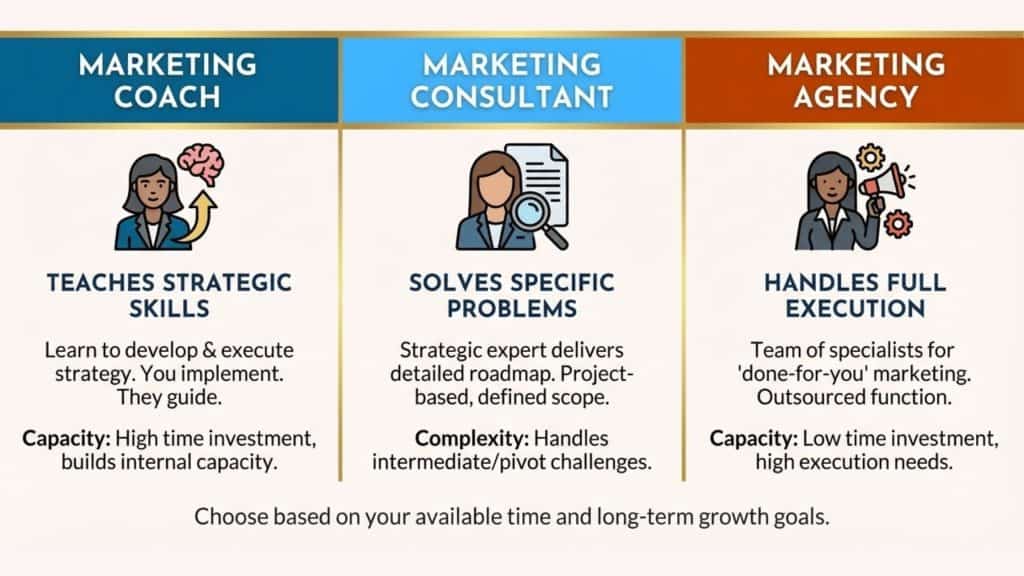
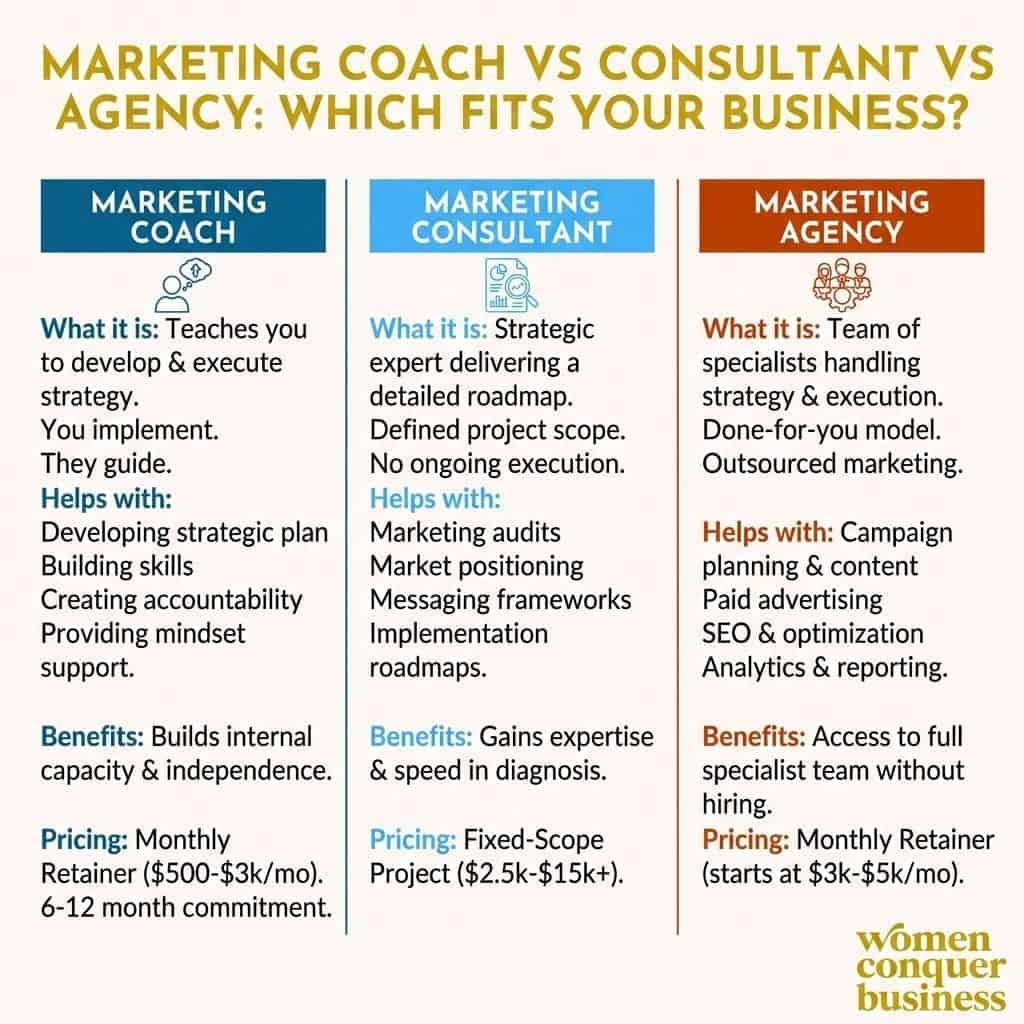
A marketing coach is a professional who teaches you to develop and execute your marketing strategy through one-on-one guidance. You remain responsible for implementation. The coach provides strategic direction, personalized training, and consistent feedback.
A coach helps clients with:
- Developing a strategic plan tailored to your goals and capacity.
- Building skills in specific areas like local SEO, email marketing, and content strategy.
- Creating accountability structures to ensure consistency.
- Providing mindset support around visibility and sustainable marketing.
What a marketing coach doesn’t do:
- Write your blog posts, emails, or social media content.
- Manage your accounts or campaigns.
- Build your funnels or automations.
If you’ve heard of a coach working on blogs, funnels, etc,. it’s likely because they offer a ‘done with you’ model. Be sure to ask specifically for that if it’s what would help you the most.
Benefits: You build internal marketing capacity that compounds over time. You remain independent and keep your business running without relying on an external provider.
Typical Pricing: Monthly retainer ($500-$3,000/month) with weekly or bi-weekly calls, email or messaging support between sessions, and access to proprietary frameworks or training materials. According to the International Coaching Federation, professional coaches average $272/hour, with business and marketing coaches typically charging higher rates. Most coaching relationships run 6-12 months minimum because skill-building and behavior change take time.
What is a Marketing Consultant?
A marketing consultant is a strategic expert hired to analyze your marketing and deliver a detailed roadmap within a defined project scope. Consultants provide specialized expertise but rarely handle ongoing implementation.
A consultant helps clients with:
- Conducting comprehensive marketing audits.
- Developing market positioning and competitive analysis.
- Creating messaging and brand clarity frameworks.
- Delivering implementation roadmaps with clear priorities.
What a marketing consultant doesn’t do:
- Handle ongoing execution after the project is complete.
- Train you to execute the strategy yourself.
- Provide long-term accountability or check-ins.
Benefits: You gain expertise and speed. A consultant can diagnose problems and create solutions in weeks that might take you months to determine on your own.
Typical Pricing: Fixed-scope projects range from $2,500 to $15,000+ depending on complexity.
What is a Marketing Agency?
A marketing agency is a team of specialists that handles both strategy and execution. This is a “done-for-you” model where you outsource the entire marketing function.
A marketing agency helps clients with:
- Campaign planning and content creation.
- Paid advertising management (Google, Meta, LinkedIn).
- SEO and performance optimization.
- Analytics and reporting.
Benefits: You get access a full team of specialists without hiring employees. It allows you to focus entirely on your clients while the agency handles the technical work.
Typical Pricing: Monthly retainers typically start at $3,000 to $5,000 for small businesses. According to Credo’s industry pricing survey, 50.97% of marketing agencies have retainer minimums between $1,000-$3,000 per month, with more established agencies commanding higher rates.
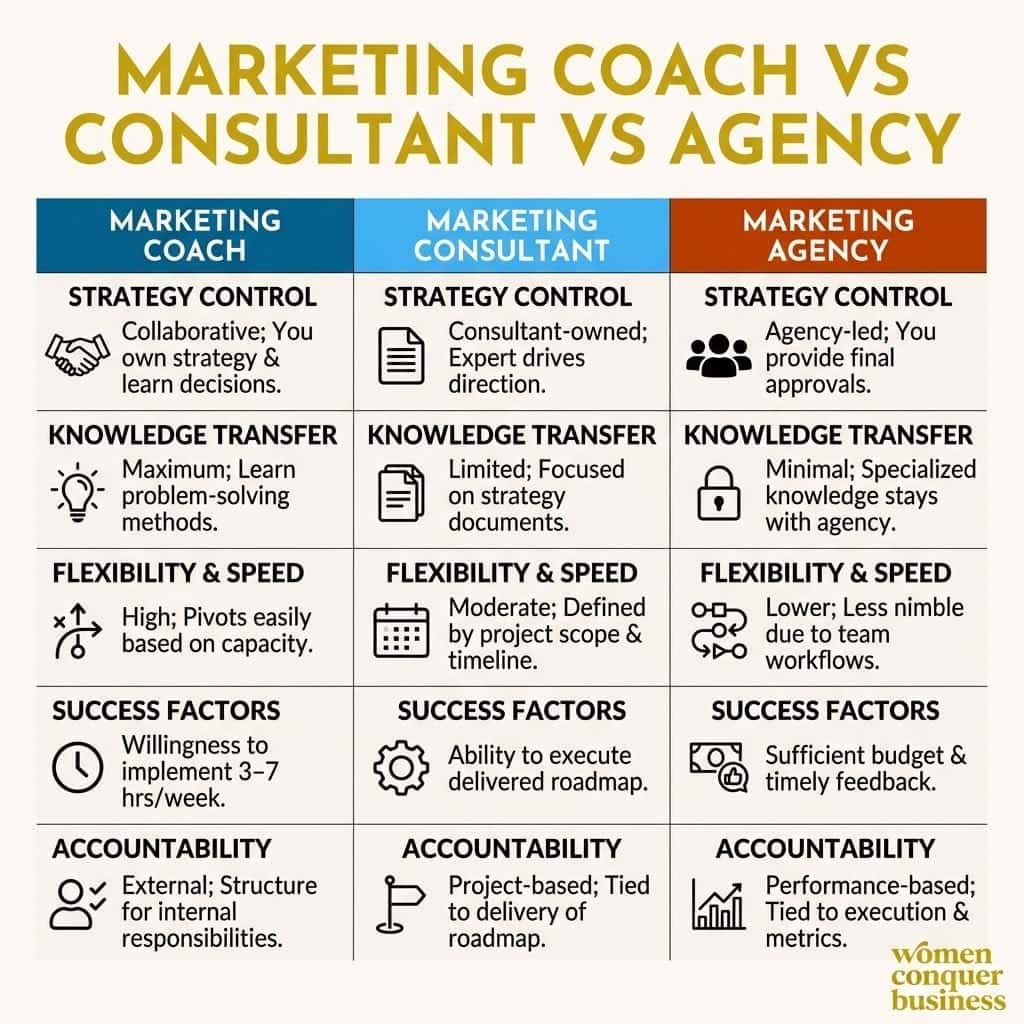
Key Differences: Marketing Coach vs. Consultant vs. Agency
Beyond the basic definitions, five core areas determine which model fits your business.
| Comparison Factor | Marketing Coach | Marketing Consultant | Marketing Agency |
|---|---|---|---|
| Strategy Control | Collaborative; you own the strategy and learn to make decisions. | Consultant-owned; the expert drives the direction during the engagement. | Agency-led; you provide final approvals based on their judgment. |
| Knowledge Transfer | Maximum; the primary focus is teaching you the problem-solving methods. | Limited; focused on delivering specific strategy documents and roadmaps. | Minimal; execution systems and specialized knowledge stay with the agency. |
| Flexibility & Speed | High; pivots easily based on your capacity, energy, or seasonality. | Moderate; defined by project scope, timelines, and agreed-upon deliverables. | Lower; less nimble due to scoped service retainers and team workflows. |
| Success Factors | Willingness to implement marketing work for 3–7 hours per week. | Ability to execute the delivered roadmap once the engagement ends. | Sufficient budget and capacity to provide timely feedback and approvals. |
| Accountability | External; the coach provides structure for your internal responsibilities. | Project-based; accountability is tied to the delivery of the strategic roadmap. | Performance-based; accountability is tied to execution and campaign metrics. |
1. Control of the Strategy
- Marketing Coach: You own the strategy collaboratively. You learn to make strategic decisions.
- Marketing Consultant: The consultant owns the strategy during the engagement. You implement what they create.
- Marketing Agency: Strategy is agency-led. You approve the direction but rely on their judgment.
2. Knowledge Transfer
- Marketing Coach: Focuses on maximum knowledge transfer. You learn the problem-solving methods.
- Marketing Consultant: Provides deliverables but limited skill development.
- Marketing Agency: Minimal knowledge transfer. Their systems and specialized knowledge stay with them.
3. Flexibility and Speed
- Marketing Coach: High flexibility. You can pivot strategies based on capacity.
- Marketing Consultant: Moderate flexibility within the project scope.
- Marketing Agency: Lower flexibility. Retainer contracts often involve scoped services that are less nimble.
4. Client Responsibilities and Success Factors
- Coach Success: Depends on your willingness to implement work for 3 to 7 hours per week.
- Consultant Success: Depends on your ability to execute a strategy once the consultant leaves.
- Agency Success: Depends on your budget and your ability to provide timely approvals.
5. Accountability Structure
- Coach: Provides external accountability for your internal responsibilities.
- Consultant: Deliverable-based.
- Agency: Performance-based.
Similarities Between Coaching and Consulting
While their delivery methods differ, both marketing coaching and consulting share several core goals. Both prioritize long-term business outcomes over short-term tactics.
They rely on deep industry knowledge to solve business challenges. Both aim to remove bottlenecks in your visibility and lead generation. Neither model is one-size-fits-all. They are tailored to your specific market.
Hidden Costs: Time and Capacity
The price on the invoice is one part of the investment.
- Time Investment: Coaching requires a high mental load and execution time. Consulting requires high effort during implementation. Agencies require low mental load but need timely feedback to avoid stalling.
- Learning Curves: You pay for the time you spend learning (coaching) or the time they spend learning your business (consulting/agency).
- Opportunity Cost: Hiring the wrong support is expensive. Choosing a coach when you need execution support leads to burnout. Hiring a consultant when you need accountability leads to unused strategy documents.
Overview: 3 C’s Decision Framework
| Factor | Choose a Coach if… | Choose a Consultant if… | Choose an Agency if… |
|---|---|---|---|
| Capacity | You have 5+ hours/week | You have team to execute | You have no execution time |
| Complexity | Foundational/One channel | Intermediate/Pivot | High/Specialized needs |
| Control | High (Own the knowledge) | Medium (Own the strategy) | Low (Outsource entirely) |
| Accountability | You need structure | You are self-disciplined | You need performance data |
3 C’s Decision Framework: How to Choose
To decide, evaluate your situation through three lenses.
Capacity: Do you have time?
Do you have the time and energy to implement? If you have less than 5 hours per week, coaching will not work. If you are buried in work, an agency might be the only functional option.
Complexity: How Complicated Is Your Marketing Challenge?
How complicated is the marketing challenge? Simple needs like setting up a content calendar are great for coaching. High-complexity challenges like enterprise SEO or sophisticated funnels often require the specialized team of an agency.
Control: Do You Need to Own This Long-Term?
How much do you need to own the knowledge? If you want to reduce dependency on outside providers, prioritize coaching. If you want marketing handled without needing to understand the mechanics, an agency is ideal.
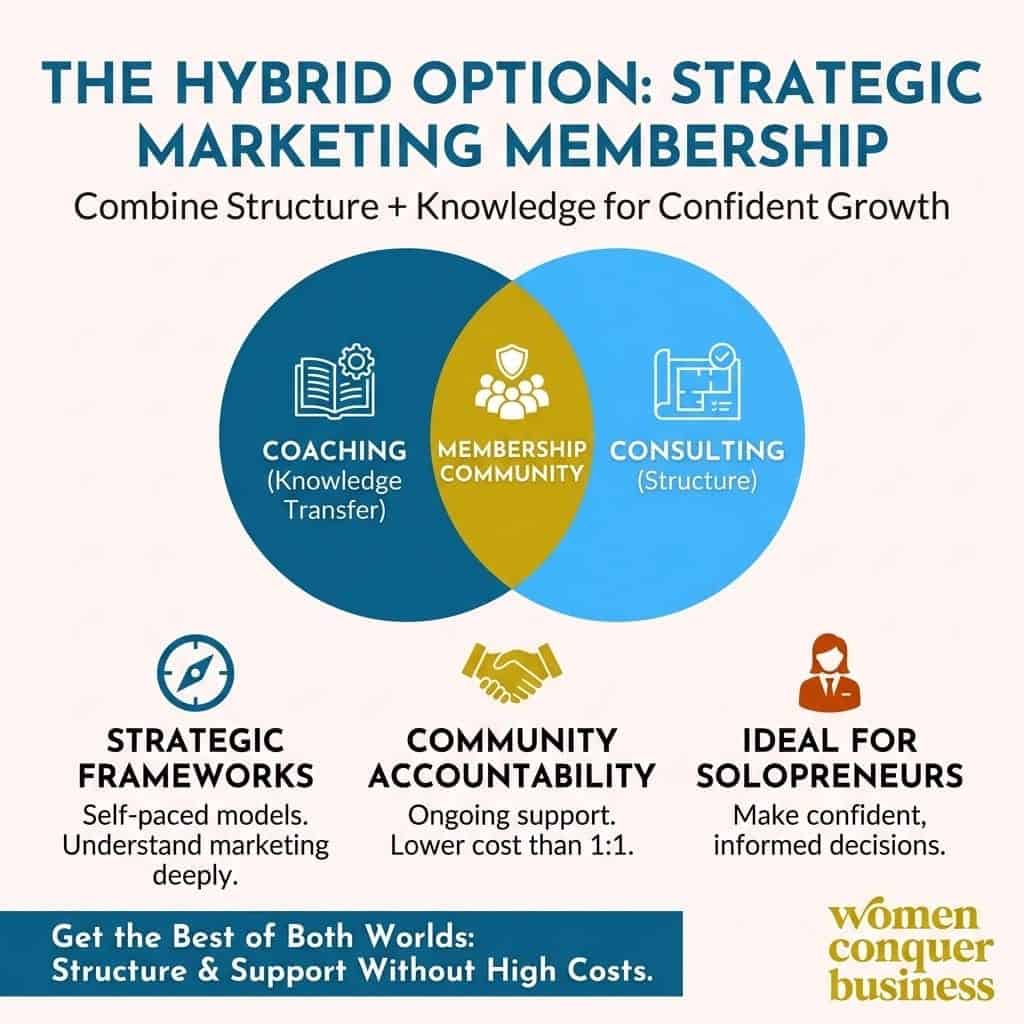
Fourth Option: Strategic Marketing Membership
Traditional categories do not fit every solopreneur. Some need the structure of consulting and the knowledge transfer of coaching without the high cost of one-on-one work.
Our paid community for solopreneurs, the Strategic Marketing Membership, is a hybrid model. It provides self-paced strategic frameworks and community accountability. This model is ideal for established solopreneurs who want to understand marketing deeply enough to make confident decisions.
The Decision Is Yours (And That’s Exactly How It Should Be)
The marketing coach vs consultant vs agency question doesn’t have a universal “right answer.” Anyone telling you otherwise is selling something.
Use the decision framework (the 3 C’s) to guide your choice. Your capacity (time, energy, cognitive load), project complexity (how sophisticated is the marketing challenge), and your desire for control (how much do you need to own this long-term) drive the boat on this.
Take the time to assess your realistic situation. Not where you think you should be. Not where some marketing guru says you need to be.
Where YOU are right now, with the capacity YOU have, for the business YOU’RE building.
If you’re an established solopreneur tired of scattered tactics and ready for strategic clarity, I’d love to help. Women Conquer Business offers marketing coaching for one-on-one support, comprehensive marketing strategy development, and our Strategic Marketing Membership for community-based learning at your own pace.
Marketing is a marathon, not a sprint. Choose support that helps you build sustainable momentum, not temporary wins that disappear when the support ends.
You deserve marketing that fits your life, not marketing that demands you fit its expectations.
FAQs: Marketing Coach vs Consultant
Which companies offer marketing coaching services compared to consulting services?
Boutique firms like Women Conquer Business specialize in both. Coaching is often found with individual experts focusing on skill-building. Consulting is standard at larger firms like Deloitte or specialized boutique agencies focusing on audits and high-level strategy.
Are there subscription services for ongoing marketing coaching or consulting?
Yes. Subscription models are common for solopreneurs. Marketing coaching often uses monthly retainers. Hybrid models, like the Strategic Marketing Membership, offer subscription access to frameworks and community support. Consulting is usually project-based.
How do marketing consultants structure their service packages compared to marketing coaches?
Consultants structure packages around deliverables. You pay for a completed project. Coaches structure packages around time and access. Coaching focuses on your progress, while consulting focuses on the completion of a specific asset.
Are marketing coaching memberships more cost-effective than hiring consultants?
For many solopreneurs, yes. A consultant project can cost $5,000 to $15,000. A membership provides the same frameworks at a lower cost ($67/month).
Which consulting firms also provide marketing coaching as part of their services?
Many boutique consultancies use hybrid models. Women Conquer Business provides CMO-level strategy alongside marketing coaching to ensure you gain the skills to manage your plan.
Where to book a free consultation session with a marketing coach or consultant?
Most experts offer a fit call. You can reach out to us at Women Conquer Business to schedule a strategy session and determine your 3 C’s before committing.
Not sure what your marketing actually needs right now?
A free 30-minute clarity call is the fastest way to find out. No pitch, no pressure... just a conversation about where your marketing is, where you want it to go, and what the realistic next step looks like.
Book Your Free Clarity Call → Learn more about working with JenGet the Free Marketing Tool Decision Framework
8 questions to ask before you add, keep, or replace any marketing tool. Stop investing in platforms you'll abandon in 3 months.
No spam. Unsubscribe anytime. We respect your inbox.