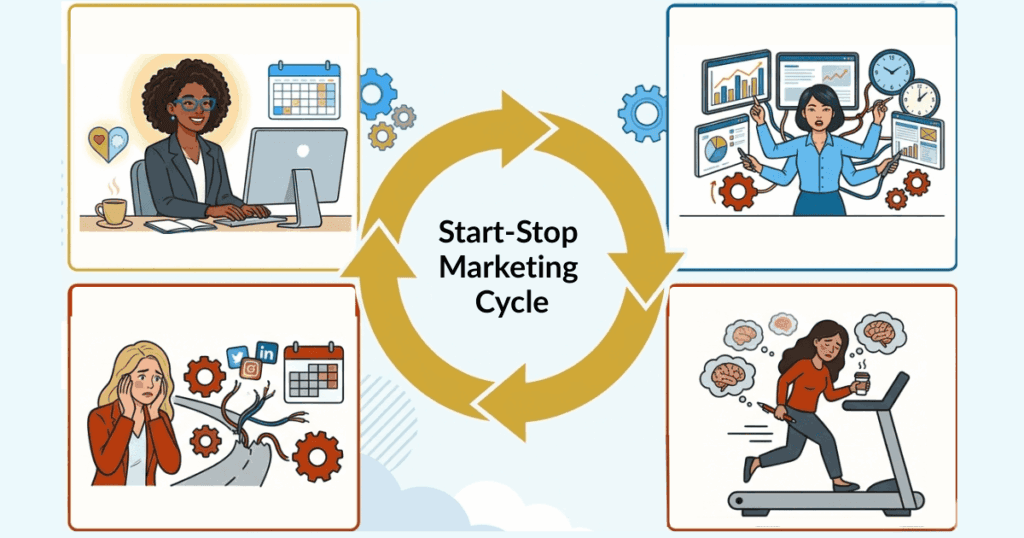
We’ve All Done This
Three weeks of posting. Maybe a newsletter goes out. You pat yourself on the back, marketing job well done (as you should).
Reading about community is one thing. Finding the right community is another.
The Women Conquer Business Membership gives women solopreneurs expert and peer support with people who understand your business, your budget, and your bandwidth.You don't have to do this alone (it's better if you don't).
See How Our Membership Works → Not sure yet? Book a free clarity callThen one, maybe two project land, or a client crisis eats your Wednesday and Thursday. Marketing slides down your priority list. A week passes. Then a month. By the time the project wraps and you look at your content calendar or plan, you’re starting over.
I’ve watched this cycle play out with hundreds of solopreneurs. You go hard, you get busy, you stop, you feel guilty, you start over. Sometimes the restart comes with a new platform or a new tactic, which makes it feel like progress when it’s the same loop wearing a different outfit.
Here’s what I want you to hear: inconsistent marketing as a solopreneur is the default outcome of working alone. And the common advice about fixing it (batch your content! use a scheduler! build an editorial calendar!) may miss the problem entirely.
Financial Pressure Drives the Cycle
The start-stop pattern doesn’t happen in a vacuum. There’s a financial engine underneath it.
Simply Business surveyed over 1,000 solopreneurs in 2025 and found that 48% have gone at least a month without income. And 68% have less than six months of savings or no financial safety net at all.
When income dips, what gets dropped first? Marketing. Why? Because client work pays now, and marketing pays later (maybe). The project in your inbox has a deadline and a dollar amount attached. The blog post you were going to write has neither.
So, you take the project. You deliver the work. The cash flow stabilizes. And by the time you look up, you’ve been invisible for six weeks.
But… what happens when the project ends? The pipeline is empty because you stopped filling it. Panic sets in. And the marketing firestorm begins again. Blasting LinkedIn posts, website redesign… Maybe a new tool that promises to make it all easier this time.
That’s the feast-or-famine cycle. It becomes a vicious, high-pressure cycle. Financial pressure makes you drop marketing, which creates a pipeline gap, which creates more financial pressure. Of the solopreneurs who’ve considered walking away from their business, the top reason is financial stress or inconsistent income.
According to QuickBooks’ 2024 research, 35% of solopreneurs report high stress levels, compared to 26% of business owners with employees. When you’re the only person making the decisions, absorbing the risk, and tracking the follow-through… you begin to wonder how 65% of solopreneurs aren’t stressed or burned out.
Why “Be More Consistent” Is Terrible Advice
You’ve heard it. I’ve heard people say it to my clients. Batch your content. Use a scheduling tool. Create a 90-day editorial calendar. These marketing myths sound like solutions but they miss the real problem.
I’m not saying those are bad ideas (we have blogs about these topics). But sometimes they solve the wrong problem.
Content batching helps with creation. Scheduling tools help you remember to hit publish. An editorial calendar organizes your plan. The problem is none of them help with the moment when you’re three weeks into a client project, exhausted, and the question isn’t “what should I post?” but “does anyone even notice that I stopped?”
When you’re your own boss, it’s SO EASY to let it slide.
No one asks whether the newsletter went out. Your LinkedIn plan? Forgotten. And that email strategy you committed to in January, the one you were going to try for a full quarter? Nobody’s checking on that either. The tools handle execution. What’s missing is the feedback loop that keeps you in motion when motivation runs out and client work takes over.
I wrote about this in the Solopreneur Loneliness Loop, and the research is clear: isolation produces withdrawal. When no one sees your work, you produce less of it. Why? Because human beings need external input to sustain effort. We’re wired that way.
The solopreneurs who blame themselves for inconsistency are blaming willpower for what’s actually a structural failure (stop acting like you’re a corporation, becasue you aren’t one). And when you frame it as a discipline problem, the “solution” is always to try harder, which works for about two weeks until the next client project lands.
What Each Restart Costs You
Unfortunately, every time you stop and restart your marketing, you lose ground, for example:
- SEO visibility. Search engines reward consistent publishing. When you post regularly for three months and then disappear for two, Google notices. Your domain loses the freshness signals that help newer content rank. If you were building authority on a topic, that progress stalls. Your competitors who kept publishing, even mediocre stuff, maintain their position while your pages drift down. Getting back to where you were takes longer than the gap itself.
- Email list engagement. Subscribers forget who you are. Open rates drop after gaps because your name no longer triggers recognition in someone’s inbox. Some email platforms will flag you for low engagement if your open rates dip enough, which affects deliverability on your next send. The list doesn’t shrink, but it goes cold, and warming it back up takes weeks of consistent sending.
- Audience familiarity. Marketing research shows it takes multiple touches before someone remembers a brand. The potential client who saw your name twice in February has forgotten you by May.
- Referral momentum. People refer the professionals they remember. If you’ve been invisible, you’re not top of mind when someone’s colleague asks “do you know a good coach/consultant/designer?” That referral goes to people who stay top of mind (outreach, social, email, etc.), not whoever was great six months ago.
Each restart is more expensive than the last because you’re rebuilding from a lower baseline.
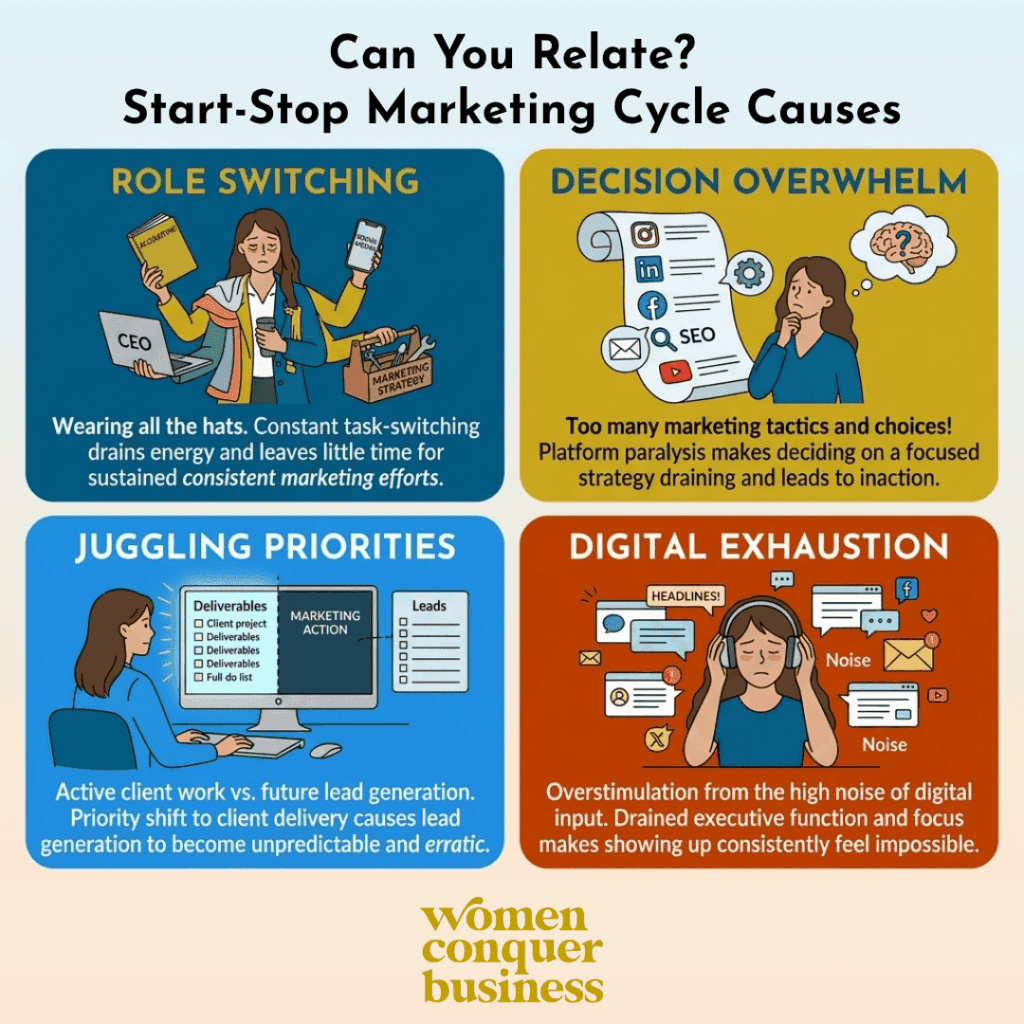
What Breaks the Cycle (Not What You’d Expect)
This isn’t about doing more or exerting more discipline. No. This is about simplifying your strategy so you’re excelling at fewer things, and getting support.
Adjust your marketing strategy expectations
If you’re trying to maintain a blog, a podcast, a weekly newsletter, LinkedIn, Instagram, and a networking group, you have a scope problem.
Pick the one or two channels that connect most directly to how your clients find you. Bonus points if it’s a channel you enjoy. The cognitive load of maintaining five channels is what makes consistency feel impossible. This decision fatigue is why fewer choices beat more options every time. When you’re tracking one channel and one output rhythm, the question stops being “how do I stay consistent?” and becomes “did I do the one thing this week?”
For most solopreneurs, that’s an email newsletter or a single social platform plus a website that ranks for what you do. Maybe add local SEO if your business serves a geographic area.
Find a business support system
If you’re like me, you can ignore an app, and a phone reminder. It’s a lot harder to ignore someone who knows your plan and will ask you about it.
Dominican University of California’s research on goal accountability found that people who sent weekly progress updates to a peer achieved their goals at significantly higher rates than those working alone: 76% success versus 43%. The difference isn’t talent or strategy: it’s having someone who knew what you said you’d do ask you if you’ve done it.
This is what marketing coaching or a structured community for solopreneurs provides. You’re experienced. You don’t need more information, but a container that makes it harder to blow off your plan. When someone asks you every Tuesday “did you send the email this week?” you send the email because you don’t want to show up empty-handed.
Your Next Move Is Smaller Than You Think
Stop building a content machine. Ask yourself what you could keep doing during a week when two clients need revisions and your kid is home sick. That’s your starting point.
Write down one channel. One frequency (weekly is fine). One way to measure whether it’s doing anything (new email subscribers, inquiry calls, whatever matters to your business). Share that plan with one other person.
If you want structure around that, the WCB community is built for this: quarterly planning so your marketing connects to your business goals, and weekly accountability so someone notices when you stop. It’s not a content library (although we do have one if you need something in particular). It serves as the expert support and accountability piece that most solopreneurs are missing. It disrupts the start-stop cycle.
The start-stop cycle doesn’t break with more motivation. Research consistently shows that most solopreneurs underestimate what it takes to handle everything alone. If you recognize that in yourself, trying harder won’t change the pattern. Scale back your marketing to something reasonable, and find someone who asks, “did you do the thing this week?”
Frequently Asked Questions
Why do solopreneurs struggle with marketing consistency?
Because client work is urgent and marketing results are delayed, marketing always loses the priority competition. When income dips, marketing gets cut first, even though that’s when it matters most. The cycle reinforces itself: you stop marketing, your pipeline dries up, financial pressure increases, and you drop marketing again when the next project lands. The problem is structural (no feedback loop, no accountability), not motivational.
How do I break the feast or famine cycle in business?
Narrow your marketing to one or two channels you can maintain during a busy client week. Share your plan with a peer or accountability partner who will check in weekly. The feast-or-famine pattern breaks when your marketing stays running during the feast, which requires both a simpler plan and someone who notices when you stop following it.
How do I stop starting over with marketing?
Each restart costs you accumulated progress in search rankings, email engagement, audience familiarity, and referral momentum. The way to stop restarting is to lower the bar until it’s maintainable. One email per week is better than a burst of five posts followed by six weeks of silence. Pair that with a standing weekly check-in, even a 15-minute text exchange, and the restart impulse fades because you never fully stopped.
Get the Free 90-Day Solopreneur Marketing Plan Template
Quarterly goals, a simple content calendar, and a monthly review framework — all in one template. Built for business owners who want a system, not a hustle.
No spam. Unsubscribe anytime. We respect your inbox.
Reading about community is one thing. Finding the right community is another.
The Women Conquer Business Membership gives women solopreneurs expert and peer support with people who understand your business, your budget, and your bandwidth.You don't have to do this alone (it's better if you don't).
See How Our Membership Works → Not sure yet? Book a free clarity call