
You’ve Already Tried This
You bought a course (it’s sitting in your inbox with 47 unwatched modules). You joined a Facebook group but it’s wall-to-wall self-promotion, with the occasional question nobody answered. And the mastermind you paid for? The “expert” talked for 45 minutes and you got three minutes of feedback that didn’t apply to your business.
Now someone’s telling you to join a community. And your reaction is reasonable: why would this time be different?
Finding the right business community for women solopreneurs requires knowing why most of them fail.
Liked this? You'll like our events even more.
Our live workshops and webinars are the easiest way to get a feel for the Women Conquer Business approach — practical marketing you can use that week, no hype, no pressure. Catch the next one live, or watch a past session on your own schedule.
See Upcoming & Past Events → Prefer to jump in? Let's goooooWhy Most Business Communities Fail Solopreneurs
The word “community” has been stretched so thin it barely means anything anymore.
Here’s what most membership products look like: a library of recorded trainings, a content drip (weekly emails, monthly workshops), and a Facebook or Slack group labeled “community.” The content might be good. Maybe the templates are useful. But the community piece? It’s an afterthought. A place where members post and hope someone responds.
This is a content product, not a community. And that distinction explains why so many people leave.
According to Marketing General’s benchmarking data, roughly half of members who don’t renew cite lack of engagement as the primary reason. They joined. They watched a few things. They didn’t network with anyone who knew their name or their business. And after a few months, they quietly stopped logging in.
I wrote about this in the Solopreneur Loneliness Loop: people can feel isolated inside a community if the structure doesn’t create real connection. A 500-person Slack channel doesn’t solve loneliness. Five people who show up every Tuesday and know what you’re working on? That works.
The structural failures are predictable:
- Groups too large for anyone to be known.
- No matching by business stage (a coach earning $80K and a SaaS founder raising a Series A have nothing useful to tell each other about their Tuesday).
- No built-in accountability or mentorship. No facilitation beyond “post your wins!”
- And critically, no honest reckoning with what happens in the first 90 days, when most cancellations happen.
What Women Solopreneurs Need (And Why It’s Different)
A 2020 KPMG study of 750 female executives found that 75% had experienced imposter syndrome at some point in their careers. And 81% said they put more pressure on themselves not to fail than their male peers.
That changes what “community” needs to look like. A room full of people sharing wins and revenue screenshots doesn’t help someone navigate entrepreneurship who’s already questioning whether she deserves the clients she has. What helps is a group of like-minded people where she can say “I’m not sure this pricing is right” and get an honest answer from someone who’s been there.
Gusto’s 2025 data shows that women now make up over half of new solopreneur businesses, and they’re 30% more likely than men to cite schedule control as their motivation for going solo. Meanwhile, Block Advisors’ 2024 report found that 21% of women entrepreneurs started their businesses specifically to accommodate childcare.
What does this mean for community design?
It means a community that runs on scaling at all costs, hustle culture assumptions (attend three live calls a week, post daily, be “all in”) will lose women solopreneurs fast. The community needs to work around your schedule, not demand that you rearrange yours.
And there’s research suggesting the gender composition itself matters. A University of Chicago study published in Marketing Science found that female entrepreneurs paired with female mentors saw a 34% increase in sales compared to a control group. The researchers attributed this to shared context: female mentors understood the specific barriers their mentees faced in ways that male mentors, however well-intentioned, often didn’t.
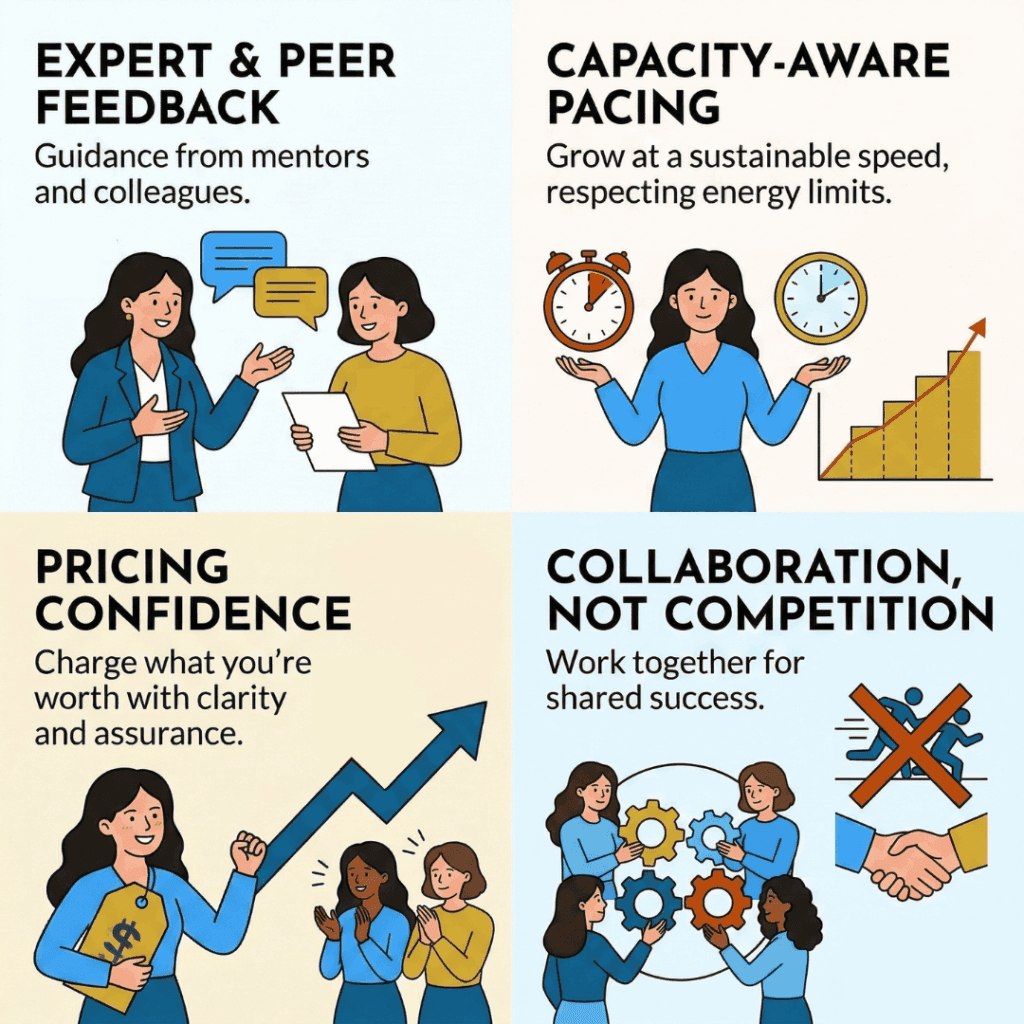
Here’s what women solopreneurs need from communities for female entrepreneurs:
- Expert and peer feedback. Get eyes on your landing page, your pricing, your email sequence from people who understand your business at your stage.
- Capacity-aware pacing. If the community creates guilt for not showing up every week, it’s making your fears worse. Good community design accounts for the weeks when client work or life takes over.
- Pricing confidence. FreshBooks research found that self-employed women earn 28% less than self-employed men. A community that doesn’t address pricing confidence is ignoring one of the biggest financial levers its members have.
- Collaboration, not competition. No “who hit six figures first” energy. A space where someone can SAFELY say “I have no idea how to price this project” without the room going quiet, or being attacked for what you “should” know.
Five Questions to Ask Before You Join
Before you pay for anything, ask these. If the answers aren’t clear, that tells you something.
1. Is this a content product or a working entrepreneur community?
Content products deliver information (courses, templates, recordings). A working community is built around connection: peer feedback, accountability, real-time problem-solving. Both have value. They’re not the same thing. If the sales page leads with the content library and mentions “community” in the last bullet point, you’re buying a course with a chat room attached.
2. How many people are in each group or cohort?
Research on group dynamics consistently shows that meaningful connection breaks down above six or seven people. If the “community” is a single channel with hundreds of members, you’re in an audience, not a peer group. Ask whether there are smaller cohorts, accountability pods, or working groups within the larger membership.
3. Is there structured accountability and support system, or is it “come when you can”?
“Come when you can” sounds flexible. In practice, it means nobody comes. Effective communities have a rhythm: weekly check-ins, monthly planning sessions, quarterly reviews. The structure isn’t rigid for the sake of it. It creates the reason to show up that your willpower can’t sustain on its own.
4. Do members interact with other women entrepreneurs, or only with the leader?
If the value proposition is “access to the expert,” you’re buying marketing coaching, not community. That’s fine if coaching is what you need. But if you’re looking for peers, the community should be designed so members help each other, not wait in line for the guru. I’ve designed my membership, so it strikes a balance: access to me and feedback from peers.
5. What happens in the first 90 days?
The onboarding experience predicts retention.
- Does someone reach out to welcome you?
- Is there a clear first step?
- Do you get matched with a peer or a small group within the first week?
- Or do you get dropped into a feed and left to figure it out?
Industry data consistently shows that a human touchpoint during onboarding dramatically improves whether someone stays past the three-month mark.
What a Working Community Looks Like (In Practice)
A working community isn’t a place you go to consume content. You go to get unstuck on the landing page you’ve been rewriting for two weeks, or to hear someone say, “that’s a $5,000 project, stop quoting $2,500.”
In practice, that means quarterly planning sessions tied to your business goals (not someone else’s curriculum). It means regular peer feedback where you bring your marketing strategy or a specific problem, and people who know your business give you input. Not “great job!” but “your headline buries the lead, and I think your call to action is confusing.”
It means someone notices when you stop showing up. In a “hey, everything okay? We missed you Tuesday” way. That’s the structural difference between a marketing membership and a content library. The content library doesn’t know you’re gone.
And it means the group is small enough that people know your name, your business, and what you said you’d do last week. When a peer asks “did you send the newsletter?” on Tuesday, you send the newsletter. That’s the same accountability mechanism I talk about in the context of the start-stop marketing cycle, and it works in community for the same reason it works one-on-one: you’re less likely to skip the newsletter when you told someone on Tuesday that you’d send it by Friday.
You Don’t Need More Information
If you’ve been in business for five or more years, you know more about marketing than you give yourself credit for. The gap isn’t knowledge, it’s having people who help you act on what you know, tell you when your idea is good enough to ship, and remind you about your commitments.
If you’re evaluating options, use the five questions above. They’ll save you from the communities that look great on a sales page and feel empty once you’re inside.
If you’ve done the evaluation and you want to see what this looks like at WCB, the strategic marketing membership is built around small groups, quarterly planning, and weekly accountability for solopreneurs doing their own DIY marketing.
But wherever you land, pick based on structure, not polish. The flashiest sales page usually belongs to the content product. The community that works is the one where someone will ask you what you got done.
Frequently Asked Questions
Are paid business communities worth it for solopreneurs?
They can be, but only if the community provides structured peer connection, not a content library with a chat room. The value of a paid community comes from accountability, peer feedback, and having people who know your business. If the community doesn’t deliver those things, you might be paying for content you could find for free. Before joining, ask about group size, accountability structure, and what happens in the first 90 days.
What should women solopreneurs look for in a business community?
Look for small group size (under eight people per cohort), capacity-aware scheduling that doesn’t require you to attend everything, peer feedback on real work rather than motivational content, and a culture of collaboration over competition. Research shows women entrepreneurs benefit significantly from female mentors and peers who share their specific business context. Avoid communities that run on hustle culture energy or shame you for missing a week.
Is a mastermind group better than a course for solopreneurs?
They solve different problems. A course delivers information. A mastermind delivers connection and accountability. If you already know what to do but can’t stay consistent or make decisions alone, a mastermind or working community will give you more return. If you genuinely need to learn a specific skill (SEO, email marketing, paid ads), a course might be the right first step. Most solopreneurs five or more years in don’t need more information. They need someone who’ll say “that email is fine, send it” on a Tuesday afternoon.
Get the Free 90-Day Solopreneur Marketing Plan Template
Quarterly goals, a simple content calendar, and a monthly review framework — all in one template. Built for business owners who want a system, not a hustle.
No spam. Unsubscribe anytime. We respect your inbox.
Want to see how we actually work before you commit?
Our live workshops and webinars are the easiest way to get a feel for the Women Conquer Business approach — practical marketing you can use that week, no hype, no pressure. Catch the next one live, or watch a past session on your own schedule.
See Upcoming & Past Events → Prefer to talk it through? Book a free clarity call