So Many Browser Tabs, So Little Time
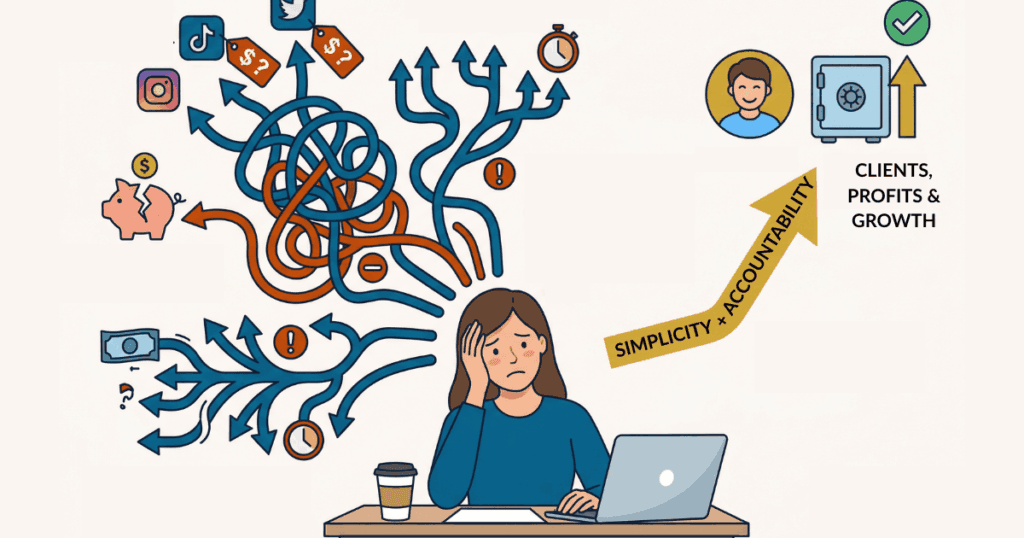
You sit down to work on marketing. An hour later, you have 14+ browser tabs open. You’ve read half a blog post about email funnels, skimmed a LinkedIn thread about whether Instagram is dead, opened a pricing page for a scheduling tool, and started a draft of… something. You’re not sure what.
You close the laptop feeling like you wasted the hour. But you weren’t procrastinating. You were trying to make a decision. Which platform. What to write. Whether to try something new or stick with what you’ve been doing (which also isn’t working). Every option required evaluating tradeoffs you couldn’t resolve alone.
That’s decision fatigue. And for solopreneurs, it isn’t that you lack discipline or information. The problem is that the number of decisions between “I should do marketing” and “I’m doing this specific thing” is staggering, and nobody’s sharing the load.
I’ve seen this play out not only client work but in my own business. It plays out the same way every time. You know what you should be working on (for me it’s finance), but it’s hard to get started. Let’s say to you need to work on your marketing strategy… you have a dozen ideas for how to do it, but you don’t do any of it. Why? Because every option opens another set of tradeoffs you can’t resolve alone.
Decision Overload: The Unbearable Weight of Alone
Simply Business surveyed over 1,000 solopreneurs in 2025 and found that 61% underestimated the challenge of handling every aspect of their business alone. That number tracks. Most people expect the work to be hard. What catches them off guard is the volume of decisions required before any work gets done.
On a team, decisions get distributed. Someone else picks the email platform. A designer handles the visual direction. A strategist decides which channels to prioritize. The copywriter writes. Nobody makes all those calls by themselves.
Reading about community is one thing. Finding the right community is another.
The Women Conquer Business Membership gives women solopreneurs expert and peer support with people who understand your business, your budget, and your bandwidth.You don't have to do this alone (it's better if you don't).
See How Our Membership Works → Not sure yet? Book a free clarity callSolo, the decisions pile up. Which platform? Which post format? What day?… Time? Is the photo is good enough?…. Does any of this matter?
And that’s before you get to the high-stakes decisions: pricing, positioning, whether to rebrand, whether to invest in SEO or ads, whether your website needs a redesign. I’m sorry. I probably just stressed you out.
But before we make it better, let’s make it worse (LOL!). Marketing tools and apps make it worse, amiright? According to Salesforce’s 2024 SMB Trends Report, the average small business uses seven different applications.
And 46% of small business owners say they feel overwhelmed by too many business tools. Each tool is another set of decisions: which one, how to set it up, whether it’s worth the $29/month, and whether it’s doing what it’s supposed to be doing
4 Ways Decision Fatigue Complicates Your Marketing
The research on this is clear. A 2008 study published in the Journal of Personality and Social Psychology found that the act of making choices (not thinking about them, but making the final call) depleted self-control resources. Participants who made more active decisions showed reduced ability to persist on subsequent tasks. The researchers called it “decision fatigue,” and it means your tenth decision of the day is measurably worse than your first.
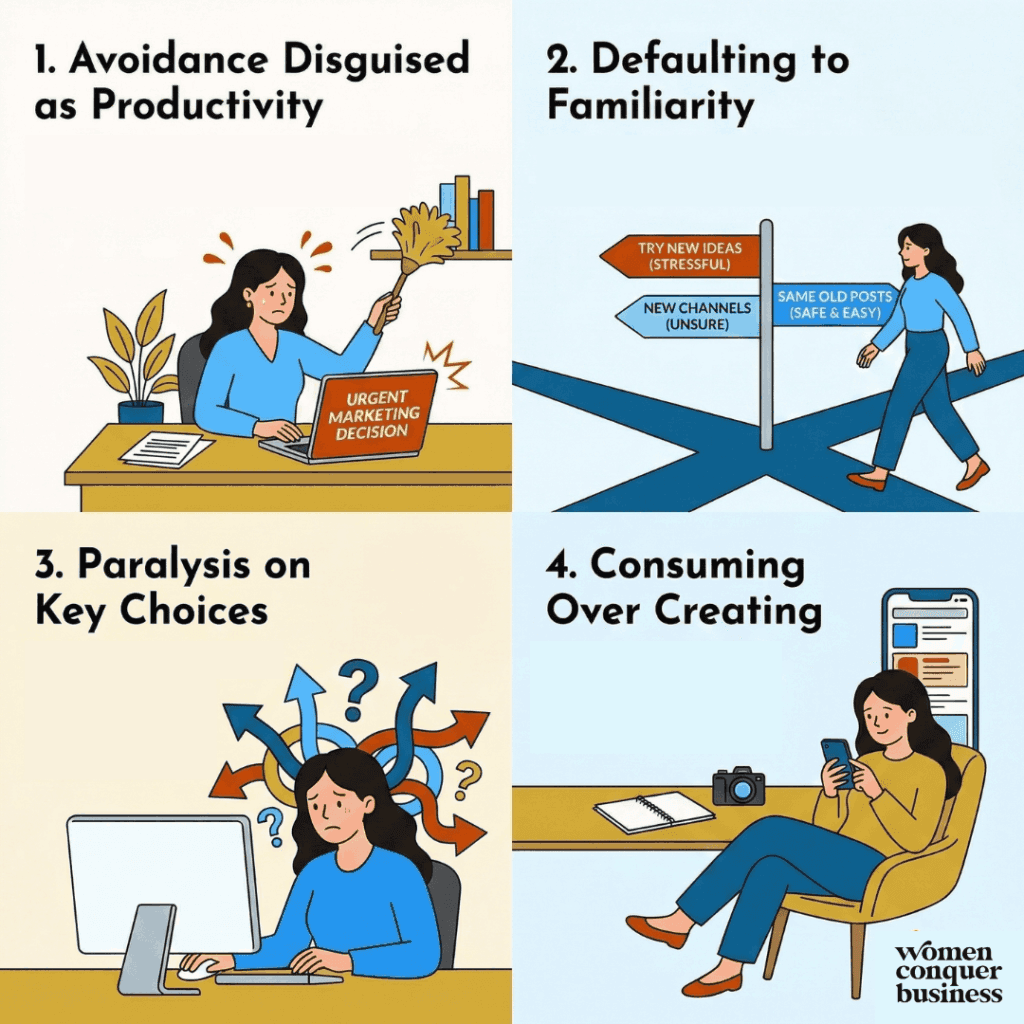
For solopreneurs, that plays out in four specific ways.
- Avoidance disguised as productivity. You reorganize your Google Drive. You update your Canva templates. You read another article about content strategy. You do anything that feels productive and requires zero decisions about what to put into the world. The inbox gets cleaned. The marketing doesn’t get done. This start-stop marketing cycle keeps you in perpetual starting mode without ever hitting momentum.
- Defaulting to whatever’s familiar. You keep posting on Instagram because that’s where you’ve always posted, even though your clients find you through Google. Trying a new channel means making a hundred small decisions about format, frequency, and voice. Sticking with the old one means zero new decisions, even if the results are flat.
- Paralysis on the choices that matter. Pricing sits untouched for two years. Website copy hasn’t changed since 2022. You know your positioning is vague but the process of clarifying it feels like standing in front of a wall of paint swatches at the hardware store. Too many options, no way to tell which one is right until you commit and live with it.
- Consuming content instead of creating it. Another podcast episode about email marketing. Another webinar about LinkedIn strategy. Another course in the cart. Research feels like progress because it postpones the moment when you have to choose. I wrote about this in the Solopreneur Loneliness Loop as one of the behavioral symptoms of isolation, and it’s worth connecting the dots here: content consumption replaces the conversation with a peer that would have ended with “try this, skip that.”
3 Filters That Reduce Marketing Decision Overload
The fix isn’t more information. You already have too much of that. The fix is fewer decisions.
The 3 C’s framework gives you three filters to run any marketing decision through before you spend an hour agonizing over it.
- Capacity: Do you have the bandwidth to do this and maintain it for 90 days? Not during an inspired weekend. During a normal week when client work is heavy and you’re tired. If the answer is no, the decision is made. Skip it.
- Complexity: Is this something you can do at a B+ level without hiring someone? Not an A+. A B+ that gets published, goes out, exists in the world. If the tactic requires skills you don’t have and would take months to learn (complex paid ad campaigns, for example), that’s a hiring decision, not a marketing decision.
- Control: Can you tolerate imperfect execution done consistently? If you can’t hit publish without rewriting something four times, the problem isn’t the tactic. It’s the absence of someone who can say “that’s good enough, send it.”
Most marketing decisions can be resolved by these three filters in under five minutes.
But here’s the catch: the filters work better with someone else in the room. Capacity is hard to assess honestly when you’re the one inside the burnout. You can’t judge complexity on a tactic you’ve never tried. And control (the hardest one) requires feedback from someone who’s seen your work and can tell you when to stop polishing.
A Sounding Board Is a Decision Tool
This is the part that doesn’t get talked about enough.
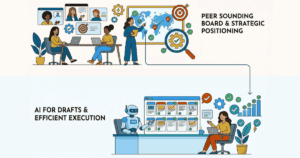
A peer who knows your business can collapse a two-hour decision into a five-minute conversation. “Should I try email or double down on LinkedIn?” becomes “Your clients come from referrals and Google. Email nurtures both. Do that.” Done. Two hours of tab-opening and article-reading, replaced by someone who knows enough about your business to give you a direct answer.
That’s not mentorship. It’s closer to what a project manager does on a team: clearing blockers so the work can move.
In marketing coaching calls, I watch this happen every week. The client shows up with three options she’s been circling for days. We talk for ten minutes. She picks one. The other two stop taking up mental space. She gets more done in the three days after the call than she did in the three weeks before it, because the decision bottleneck is cleared.
A community built for solopreneurs works the same way at scale. I’ve seen it happen every month in our community. Someone brings the landing page they’ve been rewriting. A member says, “the headline buries the lead, but the rest is fine.” I walk them through the design and conversion fixes. They make the fix and publish. The alternative was another week of staring at it, or abandoning it entirely.
Research consistently shows that solopreneurs sacrifice personal time at alarming rates: family dinners missed, sleep cut short, weekends spent catching up on the work that didn’t get done during the week. Decision overload is a contributor to all of it.
Every unresolved marketing decision you carry is taking up cognitive space that could go somewhere else. If you’ve been wondering why you’re so burned out on marketing, the decision load is probably a bigger factor than the work itself.
Here’s Your Two-Part Fix
Reduce the number of decisions. Then get help with the ones that remain.
The first part is concrete. Pick two marketing channels and drop the rest. Commit to one email frequency and stop debating it every week. Choose one scheduling tool and cancel the others. Every decision you eliminate is cognitive space you get back for the decisions that matter, like what to say and who to say it to.
The second part requires another person. If you want that in a structured form, the WCB community runs weekly peer feedback sessions where solopreneurs bring the decisions that are stalling their marketing and leave with clear answers. Not another course. A room where someone tells you, “That’s good enough, go.”
But the person doesn’t have to come from a paid community. A single accountability partner who understands your business and will meet for 30 minutes a week can do a surprising amount of the heavy lifting. The key is that they know enough about your work to give you a direct “do this, skip that” instead of “well, it depends.”
Frequently Asked Questions
How does decision fatigue affect solopreneur marketing?
It shows up as avoidance (cleaning files instead of writing the email), defaulting to familiar channels even when they’re not working, paralysis on high-stakes decisions like pricing or positioning, and consuming marketing content instead of making marketing decisions. The underlying mechanism is that each unresolved decision depletes cognitive resources, making the next decision harder. On a team, decisions get distributed. Solo, they stack on one brain until the system overloads.
How do I reduce marketing decisions as a solopreneur?
Start by eliminating decisions you’re making repeatedly. Pick two channels and stop evaluating new ones. Set a posting frequency and stick to it for 90 days without reconsidering. Choose one tool per function and cancel the duplicates. Then, for the decisions you can’t eliminate (positioning, pricing, content direction), get a sounding board: a peer, a coach, or a community where someone who knows your business can say “do this” and save you three hours of agonizing.
Get the Free 90-Day Solopreneur Marketing Plan Template
Quarterly goals, a simple content calendar, and a monthly review framework — all in one template. Built for business owners who want a system, not a hustle.
No spam. Unsubscribe anytime. We respect your inbox.
Reading about community is one thing. Finding the right community is another.
The Women Conquer Business Membership gives women solopreneurs expert and peer support with people who understand your business, your budget, and your bandwidth.You don't have to do this alone (it's better if you don't).
See How Our Membership Works → Not sure yet? Book a free clarity call