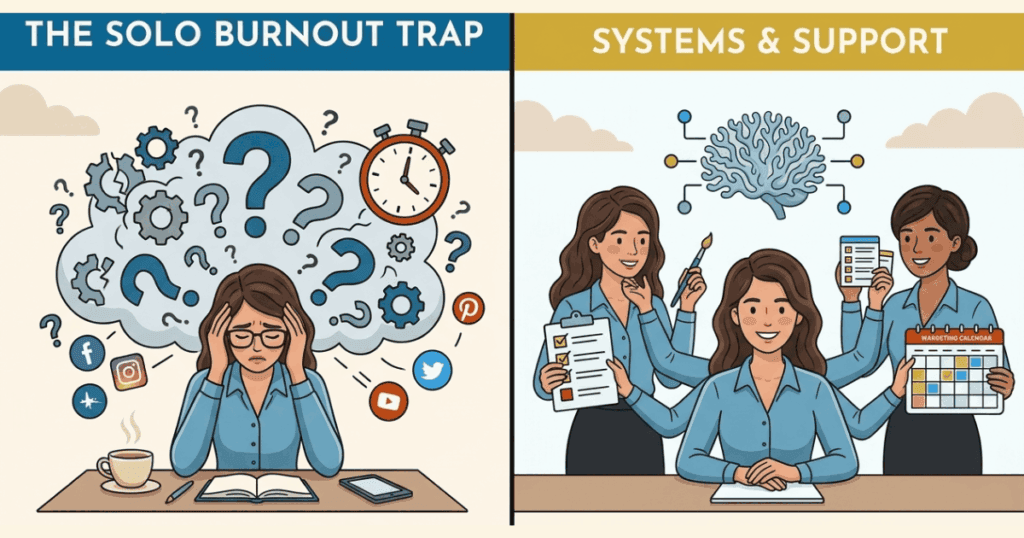
You Don’t Hate Marketing. (You Hate the Version Built for a Team You Don’t Have.)
Most solopreneurs I work with don’t have a marketing problem. They have a scale mismatch. They’re trying to execute a content calendar, a funnel, a nurture sequence, a podcast, and a weekly newsletter while also delivering client work, paying quarterly taxes, and keeping the lights on in a one-person business. Then they wonder why they’re tired.
If I just described how you feel, you’re not alone. In 2024, a Harvard Business Journal article on entrepreneur burnout found that founders who pour themselves into work without recovery windows break down faster than those who pace. In addition to working too many long hours without breaks, the 2025 SimplyBusiness solopreneur report found that loneliness, unpredictable income, and time management sit at the top of the list of what’s wearing people down.
If your marketing feels like it’s eating you alive, this article is your opportunity to unpack what’s happening, and brainstorm solutions.

Your Biggest Problem: Running a Team Marketing Strategy at Solo Capacity
Most marketing strategy advice assumes you have a team. A content manager to write, a designer to format, a VA to schedule, a strategist to watch the numbers. Pull all four of those roles into one person and the same strategy becomes a wall.
Liked this? You'll like our events even more.
Our live workshops and webinars are the easiest way to get a feel for the Women Conquer Business approach — practical marketing you can use that week, no hype, no pressure. Catch the next one live, or watch a past session on your own schedule.
See Upcoming & Past Events → Prefer to jump in? Let's goooooYou see it in the shape of the week. A weekly newsletter sounds modest until you count the steps. Ideation. Writing. Editing. Formatting. Subject line testing. Segmenting. Sending. Reviewing. Then doing it again seven days later, on top of client calls and a sick kid and a car that needs new brakes.
The strategy isn’t wrong. The staffing assumption is.
When I sit down with a new client in marketing coaching, we almost always start by cutting. Not adding. The question is never “what more should you be doing?” It’s let’s track your marketing actions, uncover what’s working (and what’s not) so we can use your limited time most effectively.
Decisions, Context & Isolation: Why Your Task List is Always Overflowing
Even if the to-do list looks reasonable on paper, three costs quietly stack up until you’re running on fumes.
Decision Fatigue: The Exhaustion is Real
Every solo marketing task is a decision. What to post. Which platform. Which hook. Whether to respond to that DM.
Research on decision fatigue consistently shows that the prefrontal cortex has a finite daily capacity for complex decisions. Use it on marketing and you’ll drag yourself through client work at half speed. Use it on client work and marketing feels impossible by 4 p.m. This is what we call decision fatigue in solopreneur marketing.
There’s a reason Steve Jobs wore the same outfit every day: fewer decisions.
Context Switching: Moving from Thing to Thing
Moving between writing, selling, delivering, and bookkeeping is not free.
Each switch costs attention and recovery time.
A solopreneur switching contexts twenty times a day is losing hours they’ll never see on a timesheet. This is one of the strongest arguments for treating marketing operations as a discipline. This start-stop cycle is what kills consistency for most solopreneurs.
The less switching you do, the more output you get from the same hours.
Isolation: Everything in a Vacuum
A 2024 review in Personnel Psychology found that entrepreneurs are uniquely vulnerable to loneliness because the people in their lives often don’t understand the work.
The solopreneur loneliness loop is real: you can’t vent about a launch that flopped to a friend who clocks out at five. You can’t get a second set of eyes on a sales page at 9 p.m. on a Tuesday.
So, you sit with the doubt, and the doubt makes every decision slower.
Here’s the thing: decision fatigue, context switching, and isolation aren’t failures of willpower. It’s the structure most solopreneurs live with every day. Once you understand how to manage the structure, you’ll get your time (and your sanity) back.
4 Things Behind Your Marketing Burnout
When a solopreneur tells me they’re burned out on marketing, I listen for four patterns. Usually, two or three of them are present.
Your Business Goals and Marketing Don’t Match
The marketing activity doesn’t tie to a current business or revenue goal. You’re posting on LinkedIn because someone said you should, but your next three clients are coming from referrals and a monthly talk. Effort with no tether drains faster than effort that’s clearly working.
Frankenstack: Marketing Tool Bloat
Four platforms, three schedulers, a CRM, an email tool, a second email tool for automations, a third for a landing page. Every login is a tiny tax. According to the Small-Business Labor Crisis report, a meaningful share of small business owners work 60-plus hours a week. A good chunk of those hours is spent fighting the stack.
Too Many Tasks Making Consistency Impossible
A rhythm you can only hit on a great week isn’t consistency. It’s a trap. Miss once and the shame spiral starts. Miss twice and you quit.
No Feedback Loop
Without a peer, a coach, or a paid community for solopreneurs to pressure-test ideas, every decision is made in a room of one. That’s how mediocre tactics survive for months. Nobody flags them.
If you can name which of the four is loudest for you, you’ve already done the hard part.
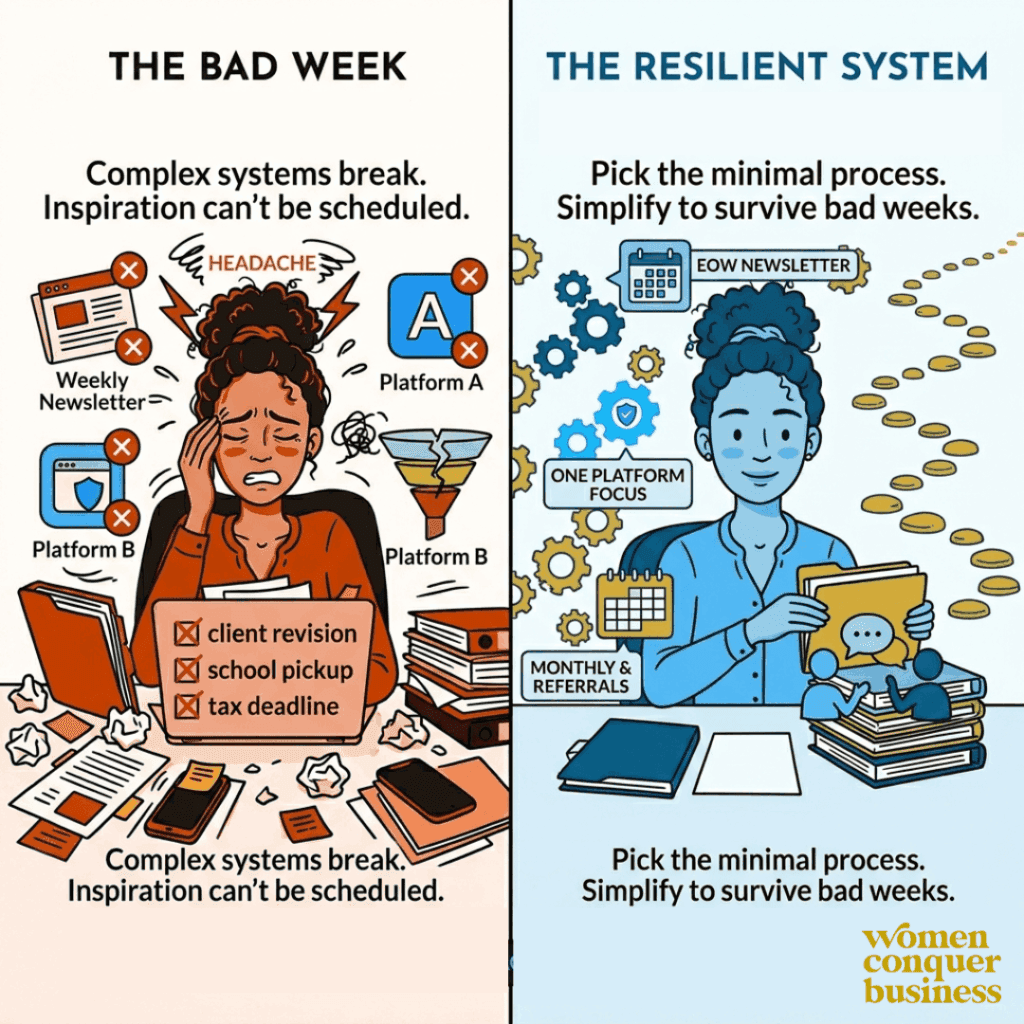
A Smaller Marketing System That Holds Up on a Bad Week
This is where I part ways with most advice on this topic. The answer isn’t more discipline. It’s smaller surface area.
Here’s the reframe I use with clients. Pick the rhythm you can keep during a bad week. The week with the migraine and the client revision and the school pickup. If a weekly newsletter won’t survive that week, it’s not your system. Go to every other week. If two platforms won’t survive, go to one. If one platform won’t survive, go to a monthly touchpoint and a referral conversation and call it done.
This is what Slow Marketing looks like in practice: a smaller, steadier pace, tasks chosen on purpose.
A workable solo marketing system usually has three pieces:
- One primary channel. Where your people are and where you can show up without hating your life. Usually email or one social platform. Rarely both.
- One content rhythm. Weekly or every other week, never daily. Daily breaks solos. I’ve watched it happen too many times to pretend otherwise.
- One relationship practice. A standing referral conversation, a client check-in, a monthly peer call. This is where the work comes from, and it’s the first thing solos cut when they get busy. It should be the last.
Everything else is optional. Everything.
Frequently Asked Questions
How do I know if I’m burned out or having a hard week?
A hard week feels heavy and then passes when the calendar clears. Burnout doesn’t clear. If you’ve been dreading marketing for more than a month and rest isn’t touching it, that’s a capacity signal, not a mood. The answer is usually to cut the system, not to push through.
Is it possible to do all my marketing myself without burning out?
Yes, with two conditions. The system has to match your real weekly capacity, not your aspirational capacity. And you need at least one outside voice, whether that’s a coach, a peer group, or a mastermind, to break isolation and catch blind spots before they cost you months.
What should I cut first if I’m already running on empty?
Cut whatever has the weakest tie to current revenue. If your last five clients came from referrals and a newsletter, the Instagram grid can go dark for a month with no real cost. Most solos are shocked by how little traffic they lose when they stop doing the thing that was draining them most.
Where to Go From Here
If this article landed somewhere uncomfortable, that’s useful information. The fix isn’t a new tool or a better calendar. It’s an honest audit of what your current rhythm costs you and your willingness to do fewer things, better so it fits the life you have right now.
One next step, if you want one: open your calendar and list everything you did for marketing in the last two weeks. Next to each item, write the revenue tie, the hours it took, and whether it survived a hard day. If most entries can’t defend themselves, you’ve found the cut.
If you’re breaking under the unbearable weight of isolation, our marketing membership for women solopreneurs provides the structure, support and accountability you need with a community who gets it.
Get the Free 90-Day Solopreneur Marketing Plan Template
Quarterly goals, a simple content calendar, and a monthly review framework — all in one template. Built for business owners who want a system, not a hustle.
No spam. Unsubscribe anytime. We respect your inbox.
Want to see how we actually work before you commit?
Our live workshops and webinars are the easiest way to get a feel for the Women Conquer Business approach — practical marketing you can use that week, no hype, no pressure. Catch the next one live, or watch a past session on your own schedule.
See Upcoming & Past Events → Prefer to talk it through? Book a free clarity call