

Want to know if your email campaigns are worth the investment? Measuring ROI (Return on Investment) helps you see how much profit your emails generate compared to what you spend. Here’s the quick formula:
ROI = [(Revenue – Costs) / Costs] × 100
Key Steps to Measure ROI:
- Track Revenue: Use UTM tags, coupon codes, and e-commerce integrations to see sales from email campaigns.
- Calculate Costs: Include platform fees, content creation, and staff time.
- Monitor Metrics: Focus on clicks, conversions, and average order value. Avoid unreliable data like email open rates.
- Use Tools: Google Analytics, email platform analytics, and tools like Metricool simplify tracking.
Challenges to Watch For:
- Multi-channel sales make attribution tricky. Use UTM tags and attribution models.
- Missing data (e.g., blocked tracking pixels) can skew results – regularly audit your tracking systems.
- Privacy protections and tech limits might block some metrics. Focus on conversions and sales instead.
By tracking ROI, you can identify which campaigns work best, spend smarter, and improve future email strategies.
Reading about marketing strategy is one thing. Having someone build it with you is another.
Marketing coaching gives you a dedicated strategist in your corner — someone who knows your business, your budget, and your bandwidth. Together, we’ll turn your ideas into a plan that fits your life.
See How Coaching Works → Not sure yet? Book a free clarity callROI Calculation Steps
ROI Formula Explained
To calculate email marketing ROI, use this straightforward formula:
ROI = [(Revenue – Costs) / Costs] × 100
Here’s how it applies to email campaigns:
- Revenue: The total sales generated from your email efforts.
- Costs: This includes email platform fees, content creation expenses, design costs, and staff time.
For instance, if you spend $1,000 on a campaign and it generates $5,000 in revenue, the calculation would look like this: [($5,000 – $1,000) / $1,000] × 100 = 400% ROI.
Having accurate metrics is key to getting reliable results.
Required Data Points
To calculate ROI effectively, make sure to track these critical metrics:
| Data Point | Description | How to Track |
|---|---|---|
| Campaign Costs | Expenses like platform fees, design, and content | Use expense tracking tools |
| Labor Hours | Time spent on planning and managing campaigns | Track with time management software |
| Email-Generated Sales | Revenue from email clicks | Use UTM parameters for tracking |
| Conversion Rate | Percentage of clicks that lead to purchases | Analyze with web analytics tools |
| Average Order Value | Typical purchase amount from email campaigns | Check your e-commerce platform |
Calculation Tools
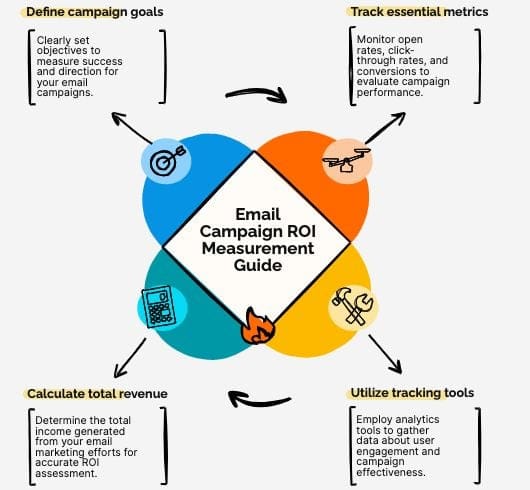
You don’t need to crunch numbers manually – several tools can simplify ROI tracking:
- Google Analytics: Set up e-commerce tracking, custom campaign URLs, and monitor conversion paths.
- Email Platform Analytics: Analyze open rates, click-through rates, subscriber engagement, and list growth.
- Metricool: Monitor marketing performance, generate ROI reports, and evaluate campaign results.
For the best results, connect your email platform with your e-commerce system and analytics tools. This integration ensures you’re capturing the entire customer journey, from the moment they open your email to completing a purchase.
ROI Performance Metrics
Email Opens and Clicks
Keep an eye on open and click-through rates using your email platform. These metrics show how well your campaign is resonating with subscribers. Strong engagement often leads to more conversions.
Sales and Revenue Tracking
To measure ROI accurately, you need reliable sales data. Add UTM parameters to your links to track revenue sources effectively, and connect your email platform to your e-commerce system. This setup helps you pinpoint which campaigns are driving sales and allows for smarter decision-making. Don’t forget – the quality of your data matters just as much as the numbers.
Subscriber List Health
Your subscriber list plays a big role in ROI. Check its health by monitoring new sign-ups, unsubscribes, and engagement levels. Regularly clean up your list by removing invalid or inactive contacts. For those who aren’t engaging, try re-engagement strategies to keep your deliverability rates high and improve overall campaign performance.
Ways to Increase ROI
Email List Groups
Segmenting your email list is a smart way to boost the performance of your campaigns. By dividing your list based on factors like purchase history, engagement levels, location, behavior, or sign-up source, you can send content that feels more personal and relevant to each group. For example, sharing product recommendations based on past purchases or offering location-based promotions can increase engagement and drive better results.
Make sure to track how each segment performs. This helps you identify which criteria are working best, allowing you to refine your approach and make more informed decisions for future campaigns.
ROI Measurement Problems
Understanding the challenges of measurement is just as important as knowing how to calculate ROI and track performance metrics. These issues can make it harder to get an accurate picture of your campaign’s success.
Sales Source Tracking
Attributing sales to a specific email campaign can get tricky when customers interact with multiple channels. For instance, a customer might open your email, visit your site via social media, and then make a purchase through a direct search. This overlap makes pinpointing the exact source challenging.
Here are a few ways to improve sales attribution:
- Use UTM tagging to better track multi-channel interactions.
- Create unique coupon codes to directly link revenue to specific campaigns.
- Set up attribution modeling in analytics tools to assign credit across touchpoints.
- Enable cross-device tracking to follow customer activity across multiple devices.
These strategies can work alongside the revenue tracking methods you already use.
Data Gaps
Missing or inaccurate data can throw off ROI calculations. Some common data gaps include:
- Incomplete purchase records
- Broken tracking links
- Email clients blocking tracking pixels
- Missing customer details
- Incorrectly attributed revenue
To address these issues, regularly audit your tracking systems and use backup methods. For instance, if tracking pixels are blocked, you can rely on click-through rates and website conversion tracking instead. Using a mix of tracking methods ensures you’re not overly reliant on one data source.
Technical Limits
Technical hurdles can also affect tracking accuracy. Here’s a breakdown of common issues, their impact, and potential solutions:
| Technical Limitation | Impact | Solution |
|---|---|---|
| Privacy protection features | Blocks open rate tracking | Focus on click-through and conversion metrics |
| Email client variations | Inconsistent tracking across platforms | Use platform-specific tracking codes |
| Cookie restrictions | Limits cross-session tracking | Implement server-side tracking options |
Instead of fixating on unreliable metrics like open rates (which are increasingly affected by privacy features), shift your focus to metrics like conversions and revenue generated on your website. These are more dependable indicators of your campaign’s success.
Additionally, consider setting up a feedback system to gather qualitative insights on how your emails influence customer decisions. This can provide valuable context that numbers alone might not reveal.
Next Steps
To expand on your understanding of ROI…
Main Points Review
Measuring the ROI of your email campaigns effectively requires attention to several key factors:
- Use UTM parameters and unique coupon codes to track revenue accurately.
- Account for all expenses, including platform fees, content creation, and staff time.
- Cross-check your data using multiple measurement methods for accuracy.
- Keep an eye on both direct metrics (like clicks and conversions) and indirect indicators (such as list growth and engagement).
Make sure to document your ROI tracking process and attribution methods to maintain consistency over time.
If you’re looking for more in-depth support, there are resources available to help you go further.
More Help
Need tailored advice on email marketing ROI? Women Conquer Business provides coaching, monthly ROI templates, campaign workshops, one-on-one consulting, and advanced analytics tools. Visit Women Conquer Business to learn more.
FAQs
What’s a “good” ROI for email marketing campaigns?
There’s no one-size-fits-all answer, but a typical benchmark is around 300–400% ROI — meaning for every $1 you spend, you make $3–4 in return. That said, your “good” ROI depends on your industry, audience size, list health, and how targeted your campaigns are.
If your campaigns are pulling in consistent sales or helping you hit your business goals (like discovery calls or downloads), you’re probably on the right track. Not seeing returns yet? Don’t panic. Start by reviewing your targeting, offers, and list segmentation.
What if I don’t sell products — can I still measure email ROI?
Absolutely. ROI isn’t just about dollars — it’s about value. If you’re a coach, consultant, or service provider, your email goal might be discovery calls, webinar signups, or nurturing leads.
Here’s how to measure ROI without direct sales:
- Assign a value to actions (e.g. $250 for each booked call)
- Track conversions (via UTM links or custom forms)
- Compare the cost of sending the emails to the value of those actions
The bottom line? ROI is about results. If your emails help you grow your business or save time, it counts.
Related Blog Posts
- Social Media vs Email Marketing: Which to Prioritize?
- 5 Common Marketing Mistakes Small Business Owners Make
- How to Build an Email List Without Paid Advertising
- 9 Best Marketing Tools Under $50/Month for Solopreneurs
Ready to stop reading about strategy and start building yours?
Marketing coaching gives you a dedicated strategist in your corner — someone who knows your business, your budget, and your bandwidth. Together, we’ll turn your ideas into a plan that fits your life.
See How Coaching Works → Not sure yet? Book a free clarity callGet the Free Solopreneur Marketing Audit Worksheet
Rate your marketing across 5 key areas in under 10 minutes. Your scores reveal exactly where to focus first, so you stop spreading yourself thin.
No spam. Unsubscribe anytime. We respect your inbox.


