

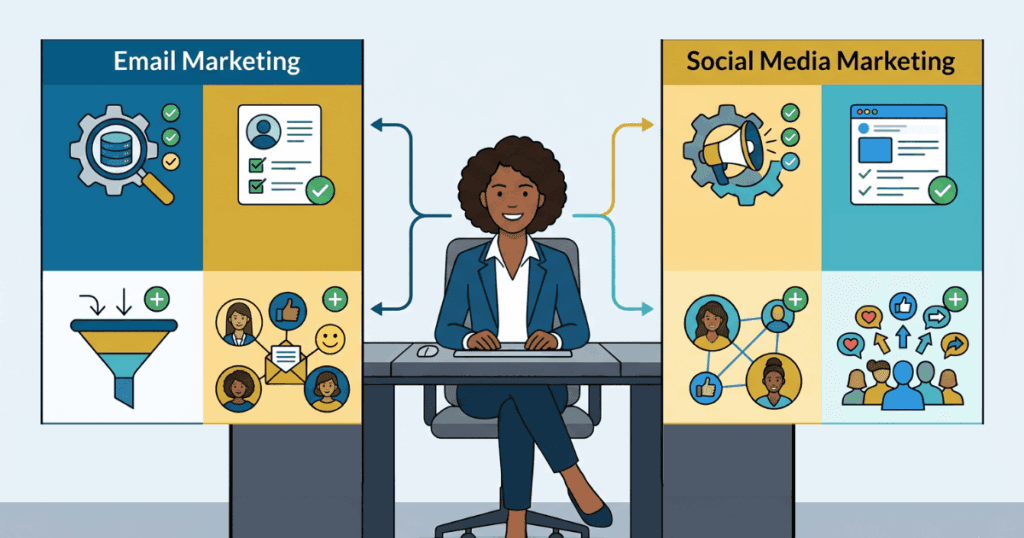
Most marketing advice about email vs social media ends with “do both.” Helpful, right?
When you have five hours a week for marketing (on a good week), “do both” is not a strategy. It’s a recipe for doing neither well. And I’ve watched enough solopreneurs burn out trying to post daily on Instagram while also sending a weekly newsletter while also running a Facebook group while also… you get it.
Reading about marketing strategy is one thing. Having someone build it with you is another.
Marketing coaching gives you a dedicated strategist in your corner — someone who knows your business, your budget, and your bandwidth. Together, we’ll turn your ideas into a plan that fits your life.
See How Coaching Works → Not sure yet? Book a free clarity callIn client work, this is one of the most common questions I hear: Where should I put my limited time? The answer depends on your business stage, your goals, and your honest capacity. But I’ll say this upfront: for most service-based solopreneurs, email should come first. Not because social media is bad. Because when time is scarce, you need the channel that converts, and the data overwhelmingly points to email.
This guide breaks down why, when the exception applies, how to build a list without paid ads, and what email marketing analytics to track so you know if your strategy is producing results. If you’d rather have someone figure this out with you, that’s what marketing coaching is for.
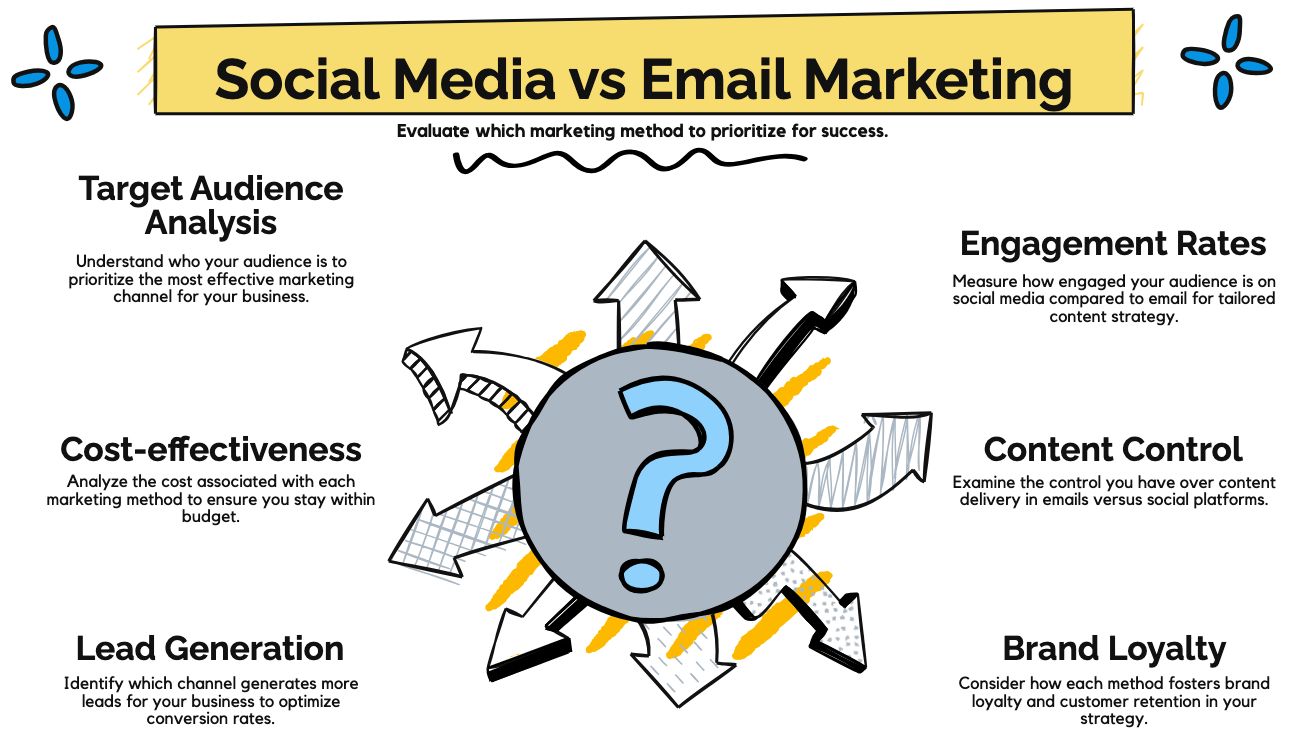
The Core Comparison: Email vs Social Media
The difference between email and social media comes down to one word: ownership.
Your email list belongs to you. Your social media audience belongs to the platform. If Instagram changes its algorithm tomorrow (and it will), your reach drops overnight. If Meta decides to charge more for visibility (and they have), your organic content becomes invisible. Facebook’s organic reach sits around 1.2% to 5.9% for most business pages. That means for every 1,000 followers, fewer than 60 people see what you post.
Email doesn’t have that problem. When you send a newsletter, it lands in someone’s inbox. They chose to be there.
Here’s how the two channels compare on the metrics that matter for solopreneurs:
| Factor | Email Marketing | Social Media |
|---|---|---|
| Ownership | You own the list. Export it anytime. | Platform controls access and reach |
| Average ROI | $36 to $42 per $1 spent (Litmus, 2025) | Varies widely; organic reach declining |
| Click-through rate | 2% to 5% average | 0.5% to 2% organic average |
| Customer acquisition | 40x more effective than social (McKinsey) | Better for awareness than conversion |
| Time investment | Can be batched and automated | Requires daily presence and monitoring |
| Content lifespan | Days to weeks in the inbox | Hours in the feed |
| Consumer preference | 60% of consumers prefer email for business communication | 17% prefer social for brand updates |
The numbers tell a clear story. Email converts. Social media introduces. Both have a role, but if you’re forced to pick one channel to invest in first, email is where revenue lives.
Here’s the catch. Those ROI numbers assume your list is healthy and engaged. A list of 10,000 people who never open your emails is worth less than 200 subscribers who read every word. The quality of your list matters more than the size.
When to Prioritize Email First
If any of these sound like you, email should be your primary channel:
You already have an audience, even a small one. If people know you exist (through networking, referrals, past clients, or social media) but you have no way to reach them outside of the algorithm, you’re leaving money on a platform you don’t control.
You sell services where trust matters. Coaching, consulting, design, therapy, financial planning. The longer someone is on your list, the more they trust you. That trust converts to clients. According to HubSpot’s 2026 State of Marketing report, for B2C brands, email marketing was the number one channel for ROI.
You want marketing that builds on itself. Every new subscriber makes your list more valuable next month. Social media doesn’t work that way. Yesterday’s post is already buried. A slow marketing approach means choosing fewer channels and going deeper with each one. Email is the channel that rewards that kind of focus.
Your capacity is limited. Email can be batched. Write a month’s worth of newsletters in one sitting (our content batching guide shows you how). Schedule them. Done. Social media doesn’t batch as cleanly because the platforms reward real-time engagement and daily posting. If you have 5 hours a week, a weekly email will outperform scattered social posts.
When Social Media Makes More Sense
I’m not here to tell you social media is useless. It’s not.
If you’re brand new and nobody knows you exist, social media gives you a stage. You can’t build an email list if no one has heard of you yet. Social fills that discovery gap, especially on platforms where your specific audience spends time. LinkedIn is strong for B2B consultants. Instagram works for visual services and coaches. If you have an engaged audience on a specific platform and the content feels sustainable for you, keep going.
Social media also works well for thought leadership. When your content gets shared, it reaches people who never would have found your website. That kind of organic reach is harder to replicate through email alone.
There’s a third scenario worth naming: if your business model relies on community and real-time interaction (group programs, live events, launches), social media gives you a public space to build that energy. Email is private and one-to-one. Social is public and one-to-many. Some business models need both dynamics.
But here’s what I see too often: solopreneurs spending 10+ hours a week on social media content with nothing to show for it except a dopamine cycle of likes and follows. Vanity metrics feel productive. They’re not.
If social isn’t feeding your email list or booking calls, it’s a time expense, not a marketing investment. Be honest with yourself about which category your social media effort falls into.
The Smarter Strategy: Use Both (But Lead with Email)
The best approach for most solopreneurs isn’t either/or. It’s a specific sequence.
Social media catches attention. Email captures and keeps it. Think of it as a funnel:
- A social post gets someone’s attention (awareness)
- A lead magnet or free resource captures their email (capture)
- A nurture sequence builds trust over weeks (relationship)
- A well-timed offer or clarity call books the meeting (conversion)
If you skip step 2, you’re doing all the work of creating content with no way to follow up. Every social post without a path to your email list is a missed opportunity.
This doesn’t mean you need to post daily or be on every platform. Pick one social channel where your audience already is. Use it to point people toward something valuable that requires an email to access. That’s it.
A solopreneur posting twice a week on LinkedIn with a clear lead magnet link will build a more valuable list than someone posting daily on four platforms with no email capture. Effort without a capture mechanism is effort that evaporates. The marketing strategy for solopreneurs that works is the one that respects your actual time and energy.
Here’s a practical way to think about time allocation if you have 5 hours a week: spend 3 hours on email (writing, scheduling, reviewing metrics) and 2 hours on one social channel, focused on list-building posts. That ratio can shift as your list grows and email becomes more automated. But start with email as the primary investment.
How to Build an Email List Without Paid Ads
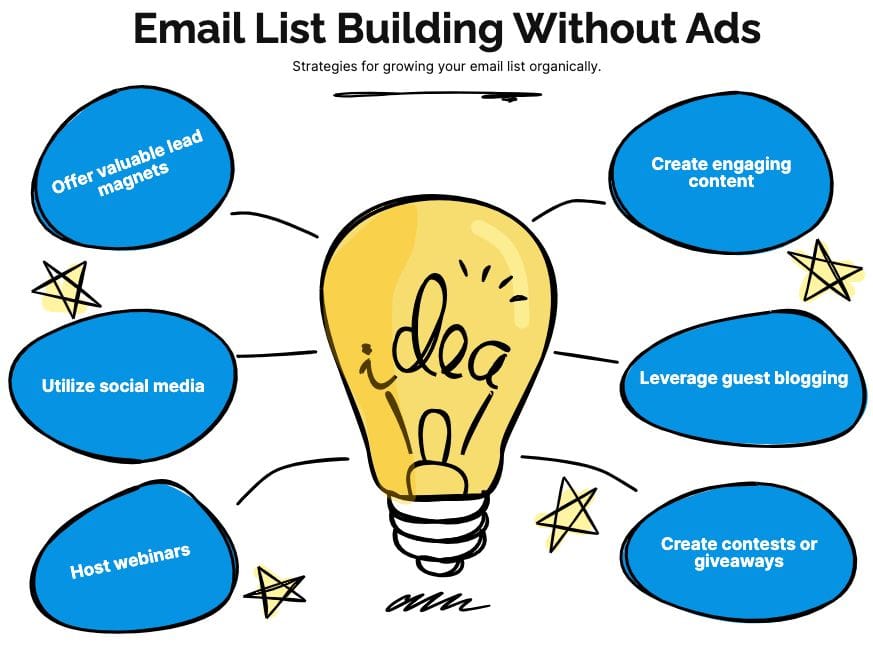
You don’t need an ad budget to grow your list. In client work, these organic methods consistently produce the most engaged subscribers for solopreneurs.
Start with a Lead Magnet That Solves a Specific Problem
Generic “sign up for my newsletter” doesn’t work. People need a reason to hand over their email. The more specific the offer, the better it converts.
A “Local Service Business Pricing Guide” will outperform “Marketing Tips Newsletter” every time. Think about the question your ideal client asks you most during discovery calls. Turn your answer into a checklist, template, or short guide.
According to HubSpot research, lead magnets tied to a specific problem convert at significantly higher rates than general newsletter signups. Aim for something your reader can use the same day they download it.
Put Sign-up Forms Where People Already Are
Your website should have at least two visible email capture points: one in the header or above the fold, and one at the end of every blog post. Exit-intent popups (the ones that appear when someone moves their mouse to leave) also work. They’re annoying when done badly, but when paired with a relevant offer, they capture attention at the exact moment someone is about to forget you.
Keep forms simple. Name and email is enough. Every extra field reduces conversions. Research consistently shows that single-field forms convert at higher rates.
Use Social Media to Feed the List
This is where social media earns its keep. Instead of posting for likes, post with a purpose: driving email signups.
Pin your lead magnet to the top of your profile. Add a link-in-bio tool (Linktree, Metricool’s built-in bio link, or a links page on your own site) that features your free resource prominently. Mention your email list in videos and stories. When you share a tip on social, end with “Want the full breakdown? Grab the free guide” and link to the opt-in.
Guest Appearances and Cross-Promotion
Podcast interviews, guest blog posts, and joint webinars with complementary businesses put you in front of someone else’s audience. Always have a specific offer for new listeners (a free resource, not “visit my website”). Speaking engagements, even virtual ones, are another underused list-building tool when you include a clear email capture at the end.
The key with any cross-promotion: both parties should benefit. If you’re a consultant and you partner with a copywriter for a co-hosted workshop on writing better proposals, both of you gain subscribers from the other’s audience. Keep it reciprocal.
Content Upgrades on Blog Posts
If you’re already publishing blog content (and you should be, since your website is owned land), add a content upgrade to your highest-traffic posts. A content upgrade is a downloadable resource specific to that article. Reading a post about pricing strategy? Offer a pricing calculator template in exchange for an email. Reading about marketing plans? Offer a one-page plan template.
These work because the offer matches the intent. The reader is already interested in the topic. You’re giving them the next logical step.
What Not to Waste Time On
Free Facebook groups as a list-building strategy sound good in theory, but in practice they often attract people who want free advice with no intention of buying. Don’t spend hours managing a group unless it’s directly producing subscribers and clients. Monitor results honestly, and redirect that time to higher-converting tactics if the numbers aren’t there.
Measuring Email Marketing Performance
Here’s where most solopreneurs get lost. They send emails but never look at the data. Or they look at the wrong numbers.
Too many businesses focus on the number of emails sent. Not enough sit with the data long enough to understand how every email supports their marketing goals.
The Metrics That Matter
Open rate: A useful directional signal, but take it with a grain of salt. Apple’s Mail Privacy Protection (introduced in 2021) pre-loads email content, which inflates open rates. In 2025, average open rates across industries rose to 30.7% (Omnisend, 2026 report), but a meaningful portion of those are phantom opens from Apple devices.
For solopreneurs with smaller lists (under 5,000), a true engaged open rate of 30% to 40% is healthy. If you’re above 40%, your content resonates. Below 20%, something is off with your subject lines, send frequency, or list quality.
Click-through rate (CTR): This is where it gets real. Did someone click a link in your email? Average CTR across industries is about 2%, but that number varies by segment. For solopreneurs sending to a warm, opted-in list, 3% to 5% is a reasonable target. If your click rate is below 1%, your content or offers aren’t connecting.
Click-to-conversion rate: Omnisend’s 2026 report found this metric jumped 53% year-over-year, from 5.9% to 9%. Fewer people are clicking, but the ones who do are more likely to buy. This tells you something important: quality of engagement matters more than volume.
Revenue per subscriber: This is the number solopreneurs should care about most and track least. If you have 500 subscribers and generate $5,000 in revenue from email in a quarter, that’s $10 per subscriber. Track this over time. It tells you whether your list is an asset or a vanity metric.
List growth rate and churn: Are you gaining subscribers faster than you’re losing them? A healthy list grows by 2% to 5% per month. If unsubscribe rates spike after a particular email, that’s data. Pay attention to it.
Tools for Tracking
Most email platforms include basic analytics. MailerLite (free up to 1,000 contacts) and Kit (formerly ConvertKit, free up to 1,000 contacts) are solid starting points for solopreneurs. Both show open rates, click rates, and subscriber growth without requiring a big budget.
For deeper tracking, use UTM parameters on the links in your emails so Google Analytics can tell you exactly which email drove traffic, signups, or sales. This is how you connect “I sent an email” to “I booked three discovery calls.”
One stat worth knowing: automated emails accounted for only 2% of sends but drove 30% of email revenue in 2025, earning 16 times more per send than scheduled campaigns (Omnisend). Even a simple welcome sequence (3 to 5 emails that go out automatically when someone joins your list) can generate outsized results compared to manual one-off campaigns. Set it up once, then let it run.
If you want CRM and email in the same platform, Brevo is the most affordable option that bundles both. HubSpot’s starter tier works but jumps to $800/month quickly, which is out of range for most solopreneurs.
Common Mistakes to Stop Making
Obsessing over open rates instead of revenue. Open rates are easy to track. Revenue attribution is harder. Do the harder thing.
Sending without segmentation. At minimum, separate your clients from your prospects. They need different messages. HubSpot’s 2025 report found that 78% of marketers say segmentation is their most effective email tactic.
Never cleaning your list. Remove subscribers who haven’t opened an email in 90 days. Send a re-engagement email first (“Still want to hear from me?”), then remove the non-responders. A smaller, engaged list performs better than a large, dead one.
Sending inconsistently. Once a week or twice a month, pick a cadence and stick with it. The consistency matters more than the frequency. Your audience needs to know when to expect you.
FAQ: Email Marketing for Solopreneurs
Is email marketing still worth it in 2026?
Yes. The data is unambiguous. Email generates $36 to $42 for every $1 spent according to Litmus, making it the highest-ROI marketing channel available. And according to HubSpot’s 2026 State of Marketing report, 40% of marketers use email, tying it with organic social as the second most-used channel. The channel keeps growing because it works.
How often should solopreneurs send emails?
Weekly or biweekly for nurture content. Match your capacity. One thoughtful email every two weeks beats four rushed emails that say nothing. Consistency builds trust. Inconsistency erodes it.
What’s the best email marketing platform for solopreneurs?
It depends on your budget and what you need. MailerLite offers strong automation and flexibility on their free plan. Kit (formerly ConvertKit) is built for creators and has a clean, simple interface. For ecommerce, Omnisend is strong. If you want CRM and email together, Brevo bundles both at a reasonable price point. Check out our marketing tool reviews for deeper comparisons.
Can I do email marketing without a big list?
Absolutely. 100 engaged subscribers who open every email and occasionally buy from you are worth more than 10,000 names collecting dust. Small lists often have higher open rates (30% to 50% is common for lists under 1,000) and stronger relationships. Start where you are.
Should I use social media to grow my email list?
Yes, that’s one of social media’s best uses for solopreneurs. Stop treating social as the destination and start treating it as the bridge to your email list. Pin your lead magnet to your profile, mention your list in posts, and make it easy for followers to subscribe (see the “Use Both” section above for specifics).
What metrics should I track first?
Start with click-through rate and revenue per subscriber. Open rates are noisy. Clicks tell you whether people care about what you’re sending. Revenue per subscriber tells you whether your email strategy is making money. Everything else is secondary.
If you’re ready to build an email strategy that fits your business and your capacity, a clarity call is the fastest way to figure out where to start.
Ready to stop reading about strategy and start building yours?
Marketing coaching gives you a dedicated strategist in your corner — someone who knows your business, your budget, and your bandwidth. Together, we’ll turn your ideas into a plan that fits your life.
See How Coaching Works → Not sure yet? Book a free clarity callGet the Free Solopreneur Marketing Audit Worksheet
Rate your marketing across 5 key areas in under 10 minutes. Your scores reveal exactly where to focus first, so you stop spreading yourself thin.
No spam. Unsubscribe anytime. We respect your inbox.


