


When “post daily and hit every platform” breaks you
A client came to me last year posting on four platforms a day, running weekly emails, and still felt invisible. She was exhausted. All the activity wasn’t converting: she’d booked one new client in three months. It’s not necessarily the strategy. It’s her capacity. One person can’t run a marketing calendar built for a five-person team.
That’s the problem: most marketing advice assumes headcount you don’t have. The 2025 Simply Business Solopreneur Report found that 34% of solopreneurs have considered giving up on their business, and 53% of those cited burnout as the reason. A University of New Hampshire survey of 227 entrepreneurs found similar numbers, with 34% reporting burnout and 46% reporting high stress.
So what does marketing look like when it’s built for the capacity you actually have?
Slow marketing, defined
Slow marketing isn’t a lighter posting schedule. It’s a capacity-aware strategy: you match your marketing rhythm to your actual bandwidth and to how your specific buyers actually decide whether to engage with you, instead of copying a content calendar built for an agency.
Here’s a working definition, borrowed and adapted from Metricool’s framing of the practice as a long-term, relationship-first approach that prioritizes trust, clarity, and consistency over noise and speed:
Slow marketing is a values-driven, capacity-aware approach that builds trust and visibility at a sustainable pace, matched to how long your buyers actually take to decide, rather than how fast a platform algorithm rewards output.
The idea borrows its philosophy from the slow food movement: right speed over rushed speed, quality over volume, well-being alongside output.
What does this mean? Slowness of message versus slowness of medium. Slowness of message means repeating one core idea for months instead of chasing a new hook every week. Sharing different dimensions, different situations. Going deep. Slowness of medium means choosing channels built for depth, like email, long-form writing, or in-person events, over ones built for speed, like short-form social. Message and medium need to work together.

How long buyers actually take to decide
If you haven’t mapped out your customer journey and tracked how long it takes, you might be surprised. It take a while because people need time to make decisions. It doesn’t mean something’s wrong. She’s slow because deciding on a coach, a consultant, a healer, or a photographer for the biggest day of her life is a real decision, and real decisions take months, not days.
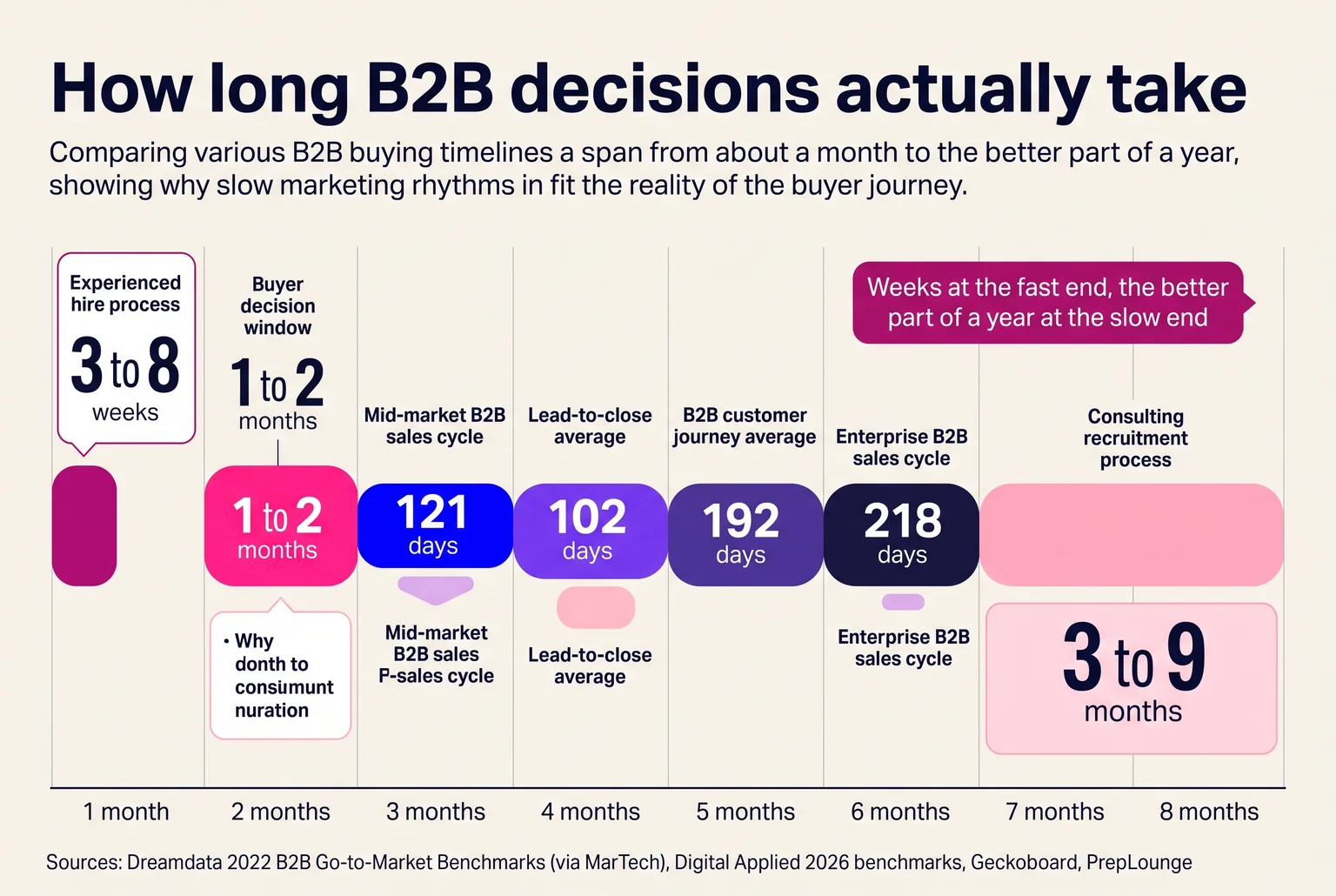
Benchmarks across B2B and professional services back this up, even though methods vary. Dreamdata’s 2022 B2B Go-to-Market Benchmarks study puts the average customer journey at 192 days from anonymous first touch to won. That’s one data point among several, not a universal law: Geckoboard’s analysis of lead-to-close cycles lands closer to 102 days, while 2026 benchmarking from Digital Applied shows mid-market deals averaging 121 days and enterprise deals stretching to 218. Consulting recruitment timelines tell a similar story, with PrepLounge reporting processes that often run 3 to 6 months, sometimes up to 9.
Building a marketing rhythm that assumes quick decisions sets you up to burn out chasing buyers who were never going to move that fast. Slow marketing honors and rewards the long game (which aligns with your buyers anyway).
Four pillars that fit a solo calendar
A framework for one person needs different math than a framework for a team. Team marketing ops can layer on coordination meetings, approval chains, and dashboards. You can’t, and you shouldn’t try. The four pillars below are built around that constraint.
Reading about marketing strategy is one thing. Having someone build it with you is another.
Marketing coaching gives you a dedicated strategist in your corner — someone who knows your business, your budget, and your bandwidth. Together, we’ll turn your ideas into a plan that fits your life.
See How Coaching Works → Not sure yet? Book a free clarity callClarity of audience and offer. Before any content or channel decision, you need a specific answer to who you serve and what you sell. Vague targeting is expensive when you’re producing everything yourself, because every unclear message has to be reworked or duplicated across formats.
One primary channel, one or two secondary ones. Solopreneur marketing guidance consistently points the same direction: master one or two mediums instead of spreading across five. Pick a primary channel where your audience already spends time, and treat everything else as secondary and lighter-touch.
Message consistency, held separately from channel choice. Your core story, voice, and brand promises stay stable across email, Instagram, or a podcast interview. The format changes; the message doesn’t. This is worth a written brand voice document and 3 to 4 content pillars you return to on repeat, so you’re not reinventing your message every time you sit down to post.
Owned, compounding assets. Your website, email list, and evergreen content work while you’re not working. A blog post from a year ago can still bring in a lead. A well-timed post from a year ago cannot.
Repeatable systems that reduce operational drag. Templates, batching, and light automation exist so the same decisions don’t get made from scratch every week.
4 Tangible Examples of What this looks like
A coach’s slowness of message is one core transformation story, repeated in a weekly flagship article and repurposed into 3 to 5 shorter posts (wait at least 90 days before assessing results). Slowness of medium means picking one primary platform (a blog and email list, usually) and treating Instagram or LinkedIn as secondary. Orbit Media’s own case study found that fewer, deeper posts promoted over months steadily doubled web visitors, which is the opposite of daily content pressure.
A consultant’s message stays fixed on one specific pain point across every proposal, LinkedIn comment, and referral conversation, while the medium (cold outreach, speaking, referral asks) can rotate depending on the week’s capacity. Consultants engaging prospects through three or more channels convert at meaningfully higher rates than single-channel efforts, but that only works if the underlying message doesn’t shift week to week.
A holistic healer’s slow medium could be an email nurture sequence: several messages over weeks explaining training, philosophy, and what a session involves before ever pitching a package. The message across those emails and any workshop or Instagram Live stays the same core promise of safety and credibility.
A photographer’s medium is almost entirely relationship-based. Over 71% of wedding bookings come from past clients, vendors, and venues, and referrals typically become the primary booking source only after 12 to 18 months of consistent, high-quality work.
Your first 90 days, mapped to the hours you actually have
Most solopreneurs have somewhere between 3 and 7 hours a week for marketing, with 5 to 7 hours often cited as the sustainable ceiling. Build your plan around that number, not the grind-it-out 8-10 hour push many influencers recommend. Here’s an example of how this could go:
Days 1 to 30: audit and simplify. Cut every channel you’re maintaining out of guilt. Pick one message (your core transformation story, your one pain point) and one primary medium. Set up basic reusable systems: a lead capture form, a short email welcome sequence, one content format you can repeat weekly. Budget 4 to 5 hours a week here, mostly setup work.
Days 31 to 60: test and hold steady. Run the message and medium you chose without switching. Track what happens, but resist judging results yet. This phase is where most people quit early.
Days 61 to 90: review and scale. Look at what’s actually converting, not what feels productive. Turn the best-performing action into your ongoing rhythm, and only then consider adding a second channel.

What working actually looks like on a six-month timeline
The most common misstep is treating slow marketing as a synonym for quiet. It isn’t. Metricool’s research on slow marketing points out that going dark for months erases you from your audience’s memory just as fast as chasing every trend does. The other common trap is using patience as an excuse to stop measuring anything, when slow marketing is meant to be data-informed, just on a longer clock.
The fix is choosing metrics that match a long buying window. Watch stage progression: are leads moving from “just found you” to “asked about pricing”? Track reply rates and click-through rates rather than opens, since Apple Mail Privacy Protection makes opens unreliable. For coaches and consultants, note who returns to your site or watches a full webinar. Ignore follower counts and raw impressions. They tell you reach, not readiness to buy.
Slow Marketing FAQs
Won’t I lose momentum if I slow down?
Momentum comes from showing up predictably, not constantly. Buffer found accounts posting consistently (at least 20 of 26 weeks) saw 450% more engagement per post than sporadic posters.
Won’t this hurt my SEO?
Publishing less often doesn’t hurt SEO. Publishing inconsistently does. One strong post every two weeks for a year builds more authority than daily posts followed by silence.
What if a competitor posts five times a day?
Let them. A weekly piece of real substance beats daily mediocrity.
Slow marketing is a system built for the capacity you actually have, and it works better than the hustle version you were sold.
If you want help building yours, that’s what I do at Women Conquer Business, through coaching, strategy sessions, or hands-on support built for women running the whole show alone.
Ready to stop reading about strategy and start building yours?
Marketing coaching gives you a dedicated strategist in your corner — someone who knows your business, your budget, and your bandwidth. Together, we’ll turn your ideas into a plan that fits your life.
See How Coaching Works → Not sure yet? Book a free clarity callGet the Free Solopreneur Marketing Audit Worksheet
Rate your marketing across 5 key areas in under 10 minutes. Your scores reveal exactly where to focus first, so you stop spreading yourself thin.
No spam. Unsubscribe anytime. We respect your inbox.
