
Long-tail keywords – specific, multi-word phrases like “best gluten-free chocolate chip cookie recipe for high altitude baking” – can help your website attract the right audience, avoid competition, and boost conversions. But finding them manually is tough. That’s where specialized tools come in.
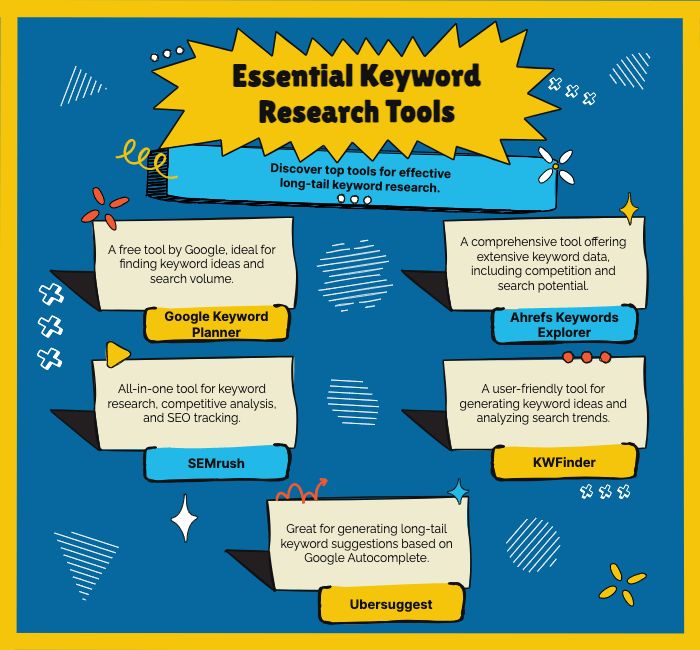
Here are 5 keyword research tools to uncover long-tail opportunities:
- Semrush: Advanced features like the Keyword Magic Tool and Position Tracking; starts at $119.95/month.
- Ahrefs Keywords Explorer: Focuses on competitor insights and search behavior; starts at $99/month.
- Google Keyword Planner: Free but basic tool with limited data unless you run ads.
- KWFinder: Simple interface with affordable pricing; starts at $29.90/month.
- Ubersuggest: Affordable tool pulling data from Google Suggest; free and paid options available.
Quick Comparison
| Tool | Starting Price | Key Features | Best For |
|---|---|---|---|
| Semrush | $119.95/month | Keyword Magic Tool, SERP insights | Advanced SEO strategies |
| Ahrefs | $99/month | Competitor analysis, Parent Topic insights | Niche markets, competitor gaps |
| Google Keyword Planner | Free | Search volume ranges, competition data | Beginners, tight budgets |
| KWFinder | $29.90/month | Keyword difficulty scores, location-based search | Budget-conscious users |
| Ubersuggest | Free/$12/month | Content ideas, keyword difficulty | Affordable, basic SEO needs |
Start with free tools like Google Keyword Planner if you’re on a budget. For deeper insights, invest in tools like Semrush or Ahrefs. The right tool depends on your goals, budget, and SEO expertise.
1. Semrush

Semrush is a well-known name in the world of keyword research, offering tools that help uncover long-tail keyword opportunities. Its extensive features make it a go-to choice for SEO professionals.
Long-tail keyword tools
The Keyword Magic Tool in Semrush analyzes over 20 billion keywords to help you find specific long-tail variations. It organizes keywords based on:
- Search intent: Breaks down keywords into informational, commercial, navigational, or transactional categories.
- Question-based phrases: Groups keywords that start with who, what, where, when, why, or how.
- SERP features: Highlights keywords that trigger featured snippets, local packs, or other special search results.
- Keyword difficulty: Scores each keyword on a scale of 1 to 100, showing how hard it is to rank for.
These tools provide valuable insights, making it easier to refine your SEO strategy.
Knowing what to do for SEO and having time to do it are two different things.
If you’re a service business owner who’d rather spend time serving clients than optimizing Google listings, that’s exactly what local SEO services are for. We handle the technical work — you get found by the right people in your area.
Explore Local SEO Services → Or book a free 30-min clarity call first →Pricing and plans
Semrush offers three primary pricing tiers, available for monthly or annual billing:
| Plan | Monthly Price | Monthly Keywords | Key Features |
|---|---|---|---|
| Pro | $119.95 | 3,000 | Basic keyword research, 3 projects |
| Guru | $229.95 | 5,000 | Content marketing tools, 15 projects |
| Business | $449.95 | 10,000 | API access, 40 projects, share of voice tracking |
Each plan is designed to cater to different levels of SEO needs, from small-scale projects to enterprise-level campaigns.
Pros and cons for small businesses
Semrush has clear advantages for small business owners and solopreneurs, but it’s not without drawbacks.
What works well:
- In-depth competitor analysis for keywords.
- Detailed metrics like CPC, competition level, and search volume.
- A topic research tool to spark content ideas.
- Position Tracking for monitoring rankings, especially useful for local SEO. If you are focused on local search, a local SEO keyword tool can help you find location-specific terms your customers are actually searching for.
Challenges:
- Higher cost compared to simpler tools.
- A learning curve for beginners.
- Limited keyword searches in lower-tier plans.
For solopreneurs, the Pro plan is often enough to build a strong keyword strategy. The Position Tracking tool stands out for businesses targeting specific locations, helping you keep an eye on rankings across different areas.
2. Ahrefs Keywords Explorer

Ahrefs Keywords Explorer, much like Semrush, provides a wealth of data, but it stands out with its focus on search behavior and competitor insights. It’s especially useful for uncovering long-tail keywords, making it a great choice for niche markets.
Long-tail keyword features
Ahrefs Keywords Explorer is loaded with tools to help you discover long-tail keywords:
- Parent Topic Analysis: Highlights broader themes linked to your target keywords, helping you branch into related long-tail variations.
- Questions Report: Generates a list of question-based keywords, organized by search volume and difficulty.
- Also Rank For: Shows additional keywords that top-ranking pages target, revealing unexpected opportunities.
- Search Suggestions: Pulls autocomplete data from multiple search engines for even more ideas.
The tool processes over 7 billion keywords and provides detailed metrics like click distribution, return rate, relevance to parent topics, and historical SERP data.
Cost and plans
Ahrefs offers tiered pricing to suit different budgets and needs:
| Plan | Monthly Cost | Keywords Tracked | Projects |
|---|---|---|---|
| Lite | $99 | 500 | 5 |
| Standard | $199 | 1,500 | 10 |
| Advanced | $399 | 5,000 | 25 |
| Enterprise | $999 | 10,000 | 100 |
All plans include essential keyword research features, while higher tiers unlock more data and advanced tools.
Pros and cons for small businesses
What works well:
- Detailed keyword metrics, including traffic potential and historical trends.
- Accurate keyword difficulty scores based on the top 10 ranking pages.
- Content gap analysis to pinpoint missed keyword opportunities.
What could be better:
- Starts at a higher price compared to basic tools.
- Can be challenging for beginners to navigate.
- Lower-tier plans limit keyword tracking.
- No free trial, though a 7-day money-back guarantee is available.
Ahrefs shines when it comes to identifying keyword gaps – those terms your competitors rank for but you don’t. For small businesses, this can be a game-changer, helping them uncover untapped opportunities in their niche markets. Paired with other top tools, Ahrefs provides the insights solopreneurs need to stay competitive.
3. Google Keyword Planner

Google Keyword Planner is a simple, free tool that can help you find long-tail keywords. Unlike advanced tools like Semrush and Ahrefs, this Google Ads tool is budget-friendly and uses Google’s own data to help you get started with keyword research.
Long-tail Keyword Features
With this tool, you can:
- Generate long-tail keyword ideas using a seed keyword or your website URL.
- See search volume ranges (e.g., 1K–10K).
- Check competition levels for keywords.
- View seasonal trends over the past year.
- Filter results by location.
Cost and Access
Google Keyword Planner is free to use, but you’ll need a Google Ads account. There are two levels of access:
| Access Level | Requirements | Search Volume Data | Features |
|---|---|---|---|
| Standard Access | Google Ads account without active campaigns | Broad ranges only | Basic keyword research |
| Full Access | Active Google Ads campaigns | Exact numbers | Full data access |
Pros and Cons for Small Businesses
This tool offers a solid starting point for solopreneurs and small businesses, especially those on a tight budget.
Advantages:
- Free to use.
- Direct access to Google’s search data.
- Provides historical trend information.
- Easy-to-use interface.
Drawbacks:
- Offers fewer long-tail keyword suggestions compared to paid tools.
- Displays broad search volume ranges unless campaigns are active.
- Focuses heavily on commercial intent.
- Provides only basic metrics.
- Groups similar keywords together.
While it doesn’t have the depth of paid tools, Google Keyword Planner is a reliable option for basic keyword research. Pairing it with other free tools can help you dig deeper into long-tail keywords and refine your strategy.
4. KWFinder
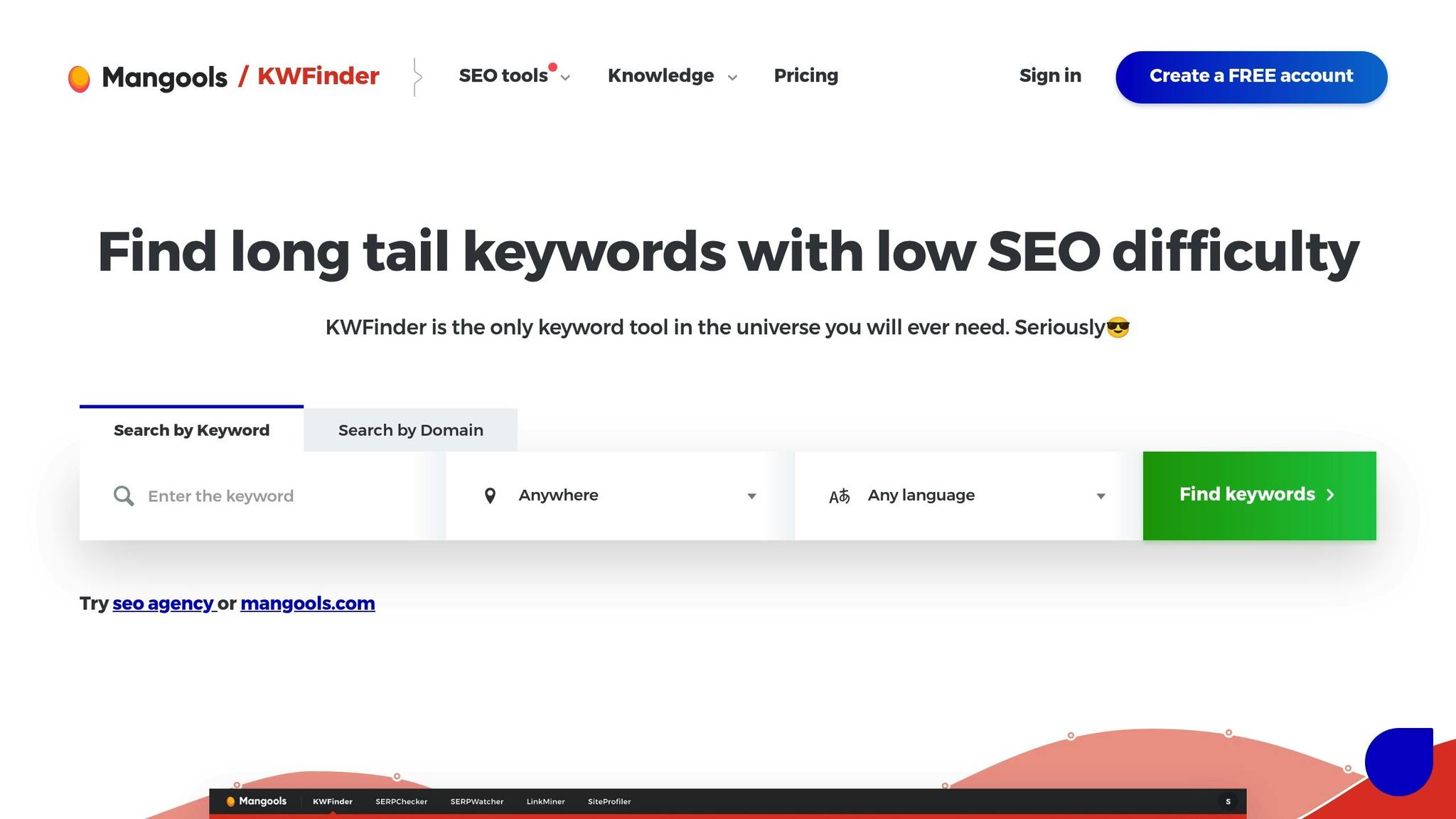
KWFinder, part of the Mangools SEO suite, is designed with a clean interface and easy-to-understand metrics. It’s a solid choice for solopreneurs and small businesses aiming to find profitable long-tail keywords without unnecessary complexity.
Long-tail Keyword Features
KWFinder focuses on simplifying keyword research while offering tools to uncover and analyze long-tail keywords effectively:
- Keyword Difficulty Score: A 0–100 score with color coding to quickly gauge competition.
- Search Volume Trends: A 12-month history to spot seasonal patterns in search demand.
- Related Keywords: Suggestions based on Google’s autocomplete and common questions.
- SERP Overview: Insights into top-ranking pages, including domain authority metrics.
- Location-based Search: Research keywords for over 50 countries and multiple languages.
Cost and Plans
KWFinder is available through the Mangools suite, offering flexible pricing options:
| Plan | Monthly Cost | Daily Keyword Lookups | Key Features |
|---|---|---|---|
| Basic | $29.90 | 100 | Essential metrics, 200 suggestions |
| Premium | $39.90 | 500 | Advanced filters, 700 suggestions |
| Agency | $79.90 | 1,200 | Bulk analysis, unlimited suggestions |
All plans include a 10-day money-back guarantee and access to other Mangools tools like SERPChecker and SERPWatcher.
Pros and Cons for Small Businesses
KWFinder strikes a balance between usability and functionality, making it a great tool for small business owners managing their own SEO.
Pros:
- Straightforward difficulty scores make it easier to find manageable keywords.
- Affordable pricing compared to enterprise-level tools.
- Seamless integration with other Mangools tools.
- Clear, visual representation of keyword data and trends.
Cons:
- Daily keyword lookup limits apply to all plans.
- Lacks some advanced features found in higher-end tools.
- Historical data is capped at 12 months.
- Does not include content optimization suggestions.
- Basic keyword clustering features.
For small business owners and solo entrepreneurs aiming to improve their search visibility, KWFinder provides the essentials without overcomplicating the process.
5. Ubersuggest

Created by Neil Patel Digital, Ubersuggest stands out for helping users find long-tail keyword opportunities. It taps into Google’s suggest data to provide highly specific keyword variations.
The tool offers a range of useful features to shape effective content strategies. For example, the Content Ideas feature identifies top-performing content, making it easy for solopreneurs to spot trending topics. Meanwhile, the Keyword Overview breaks down key metrics like search volume trends, keyword difficulty, and cost-per-click estimates, helping users fine-tune their approach to target less competitive niches.
Next Steps
Picking the right tools means balancing your business needs with your resources. When evaluating tools, think about your technical skills, the stage of your business, and how much time you can dedicate. Free tools like Google Keyword Planner offer basic features, but premium tools often require a larger financial commitment.
Here’s a simple framework to help you align your tool choices with your priorities:
| Factor | Questions to Consider | Why It Matters |
|---|---|---|
| Budget | What’s your monthly tool budget? | Helps you avoid overspending |
| Time Investment | How many hours can you dedicate? | Determines if automation features are needed |
| Technical Skills | What’s your SEO and marketing level? | Affects whether you need extra support |
| Business Stage | Are you starting or scaling up? | Impacts the level of features required |
This framework can guide your decisions, but sometimes expert advice makes all the difference.
For solopreneurs who feel overwhelmed by SEO, expert coaching can be a game-changer. Women Conquer Business offers personalized digital marketing strategies for small business owners. Member Jeanne Vaseleck shares:
“I was never sure where to begin with my marketing plan and was always getting so many mixed messages about what I needed to do. Jen helped me understand that there are many ways to do marketing and find the best way for me”.
Combining the right tools with expert guidance is a powerful strategy. Membership programs offering ongoing support can elevate your SEO efforts. Crispin Spaeth explains:
“The WCB Membership has helped me think big picture for my marketing, with the confidence that I am following an actual strategy and not just spinning my wheels. The techniques I’ve learned from Jen have saved me precious time and grown my audience. As a solopreneur, it can be easy to lose perspective on my efforts. Jen and the other amazing members help me keep it real and keep it going. An important part of my work week!”.
Editorial Note: AI SEObot assisted with brainstorming and summarizing information (editorial policy).
Want someone to handle all of this for you? That’s literally what we do.
If you’re a service business owner who’d rather spend time serving clients than optimizing Google listings, that’s exactly what local SEO services are for. We handle the technical work — you get found by the right people in your area.
Explore Local SEO Services → Or book a free 30-min clarity call first →Free SEO Audit