
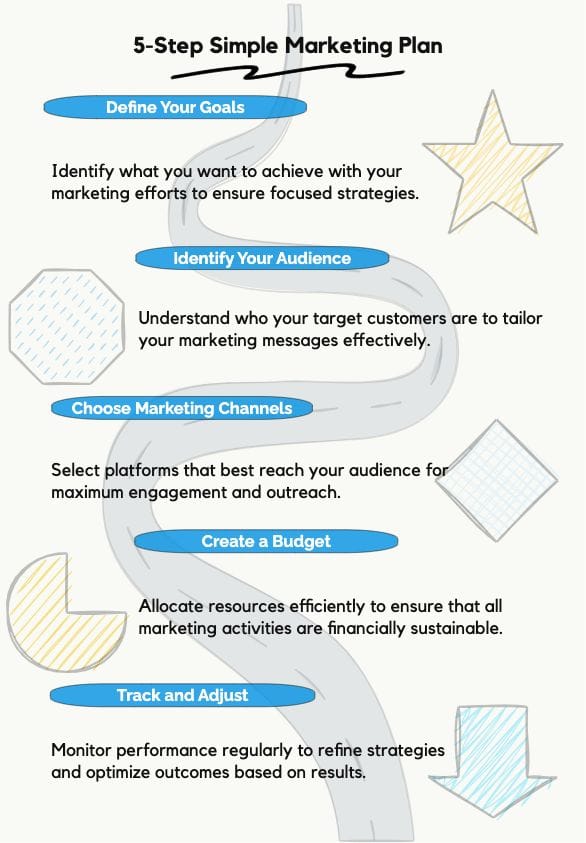
A simple marketing plan helps you stay focused, connect with your audience, and achieve your business goals. Here’s how you can create one in 5 straightforward steps:
- Identify Your Target Audience: Research your ideal customers using surveys, social media analytics, and competitor analysis. Build detailed customer personas to guide your marketing efforts.
- Set SMART Goals: Create goals that are Specific, Measurable, Achievable, Relevant, and Time-bound. For example, “Increase Instagram engagement from 2% to 3.5% in 90 days.”
- Choose Marketing Channels: Focus on platforms where your audience is active (e.g., social media, email, SEO). Prioritize channels based on your goals and resources.
- Plan Your Budget: Allocate your marketing budget wisely across activities like content marketing, digital ads, and email campaigns. Use affordable tactics like free analytics tools and organic social media strategies if resources are limited.
- Create a Timeline: Break your goals into smaller tasks, schedule them, and track progress using tools like Trello or Google Workspace.
Our Strategic Marketing Membership includes quarterly marketing planning strategies that start with your business goals and help you work through these steps.
How To Write A Marketing Plan In 5 Easy Steps
Step 1: Identify Your Target Audience
Knowing your ideal customers is the foundation of any marketing strategy. HubSpot research shows that businesses using detailed buyer personas experience a 45% boost in website traffic and a 20% rise in sales.
Reading about marketing strategy is one thing. Having someone build it with you is another.
Marketing coaching gives you a dedicated strategist in your corner — someone who knows your business, your budget, and your bandwidth. Together, we’ll turn your ideas into a plan that fits your life.
See How Coaching Works → Not sure yet? Book a free clarity callGather Data Through Market Research
Here are some effective ways to collect valuable information about your audience:
| Research Method | Purpose | Key Insights |
|---|---|---|
| Online Surveys | Gather demographic and behavioral data | Learn about buying habits and preferences |
| Social Media Analytics | Analyze engagement and preferences | Spot audience patterns and content interests |
| Competitor Analysis | Discover market gaps and opportunities | Identify unmet needs and pain points |
| Google Trends | Observe seasonal trends and demand | Pinpoint the best timing and content topics |
Our membership includes online survey templates and a Market Research class.
Build Customer Personas
Transform your research into detailed personas to guide your decisions:
| Component | Details to Include | Impact on Marketing |
|---|---|---|
| Demographics | Age, location, income, education | Helps tailor messaging |
| Behaviors | Shopping habits, brand preferences | Shapes your overall strategy |
| Goals | Professional and personal aspirations | Refines your value proposition |
| Challenges | Problems they need solved | Guides solution-focused content |
Tools like HubSpot’s free Make My Persona can simplify this process.
Step 2: Set Clear Marketing Goals
Having clear marketing goals is crucial for growth – businesses with defined objectives grow twice as fast as those without.
How to Create SMART Goals
The SMART framework is a practical way to set goals that are Specific, Measurable, Achievable, Relevant, and Time-bound. Here’s how it works:
| SMART Element | Key Question | Example Application |
|---|---|---|
| Specific | What do you want to achieve? | Generate 50 qualified leads per month |
| Measurable | How will you track it? | Set up Google Analytics goals |
| Achievable | Is it realistic? | Match resources and capabilities |
| Relevant | Does it support business goals? | Align with revenue targets |
| Time-bound | When to achieve it? | Set clear deadlines |
For example, a SMART goal could look like this: “Increase Instagram engagement from 2% to 3.5% in 90 days through daily posts and a $500 ad budget.” Need more examples? Here are 9 examples of SMART marketing goals.
Align Goals with Business Priorities
After setting SMART goals, make sure they align with your overall business objectives. This ensures your efforts contribute directly to the bigger picture. Here’s how to connect marketing goals with business priorities:
| Business Objective | Aligned Marketing Goal | Key Performance Indicators |
|---|---|---|
| Increase Revenue | Boost Q2 online sales by 30% | Conversion rate, Avg. order value |
| Improve Customer Retention | Grow email engagement 25% in 6 months | Open rates, Click-through rates |
| Enter New Markets | Generate 200 qualified leads by July 2025 | Lead quality, Geographic distribution |
“Aligning marketing goals with business objectives requires clear communication and consistent planning.”
Aligned strategies can lead to 24% faster revenue growth and 27% higher profits. Focus on one or two main goals to maintain clarity and avoid spreading resources too thin. Track progress monthly to evaluate performance and make adjustments as needed.
Once your goals are set, the next step is selecting the right marketing channels to effectively connect with your audience.
Step 3: Select Effective Marketing Channels
Focusing on the right marketing channels can deliver results up to three times better than spreading your efforts too thin. Let’s break down how to choose and make the most of these channels to hit your targets.
Assess Popular Marketing Channels
Each platform has its own strengths and audience. Knowing these can help you decide where to focus. Here’s a quick overview:
| Marketing Channel | Best For | Key Benefits |
|---|---|---|
| Email Marketing | Customer retention | Direct communication |
| Social Media | Brand awareness | Real-time engagement |
| SEO | Long-term growth | Consistent traffic |
| Content Marketing | Authority building | Lead generation |
| Paid Advertising | Quick results | Targeted reach |
Think about your resources and expertise when picking channels. For example, while SEO can drive steady traffic over time, it requires ongoing effort and patience to see the payoff.
Fine-Tune Your Channel Strategy
Focus on where your audience spends their time. For instance, Pew Research Center reports that 72% of adults aged 18-29 use social media, making platforms like Instagram and TikTok ideal for connecting with younger audiences.
Tie your channel choices to your SMART goals. If your aim is to boost engagement, platforms like social media or email marketing – where interaction is direct – might be your best bet. Keep these points in mind:
- Choose platforms that align with your audience’s habits and preferred content types.
- Make sure you have the bandwidth to maintain a consistent presence.
- Use analytics tools to track performance and confirm your strategy is working.
Regularly review how your channels are performing and tweak your approach based on the data. Stick with the ones that resonate most with your audience and contribute the most to your goals.
Once you’ve nailed down your channels, the next step is allocating your resources to maximize their impact.
Step 4: Plan Your Marketing Budget
Setting a practical marketing budget ensures you can make the most of your chosen channels without overspending. A study by BDC found that businesses dedicating 10-15% of their revenue to marketing often see better outcomes.
Allocate Your Budget Wisely
Divide your budget based on your SMART goals and the channels you selected earlier. This helps maintain focus and ensures your spending aligns with your priorities:
| Marketing Activity | Recommended % | Best For |
|---|---|---|
| Content Marketing | 30-35% | Building your brand, SEO efforts |
| Digital Advertising | 25-30% | Fast results, targeted outreach |
| Email Marketing | 15-20% | Retaining customers, driving sales |
| Social Media | 15-20% | Boosting awareness, engagement |
| Tools & Analytics | 5-10% | Tracking performance, adjustments |
These percentages aren’t set in stone. For instance, if you’re launching a new product, you might want to allocate more to advertising.
Affordable Marketing Tactics for Small Businesses
If you’re working with a smaller budget, these strategies can still deliver strong results:
- Use Free Analytics Tools: Free tools (like Google Analytics or social media analytics) can help you track performance and fine-tune your efforts to focus on what’s working.
- Prioritize Organic Social Media: Build a consistent presence on social platforms before diving into paid ads. Remember social media is becoming pay-to-play but you can make inroads with consistent insights and connections. Share content that resonates with your audience.
- Optimize Email Marketing: Email marketing often has the highest ROI among digital channels. Social media platforms change algorithms, and even come and go. Email, like your website is something you own. Start small with a basic platform (here are my favorite tools) and refine campaigns based on open and click rates.
- Create Strategic Content: Plan a content calendar that aligns with your goals. It’s crazy to me that less than half of small businesses plan their content. Content takes time. Plan. It. Out. Focus on evergreen content (content that doesn’t change often) to generate ongoing traffic and leads.
To stay on track, monitor your spending monthly using a simple spreadsheet. Compare your results to your SMART goals to pinpoint which tactics are delivering the best return.
With your budget ready, the next step is to map out a timeline to keep your plan organized and effective.
Step 5: Create a Practical Timeline
This is one of the biggest issues I see with solopreneurs and small businesses: overaggressive goals and unreasonable timelines. Remember that marketing is a small piece of your overall business puzzle. That’s why in our membership we focus on one goal per quarter. Trust me, it works.
Once your budget is set, the next step is crafting a timeline to turn your marketing plan into action. A clear timeline helps you stay organized, ensures consistent execution, and keeps you on track to meet your goals.
Break Down Goals into Manageable Tasks
Your timeline should match your SMART goals and budget, making sure each task directly supports your overall strategy. Break your goals into smaller, actionable steps, like auditing your content, scheduling regular posts, and promoting through email or social media. This approach keeps things moving smoothly and reduces the risk of delays.
For example, if your goal is to boost website traffic by 50% in six months, you can break it down into actions like reviewing your current content, writing and publishing new blog posts, and setting up promotional campaigns through various channels. Be sure to account for task dependencies and available resources to keep everything running in a logical order.
Leverage Tools to Stay Organized
Project management tools can make a big difference in tracking tasks and maintaining collaboration. Here are a few options to consider:
| Tool | Best For | Key Benefit |
|---|---|---|
| Trello | Solopreneurs | Easy-to-use visual boards |
| Asana | Small teams | Managing project dependencies |
| Google Workspace | Tight budgets | Simple, collaborative tools |
Set weekly checkpoints for smaller tasks and monthly reviews for bigger-picture goals. This helps you catch any issues early and adjust as needed. Keep an eye on metrics that align with your SMART goals to measure progress effectively.
A well-thought-out timeline not only keeps your marketing plan on track but also gives you the flexibility to make adjustments based on what’s working (or not).
Conclusion: Start and Adjust Your Plan
Key Points from the 5 Steps
Your marketing success starts with understanding your audience and adapting as needed. Here’s how each step builds a solid foundation for your strategy:
| Component | Purpose | Key Consideration |
|---|---|---|
| Target Audience | Basis of your strategy | Grounded in real market research |
| SMART Goals | Clear direction | Aligned with overall business goals |
| Marketing Channels | Reach your audience | Tailored to their preferences |
| Budget | Allocate resources | Prioritize cost-efficient methods |
| Timeline | Structure execution | Regularly track progress |
With these elements in place, you’re ready to refine and adjust your plan over time.
Why Regular Plan Reviews Matter
Tracking KPIs like website traffic, social media engagement, and conversion rates is essential for evaluating your plan’s performance. If a particular channel isn’t meeting expectations, shift resources to areas showing stronger results. Staying flexible allows you to make smarter budget decisions and keep your strategy aligned with your goals.
“Regular reviews help ensure that the marketing plan remains aligned with evolving business needs and market trends. Adjustments can be made to address any gaps or inefficiencies, allowing for more effective use of resources and better alignment with changing customer needs.”[3]
Start by diving into your audience research and building each step of your plan thoughtfully. As your strategy unfolds, stay open to changes based on actual results and market shifts. By doing so, you’ll create a marketing plan that adapts to your business needs and consistently delivers outcomes.
FAQs
How to make a simple marketing plan template?
Creating a straightforward marketing plan template involves focusing on key sections that drive results. Here’s a practical outline:
| Component | Description | Key Elements to Include |
|---|---|---|
| Budget Planning | Financial framework | Resource allocation, cost breakdowns, ROI projections |
| Market Research | Insights into your audience | Customer data, competitor analysis, market trends |
| Marketing Strategy | Actionable steps | Campaign timelines, channel selection, content plans |
| Measurement Plan | Tracking success | KPIs, reporting schedule, adjustment strategies |
Inside the membership, we have a much simpler template focused on action, plus you get support from me throughout the month.
Work through your template step-by-step, starting with the executive summary. Use SMART criteria to set clear, measurable goals. This ensures your plan remains actionable and focused.
To keep your plan relevant, review and update it every quarter. You might also want to use project management tools to track your progress and ensure smooth implementation.
This structure simplifies the planning process and helps align your marketing efforts with your goals.
Need help? Schedule a marketing strategy consultation.
FAQs
How do I know which marketing channels are right for my business?
Great question—and one of the most important decisions you’ll make. Start by looking at two things:
-
Where your audience spends time.
Check your social media analytics, email engagement, and website traffic sources. You can also snoop on competitors to see where they show up most often. -
Your strengths and capacity.
If you’re great at writing, blogging and email might be your jam. Love video? Short-form social content could be your best bet. Just remember: it’s better to show up consistently on one or two platforms than spread yourself too thin everywhere.
What if I don’t hit my marketing goals—does that mean my plan failed?
Nope. Missing a goal doesn’t mean failure—it means it’s time for reflection and adjustment.
Here’s what to do:
- Check the data: Did your tactics move the needle at all? What worked better than expected? What fell flat?
- Reassess the goal: Was it realistic? Was it aligned with your audience and resources?
- Refine your strategy: Maybe the channel wasn’t the right fit or you need to post more consistently. Maybe you actually need more rest, not more hustle.
Marketing is like strength training—it builds over time. That’s why we recommend quarterly reviews. We even include them in the membership to help you reset your plan without the burnout spiral.
Related Blog Posts
- 7 Digital Marketing Basics for Service Businesses
- Client Attraction Checklist: 12 Essential Marketing Tasks
- 5 Common Marketing Mistakes Small Business Owners Make
- How to Build an Email List Without Paid Advertising
Ready to stop reading about strategy and start building yours?
Marketing coaching gives you a dedicated strategist in your corner — someone who knows your business, your budget, and your bandwidth. Together, we’ll turn your ideas into a plan that fits your life.
See How Coaching Works → Not sure yet? Book a free clarity callGet the Free Solopreneur Marketing Audit Worksheet
Rate your marketing across 5 key areas in under 10 minutes. Your scores reveal exactly where to focus first, so you stop spreading yourself thin.
No spam. Unsubscribe anytime. We respect your inbox.