Most solopreneurs know they need marketing help. The hard part is figuring out what kind.
A consultant? A coach? An agency? A freelancer? Someone local, or does it matter? The answer depends on where your business is right now, not where some guru says you should be.
Thinking about hiring marketing help? Let’s figure out what you actually need.
Before you spend hours researching, a free 30-minute clarity call can tell you exactly what kind of support fits your business and budget. No pitch, no pressure... just a straight answer.
Book a Free Clarity Call → Learn more about coaching optionsI’m a Portland-based marketing consultant, and here’s what I tell every new client: the problem is rarely a lack of effort. It’s a lack of direction. You’re doing marketing activities, but they don’t connect to a marketing strategy. Random activity is not strategy, and no amount of hustle fixes that.
Wondering about cost first? Here’s what marketing consultants charge in 2026.
This guide walks you through when to hire a marketing consultant, what to look for, what to expect, and how to evaluate whether it’s working.
When to Hire a Marketing Consultant
By the time you think you need a consultant, you’ve probably needed one for a while. Digital marketing is complex. Running it well while delivering client work is increasingly impossible for one person to manage alone.
Here are the signals that it’s time:
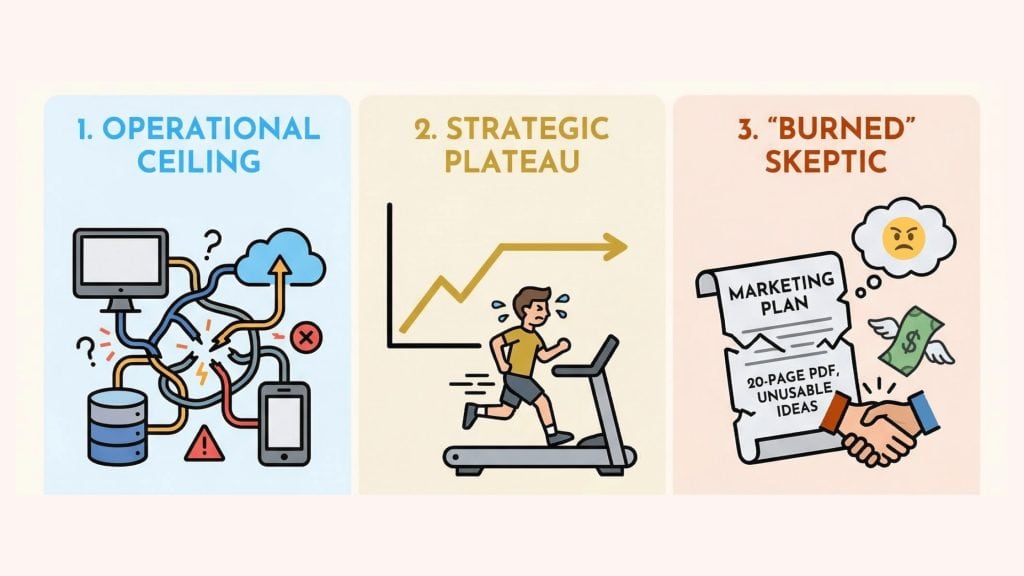
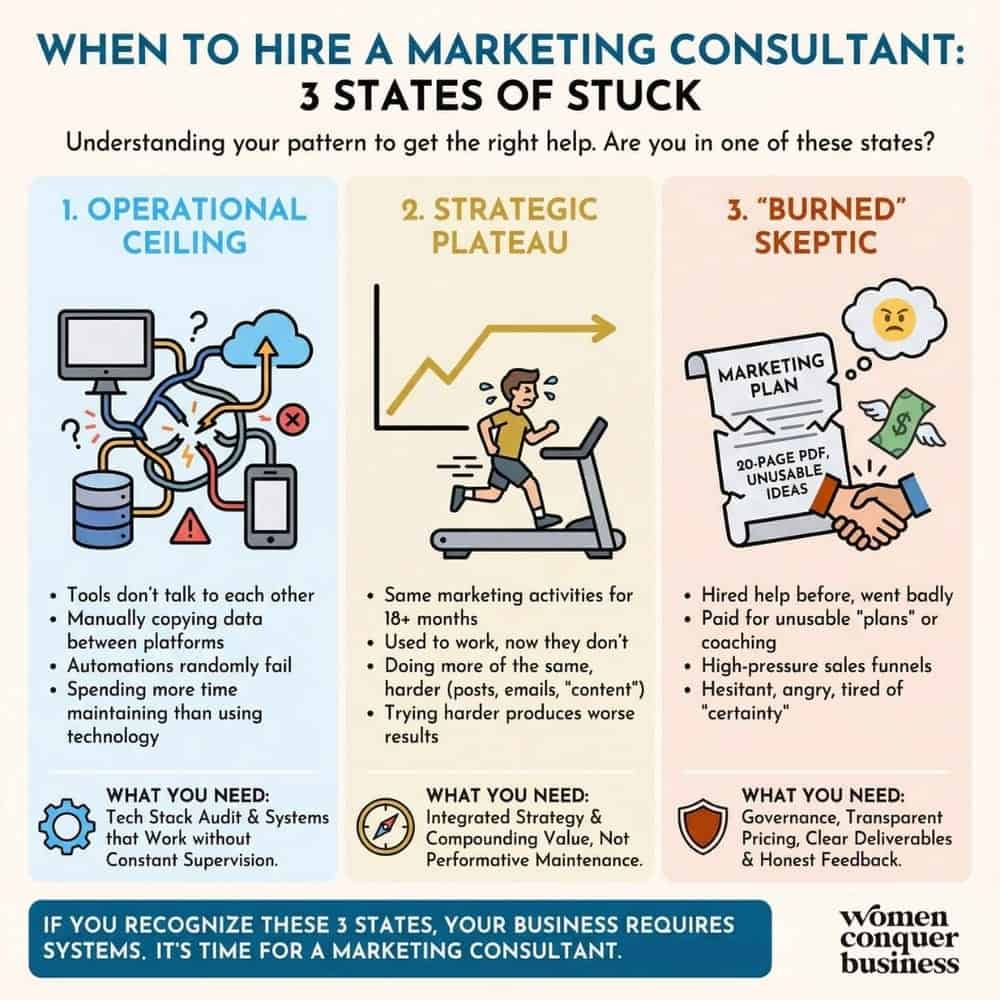
Your marketing feels scattered. You’ve been DIYing for a year or more and growth has stalled. You tried Instagram, switched to LinkedIn, wondered about email. Nothing sticks because there’s no plan underneath it.
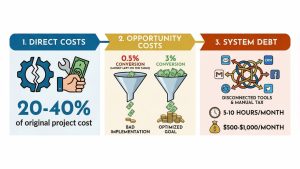
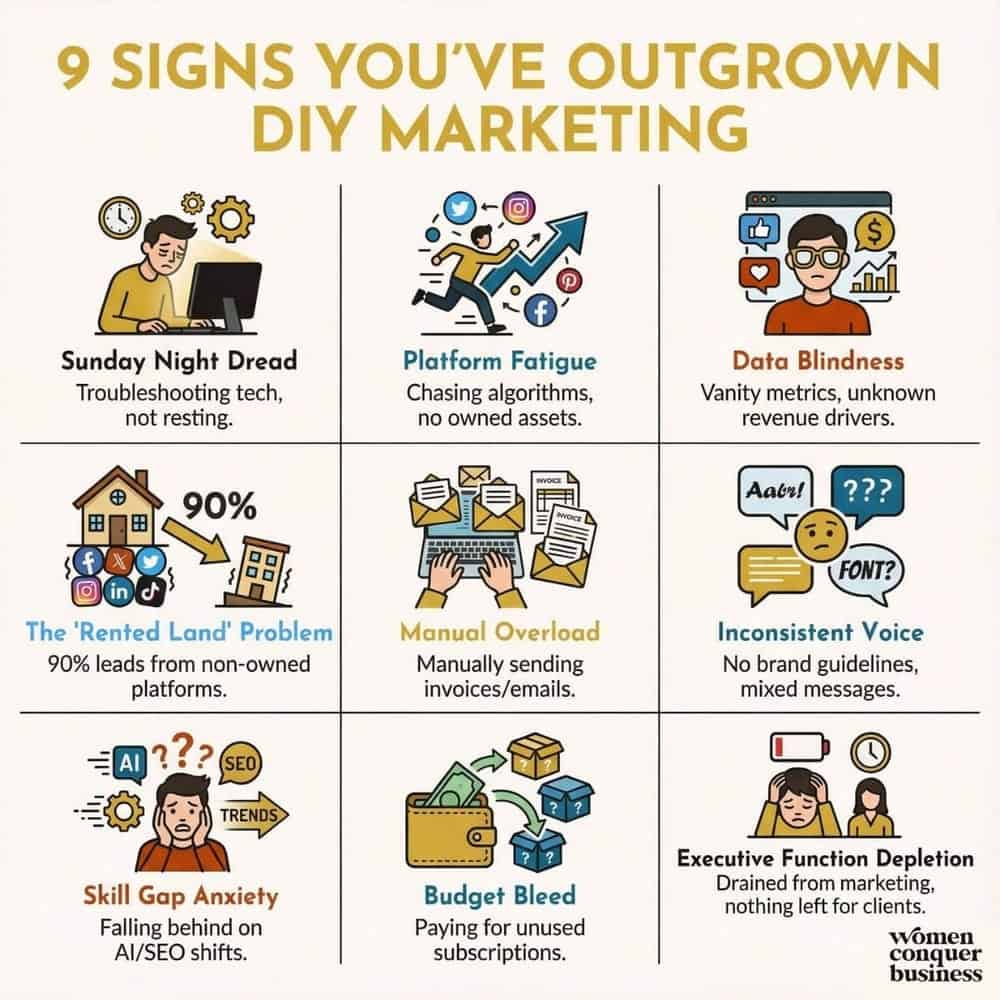
You’re spending money with no clear strategy connecting it. That $200/month email tool you only use for a monthly newsletter. The paid ads running to a landing page nobody converts on. The scheduling app you signed up for but never configured. Those costs add up. In client work, the pattern is consistent: solopreneurs spend on tools and tactics they don’t need yet because someone told them they “should.”
You know what to do but can’t execute. You’ve taken the courses. Bought the templates. The knowledge isn’t the problem. It’s the bandwidth. According to SCORE, citing research from The Alternative Board, 84% of business owners work more than 40 hours a week. The average business owner reports only about 1.5 hours of uninterrupted, productive time per day. Your marketing plan needs to fit inside that window. Not the 10-step content funnel some influencer is pitching.
You’re about to launch something. New service, rebrand, market expansion. You need strategic direction before spending money on tactics.
Your marketing activities aren’t generating leads or revenue. Posting consistently but getting likes instead of clients? That’s a strategy problem, not a content problem.
You’ve been burned before. You paid thousands for a “marketing plan” that was a 20-page PDF of ideas you couldn’t implement. Or you signed up for a coaching program that turned out to be a high-pressure sales funnel. You’re hesitant. That’s reasonable. What you need now is transparent pricing, clear deliverables, and someone who will tell you when something won’t work.
Your tech stack fights you more than it helps you. Your tools don’t talk to each other. You’re manually copying data between platforms. Automations randomly fail. You spend more time maintaining technology than using it to acquire customers. That’s an operational ceiling, and it requires a systems-level fix.
When You Don’t Need a Consultant
If you’re in your first year and still figuring out what you sell and who buys it, a consultant can’t help you yet. You need customers and conversations before you need a strategy.
If you have no budget for marketing at all, a consultant can give you clarity, but you won’t have resources to act on their recommendations. A marketing membership or peer community might be a better starting point.
And if what you need is someone to do the work (not tell you what to do), you need a freelancer or an agency. A consultant gives you the plan. They don’t write your emails or manage your ads.
What to Look For in a Marketing Consultant
This is where most people get it wrong. They Google “marketing consultant” and end up comparing firms that work with Fortune 500 companies. That’s not the same service.
They understand your business size and stage. A consultant who works with funded startups or enterprise companies won’t understand solopreneur constraints. You need someone who’s worked with businesses at your stage, your scale, and your capacity. Ask specifically.
They focus on strategy, not sales. A consultant who leads with “here’s what you need” before understanding your business is selling, not consulting. The first call should be mostly questions from them. Do they listen more than they pitch? That’s the best predictor of a good fit.
They’re transparent about pricing. Red flag if they won’t give you a range before the first call. Marketing consultant costs vary widely, but you deserve to know the ballpark before investing an hour in a sales conversation.
They deliver clear, defined outcomes. What do you get? A strategy document? Monthly calls? A marketing operations audit? Ongoing support? Ask before signing. Vague deliverables lead to vague results.
They explain in plain language. If you don’t understand the strategy, you can’t execute it. A good consultant talks in terms of your goals, your revenue, your time. Not jargon.
They practice what they teach. Look at their own website. Is it clear? Is their content consistent? If their own marketing is a mess, that tells you something. Check whether their content demonstrates the strategic thinking they’d bring to your business.
They’re honest about what they can’t do. The best consultants have clear boundaries. They tell you when something is outside their area, when you need a specialist, or when the answer is “I don’t know, but I’ll find out.”
Red flag checklist:
- They guarantee specific results before understanding your business
- They require a 12-month commitment before they’ve audited your systems
- They pitch a package before asking a single question
- They talk about “secrets” or “hacks” instead of systems and strategy
- Their pricing is completely opaque until after a high-pressure sales call
Benefits of Hiring a Marketing Consultant
Outside perspective grounded in experience. You can’t read the label from inside the jar. You know your business so well that you can’t see what confuses a potential client visiting your website for the first time. A consultant has looked at dozens (or hundreds) of businesses and can spot the patterns you’ve stopped noticing. Not a focus group. Not a survey. Someone who’s done this before.
Faster path from effort to results. DIY marketing is a viable path. But it’s slow. The learning curve for SEO alone takes months. A consultant compresses that timeline because they’ve already made the mistakes. They know which tactics move the needle for service businesses and which ones are busywork. The difference between learning by trial-and-error over 18 months and getting a clear starting point in month one is significant. It’s not a shortcut. It’s skipping the part where you spend six months doing things that don’t work before discovering what does.
Cost efficiency vs. full-time hire. According to the Gartner 2025 CMO Spend Survey, marketing budgets have held flat at 7.7% of company revenue. That data comes from companies with billion-dollar revenues and full marketing departments. For a solopreneur, your “marketing budget” is probably a fraction of that, and the margin for waste is zero. A consultant costs a fraction of a marketing director salary, and you pay for what you need.
Accountability and focus. Someone who checks in, holds you to priorities, and calls it out when you’re drifting back into random acts of marketing.
The Hidden Cost of Not Hiring
The biggest expense isn’t the consultant’s fee. It’s the money you’re losing while your marketing stays broken.
Solopreneurs commonly spend $200-$500/month on tools they don’t use, run ads to pages that don’t convert, and spend hours each week on activities that produce zero leads. A single strategy session ($150-$500) often pays for itself within a month when it helps you cancel unnecessary subscriptions and redirect your time toward what works.
If your time is worth $150/hour and you spend 10 hours a month on misdirected marketing effort, that’s $1,500 in lost productivity. Every month. The “I can’t afford a consultant” math rarely holds up once you account for the cost of staying stuck.
What to Expect from a Marketing Consultant
Buyer anxiety is real. Most people have never hired a consultant before, or they’ve hired one that didn’t deliver. Here’s what the process typically looks like with a good one.
Discovery and intake. The first call or session is diagnostic. Expect questions about your goals, current marketing, budget, capacity, and past efforts. A good consultant listens more than they talk in this phase. If they’re prescribing solutions in the first 15 minutes, they’re selling.
Assessment and audit. They review what you’re doing now: what’s working, what’s not, what’s missing entirely. This might include a tech stack audit, content audit, SEO review, or competitive analysis. Expect to invest 2-4 hours of your time during this phase.
Strategy and roadmap. A written plan with priorities, timelines, and action items. Not a 50-slide deck. Not a 20-page PDF of ideas you can’t implement. A document you can follow.
This is where the 3 C’s framework matters:
- Capacity: Can you sustain this for 12 months? Not in a burst of motivation. Consistently, including on bad weeks.
- Complexity: Is this something you can learn, or does it require skills you don’t want to build?
- Control: If you hand part of this off, will the quality hold?
A consultant who respects your capacity will give you two or three focused priorities. Not twelve.
Implementation support. Some consultants hand off the plan. Others (like marketing coaching) walk alongside you during execution. Know which model you’re buying before you commit.
Measurement. How will you know it’s working? Set success metrics up front. Leads generated, bookings, revenue. Not vanity metrics like followers or likes.
Marketing Consultant vs. Coach vs. Agency: Which Do You Need?
The marketing industry blurs these lines to charge premium prices for junior-level work. Here’s how to tell the difference.
| Consultant | Coach | Agency | |
|---|---|---|---|
| Best for | Strategic direction + specific projects | Ongoing accountability + skill building | Full execution across channels |
| Engagement | Project-based or retainer | Monthly sessions, ongoing | Monthly retainer, team-based |
| You get | A plan + recommendations | A plan + someone who builds it with you | Execution + reporting |
| Your time | Medium (review/feedback) | High (3-7 hrs/week implementation) | Low (approvals only) |
| Cost range | $150-$300/hr or $2K-$5K per project | $500-$2,000/month | $3,000-$10,000+/month |
| Best when | You know what you need but not how | You need clarity AND accountability | You need everything done for you |
Not sure which model fits? That’s what a clarity call helps you figure out. Here’s how marketing coaching works at WCB.
How Much Does a Marketing Consultant Cost?
Most marketing consultants charge $100-$300 per hour or $2,000-$10,000 per project, depending on scope and expertise. Monthly retainers for ongoing strategic guidance typically fall between $1,500 and $5,000.
For a detailed breakdown of 2026 rates, hidden costs, and how to evaluate value vs. price, see the complete guide to marketing consultant costs.
Quick math for solopreneurs who bill by the hour: if your time is worth $150/hour and a consultant saves you 10 hours of misdirected effort per month, you’ve recouped the cost before the strategy itself produces a single lead.
Why “Be Consistent” Isn’t a Strategy
Most marketing advice assumes you have a marketing team and unlimited capacity. Post every day. Email weekly. Show up everywhere.
That’s not a strategy. That’s a recipe for burnout.
If you have ADHD, chronic illness, or heavy caregiving loads, “be consistent” ignores the reality of how your brain and life work. Capacity is the issue, not motivation.
A good marketing consultant doesn’t hand you a strategy that requires cognitive abilities you don’t have on your worst weeks. They design systems that reduce the load:
- Batching: Group similar tasks to reduce the attention-switching penalty you pay every time you bounce between writing, scheduling, and client work.
- Automation: Set up email sequences, follow-ups, and workflows that run regardless of your mental state.
- Prioritization: Two focused channels done well will outperform six channels done sporadically. Every time.
The question isn’t “can I do more marketing?” It’s “which marketing can I sustain for 12 months without it becoming a second job I didn’t apply for?”
FAQ: Hiring a Marketing Consultant
How do I find a marketing consultant for my small business?
Start by defining what you need: strategic direction, a specific project (like SEO or a website overhaul), or ongoing guidance. Then look for consultants who specialize in your business size and type. Ask for references from businesses similar to yours. Avoid anyone who pitches a solution before asking about your situation.
What should I ask a marketing consultant before hiring them?
Ask to see an example of a strategy they’ve built, not a slide deck. Ask how they handle it when a strategy doesn’t work. Ask about their process for the first 30 days. The best consultants don’t promise perfection. They promise a process for adjustment.
How long does it take to see results from a marketing consultant?
Strategic clarity comes within weeks. Operational improvements (like cutting unnecessary tools and streamlining your tech stack) show up fast. Revenue impact from strategic changes typically takes 3-6 months. Anyone promising overnight results is selling, not consulting.
Can a solopreneur afford a marketing consultant?
If you’re earning under $50K in revenue, peer groups and self-paced learning might be a better fit. Once you hit $75K-$100K, your time is worth more than the cost of a consultant. A single strategy session ($150-$500) often pays for itself within a month when it helps you cut unnecessary subscriptions and focus your efforts. For ongoing support at a lower price point, a marketing membership can fill the gap.
What’s the difference between a marketing consultant and a marketing coach?
A consultant focuses on strategy and direction for your business. They assess your situation, build a plan, and advise on execution. A coach focuses on building your skills and confidence so you can handle marketing yourself. Consultants tell you what to do. Coaches teach you how. Some professionals do both. The core difference is whether you’re paying for a plan or for development.
Is it better to hire a local marketing consultant or work remotely?
For most solopreneurs, it doesn’t matter. Strategy work translates well over Zoom. The exception: if local SEO is critical to your business, a consultant who understands your geographic market can be an advantage. But expertise and fit matter more than proximity.
Ready to Talk to a Marketing Consultant?
If your marketing feels scattered, you’re not behind. You’re undersupported.
What changes when you bring in the right consultant isn’t the volume of your marketing. It’s the confidence behind each decision. You stop second-guessing which platform to post on and start knowing why you chose it.
If you want to see what that looks like for your business, schedule a free consultation and we’ll figure out where to start. 30 minutes, no pitch. An honest conversation about where your marketing is and what the realistic next step looks like.
Not sure what your marketing actually needs right now?
A free 30-minute clarity call is the fastest way to find out. No pitch, no pressure... just a conversation about where your marketing is, where you want it to go, and what the realistic next step looks like.
Book Your Free Clarity Call → Learn more about working with JenGet the Free Marketing Tool Decision Framework
8 questions to ask before you add, keep, or replace any marketing tool. Stop investing in platforms you'll abandon in 3 months.
No spam. Unsubscribe anytime. We respect your inbox.