

Marketing doesn’t have to be expensive to work. Here are 8 affordable strategies that can drive results without breaking the bank:
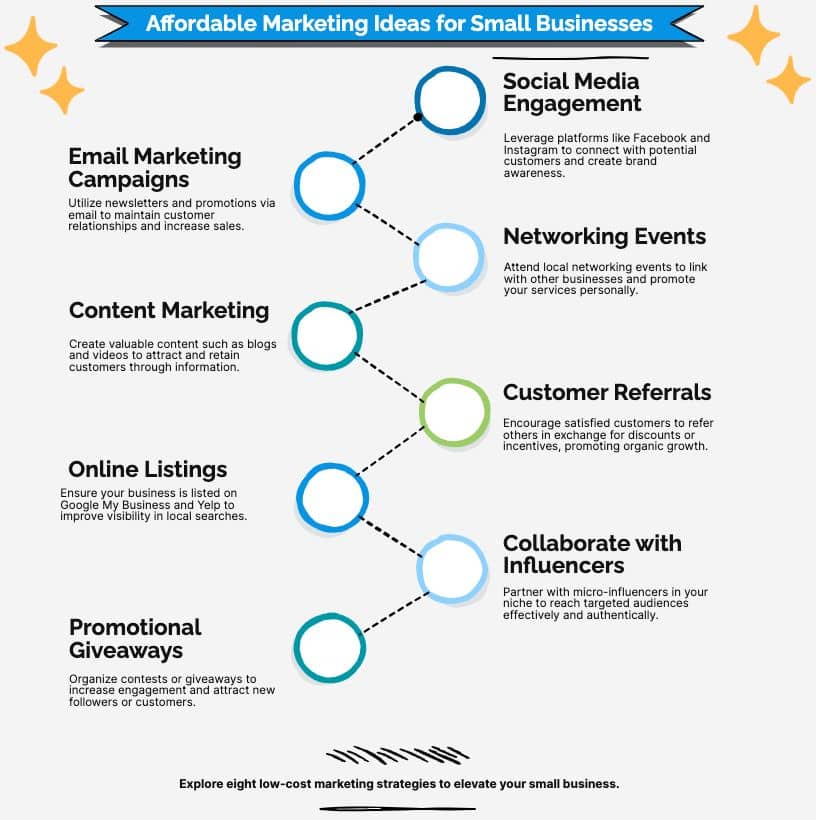
- Build Active Social Media Groups: Engage your audience on platforms like Facebook or Instagram to build a loyal community.
- Partner on Content Creation: Collaborate with complementary businesses to share resources and reach new audiences.
- Repurpose Content: Reuse existing material (like blogs or videos) in new formats to save time and expand reach.
- Work with Micro-Influencers: Partner with influencers who have smaller, engaged audiences for product exchanges or minimal costs.
- Add Local Business Schema Markup: Boost your local search rankings by optimizing your website’s technical setup.
- Host Free Online Classes: Share your expertise to attract leads and build credibility.
- Set Up Referral Systems: Turn happy customers into advocates with incentives for referrals.
- Build Email Follow-Up Campaigns: Use automated email sequences to nurture leads and drive conversions.
Why These Work
- High ROI: Email marketing alone delivers $42 for every $1 spent.
- Community Focus: Strategies like social media groups and referrals build trust and long-term value.
- Affordable Tools: Many of these ideas rely on free or low-cost platforms like Canva, MailerLite, or Google Workspace.
By combining these tactics, you can create a cost-effective and sustainable marketing plan tailored to your business.
1. Build Active Social Media Groups
Facebook Groups, with 1.8 billion monthly users, offer a cost-effective way for small businesses to connect with their audience. The key is to pick platforms where your audience is already active. For discussion-focused communities, Facebook Groups shine. On the other hand, visual brands targeting younger users might find Instagram or TikTok more effective. For instance, Mala the Brand created a 10,000-member Facebook group centered on sustainable living. This group now generates 20% of their online sales through exclusive promotions.
How to Keep Your Group Engaging
Reading about marketing strategy is one thing. Having someone build it with you is another.
Marketing coaching gives you a dedicated strategist in your corner — someone who knows your business, your budget, and your bandwidth. Together, we’ll turn your ideas into a plan that fits your life.
See How Coaching Works → Not sure yet? Book a free clarity callSocial media strategist Kiana Safari suggests the 3E framework to keep members interested:
- Educate: Share industry tips and useful insights.
- Entertain: Post behind-the-scenes content or fun updates.
- Empower: Highlight members and their contributions.
This method works. According to Hootsuite, groups with weekly interactive content retain 62% more members compared to those with more passive strategies.
Tips for Managing Your Group
To keep things running smoothly:
- Stick to a regular posting schedule (e.g., every Tuesday and Thursday).
- Limit promotional posts to less than 20% of your content.
- Respond to member questions or comments within 24 hours.
Encourage User Contributions
Get members involved by promoting branded hashtags or featuring their content. Not only does this strengthen the sense of community, but it also provides you with marketing material.
Track What’s Working
Use free tools on social platforms to monitor:
- Member growth each week.
- Engagement on posts, such as comments and shares.
- Conversion rates – how many group members become paying customers.
These metrics can help you identify collaboration opportunities, which ties into the next strategy.
And here’s a compelling stat: 77% of consumers are more likely to buy from brands they follow on social media. Engaging directly with your audience through groups can be a resource-friendly alternative to paid ads.
2. Partner on Content Creation
Collaborating on content creation is a smart way to cut marketing costs while broadening your audience. By sharing resources, you can reduce production expenses by up to 60% and double your exposure through cross-promotion.
Finding the Right Partners
Look for businesses that aren’t direct competitors but cater to the same audience. Check out local chamber directories, industry-specific forums, or social media groups to spot potential collaborators offering complementary products or services.
Partnership Formats That Work
Certain collaboration formats consistently deliver results. For example, co-hosted webinars generate 57% more leads than solo efforts. Other effective approaches include:
- Guest blog exchanges
- Social media account takeovers
- Co-branded lead magnets
These types of partnerships often achieve click-through rates three times higher than standalone content.
A Success Story
‘Our seasonal lookbook collaboration with local photographers transformed our marketing reach,’ says Sarah Chen, owner of Bloom Boutique. ‘By combining our fashion expertise with professional photography and sharing email lists, both businesses saw a 120% increase in website traffic within three months.’ For more inspiration on seasonal collaborations, explore this guide to seasonal brand collaborations that work.
Efficient Resource Sharing
Here’s how to manage resources for partnerships effectively:
| Collaboration Type | Resource Split | Best For |
|---|---|---|
| Skills Barter | Exchange services (e.g., design for writing) | Solopreneurs (less than 5 years open) |
| 50/50 Cost Share | Equal financial investment | Established businesses |
| Revenue Share | Split profits from co-branded products | Product-based businesses |
Tools to Simplify Collaboration
Make teamwork easier with tools like:
- Trello for managing projects
- Canva for joint design work
- Google Workspace for sharing documents
Protect Your Brand
Set clear brand guidelines and define calls-to-action (CTAs) before starting. Also, follow platform-specific disclosure rules for partnerships. This keeps your messaging consistent and ensures compliance with legal standards.
Track Your Results
Measure the success of your partnership efforts using tools like Google Analytics for referral traffic, engagement stats on co-branded content, and conversion rates from exclusive promotional codes.
These insights will naturally lead into the next step: repurposing your existing content for even greater impact.
3. Transform Existing Content
Once you’ve built collaborative partnerships, take things a step further by reworking your existing content. Studies show that repurposing content can triple your audience reach while slashing creation time by 40-60%. This builds on earlier strategies by squeezing more value out of the resources you already have.
How to Repurpose Content
| Original Content | New Formats | Potential Results |
|---|---|---|
| Blog Post | Social Carousels, Infographics | 2-3x more engagement |
| Customer Stories | Video Testimonials, Email Series | 32% higher email open rates |
| Product Features | Tutorial Videos, Instagram Stories | 25-35% boost in organic traffic |
Real-World Examples
‘Schedule monthly batch-creation cycles,’ suggests Hootsuite. ‘When reusing content, add 20% new insights to keep it relevant.’ [7][5]
One standout example is Bushbalm. They turned a $200 blog post into Instagram Stories, a 45k-view YouTube tutorial, and a high-performing email course with a 32% open rate – resulting in $18,000 in sales.
Similarly, Bokksu saw a 300% engagement boost by repurposing blog content into YouTube snack unboxing videos.
Tools to Streamline the Process
Here are a couple of free tools to help you rework your content:
Keep It Fresh and Consistent
Repurposing content isn’t just about reformatting – it’s also about updating. Add new stats and insights to keep the material relevant. Businesses that regularly refresh old posts see 78% more traffic than those focused only on creating new content. To stay on-brand, use style guides and synced calendars.
Track Your Success
Monitor the performance of your revamped content by focusing on:
- Engagement rates across platforms (aim for at least a 15% boost).
- Time users spend on the transformed content compared to the original.
- Conversion rates for each new format.
4. Exchange Services with Small, Local Influencers
Working with micro-influencers (1K-50K followers) can be a cost-effective way to boost your brand’s visibility. These creators often achieve engagement rates of over 3%, making them a smart choice for brands looking to maximize impact without overspending.
How to Choose the Right Influencers
When selecting influencers to collaborate with, look for those who:
- Have an engagement rate of at least 3% (calculated as likes/comments ÷ followers).
- Share audience demographics that align with your target market.
- Produce content that fits your brand’s style and tone.
Focus on nano-influencers (1K-10K followers) and micro-influencers (10K-50K followers). These creators are often open to product exchanges instead of cash payments.
Setting Up a Successful Collaboration
To ensure smooth partnerships, outline clear agreements that cover:
- Specific content deliverables like posts, stories, and timelines.
- Brand guidelines to maintain consistency.
- FTC compliance to meet legal requirements.
- Content usage rights for repurposing influencer-created material.
Tracking Results
Measure the success of your partnerships by monitoring:
- Engagement rates compared to the influencer’s usual performance.
- Website traffic using UTM parameters.
- Sales driven by influencer-specific discount codes.
- The value of user-generated content created during the collaboration.
Steps for a Systematic Approach
Follow these steps to streamline your influencer campaigns:
- Start with short trial collaborations to test compatibility.
- Provide clear creative guidelines but allow influencers to stay authentic.
- Use tools like Hootsuite to monitor brand mentions and track performance.
- Repurpose content from your top-performing influencers into reusable assets.
These collaborations with smaller influencers can seamlessly tie into broader strategies for enhancing local search visibility.
5. Add Local Business Schema Markup
Optimizing your website’s technical setup can make a big difference in how easily local customers find you. Adding local business schema markup is an easy and free way to improve your visibility in local search results. When paired with local partnerships from Strategy 2, this approach becomes even more effective. According to Search Engine Land, websites with schema markup often rank up to four positions higher than those without it.
Key Schema Components
Make sure your local business schema includes these details:
- Business name and type
- Full address
- Phone number and website URL
- Operating hours
- Service descriptions
How to Get Started
Good news: you don’t need coding skills to implement schema markup. Here’s how:
- Use this schema markup tool to create the structured data code (select local business from the dropdown, then fill in the blanks).
- After you’ve filled it out, copy the code to the right, then test the code with Google’s Rich Results Test before publishing (click code, and paste the code, then click Test Code).
- If you don’t get any errors, you can copy and paste the code into the header of your homepage (you’ll need to talk to your developer or read the instructions for your particular website builder).
- Monitor your progress using Google Search Console.
Tips for Effective Schema Markup
To keep your schema working well:
- Update it as soon as your business details change.
- Check it every few months to ensure accuracy.
- Avoid using duplicate markup across multiple pages.
- Only include accurate, up-to-date information.
Track Your Results
Use Google Search Console to monitor how your rankings, traffic, and rich snippet appearances improve over time.
Industry-Specific Advantages
BrightLocal research shows that 58% of local searches result in store visits, making schema markup especially useful for certain industries:
| Industry | Key Elements to Highlight |
|---|---|
| Restaurants | Menu items, cuisine type |
| Professional Services | Certifications |
| Retail | Product availability |
This technical approach supports the community-driven strategies mentioned earlier and sets the stage for the referral systems discussed in the next section.
6. Lead Free Online Classes
Hosting free online classes is an effective way to build credibility and attract new leads. This approach uses your existing expertise, making it a cost-efficient strategy. Studies show that 80% of marketers find educational content to be a strong driver of lead generation and nurturing.
Choose Topics That Resonate
Pick topics that align with your audience’s needs. For instance, sessions like “Instagram Reels for Local Retail: A Step-by-Step Guide” or “Facebook Ads on a $100 Budget” can grab attention and provide practical value.
Pick the Right Platform
Different platforms work better for different types of sessions. Here’s a quick guide:
| Platform | Best For |
|---|---|
| Zoom | Interactive workshops |
| YouTube Live | Reaching large audiences |
| Google Meet | Small group training |
Keep Your Audience Engaged
Make your class interactive and valuable by including:
- Real-World Examples: Show how your solutions apply in practical scenarios.
- Interactive Tools: Use polls or quick exercises to keep participants involved.
- Q&A Time: Dedicate 15 minutes for live questions to address specific concerns.
Turn Attendees Into Customers
Providing high-quality content is key to converting attendees. Research indicates that businesses often achieve a 20% conversion rate from free webinar participants to paying customers when they follow up strategically.
Track Your Results
Measure your success by monitoring these key metrics:
| Metric | Ideal Range |
|---|---|
| Registration Rate | 20-40% of invitees |
| Attendance Rate | 40-50% of registrants |
| Lead Conversion | 2-5% to customers |
This method pairs well with referral systems (covered in Strategy 7), as attendees who gain value from your classes often become enthusiastic advocates for your brand.
7. Set Up Customer Referral Systems
Referral systems turn satisfied customers into your biggest advocates, building on the trust established through free classes (Strategy 6). Like working with influencers or forming local partnerships, referrals rely on personal connections rather than paid ads. Fun fact: word-of-mouth marketing drives a whopping $6 trillion in consumer spending every year.
Offer Rewards That Benefit Everyone
Make your referral program appealing by rewarding both the referrer and the new customer. This strategy works wonders – just look at Dropbox. Their storage-based rewards system boosted signups by 60% and increased paid subscriptions by 35%. Here’s how you can structure rewards:
| Participant | Example Rewards |
|---|---|
| Referrer | 20% off next purchase or $25 store credit |
| New Customer | 15% off first purchase or free trial extension |
| Both Parties | Loyalty points, exclusive access, or free products |
Keep It Simple
A referral program should be easy for customers to use. Here’s how to make it effortless:
- Unique Referral Links: Provide personalized codes for easy tracking.
- Clear Instructions: Explain the steps in plain language.
- Automated Rewards: Deliver incentives quickly without manual follow-up.
- Mobile-Friendly Design: Ensure customers can share links on any device with ease.
Monitor and Improve Your Program
Track these metrics to see how well your referral system is working:
| Metric | What to Watch for |
|---|---|
| Referral Conversion Rate | Compare your rate to industry standards. |
| Customer Retention Rate | Keep an eye on monthly trends. |
| Customer Lifetime Value | Weigh it against your acquisition costs. |
When to Ask for Referrals
Timing is everything. Request referrals when customers are most satisfied – after a glowing review, a successful product experience, or a repeat purchase.
Non-cash incentives can be up to 24% more effective than cash incentives in motivating people to make referrals [3].
Affordable Tools to Get Started
You don’t need a big budget to set up a referral system. Platforms like ReferralCandy (great for e-commerce) and HelloReferrals (ideal for service businesses) can manage the process for you. If you’re just starting out, even Google Forms can do the trick.
Referral programs work seamlessly with structured email campaigns – something we’ll dive into next.
8. Build Email Follow-up Campaigns
While referrals help kickstart customer advocacy, email campaigns strengthen these connections with consistent, structured communication. In fact, automated email campaigns generate 320% more revenue than non-automated ones.
Focus on Effective Sequences
The best email sequences address specific customer actions and needs:
| Sequence Type | Timing | Purpose | Average Results |
|---|---|---|---|
| Welcome Series | 3-5 emails over 2 weeks | Introduce your brand and offers | 21.33% open rate |
| Abandoned Cart | 1-3 emails within 72 hours | Recover potentially lost sales | 45% open rate, 10.7% conversion |
| Post-Purchase | 2-3 emails over 2 weeks | Build loyalty and gather feedback | 481% higher transaction rate |
Make It Personal
Personalization can make a big difference. Including customer names and tailoring emails based on behavior can increase open rates by 50%. For example, Beardbrand’s 5-email personalized welcome sequence saw a 32% higher conversion rate by simply adding customer names.
Keep Your List Healthy
Pay attention to these key metrics:
| Metric | Target Range | Why It Matters |
|---|---|---|
| Open Rate | 15-25% | Measures how appealing your subject lines are |
| Click Rate | 2-5% | Reflects the relevance of your content |
| Unsubscribe Rate | Below 0.5% | Indicates the quality of your list |
Regularly monitoring these metrics ensures your campaigns remain effective and your subscribers stay engaged.
Affordable Tools to Get Started
Here are some tools that won’t break the bank:
- MailerLite: Free for up to 1,000 contacts.
- Brevo (Formerly Sendinblue): Includes SMS marketing alongside email.
- Kit (Formerly ConvertKit): Great choice for content creators.
These platforms can easily integrate with referral systems and class registrations mentioned in earlier strategies.
“Automated email campaigns generate $36 for every $1 spent, making them one of the most cost-effective marketing tools available to small businesses” [10].
Think Mobile First
Most people check emails on their phones, so design with mobile in mind:
- Use single-column layouts for easy scanning.
- Make buttons large enough for thumb taps.
- Keep paragraphs short – 30 to 50 words max.
This approach aligns with the accessibility principles seen in strategies like social media groups (Strategy 1) and free classes (Strategy 6).
Closing Thoughts
These eight strategies – ranging from building social communities to using automated emails – show that impactful marketing doesn’t have to break the bank. For instance, email marketing delivers an impressive $36 return for every $1 spent, highlighting how well-planned digital tactics can drive results.
Combining these methods makes them even more effective. For example, using social media engagement (Strategy 1) to grow email lists (Strategy 8) or leveraging local partnerships (Strategy 2) to improve search visibility (Strategy 5) creates a powerful ripple effect.
To get the most out of these strategies, focus on:
- Consistent Engagement: Increases brand awareness.
- Performance Tracking: Helps refine and improve campaigns.
- Channel Synergy: Drives higher conversion rates.
When it’s time to scale, these strategies provide a strong foundation for growth while staying cost-efficient. Success comes from creating a connected marketing system where each piece strengthens the others.
Need help? Schedule a marketing strategy consultation.
FAQs
How do I start email marketing for my small business?
Start by using platforms like MailerLite, which offer free plans for up to 1,000 contacts. Use the platform’s templates to design easy-to-understand signup forms and add them to key areas of your website.
To grow your email list, try these steps:
- Provide value: Offer something like a free resource or a discount code to encourage signups.
- Leverage other channels: Use social groups, partnerships, or repurposed content (as mentioned in earlier strategies) to reach more people.
- Set up automated welcome emails: These emails can introduce your brand to new subscribers, building on the automated sequences discussed in Strategy 8.
This approach keeps things simple and doesn’t require advanced technical skills.
How can I start marketing for free?
One of the best free marketing tools is optimizing your Google My Business profile. Businesses with complete profiles are 70% more likely to attract visits and 50% more likely to drive purchases.
Here are some no-cost ways to get started:
- Engage on social media: Post regularly on platforms where your audience is active. As explained in Strategy 1, focus on the platforms your audience already uses.
- Create content: Start a blog that highlights your expertise and answers common questions in your field.
- Build local connections: Join local business groups on LinkedIn or Facebook. Participate in discussions and share helpful insights to establish yourself as an authority.
- Encourage reviews: Ask happy customers to leave reviews on Google or other relevant platforms. Reviews matter – 81% of consumers read them before making decisions.
Pick a couple of these strategies and stick with them consistently to see results over time.
Ready to stop reading about strategy and start building yours?
Marketing coaching gives you a dedicated strategist in your corner — someone who knows your business, your budget, and your bandwidth. Together, we’ll turn your ideas into a plan that fits your life.
See How Coaching Works → Not sure yet? Book a free clarity callGet the Free Solopreneur Marketing Audit Worksheet
Rate your marketing across 5 key areas in under 10 minutes. Your scores reveal exactly where to focus first, so you stop spreading yourself thin.
No spam. Unsubscribe anytime. We respect your inbox.


