


Solopreneur marketing myths are structural failures that lead to burnout by ignoring your real-world capacity. By debunking toxic bro marketing habits, you can build sustainable, ethical digital marketing systems that prioritize strategic clarity, revenue-generating metrics, and operational sanity over the "be everywhere" grind.
At a Glance
- What it is: A capacity-aware guide to killing the "hustle culture" habits that leave you revenue-flat and exhausted.
- Who it’s for: Experienced women solopreneurs and consultants (7+ years) tired of the omnichannel trap.
- Time to implement: 1–2 hours for a radical capacity and complexity audit.
- Typical cost: $0—you are actually getting your time and energy back.
- Skill level: Intermediate to Advanced business operations.
- Primary outcome: Strategic confidence and a business that hums even during your "hardest weeks".
If you’re an established coach or consultant who has spent years following (or looking side-eye at) the 'bro-marketing' playbook only to end up exhausted and revenue-flat, I have news for you: the burnout you're feeling isn't a badge of honor. It's a symptom of a marketing plan that ignores your realities.
In my 25+ years in marketing, I've seen that most solopreneur marketing myths are structural failures. They're using plans designed for VC-backed teams, enterprise organizations, or the latest popular YouTube sensation... not for a solopreneur hungry for valuable business advice.
It is incredibly frustrating to feel like you’re doing everything "right" while your organic reach collapses. Seeing your Facebook reach hit a statistically insignificant 1.2% is enough to make anyone want to quit.
You aren't failing because you lack discipline. You’re struggling because you’re following a map built for a business that looks NOTHING like yours.
Here's your operational intervention. I’m pulling back the curtain to help you protect your energy while building authority. It’s time to move from survival mode to a CEO mindset.
Top 5 Solopreneur Marketing Myths
Myth #1: Solopreneur Badge of Honor
The term "solopreneur" is one of the most expensive words in the modern business vocabulary. It implies a closed ecosystem where reliance on external support deviates from the ideal.
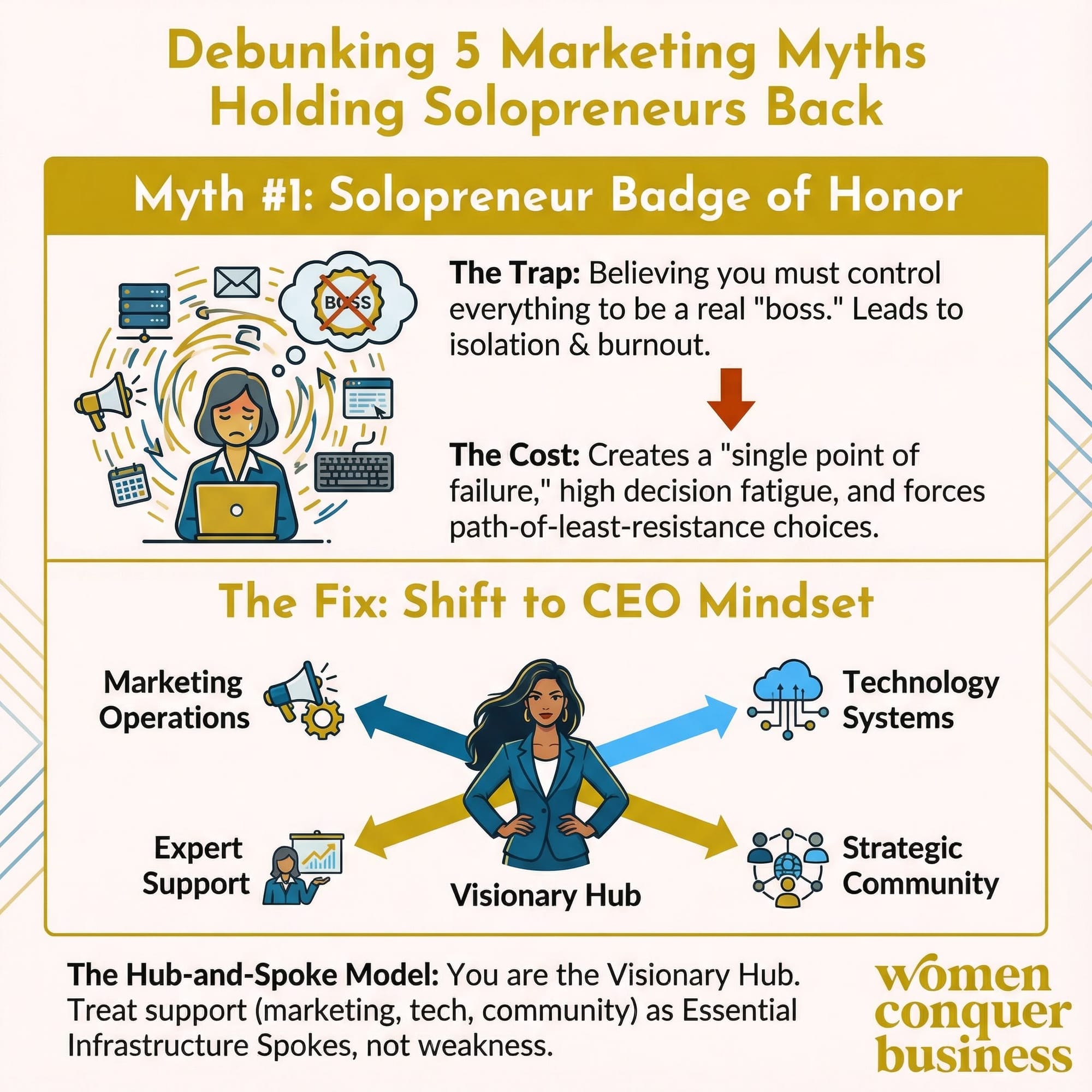
But let’s be honest: Solopreneurship is a tax status, not an operational model. When you believe you must control everything from server management to copywriting to validate your status as a boss, you’re building a single point of failure.
According to the Bureau of Labor Statistics, nearly 10 million Americans are self-employed, yet 20% of small businesses fail in their first year. Often, this is because of the "Human Capital Crisis" that moment where your professional capacity to make complex decisions simply evaporates.
From Survival Mode to the CEO Mindset
Isolation acts as a force multiplier for decision fatigue. In a corporate environment, strategic choices are stress-tested by teams. In your business? You bear the totality of the cognitive load. By 3:00 PM, your brain is often functionally exhausted, leading you to select the path of least resistance rather than the path of strategic value.
To break this cycle, you don't have to take on a partner, but you do need to shift your thinking to the Hub-and-Spoke Model. You are the CEO: you hold the vision and serve as the strategic "Hub."
Your marketing operations, technology, and support systems are the "Spokes" that move the business forward. This doesn't mean you need a staff of fifty; it means you need a network.
Whether it’s a strategic community or understanding the difference between a marketing coach and a consultant, high-performing solopreneurs treat support as essential infrastructure.
Myth #2: Consistency is Key (The Omnichannel Trap)
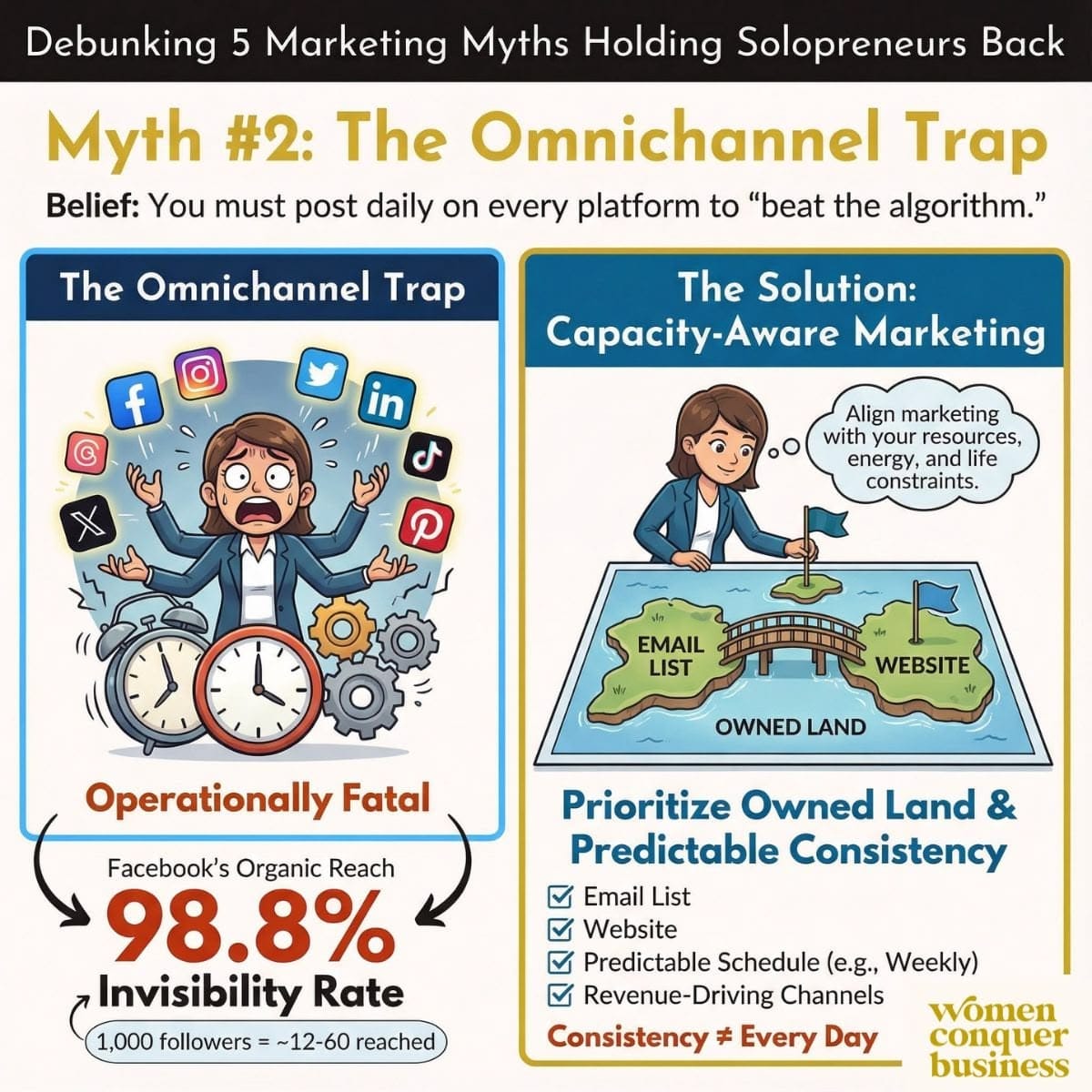
The omnichannel trap is the belief that you must post daily on every platform to "beat the algorithm." For a solopreneur with limited hours, this is operationally fatal.
Capacity-Aware Marketing is a strategic framework that aligns your marketing operations with your biological resources, energy levels, and life constraints. It rejects the "Be Everywhere" mandate in favor of consistency within your specific capacity. This ensures your business survives low-energy days or life's inevitable "hard weeks."
The Mathematics of Invisibility
Facebook’s organic reach has plummeted. For example, if you have a following of 1,000 people, you are investing hours of labor to reach perhaps 12 to 60 of them. That's a 98.8% Invisibility Rate.
Instead of trying to feed the beast, you need a plan for marketing coaching services that prioritizes 'Owned Land.' Your email list and your website are assets that don't subject you to algorithmic decay.
Consistency doesn't mean "every day." It means showing up predictably on the channels that drive revenue (hint: where your customers are), even if that's only once a week.
Myth #3: Passive Income + Funnel Fallacy
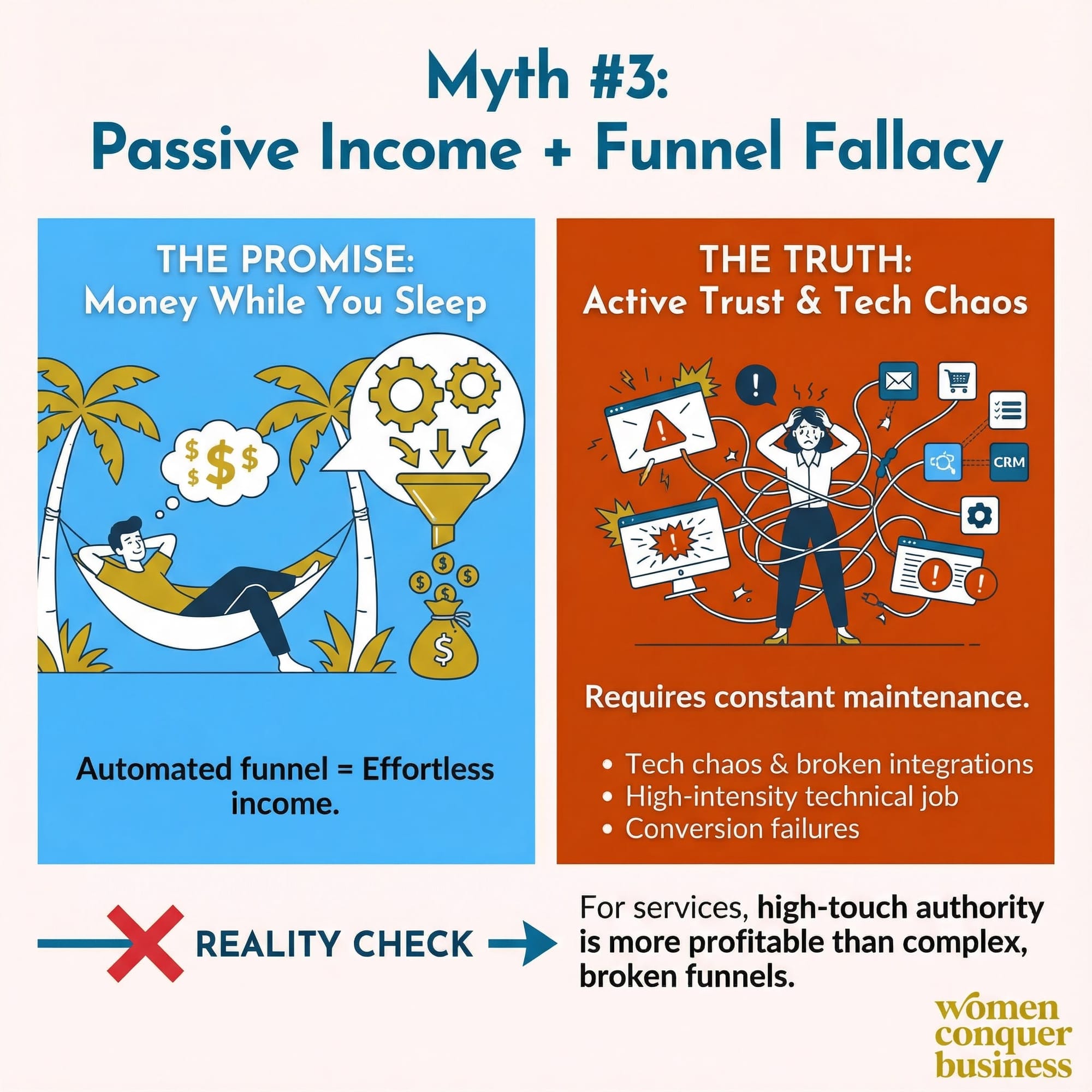
The promise of passive income (making money while you sleep through automated funnels) is the siren song of the solopreneur world. But here is the kicker: Passive income often requires active trust and immense technical maintenance.
Untangling Tech Chaos
In my client work, I consistently see entrepreneurs drowning in tech chaos, where you’re paying for ten software subscriptions that refuse to talk to each other. When your integrations fail or your checkout page won't load, your "passive" system becomes a high-intensity technical job you never applied for.
The Gartner CMO Survey reveals that while marketing budgets are tightening, investments in marketing operations and efficiency are rising.
Why? Because a 20-step sales funnel is useless if it breaks, is difficult to maintain, or doesn't convert. For a professional services business, high-touch authority is often easier and more profitable to sell than low-ticket digital products that require expensive traffic volumes to break even.
Myth #4: The Money is in the List
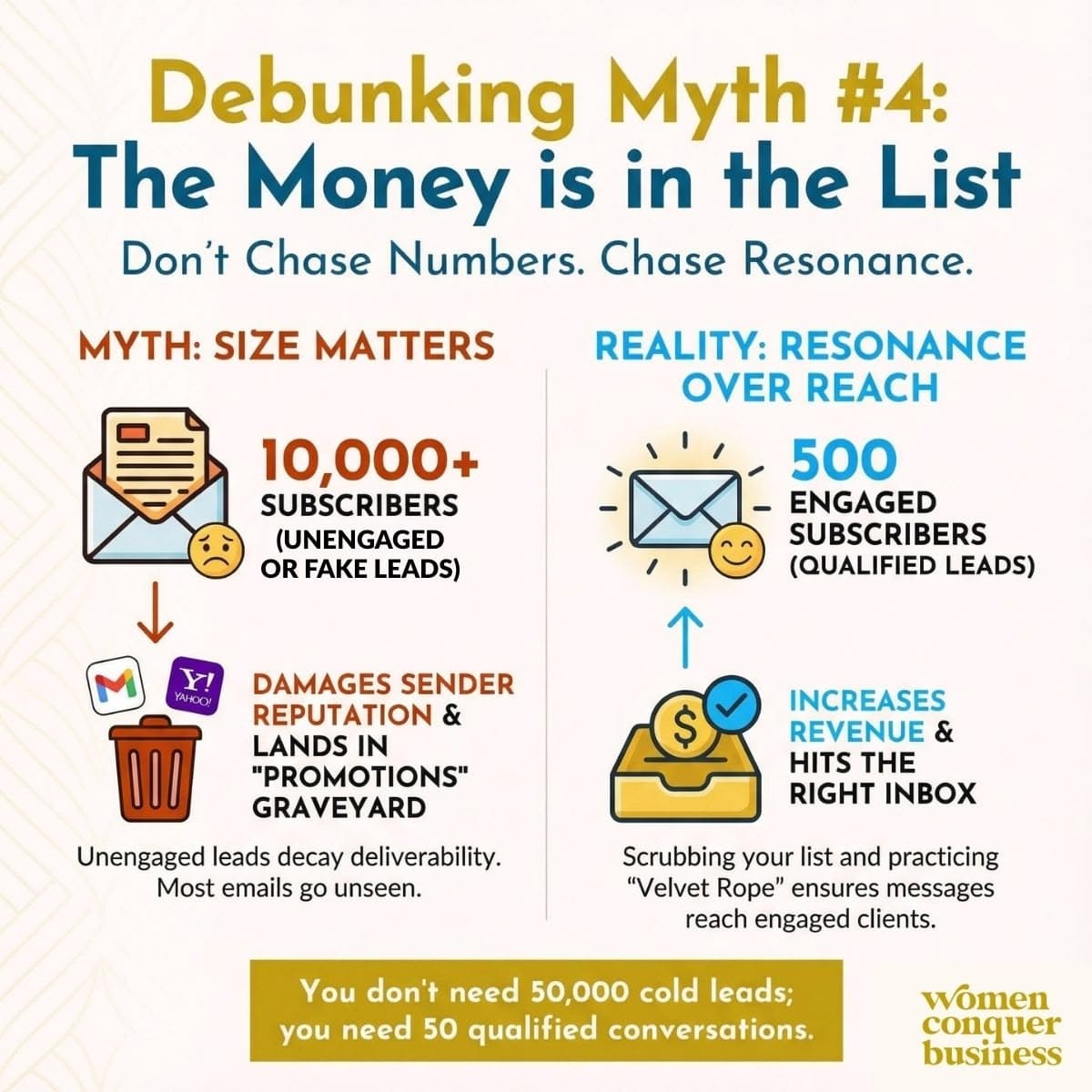
It's a common myth that a list of 10,000 subscribers is inherently superior to a list of 500. Typically, this is technically and strategically false.
If your list is bloated with unengaged leads, you are likely damaging your Sender Reputation. That’s the score Internet service providers like Gmail use to decide if your emails land in the inbox or the "Promotions" graveyard.
Choose Resonance over Reach
Modern email deliverability relies on engagement signals. If thousands of "cold" leads never open your emails, Google and Yahoo see you as a low-quality sender. This decay means your most engaged clients might never see your messages.
For high-ticket consultants and coaches, the goal is resonance, not reach. You don't need 50,000 cold leads; you need 50 qualified conversations.
In real-world implementation, scrubbing your list and practicing the "Velvet Rope" strategy (removing those who don't engage) increases your revenue by ensuring your message hits the right inbox.
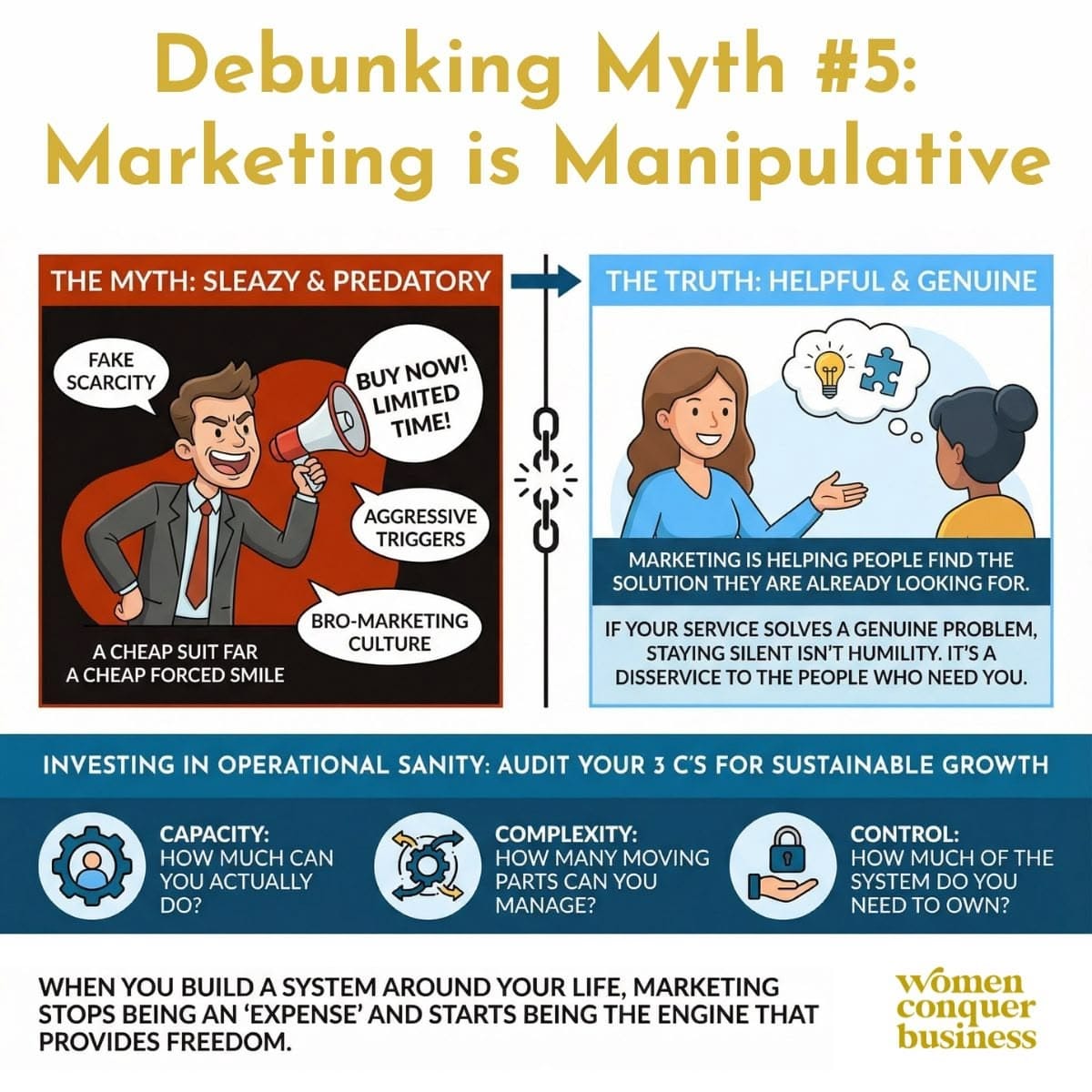
Myth #5: Marketing is Manipulative (or Expensive)
Many women solopreneurs hesitate to promote themselves because they fear appearing "sleazy." This stems from a toxic "bro-marketing" culture that relies on fake scarcity and aggressive psychological triggers.
At Women Conquer Business, we take an anti-predatory marketing stance.
Marketing is simply helping people find the solution they are already looking for. If your service solves a genuine problem, staying silent isn't humility. It’s a disservice to the people who need you.
Investing in Operational Sanity
The "Marketing is expensive" myth usually comes from business owners who have "eaten" thousands of dollars in failed ads or abandoned courses.
The cost of mistakes is almost always higher than the cost of a guide.
Sustainable growth requires an audit of your 3 C's:
- Capacity: how much can you actually do?
- Complexity: how many moving parts can you manage?
- Control: how much of the system do you need to own?
When you build a system around your life, marketing stops being an "expense" and starts being the engine that provides freedom.
How to Stop Buying the Hype
As an established solopreneur, your most valuable asset is your attention. The marketing industry is designed to monetize your FOMO. Every week, a new tool lands in your inbox, promising to be the "one thing."
At Women Conquer Business, we use filters to protect our clients from tactical overwhelm. Before you subscribe to another platform, ask yourself:
If I add this to my plate, does it remove five hours of friction elsewhere? Or does it just add five hours of labor to my week?
If the answer is labor without relief, it’s not a strategy. It’s a distraction.
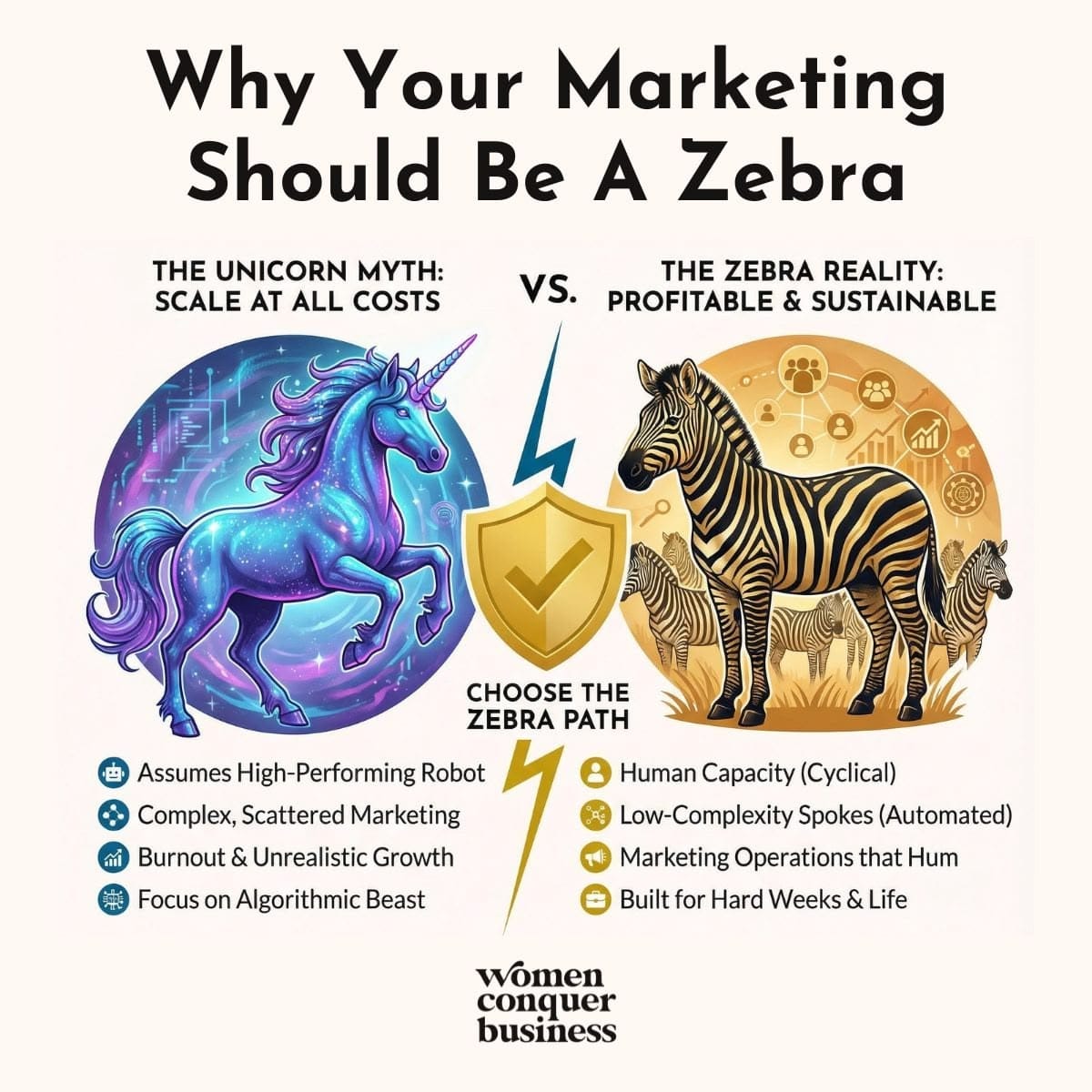
Why Your Marketing Should Be a Zebra
Silicon Valley is obsessed with unicorns (businesses that scale at all costs). But you don't need to be a unicorn. You need to be a zebra. Zebras are real. They are profitable, sustainable, and they exist in a community (a dazzle!) that supports them.
A "Zebra" marketing system is built using hard week planning.
We design your systems to work when you have a migraine, when your kid is sick, or when your ADHD brain simply refuses to cooperate. Most marketing advice assumes you are a high-performing robot.
Hard Week Planning assumes you are a human being with a cyclical capacity.
By building low-complexity spokes in your marketing strategy (like an automated welcome sequence or evergreen content) you ensure your brand remains visible even when you are offline. You move from a state of scattered marketing to marketing operations that hum in the background.
Choosing the Zebra Path
The marketing industry has spent years handing you a map designed for a unicorn, leaving you to wonder why you’re lost in the weeds. We’ve debunked these solopreneur marketing myths because your business shouldn't be a source of structural burnout.
Success isn't about doing more; it’s about doing what works within your life's constraints.
Your first step forward is a radical audit of your 3 C’s: Capacity, Complexity, and Control. Stop feeding the algorithmic beast. Start building systems that survive your hardest weeks.
Whether you need a high-level marketing strategy to untangle your tech knots or the support of a paid community for solopreneurs, remember that you don't have to navigate this alone.
Marketing is a marathon, not a sprint. The goal is an unshakeable foundation that respects your neurodivergence and your time. You deserve a business that hums in the background, leaving you with the energy to lead.
Solopreneur Myths: FAQs
What is the "Human Capital Crisis" in solopreneurship?
It’s the point where a founder's cognitive resources are entirely depleted by trying to manage every operational spoke (marketing, admin, delivery) alone. This exhaustion leads to decision fatigue, which many founders cite as a primary reason for strategic failure. In a service model, your brain is your primary asset; when it's overdrawn, the business becomes a single point of failure. Being solo doesn't mean doing it all.
Why is organic reach on social media so low?
Major platforms have shifted to "Pay-to-Play" models to maximize ad revenue. Facebook's organic reach is now roughly 1.2% to 5.9%, meaning nearly 99% of your followers never see your content. We prioritize "Owned Land" like email and SEO.
What is the difference between a marketing Zebra and a Unicorn?
Unicorns focus on exponential, often unsustainable growth at the expense of profit and founder health. Zebras focus on being profitable, sustainable, and grounded in reality. Zebra systems are built for long-term resilience rather than short-term viral spikes.