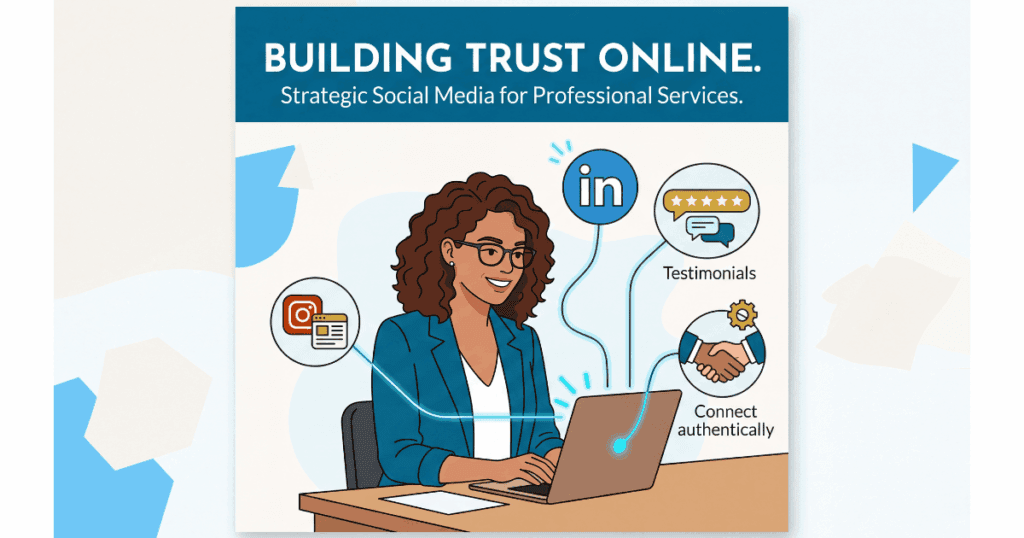
Most of the social media advice out there is written for product brands with marketing teams. Five posts a day. Trending audio. Content pillars. Engagement pods.
You’re a solopreneur running a service business. You don’t have a team. You don’t have four hours a day to spend on Instagram. And the advice that assumes you do? It’s not helping. It’s making you feel behind.
Here’s what I know from working with service-based business owners for over 25 years: the ones who win at social media aren’t the ones posting the most. They’re the ones who picked a lane, stayed consistent, and treated their online presence like an extension of their business, not a second job.
This guide pulls together everything that works for one-person service businesses. Platform strategy, content systems, engagement that doesn’t eat your day, ethical practices that build real trust, and honest math about how much time this takes. No fluff. No “be everywhere” nonsense.
Reading about marketing strategy is one thing. Having someone build it with you is another.
Marketing coaching gives you a dedicated strategist in your corner — someone who knows your business, your budget, and your bandwidth. Together, we’ll turn your ideas into a plan that fits your life.
See How Coaching Works → Not sure yet? Book a free clarity callIf you’re not already asking clients how they found you during your discovery call intake, start now. That one question will tell you more about where to focus than any marketing blog (including this one).
Choosing the Right Platform (Without Spreading Yourself Thin)
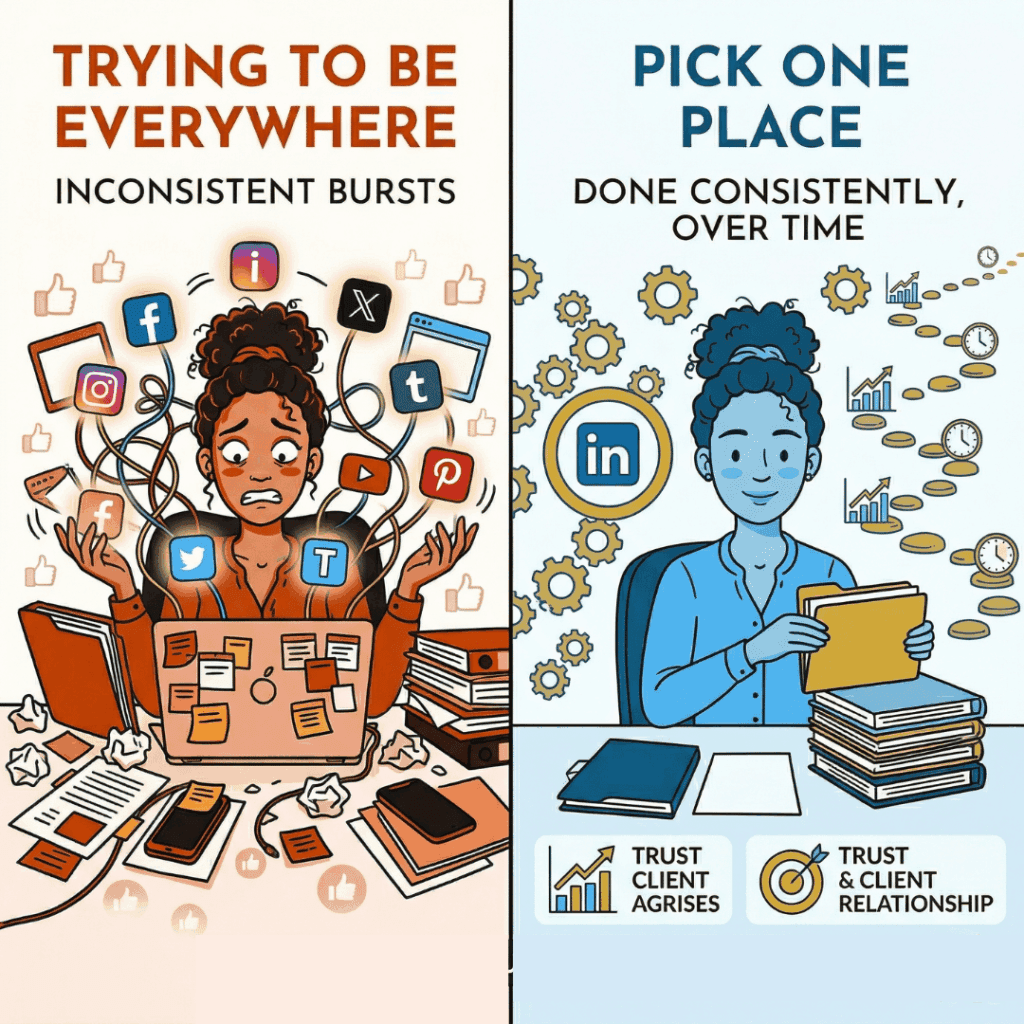
I’ll say it loud for those in the back: it’s NOT about being everywhere.
Focus on one to two platforms. Master those. Expand later if it makes sense. Trying to maintain a presence on five platforms when you’re a team of one is a recipe for mediocre content everywhere and burnout by March.
Two things determine which platform is right for your business. First, where do your ideal clients spend time? Second, what type of content are you willing to create consistently?
That second question is the one nobody talks about. If you don’t like making video, there’s no point in committing to TikTok or YouTube Shorts. It doesn’t matter that video is “where things are going.” You won’t do it. And inconsistent posting is worse than not being on a platform at all.
According to Pew Research Center data, platform use varies significantly by age, gender, income, education, and community type. Not everyone is on every platform, and they’re not on there all the time. The assumption that LinkedIn is where “your people” are because you serve professionals? That might be wrong. The assumption that Instagram is for young consumers? Also potentially wrong.
Here’s how to figure it out without guessing:
- Ask during discovery calls. Add “How did you hear about us?” to your intake process. If clients are finding you through Google or referrals rather than social, that tells you something important about where to invest.
- Check demographics against your audience. If you’re targeting professional women in their 40s and 50s, Facebook and LinkedIn tend to have stronger reach for that group. Targeting creative entrepreneurs? Instagram is still strong.
- Match platform to YOUR content style. You write well but hate video? LinkedIn and Facebook. You’re a natural on camera? Instagram Reels or YouTube. Love quick commentary? X/Bluesky or Threads.
The platform that fits your content style AND reaches your audience is the right one, even if it’s the second or third most popular option overall.
Building a Brand Identity That Converts
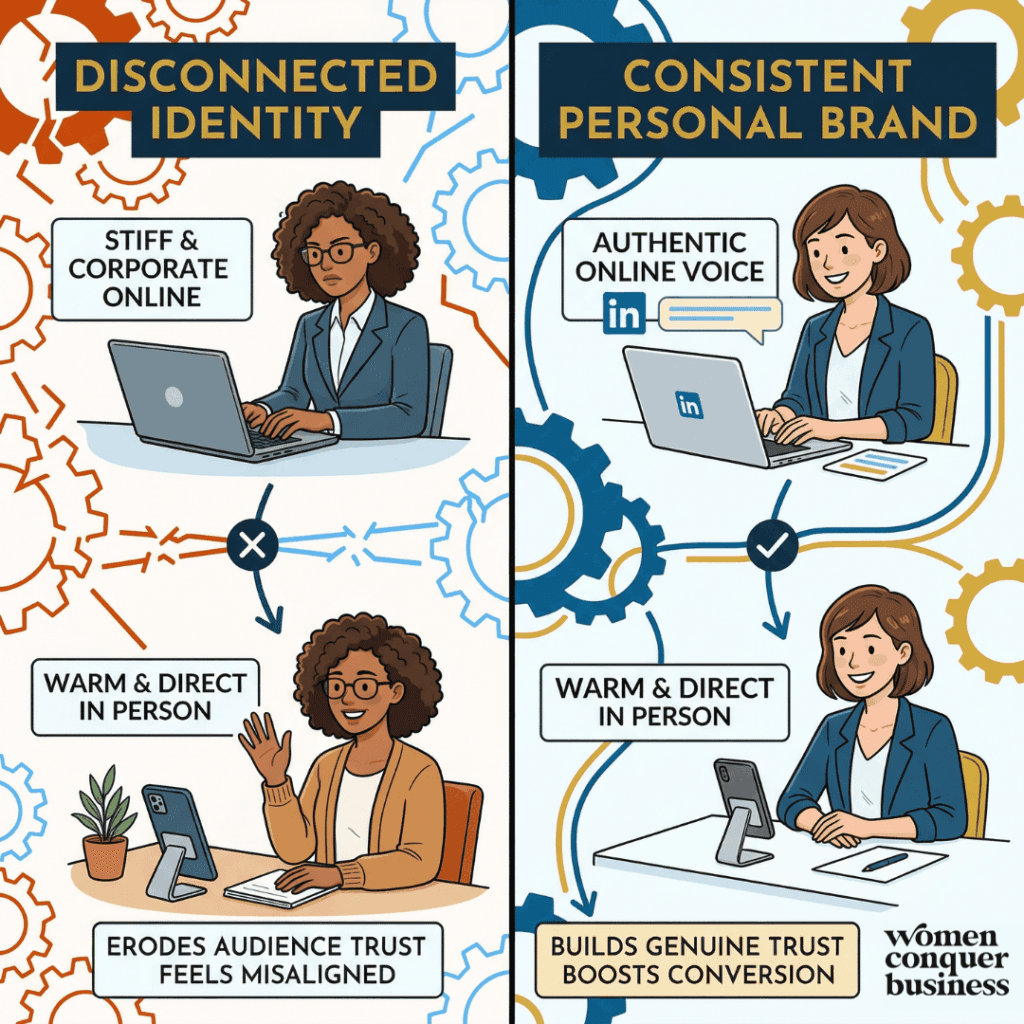
Your brand identity on social media isn’t a logo or a color palette. As a solopreneur, your personal brand IS the business brand. Your audience is buying you: your perspective, your expertise, your way of doing things.
That means consistency matters. Your brand voice should sound the same in a LinkedIn post as it does on a discovery call. If you’re warm and direct in person but stiff and corporate online, there’s a disconnect, and your audience can feel it.
What does consistent brand identity look like in practice?
Show your thinking, not a highlight reel. Share the observations you make in client work (without breaking confidentiality). Post about the patterns you see in your industry. Take a position on something. People follow service providers who have a point of view.
Don’t stop at self-promotion. Your content mix should include testimonials and success stories, industry insights and your take on trends, the things that make you different from everyone else offering a similar service, and behind-the-scenes moments that show how you work. In client work, I’ve found that the posts where someone explains why they do something differently tend to outperform the posts where they announce a new offering.
Your brand identity is built through repetition. Same voice. Same values. Same quality. Week after week. That’s what sticks.
Content Strategy for One-Person Businesses
When I speak to groups about content calendars, I can feel the collective groan. Nobody wants to hear “you need a content plan.” But here’s the thing: content without a plan is noise. Content with a plan is marketing strategy.
The good news? Your content plan doesn’t need to be complicated.
Start with what your clients ask you. Keep a notepad by your desk (physical or digital) and write down every question clients bring up during strategy sessions, discovery calls, or emails. Those questions are your content gold. You’ll never be stuck for ideas again if you’re paying attention to what people need to know.
Consistency beats volume. Posting twice a week on one platform will outperform posting once a day for two weeks and then going silent for a month. Pick a frequency you can maintain when things get busy, because things will get busy.
Use a simple tracking system. One of the cheapest ways to stay organized is Google Sheets’ pre-built content tracker table. It lets you list content types, status, and dates in one place. You can also track content in a scheduling tool like Metricool or SocialBee, but keeping a separate record means you don’t lose everything if you switch platforms.
Don’t box yourself into content formats you hate. Everyone talks about video, but the best social content is the kind you’re willing to make again and again. If your strength is writing and you’ll never sustain a video schedule, write. The right content type for you might run counter to the trends, and that’s fine, as long as it reaches your audience consistently.
About content quality: marketing people love to say “content is king,” but the more accurate version is that quality content, posted consistently, for an audience that needs it is what works. One thoughtful post that answers a real question from your ideal client is worth more than five generic tips posts.
Quick practical note on visuals: you don’t need to be a designer. Canva works for creating graphics, and the visual style that performs best on most platforms is clean and simple, not overproduced. Pay attention to what YOU want to click in your own feed. That’s a good indicator of what resonates.
Engagement: Social Media Is a Conversation, Not a Billboard
You can’t post and dash.
I know that sounds obvious, but I see it constantly. A service provider spends an hour crafting the perfect post, publishes it, and then disappears until the next post is due. Social media rewards conversation, not broadcasting.
Respond to comments. Answer questions. When someone takes the time to engage with your content, respond within a few hours if you can. This sends a clear signal: you’re present, you’re paying attention, and you care about the people following you.
Encourage interaction intentionally. Ask questions in your posts that people can answer quickly. Run a poll. Respond to other people’s content in your niche. Remember, social media isn’t a monologue. The businesses that grow their following fastest are the ones having conversations, not the ones shouting into the void.
On hashtags: use them, but don’t go overboard. A few targeted, industry-relevant hashtags per post will do more for your reach than stuffing 30 tags at the bottom. Research what hashtags your ideal clients follow, and use those.
On micro-influencers: if there are local or niche influencers who align with your brand values and serve a similar audience, a collaboration can expose you to new people. This doesn’t have to mean paid sponsorships. A joint Instagram Live, a shared blog post, or even tagging each other in relevant content can work. Look for people with engaged, smaller followings rather than big numbers with low interaction.
On contests and giveaways: these can boost engagement, but only if the prize is relevant to your business and attracts the right people. Giving away an iPad attracts everyone. Giving away a 30-minute strategy session attracts potential clients. If you want to try this, King Sumo ($49 one-time) is an affordable starting point for creating simple contests.
Ethical Social Media Practices That Build Real Trust
Here’s where most social media advice falls short. Everyone tells you what to post and when to post, but almost nobody talks about how to show up ethically, especially when the pressure to grow fast can make shortcuts tempting.
This matters. According to Label Insight’s Transparency ROI Study, 94% of consumers are more likely to stay loyal to a brand that offers complete transparency, and 73% would pay more for products from brands that provide it. Separately, Stackla’s Consumer Content Report found that 86% of consumers say authenticity is important when deciding which brands they support. For a service business where the relationship IS the product, trust is your most valuable asset.
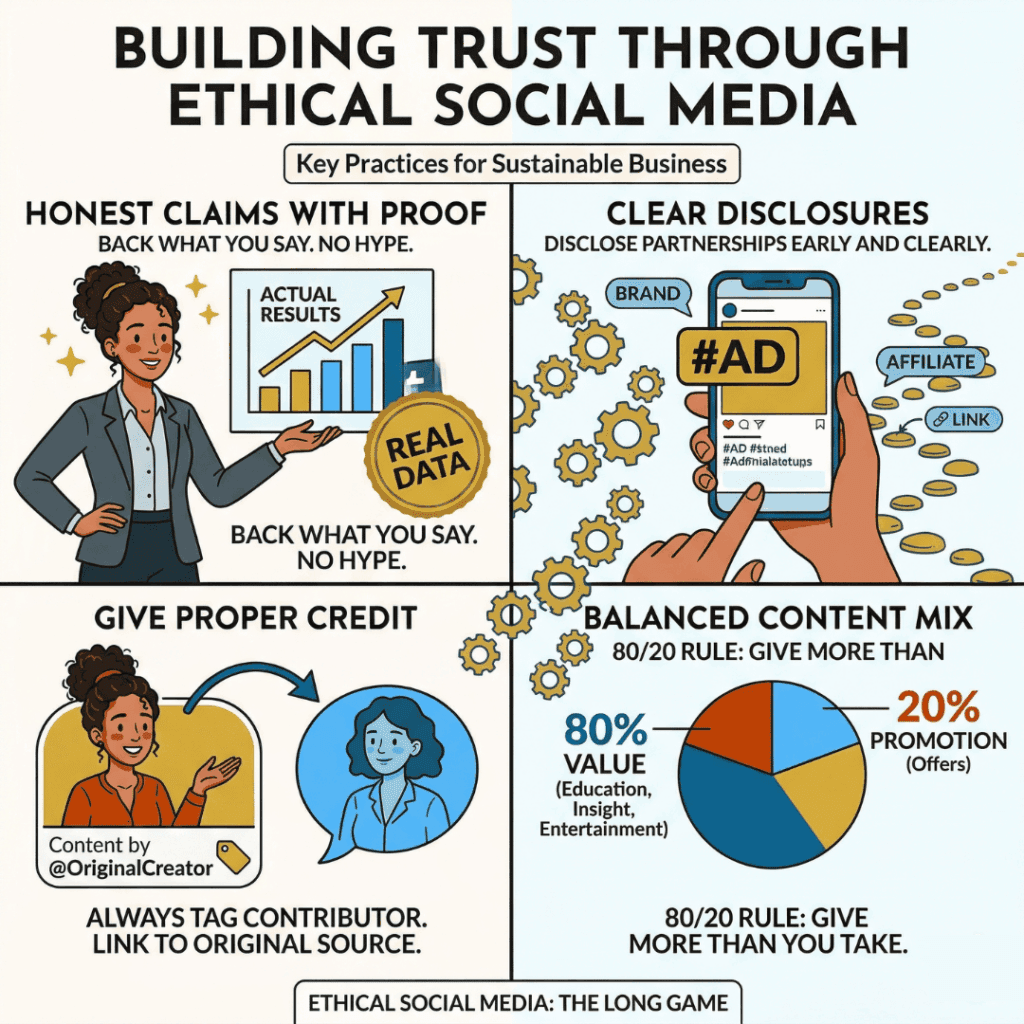
Be honest in your claims. Back up what you say with real results and data, not hype. If you’re highlighting time savings or client outcomes, use actual examples (with permission). Misleading claims, even small ones, erode trust faster than you can build it. Remember the TurboTax “free” filing controversy and Red Bull’s overstated performance claims. Both led to significant financial consequences. Your business can’t absorb a hit like that.
Disclose partnerships and affiliates clearly. FTC Endorsement Guides (revised 2023) require you to disclose financial relationships with brands, whether that’s affiliate links, sponsored content, or gifted products. Don’t bury the disclosure in a wall of hashtags. Use clear language like “This post contains affiliate links” or “#ad” at the beginning of your tag list, not the end. According to a survey of over 1,100 marketers, 94% agree that transparency and authenticity are key to influencer marketing success. Transparency doesn’t hurt your engagement. Hiding sponsorships does.
Give proper credit for content. When you share someone else’s work, tag them. On Instagram, mention contributors in the caption and tags. On Pinterest, link back to the original source. Under 17 U.S.C. § 504, copyright statutory damages range from $750 to $30,000 per work infringed (up to $150,000 if willful), even when the oversight is unintentional.
Balance your content mix. Constant promotion drives followers away. The 80/20 rule is a good baseline: 80% of your content provides value (education, insight, entertainment) and 20% promotes your offers. Some people prefer the 5-3-2 rule (five curated pieces, three original, two personal). The specific ratio matters less than the principle: give more than you take.
Protect your audience’s data. If you collect email addresses, run ads, or use tracking pixels, you need to understand your obligations under GDPR (if you serve anyone in Europe) and CCPA (for California residents). Non-compliance isn’t abstract. GDPR penalties can reach up to 4% of annual revenue or 20 million euros. CCPA fines run $2,500 per unintentional violation and $7,500 per intentional violation, with no cap on the total. Review what data you collect, where you store it, who has access, and make it easy for people to opt out.
Check facts before you share. Misinformation spreads fast on social media, and sharing inaccurate information, even unintentionally, damages your credibility. Before sharing statistics, news, or claims from other accounts, verify the source. If you make a mistake, correct it quickly and directly.
Create basic ethical guidelines for yourself. Even as a solo operation, writing down your principles helps. What will you post about and what won’t you touch? How will you handle negative comments? What’s your response time commitment? Having these answers before you need them prevents reactive decisions you’ll regret.
Ethics aren’t a burden on your social media strategy. They’re the foundation. In a market full of performative marketing and inflated claims, being the person who tells the truth is a competitive advantage.
Measuring What Matters
Engagement rates are the heartbeat of your social media presence: likes, shares, comments, saves, and mentions. A high engagement rate means your content resonates. A low one means something needs to change, either the content, the timing, or the platform.
Use tools like Google Analytics or Google Looker Studio to track whether your social media posts are driving traffic to your website. Every visit is a potential client stepping into your digital storefront.
But here’s the question that matters most: how many social media followers are converting into clients? If you have 5,000 followers and no one is booking calls, your follower count is a vanity metric. Track conversion rates, not applause metrics.
Growing your audience does matter, but quality over quantity. Like during my softball days, swinging for a well-placed hit was often more rewarding than swinging for the fences. A smaller, engaged audience of people who match your ideal client profile is worth more than a large, disengaged following.
Revenue is the metric that matters most. If social media isn’t contributing to revenue, directly or indirectly, something in your strategy needs to shift.
Managing Your Time (The Solopreneur Reality Check)
Let’s be real about the time commitment. When you’re starting out with social media marketing, expect to invest about 10 to 12 hours per week: creating content, engaging, scheduling, and checking analytics.
That’s a lot. Almost half a day every week.
But it gets more efficient. As you build templates, develop a content rhythm, figure out what works, and establish a scheduling routine, the time drops. Batch-creating content on one day (say, Monday mornings) and scheduling it out for the week is far more efficient than creating on the fly every day.
Tools that help:
- Metricool is one of the easiest social media schedulers that also gives you analytics across platforms and even ads/website performance.
- SocialBee handles scheduling and content categories well.
- Meta Business Suite is free if you’re focused on Facebook and Instagram.
On budget: You don’t need a big marketing budget for effective social media. Creativity and consistency matter more than spending. I’ve seen businesses with significant budgets fall flat because they lacked those two things, and businesses with almost no budget succeed because they showed up regularly with content that mattered to their audience.
The tension for solopreneurs is real: social media takes time away from client work, which is the work that pays the bills. If social media is consistently pulling you away from revenue-generating activities, it’s worth considering whether you need marketing coaching or a virtual assistant to take some of the load off. Get help before social media becomes the thing you resent instead of the thing that grows your business.
And here’s a perspective most marketers won’t give you: social media is rented land. You don’t own your follower list. Algorithms change. Platforms disappear. The smartest social media strategy always points people toward assets you own, your email list, your website, your community. Social is the megaphone. Your owned channels are the house.
One Platform, Done Consistently, Over Time
Patience and persistence. That’s the whole strategy underneath the tactics.
You’re not selling a product with a one-click purchase. You’re building trust with people who will eventually hire you for something that requires a relationship. That takes time. Social media done well is a long game, and the solopreneurs who succeed at it are the ones who stopped trying to be everywhere, picked one place, and kept showing up.
Start where your clients are. Post what you can sustain. Respond when people talk to you. Tell the truth. Track what matters.
That’s the whole playbook.
Ready to stop reading about strategy and start building yours?
Marketing coaching gives you a dedicated strategist in your corner — someone who knows your business, your budget, and your bandwidth. Together, we’ll turn your ideas into a plan that fits your life.
See How Coaching Works → Not sure yet? Book a free clarity callGet the Free Solopreneur Marketing Audit Worksheet
Rate your marketing across 5 key areas in under 10 minutes. Your scores reveal exactly where to focus first, so you stop spreading yourself thin.
No spam. Unsubscribe anytime. We respect your inbox.