Most Businesses Don’t Plan Their Content (and It Shows)
Here’s a stat that should make you feel better about your own marketing: only 40% of B2B marketers have a documented content marketing strategy. That means the majority are winging it. Not a loose plan. Not a “we’ll figure it out” plan. No documented plan.
And the ones who do create content without a plan? They end up staring at a blank social feed on Tuesday afternoon, scrambling for something to post, wondering why this whole “content marketing” thing feels like a second full-time job.
The problem isn’t effort. Most solopreneurs work hard on their content. The problem is that effort without a system is exhausting and produces inconsistent results. You post for two weeks, life happens, you go quiet for a month, then feel guilty about it. Sound familiar?
Content batching fixes this. Not because it’s a productivity trick. Because it’s a system that separates the thinking from the doing, so you’re not trying to be strategic and creative at the same time. In client work, this is one of the first things we address with marketing coaching clients, because random posting isn’t marketing strategy. It’s noise.
What Is Content Batching (and Why It Works)
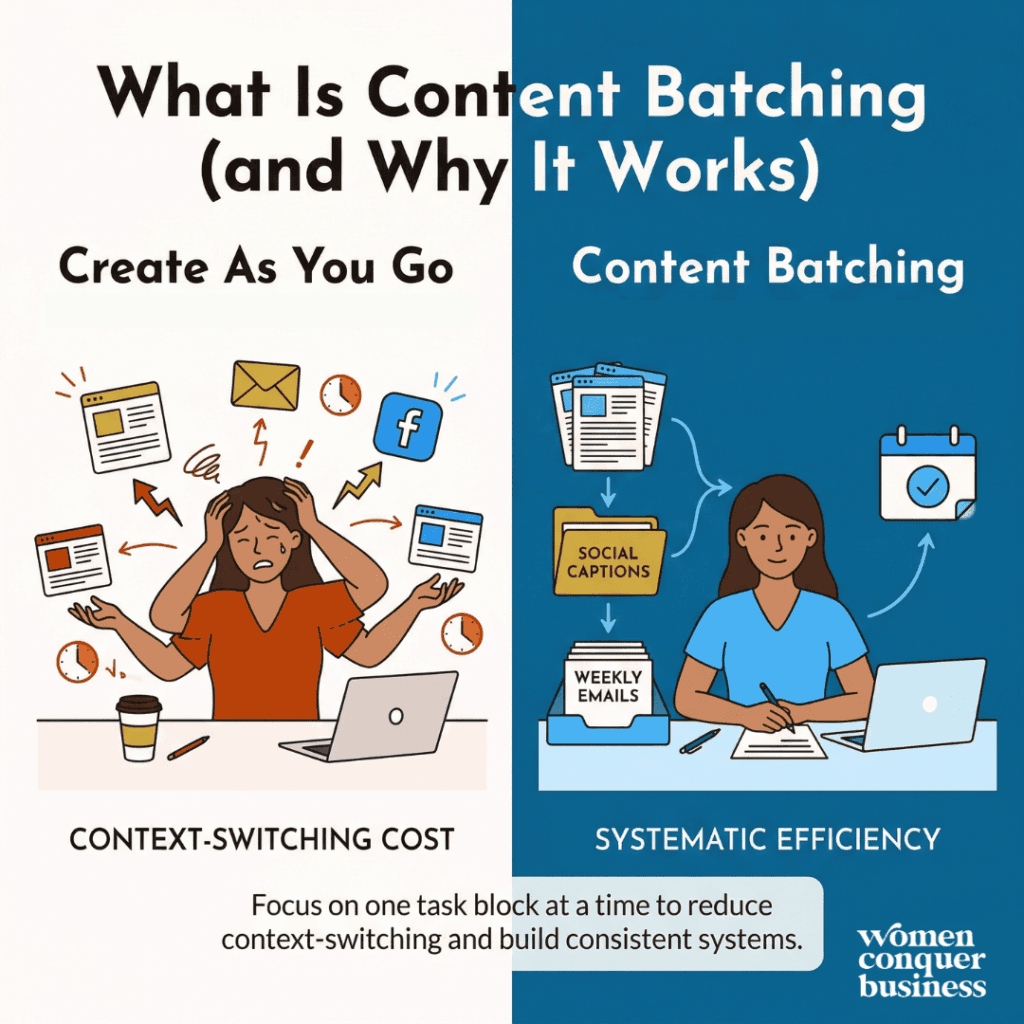
Content batching means grouping similar tasks and completing them in dedicated time blocks. Instead of writing one blog post on Monday, one social caption on Tuesday, and one email on Wednesday, you write all your blog posts in one sitting, all your captions in another, and all your emails in a third.
Reading about marketing strategy is one thing. Having someone build it with you is another.
Marketing coaching gives you a dedicated strategist in your corner — someone who knows your business, your budget, and your bandwidth. Together, we’ll turn your ideas into a plan that fits your life.
See How Coaching Works → Not sure yet? Book a free clarity callWhy does this work better than the “create as you go” approach? Two reasons.
Context-switching is expensive. Every time you shift from writing a blog post to designing a graphic to answering emails, your brain needs 15 to 25 minutes to fully re-engage with the new task. If you switch tasks ten times a day, you’re losing hours to mental startup costs. Batching keeps you in one mode at a time.
Consistency comes from systems, not willpower. You don’t need to feel inspired on the day a post is due. You already created it. It’s scheduled. That reliability is what algorithms reward and what your audience learns to expect.
Here’s the catch. Batching only works if the content you’re batching is tied to a goal. Creating 20 social posts in one sitting feels productive, but if those posts aren’t connected to your offers, your content pillars, or your audience’s needs, you’ve spent a lot of time on content that won’t move the needle.
Make it worthwhile.
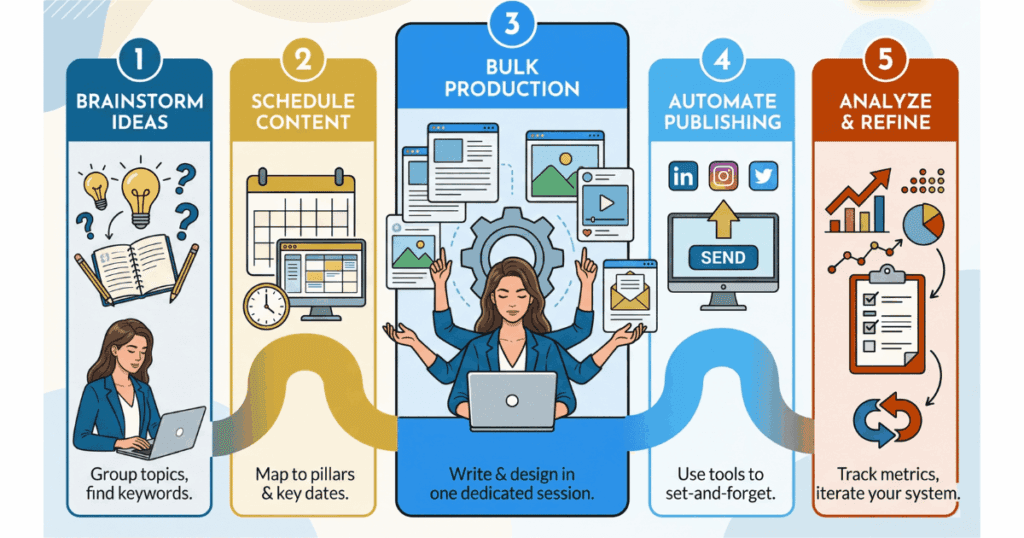
The Content Batching Process
Start with a clear marketing strategy that connects your content to your business goals. Skip this step and you’ll batch efficiently toward nothing.
Planning: What Goes Where
Think about your content pillars first. These are the broad themes your business talks about, such as your core services, educational topics, behind-the-scenes, and promotional content. Different types of content map to different stages of the funnel:
| Planning Phase | Key Activities | Expected Outcome |
|---|---|---|
| Goal Setting | Define what success looks like (leads, sales, traffic, email signups) | Clear metrics to track |
| Audience Research | Identify what your people ask about and struggle with | Content topics that resonate |
| Message Development | Decide your core themes and key talking points | Consistent brand voice |
| Format Selection | Pick primary content types (blog, social, email, video) | Focused creation plan |
A quick note about the funnel: case studies build consideration. Educational content builds awareness. Fun, relatable content builds trust. Promotions drive transactions. All of it matters, but you don’t need to do all of it at once.
Don’t feel like you have to do everything. Having an awareness of where each piece fits helps your batching strategy without adding overwhelm.
The 2-2-2 Method for Using AI in Your Batching
AI tools can speed up your process when used as assistants, not authors. One approach that works well:
- Initial Creation (2 minutes): Write down your main idea and a few supporting points. Don’t edit. Don’t overthink.
- AI Enhancement (2 minutes): Feed your outline into a tool like ChatGPT to expand the draft and generate variations.
- Human Polish (2 minutes): Rewrite the AI output in your voice. Add your experience. Remove anything that sounds generic.
The AI does the heavy lifting on structure. You bring the perspective and personality. That’s the part your audience cares about, and the part AI can’t replicate.
Organize by Content Format
Batching by content type keeps you in the same creative headspace. Business coach Anna Byang emphasizes that dedicating specific time blocks to each format improves focus and output quality.
Group your work into categories like these:
- Primary Content: Blog posts, podcast episodes, or videos. These are your anchor pieces.
- Social Media: Repurpose primary content into platform-specific posts. Pull quotes, create short clips, summarize key points.
- Visual Content: Design graphics, create video thumbnails, or batch photography.
- Email Content: Newsletters, promotional sequences, welcome emails.
The order matters. Create your primary content first, then repurpose it into smaller formats. One blog post can become four or five social posts, an email newsletter, and a quote graphic. That’s working smarter, not harder.
How to Batch Seasonal and Quarterly Content
Your content doesn’t exist in a vacuum. It lives in a calendar alongside holidays, industry events, business cycles, and the rhythms your audience follows throughout the year.
Planning seasonal content in advance keeps you from scrambling to create a Black Friday post the week of Thanksgiving or missing your industry’s biggest awareness month.
Identifying Key Seasonal Events
Map out dates that matter to your business. Skip the ones that don’t.
- Federal holidays and cultural celebrations: New Year’s Day, Black History Month, Pride Month, whatever resonates with your audience and your values
- Shopping events: Black Friday, Cyber Monday, Small Business Saturday
- Business cycles: Tax season (January through April), fiscal year transitions, budget planning season (October through December)
- Industry-specific events: Conferences, trade shows, National Small Business Week in May
- Personal seasonal rhythms: Some clients build content around seasons, school calendars, or (for one creative client) moon cycles. Base it on what makes sense for your business and your audience.
Lead Time: When to Start Creating
Seasonal content needs advance work. Here’s a realistic timeline:
| Content Type | Lead Time | Example |
|---|---|---|
| Major Holidays | 6 to 8 weeks | Start Halloween content in mid-September |
| Shopping Events | 8 to 12 weeks | Launch holiday gift guides by early October |
| Business Planning | 4 to 6 weeks | Post year-end reviews starting mid-November |
| Industry Events | 3 to 4 weeks | Publish conference previews by late August |
Content Clusters Around Seasonal Events
Group related content pieces around a single seasonal event. For the December holidays, you could create:
- Gift guides tailored to your niche
- Year-end business reflection templates
- New Year planning frameworks
- A seasonal email campaign tied to your offers
This approach gives you a cohesive message across platforms instead of disconnected one-off posts.
SMART Goals for Seasonal Campaigns
Apply the SMART framework to each seasonal push:
| Component | Description | Example |
|---|---|---|
| Specific | Clear, focused outcome | Increase views on holiday gift guide page |
| Measurable | Quantifiable target | Reach 5,000 page views in December |
| Achievable | Realistic given your capacity | Based on current traffic of 2,000 views |
| Relevant | Connected to business goals | Supports Q4 product sales |
| Time-bound | Has a deadline | December 1 through 31 |
Without goals, seasonal content is decoration. With goals, it’s strategy.
Tools for Content Batching
You don’t need a dozen apps. You need one planning tool, one AI tool, and one scheduling tool. Pick from each category and start.
Planning and Scheduling
| Tool | Best For | Starting Price |
|---|---|---|
| Trello | Visual organization with Kanban boards | Free |
| Notion | Content databases and templates | Free |
| Buffer | Multi-platform social scheduling | $5/month |
| Metricool | Social analytics and team scheduling | $20/month |
Many solopreneurs combine Notion for planning with Buffer or Metricool for scheduling. Start with one from each category.
AI Content Tools
- Claude: Expand outlines, brainstorm topic angles, draft variations. Always review and rewrite in your voice.
- Canva: Design social graphics, video thumbnails, and infographics using templates.
- Descript: Edit video and audio, create transcripts, repurpose long-form content into clips.
Content Management
Use your website’s built-in CMS (WordPress, Squarespace, Ghost) to schedule blog posts in advance. Most CMS platforms let you set future publish dates, which means you can write three blog posts in one sitting and have them release over three weeks.
Building Your Batching System
Set Up Your Content Calendar
Your calendar needs four columns at minimum: what you’re posting, where it goes, when it publishes, and what stage it’s in (planning, in progress, review, done).
| Content Element | What to Include | Update Frequency |
|---|---|---|
| Topic Clusters | Main themes and subtopics (content pillars) | Monthly |
| Content Types | Blog posts, social updates, emails, videos | Weekly |
| Publishing Schedule | Dates and platforms | Weekly |
| Status Tracking | Planning, In Progress, Review, Done | Daily |
Batching at Scale: Brendan Burchard
Here’s what batching looks like at scale. Business coach Brendan Burchard creates four videos on one day each month. That single production day generates: videos for YouTube, audio for podcasts, transcripts for blog posts, blog summaries for email newsletters, and video clips for social media.
One day. Four videos. Months of content across multiple platforms.
(Note: Burchard has a team, so don’t feel like you need to start this aggressively to be successful. Batching is a productivity tool, not a pressure cooker.)
Time Blocking for Content Creation
The simplest way to batch: block 2 to 3 hours on your calendar during your most productive time of day. Protect that block like a client meeting.
- Use your peak energy hours for heavy creation (writing, recording)
- Group similar tasks in one block (all captions together, all graphics together)
- Separate creation from editing. Batch your edits in a different session.
This approach reduces task-switching and helps you stay in a creative flow instead of bouncing between writing, designing, and scheduling all in one chaotic afternoon.
Track Results and Improve
Batching doesn’t work if you never look at what’s performing. Set aside 30 minutes per month to review.
What to Track
| Metric | What It Tells You |
|---|---|
| Engagement rates | Which content your audience responds to |
| Conversion rates | Which content drives leads or sales |
| Time saved | Whether batching is improving your efficiency |
| Seasonal patterns | When engagement peaks around specific events |
| Content format performance | Which formats (video, blog, social) work best for you |
Making Adjustments
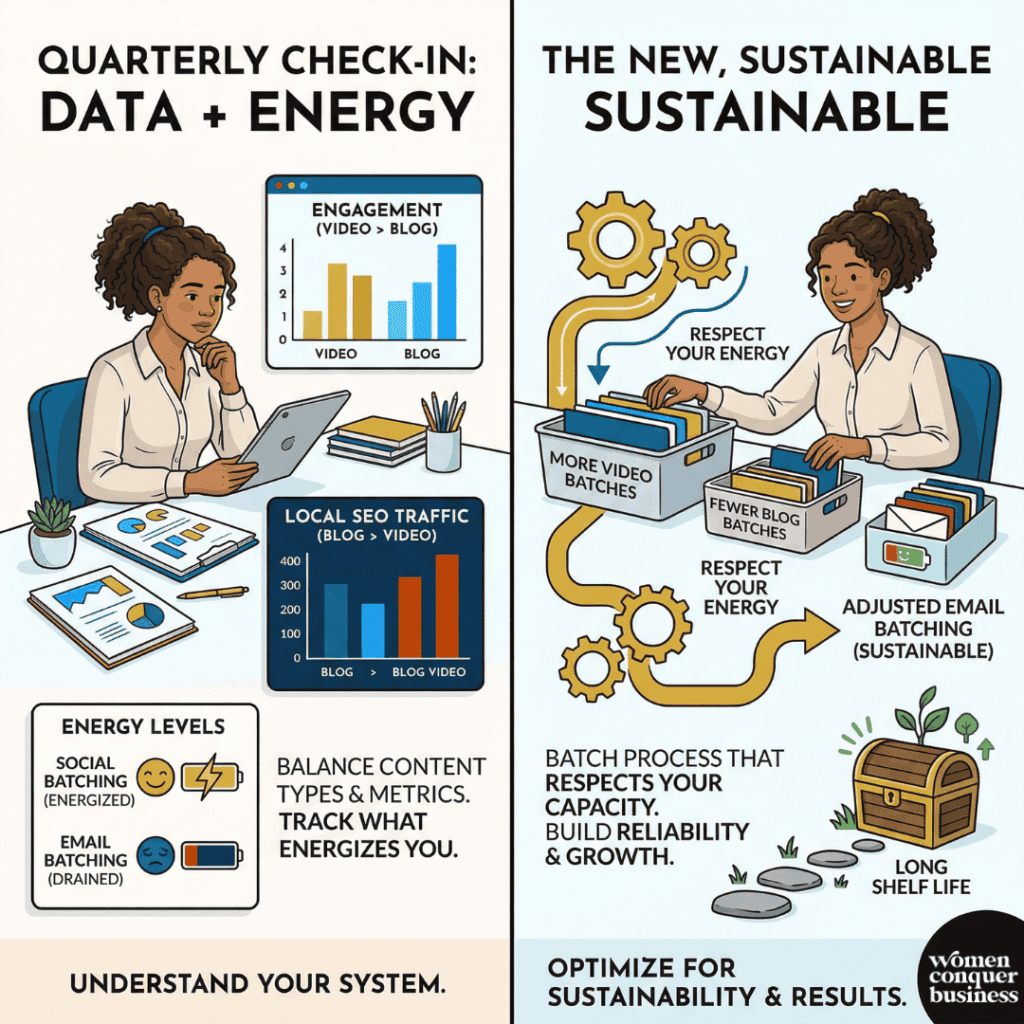
Look at your data quarterly. If video consistently outperforms blog posts for engagement but blog posts drive more local SEO traffic, that’s useful information. You might batch fewer blog posts and more videos, or you might double down on blog posts because organic traffic has a longer shelf life.
It’s also worth tracking how you feel. If batching social media posts energizes you but batching emails drains you, adjust your system. You’re more likely to stick with a process that respects your energy.
Frequently Asked Questions
How do I know which type of content to batch first?
Start with whatever takes the most time or causes the most stress. For most solopreneurs, that’s social media posts or email newsletters because they happen so frequently.
Still not sure? Ask yourself: what content supports your most important business goal right now (leads, sales, visibility)? Start there. Batch one thing, get the win, and build from that success.
How far in advance should I plan seasonal content?
For major holidays and shopping events, 8 to 12 weeks of lead time is ideal. For business-cycle content (tax season, year-end planning), 4 to 6 weeks works. Industry events need 3 to 4 weeks. Start with whatever is closest on the calendar and work backward.
I’ve batched some content. Now how do I stay consistent?
Three things:
- Use a content calendar. Whether it’s Notion, Trello, or a printed planner, your calendar is your visibility plan in action.
- Schedule your content ahead of time. Tools like Buffer or Metricool make batching pay off by automating the publishing.
- Review monthly. Look at engagement, conversions, and how you feel. If batching is reducing your stress, you’re doing it right.
Batching isn’t a one-time miracle. It’s a system that gets easier and better every time you use it.
Can I use AI for all my content batching?
AI is a useful tool for brainstorming, outlining, and creating first drafts. It’s not a replacement for your voice, your experience, or your point of view. Use AI to speed up the parts that slow you down (outlining, rephrasing, format variations) and spend your time on the parts that matter most (your perspective, your stories, your expertise).
What if I can’t batch a full month of content at once?
Then don’t. Batch a week at a time. Or batch by format: write all your social captions for two weeks in one sitting, then batch your emails another day. The goal is to reduce daily scrambling, not to create some perfect month-long content library on day one. Start where you are.
Your Next Step
Pick one content type. Block two hours on your calendar this week. Batch it.
That’s it. You don’t need the perfect tool, the perfect plan, or the perfect afternoon. You need to start, see how it feels, and adjust from there.
If you want help building a content system that fits your business and your capacity, Women Conquer Business offers a Strategic Marketing Membership with templates, workflows, and coaching designed for solopreneurs who want clarity without the hustle. Or reach out for marketing coaching if you need a more tailored approach.
One batch at a time.
Ready to stop reading about strategy and start building yours?
Marketing coaching gives you a dedicated strategist in your corner — someone who knows your business, your budget, and your bandwidth. Together, we’ll turn your ideas into a plan that fits your life.
See How Coaching Works → Not sure yet? Book a free clarity callGet the Free Solopreneur Marketing Audit Worksheet
Rate your marketing across 5 key areas in under 10 minutes. Your scores reveal exactly where to focus first, so you stop spreading yourself thin.
No spam. Unsubscribe anytime. We respect your inbox.