
Open your inbox. Odds are an SEO pitch (or two) is waiting. Probably a “Your Google Business Profile needs verification” message on your phone, too.
“We found errors on your site.” Delete. Two days later, “optimize for first page in 30 days.” Delete.
Knowing what to do for SEO and having time to do it are two different things.
If you’re a service business owner who’d rather spend time serving clients than optimizing Google listings, that’s exactly what local SEO services are for. We handle the technical work — you get found by the right people in your area.
Explore Local SEO Services → Or book a free 30-min clarity call first →My inbox gets these too. So does Google’s. In its 2026 SEO hiring guide Google admits, “Amazingly, we get these spam emails too.”
Let’s be honest about what happens after you hit delete. Your gut says the pitch is shady, and your gut is right. Still, a small worry hangs around. If you ignore every one of these, are you falling behind on something important?
Don’t worry, you’re not. Ethical SEO practices are the alternative, and it’s a lot simpler than anything in your inbox. Make your good work easy for the right people to find, then stay with it long enough for it to count.
So yeah, keep deleting. The SEO worth keeping is small enough to fit around a full client calendar, and none of it starts with a cold email.
What to delete: the pitches that sell rented results
Delete any pitch that sells you a result instead of explaining the work.
The truth is, some of these black hat tactics do move rankings for a while. What you’re paying for is rented and short-lived, with a cleanup bill when Google’s algorithm catches up. Google’s spam policies, updated in 2026, put it plainly: “Sites that violate our policies may rank lower in results or not appear in results at all.”
I’ve been calling out sleazy online marketing since my ClickFunnels review. SEO pitches run on the same fuel: manufactured urgency and a promise nobody can keep.
Black hat promises of page one
Nobody can deliver this. Google’s hiring guide even says “No one can guarantee a #1 ranking on Google.”
SEO agencies who promise page one tells you one of two things:
- They don’t understand how search works, or
- They’re counting on you not to.
Link packages
Hundreds of backlinks (links back to your website) for one low price sounds like a deal. But…. Google calls it link spam, which it defines as “creating links to or from a site primarily for the purpose of manipulating search rankings.” Buying links and excessive link swaps are both on the list by name.
AI content mills
These pitches promise a steady stream of blog posts using your keywords, written fast and priced low. Google’s spam policies call this scaled content abuse, including “Using generative AI tools or other similar tools to generate many pages without adding value for users.”
The policy is about volume without value, whether it’s created with AI or not. The most important thing here is adding value: as an ethical business owner, you always want to add to the conversation.
Fake audits and fake Google calls
“We found errors on your site” is a sales script disguised as a diagnosis. A real audit, per Google’s hiring guide, gives you “realistic estimates of improvement, and an estimate of the work involved.”
The phone version is worse. In 2018, the FTC halted robocalls that warned small business owners Google would mark them “permanently closed” unless they pressed one to reach a “Google specialist.” The upsell was $949.99 for promised top placement, plus monthly fees. Google’s own help pages say it will never ask for payment information over the phone.
If you get these calls, hang up.
SEO Consulting: What to decline, and one question to ask
Some pitches come from real people, and a few will sound reasonable. Decide your no list before the call. Here’s the one I give clients:
- Any promise of page one, however it’s worded.
- Owner or Full access to your Search Console for someone you haven’t hired. Google’s hiring guide says to “only grant read access to Search Console (at this stage, don’t grant them write access).” In practice, add them as a Restricted user and keep Owner for yourself.
- Bought links or link swaps, however they’re packaged.
- Long locked-in contracts (but you do need to give SEO 3-6 months to work).
- Reports you can’t open.
I covered more warning signs, including the newer AI visibility pitches, in my guide to AI SEO for consulting businesses.
Now for the question. Ask every SEO who makes it past your no list: “What will change on my site, and when can I see it?”
A good answer names pages or listings and tells you where to look.
Google’s own hiring checklist asks nearly the same thing: will the SEO “share with me all the changes you make to my site”?
If they get cagey, end the call.
Ethical SEO: what to keep doing
Keep the basics accurate and keep showing up. In client work, DIY owners spend 2-6 hours a month on SEO, but those hours need to go to the right places.
Start with your Google Business Profile. According to Google Business Profile Help, “Businesses with complete and accurate info are more likely to show up in local search results.” Your hours, phone, address, and services should match your website.
If you’re cramped for time, do this one thing: check that your listing is accurate and answer any new reviews.
Then head over to your website. Review your About page: does it say who you are and who you serve, in the words your customers use? In my training sessions, I tell business owners that websites are a treasure map, not a scavenger hunt. Look at each page. Are you leading the web visitor to the most important action (the treasure)?
Then, add one useful page at a time, built around a question clients ask you on calls. Ask happy clients for reviews (no discounts, no swaps), and reply to the ones you get.
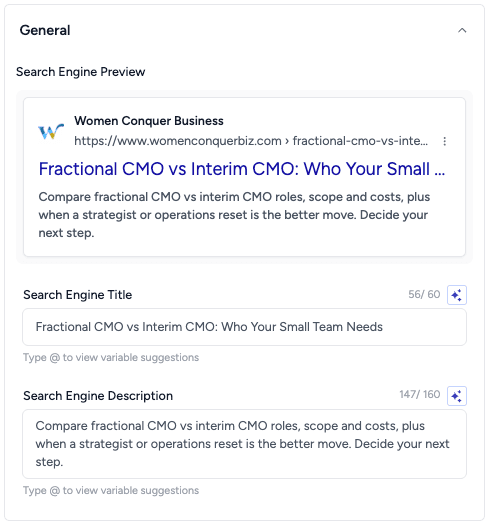
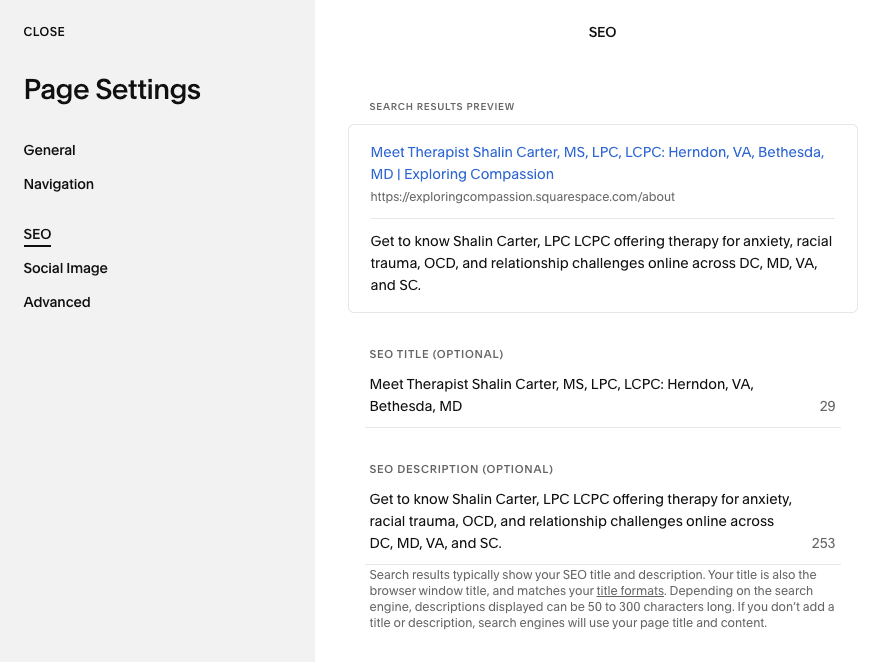
Use your SEO plugin (e.g., Yoast, RankMath), or the SEO title and description fields in your Squarespace or Wix account. Be sure to link to other useful, related pages.
You can make fewer moves, consistently, and SEO stays one piece of a marketing strategy you can sustain. Read the step-by-step guide: SEO and AI visibility guide.
Search Engine Optimization: When to ask for help
Ask for help when the work keeps slipping, or when you’re about to redesign your site. Google’s hiring guide calls a redesign “a great time to hire,” and adds, “the earlier, the better.”
The same guide says that if you run a small local business, “you can probably do much of the work yourself.” That’s true. But “can” and “will, every month, during your busiest season” are different things. Plenty of owners know what to do and still want someone else to own it.
There are also some technical SEO services like structured data and link-building strategies (PR, guest blogs, podcast guesting) that may be more effective when handled by a consultant.
If you don’t know what Google Analytics and Google Search Console are, then you might need someone to help you get those set up and connected to your site. It’s not particularly technical, but it all depends on what you want to learn and do yourself.
So, should you answer any of these emails?
You can delete the cold pitches without guilt. There are also a lot of bros out there pushing AI SEO, GEO (generative engine optimization), and other AI-specific tactics. At this time, Google says that white hat, ethical SEO is synonymous with AI SEO.
Besides, as of this writing (October 2026) traditional search is still growing quicker than AI search, and it’s higher-converting. That doesn’t mean it’s not something to think about, but your number one priority is to build trust with with good, helpful content that answers customer questions.
If you’re ready for local SEO help, book a Free Clarity Call.
Frequently Asked Questions
Can anyone guarantee a first-page ranking on Google?
No. Google’s hiring guide says, “No one can guarantee a #1 ranking on Google.” For local results, Google Business Profile Help says, “There’s no way to request or pay for a better local ranking on Google.” Anyone promising page one or a top spot on the map is selling something Google says can’t be bought.
Is using AI to write SEO content unethical?
Not by itself. Google’s 2026 generative AI guidance says AI “can be particularly useful when researching a topic, and to add structure to original content.” The line is volume without value. The same page warns that using AI “to generate many pages without adding value for users may violate Google’s spam policy on scaled content abuse.” It also says to fact-check and review everything before publishing.
Is link building sleazy?
Buying links to manipulate rankings is sleazy, and it’s spam by Google’s definition. Earned links are a different thing. Google’s spam policies say paid links are fine for advertising and sponsorship as long as they’re marked with a rel=”nofollow” or rel=”sponsored” attribute. What crosses the line is creating links “primarily for the purpose of manipulating search rankings.” Earned mentions come from being worth mentioning: a podcast interview, or a partner’s resource page that lists you because clients ask.
Want someone to handle all of this for you? That’s literally what we do.
If you’re a service business owner who’d rather spend time serving clients than optimizing Google listings, that’s exactly what local SEO services are for. We handle the technical work — you get found by the right people in your area.
Explore Local SEO Services → Or book a free 30-min clarity call first →