Most solopreneurs know exactly what they want, which means it’s not a goal problem. The tricky bit for most solopreneurs is aligning your marketing strategy and tactics with your biggest business goals.
You’ve probably heard the SMART goals pitch before: set goals that are specific, measurable, achievable, relevant, time-bound (during training, my example of a SMART goal is: 5 new consulting clients by June 1, 2025). Marketers talk about it during marketing courses, it shows up in planning templates, and business coach’s slide deck. BUT… when I ask small business owners what their marketing goals are, the most common answer is still some variation of “grow my business” or “get more clients.”
Those aren’t goals… those are wishes.
In client work, we consistently see business owners setting someone sets a marketing goals like “post more on social media.” It might work for a few weeks, but then it runs out of steam because nothing … happens. That’s because there’s no connection between “post more on social media” (vague) and “5 new consulting clients by June 1” (specific). Once you knit the two together (business and marketing goals), then you can begin to track whether your social media efforts are worthwhile (or not).
This post walks through how to set SMART goals that tie your marketing to your actual revenue targets. You’ll find examples organized by channel, a dedicated section on social media goals (since that’s where most solopreneurs spend their time), and a template to get started today.
Reading about marketing strategy is one thing. Having someone build it with you is another.
Marketing coaching gives you a dedicated strategist in your corner — someone who knows your business, your budget, and your bandwidth. Together, we’ll turn your ideas into a plan that fits your life.
See How Coaching Works → Not sure yet? Book a free clarity call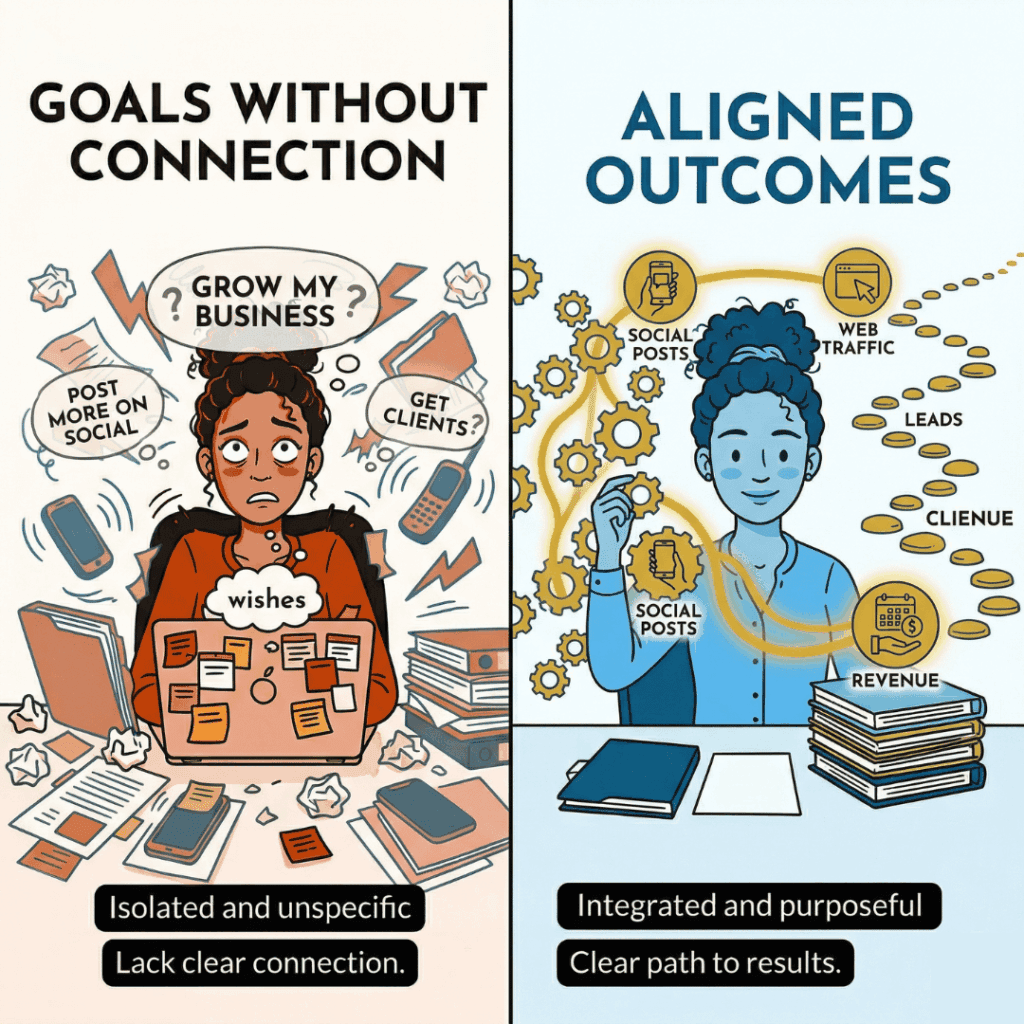
What Are SMART Goals? (And Why They Matter for Marketing)
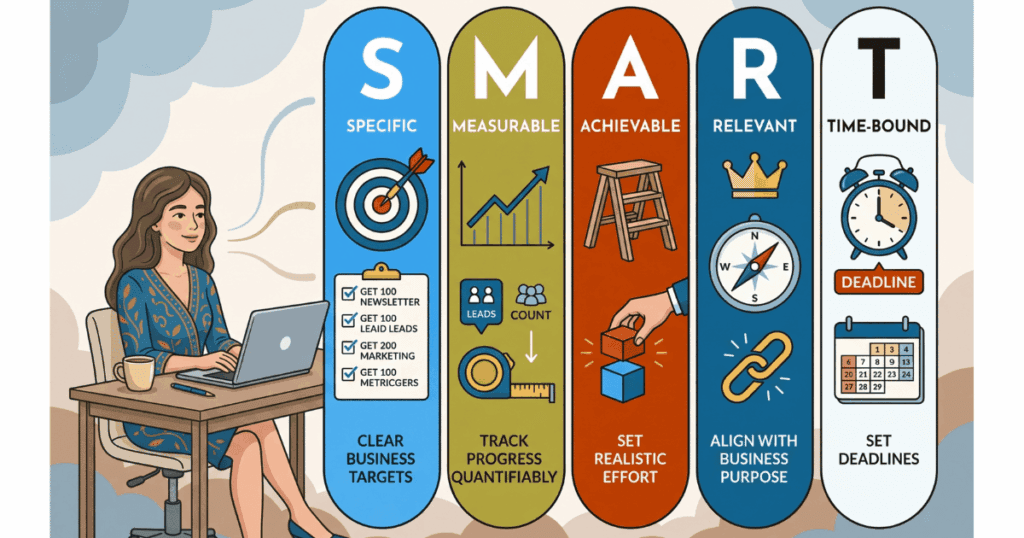
SMART is an acronym. You probably know this, but here’s a quick primer on SMART objectives in case you’re not familiar with the concept.
S – Specific. Name the exact thing: “improve SEO” is super vague, but “increase organic traffic to my services page by 15%” is specific.
M – Measurable. Attach a number: if you can’t measure it, you can’t evaluate it, and you’ll end up guessing whether your effort was worth it. (No, gut feeling isn’t enough.)
A – Achievable. This is where solopreneurs get tripped up. We tend to believe we can do waaaay more than is possible given we’re wearing all the hats. For example, setting a goal to “get 50 backlinks in 3 months” when you’ve never done SEO outreach before are not attainable goals. In fact, it’s a recipe for burnout. Ambitious is good. Impossible is demoralizing.
R – Relevant. Does this goal support what your business needs right now? If your business goal is to increase revenue from a specific service, a marketing goal about growing your TikTok following (when your clients are on LinkedIn) is a distraction, no relevant to your goals. The wildest example of “oh no, that’s not relevant” was during a podcast interview. The interviewer told me they were going to start selling pools (they were a therapist). I had zero poker face asked how it would help her get qualified leads for her therapy business. Oops. The interview never ran.
T – Time-bound. Give it a deadline. Without one, everything stays on the “someday” list forever. The only way to make something a priority is to give it a deadline.
The reason I love to use SMART frameworks is that it’s the BEGINNING of your plan. You stop guessing and start tracking. And when something isn’t working, you can see it in the numbers instead of feeling it in your gut (which could be wrong anyway).
Business Goals vs. Digital Marketing Goals: Know the Difference
Here’s the mistake that trips up most small business owners: they replace their business goals with marketing goals. A social media manager tells you that you need 10,000 followers and suddenly that becomes the mission. But followers won’t buy you milk.
Business goals are about where you want your business to go. Revenue targets, client capacity, new service launches, profit margins. These are the things that keep your business alive.
Marketing goals are the specific activities that support those business goals.
When solopreneurs say “marketing doesn’t work,” it’s usually because there’s a disconnect between their business goals and marketing actions. Posting on Instagram because you feel like you “have to” without considering how it connects to client acquisition is keeping busy, but it’s not a strategy. In our marketing strategy work, we define SMART business goals first, then build SMART marketing goals that support them.
Here’s what that looks like in practice:
- Business goal: Increase coaching revenue by 15% by the end of Q3.
- Marketing goal: Publish two SEO-focused blog posts per month targeting high-intent keywords related to coaching services, starting in Q1.
- Marketing goal: Speak to four women’s networking groups per quarter with a service-related list-building offer.
- How you measure it: Track services revenue, ask new clients how they found you, and monitor organic traffic to your services pages.
If your marketing goals can’t trace a line back to a business goal, they need to be rethought or scrapped.
How to Set SMART Marketing Goals (Step-by-Step)
You don’t need a fancy tool or a 90-minute planning session to get started. But you do need to be honest about where you are right now.
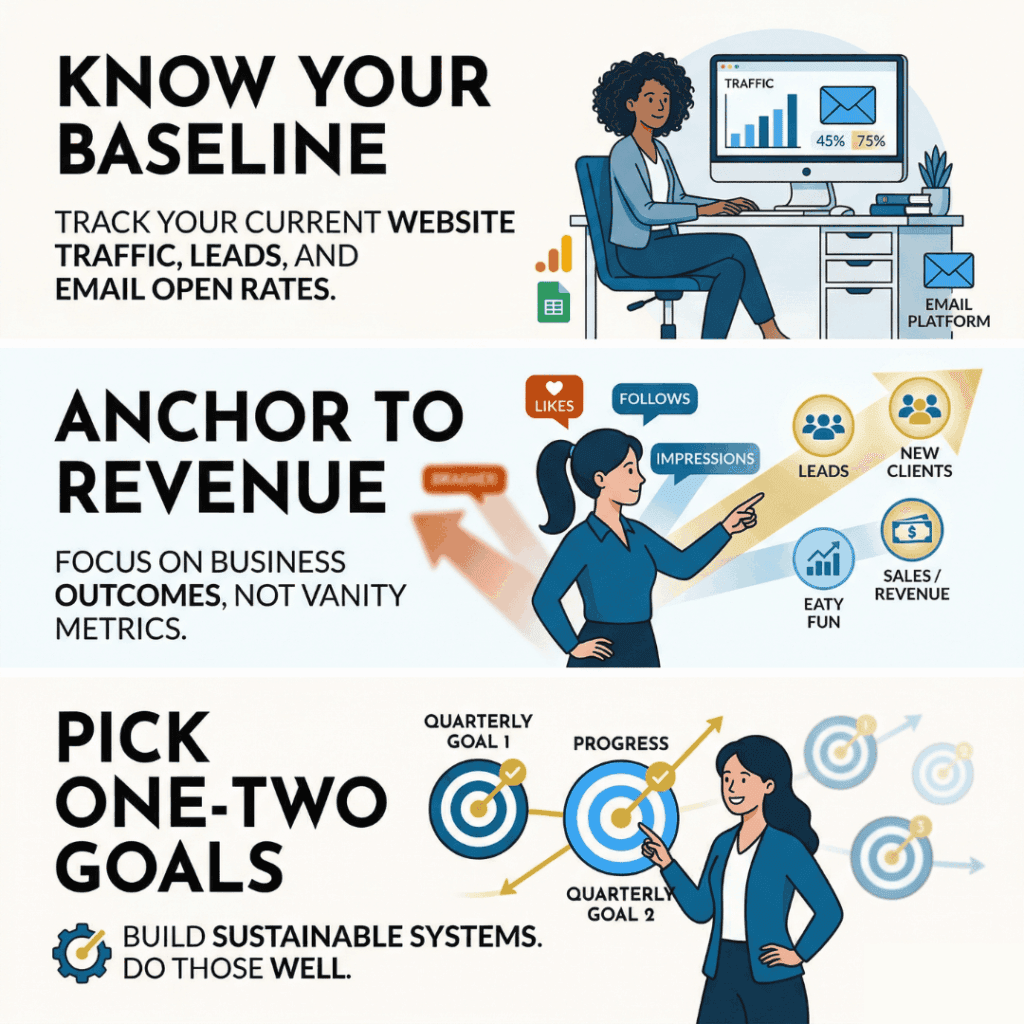
1. Start with your numbers
Before you pick a goal, know your baseline. What’s your current website traffic? How many leads came in last quarter? What’s your email open rate? You can’t set a meaningful target if you don’t know where you’re starting.
If you don’t have these numbers, that’s your first goal: set up tracking. Google Analytics, your email platform’s dashboard, and a simple spreadsheet are enough.
2. Anchor to revenue, not vanity metrics
Here’s the thing. Likes, follows, impressions, even website traffic on its own don’t tell you whether your marketing is working. These metrics tell a marketer their work is getting eyeballs on your brand. They don’t tell a business owner whether new clients are coming in.
The SMART framework we use with clients always starts with business metrics: revenue, number of clients, lead generation, average order value. Marketing KPIs like click-through rates and social engagement should be anchored to those business numbers. Otherwise you’re chasing vanity metrics.
A social media follower count of 5,000 means nothing if none of those people are buying. More followers don’t automatically correlate with business growth, especially since you don’t own your followers on rented platforms.
3. Pick one to two goals per quarter
If you’re a solopreneur (and if you’re reading this, you probably are), you don’t have the capacity for seven simultaneous marketing goals. Pick one or two that support your most important business objective. Do those well. Add more when you’ve built the system to sustain them.
9 Examples of SMART Marketing Goals by Channel
These nine examples are organized by marketing channel. Each one spells out all five SMART components. Pick the ones that connect to your business goals and adapt the numbers to your reality.
Social Media Marketing
1. Grow Your Pinterest Presence
Business goal: 15+ attendees at an online women-led business training event.
Marketing goal: expand awareness on Pinterest in Q1 so you can run a Pinterest ad campaign in Q2.
Increase brand awareness on Pinterest by scheduling three posts per week starting Q4, targeting an 8% follower growth among women business owners by the end of Q1 to prepare for a Q2 marketing campaign. Awareness content will focus on industry insights and educational tips related to your core services.
- Specific: Focused on one platform with a clear growth metric
- Measurable: Track follower count weekly
- Achievable: Three posts per week is sustainable for most solopreneurs
- Relevant: Supports brand visibility for women-led businesses active on Pinterest
- Time-bound: Six months gives you enough data to evaluate
2. Increase Instagram Engagement
Business goal: increase farmer’s market bakery sales by 10% in Q4.
Marketing goal: Grow Instagram follower count by 15% over the next three months by posting four times per week and engaging with 10 accounts daily in in the local area (Instagram is great for local businesses).
Be realistic here. If you’ve never posted consistently, start with three times per week and build up. The engagement piece (commenting on other accounts) is where the growth comes from, not the posting alone.
3. Build LinkedIn Connections
Business goal: develop 5 referral partner relationships with complementary providers by Q3.
Marketing goal: Add 50 new LinkedIn connections per month (about half complementary providers) for the next quarter by participating in two business groups weekly and sharing one original post per week. Schedule 2-3 coffee chats/week.
For consultants and coaches, LinkedIn is often the highest-value social platform. But 50 connections per month requires active participation, not passive scrolling.
SEO
4. Scale Your Search Visibility
Business goal: Increase consult calls for a specific service by 5% by the end of Q1.
Marketing goal: Increase organic search traffic by 3% in six months by securing 10 high-quality backlinks through guest posting on sites with 50+ domain authority.
A note on this one: 10 backlinks in six months is realistic for a solopreneur. Fifty is not, unless you have a marketing team or a dedicated outreach partner. In the original version of this post, I used 50 as the target, and honestly, that’s too aggressive for most of my readers. Scale accordingly.
Email Marketing
5. Grow Your Email List
Business goal: increase sales for a digital product by 10% by the end of Q2.
Marketing goal: Add 200 new email subscribers in the next quarter by creating a lead magnet specific to your most popular digital product and promoting it through existing blog content and social channels.
Your email list is the one marketing asset you own. Unlike social followers, these are people who opted in to hear from you. This goal pays dividends long after the quarter ends.
Content Marketing
6. Start (or Restart) Your Blog
Business goal: Increase conversion rate by 5% for a specific high-end service by the end of Q2.
Marketing goal: Add blogging to your strategy within the next two months. Publish and optimize one well-researched post per week focused on high-intent keywords related to your high-end service. Roll out a backlink program in month three to get five quality backlinks per month. During consults refer new leads to your thought leadership articles for more information, promote via your newsletter.
This one requires support if you’re doing it alone. Weekly blogging on top of client delivery is A LOT. Consider biweekly if weekly feels like too much. Consistency over volume, always.
Referrals and Partnerships
7. Activate Your Referral Network
Survey 50 current and former clients in the next 30 days for satisfaction feedback and to identify new advocates for your referral network. Address negative feedback within 30 days through your improvement process.
This is a two-for-one goal. You get market research, client retention data, and potential referral partners in one effort.
8. Build Strategic Partnerships
Develop partnerships with three complementary businesses within three months to generate 5-10 referral leads per month within six months. (Our LinkedIn example is one approach.)
The key word is complementary. A web designer partnering with a copywriter makes sense. And at the six-month mark, you may not hit 5-10 monthly leads, but you should see progress.
Website and Revenue
9. Overhaul Your Website Experience
Use care with this. A lot of times people default to “I need a new website” as an excuse to avoid sales (e.g., I’d do more outreach if my website were up to date/prettier/other). Do the outreach anyway. Your website shouldn’t stop you.
SMART goal example: Within 60 days, hire a website expert to audit your user web customer experience and deliver an implementation report. Then implement the changes within 90 days, including a tracking system to evaluate results.
This is a bigger investment, both time and money. But if your website isn’t converting visitors into inquiries, no amount of social posting will fix it. Use AI to do market research, adjust your messaging, etc. Your website is foundational, and sometimes you have to fix the plumbing before you repaint the walls.
SMART Goals for Social Media
Social media deserves its own section because it’s where most solopreneurs spend the majority of their marketing time, and it’s where the vanity metrics trap is strongest.
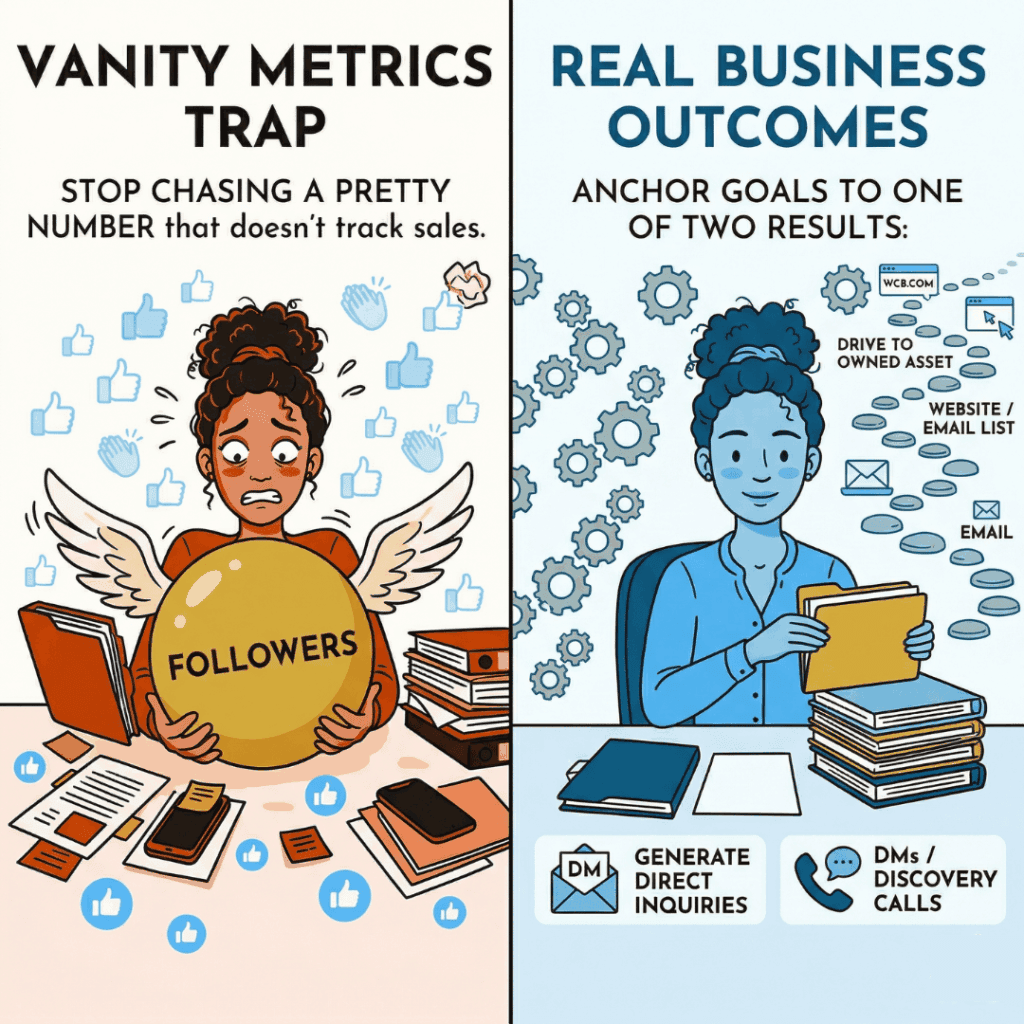
Here’s the honest truth about social media goals: if your only measure of success is follower count, you’re measuring the wrong thing. In client work, we anchor every social media goal back to one of two outcomes: either it’s driving people to an owned asset (your website, your email list) or it’s generating direct inquiries.
LinkedIn lead generation example:
Post two original thought-leadership pieces per month on LinkedIn for 90 days. Track profile views, connection requests, and (most importantly) DMs and discovery call bookings. Target: 5 new discovery calls attributed to LinkedIn content within the quarter (might be too aggressive).
Instagram to email list example:
Use Instagram Stories three times per week to promote your lead magnet for the next 60 days. Track link clicks in Stories, refine CTAs, and new email subscribers attributed to Instagram. Target: 75 new email subscribers from Instagram in two months.
Facebook Group engagement example:
Increase weekly engagement in your Facebook Group by 20% over the next three months by posting a discussion prompt every Tuesday and a resource share every Thursday. Track comments, not likes.
Key takeaway: choose a specific platform, a specific action cadence, a specific metric (e.g., increasing the number of consult calls from the group) tied to a business outcome, and a deadline.
If you can’t tie a social media goal back to revenue or list growth, question whether it’s worth your limited hours.
Warning: Vanity Metrics are Different From Goals
Metrics like social media followers, search engine rankings, website traffic, and click-through rates are fine to track. But they’re not the end goal. All marketing activities should be anchored to business outcomes like increased revenue, new client acquisition, customer retention, or lead generation.
Without that anchor, you can feel productive (look at all those likes!) while your business revenue remains stagnant.
Here’s a quick test: if a metric going up by 50% wouldn’t change your revenue at all, it’s probably a vanity metric. Track it if you want, but don’t build your strategy around it.
SMART Goal Template
Here’s a fill-in template you can use right now:
Business goal: Increase [specific revenue stream or business metric] by [X%] by [date].
Marketing goal: [Specific marketing action] targeting [specific metric] by [date], using [specific channels or tactics].
How I’ll measure it: [Tools and metrics I’ll track weekly/monthly].
What I’ll adjust if it’s not working by [midpoint date]: [Specific pivot plan].
Want a more detailed planning framework? Our 90-Day Marketing Plan workbook walks you through this process step by step, including the business goal alignment piece that most templates skip.
Frequently Asked Questions
Can SMART goals work for solopreneurs without a team?
Yes. In fact, they work better for solopreneurs because they force you to be realistic about what you can accomplish. The “A” in SMART (achievable) is your built-in reality check. If a goal requires 20 hours per week of marketing effort and you have five, that’s not achievable. Adjust the number, extend the timeline, or choose a different goal. SMART goals for a one-person business should be smaller, tighter, and more focused than what you’d see at a company with a marketing department.
How often should I review my SMART goals?
Monthly at minimum. In our marketing coaching work, we check in on goals every two weeks. If you wait until the end of the quarter to look at your numbers, you’ve lost the ability to adjust course. Set a recurring 30-minute review on your calendar. Look at your metrics, note what’s moving, and decide if anything needs to shift.
What’s the difference between business and marketing goals?
Business goals define where your business is going: revenue targets, client capacity, new offers. Marketing goals are the specific tactics and campaigns that support those business goals. They’re not the same thing, and confusing the two is the most common reason solopreneurs feel like marketing “isn’t working.” Always set business goals first, then build marketing goals underneath them.
What tools can I use to track SMART goals?
You don’t need anything expensive. Google Analytics handles website traffic and conversions. Your email marketing platform (MailerLite, ActiveCampaign, ConvertKit) gives you list growth and engagement data. Google Search Console tracks your search performance. For the actual goal tracking, a simple spreadsheet or a project management tool like Asana or Notion works fine. The tool matters less than the habit of checking your numbers regularly.
Are SMART goals suitable for both short-term and long-term planning?
They work for both, but the variables change. Short-term SMART goals (30-90 days) should focus on specific campaigns or sprints. Long-term goals (6-12 months) should focus on compounding activities like SEO, content marketing, or audience building. The framework stays the same. The ambition level and timeline adjust.
What if I set a SMART goal and realize it’s wrong?
Change it. Your goals aren’t carved in stone. If you set a goal to grow your Instagram by 25% and two months in you realize Instagram isn’t where your clients hang out, stop. Redirect that energy to where it matters. The SMART framework gives you the data to make that call with confidence instead of guessing.
Your Marketing Goals Need a Business Reason to Exist
Set your business goals first. Then build marketing goals that support them. Track the numbers that connect to revenue. Review monthly. Adjust without guilt.
If you want support building a marketing strategy that respects your capacity and connects to real business outcomes, marketing coaching for solopreneurs is built for exactly that.
Ready to stop reading about strategy and start building yours?
Marketing coaching gives you a dedicated strategist in your corner — someone who knows your business, your budget, and your bandwidth. Together, we’ll turn your ideas into a plan that fits your life.
See How Coaching Works → Not sure yet? Book a free clarity callGet the Free Solopreneur Marketing Audit Worksheet
Rate your marketing across 5 key areas in under 10 minutes. Your scores reveal exactly where to focus first, so you stop spreading yourself thin.
No spam. Unsubscribe anytime. We respect your inbox.