


Voice search optimization is adapting website content and technical elements to appear in voice assistant search results. It focuses on conversational language, featured snippet targeting, and local SEO signals that Google Assistant, Alexa, and Siri use to answer spoken queries.
At a Glance
- What it is: Optimizing content for voice assistant search results
- Who it's for: Local service businesses with physical presence
- Who it's NOT for: Online-only consultants, coaches without local clients
- Time to implement: 2-4 hours (basic) to 8+ hours (advanced)
- Skill level: Intermediate SEO knowledge
- Primary outcome: Visibility in "near me" and question-based searches
Voice search optimization has been flagged by marketers as "essential" for about five years now. You'd think we'd all be invisible without it by now.
Approximately 20.5% of internet users globally use voice search, but that’s a far cry from a tactic “everyone” needs to address. The disconnect between hype and reality is significant.
Instead of assuming voice search optimization belongs on your to-do list, we'll help you decide whether it does. You'll get the fundamental implementation steps. But more importantly, you'll get a framework for figuring out where voice search fits into your overall marketing strategy.
By the end, you'll know exactly who benefits from voice search SEO, what it costs in time and effort, and whether to prioritize it over strengthening your search engine optimization foundation. No breathless predictions about the future of search. No guilt if you decide this can wait. Just clarity about what makes sense for your service business right now.
How Voice Search Works (And Why Most Advice Misses the Point)
Understanding voice queries starts with one key insight: voice assistants don't have their own search index. They borrow from existing search engines.
The Technical Reality
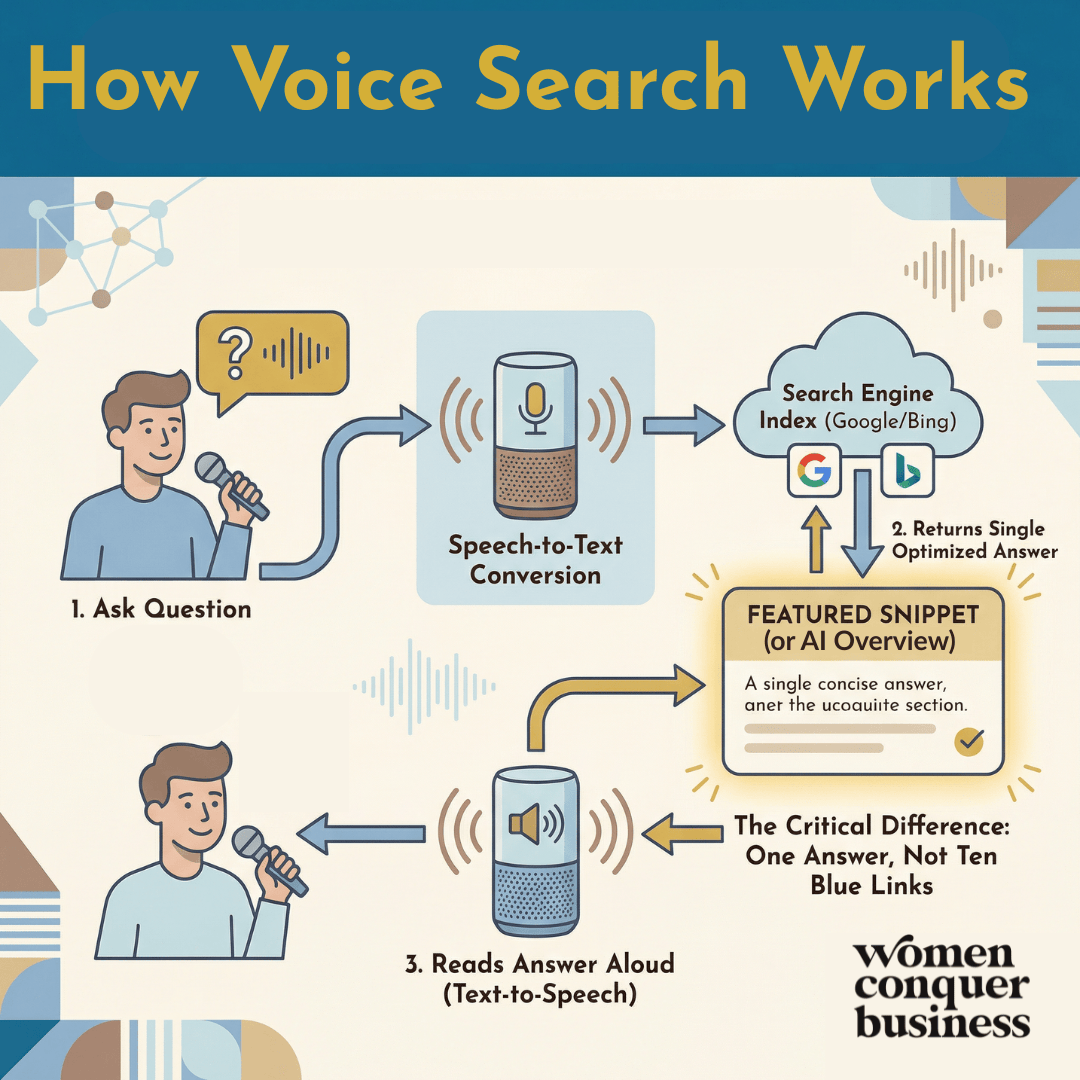
When someone asks Google Assistant, Alexa, or Siri a question, here's what happens:
- The voice assistant converts speech to text
- It sends that text query to a search engine (Google for Google Assistant and Siri; Bing for Alexa)
- The search engine returns results optimized for a single spoken answer
- The assistant reads that answer aloud using text-to-speech
The critical difference from traditional search queries? Voice assistants typically deliver one answer, not ten blue links. That answer usually comes from a featured snippet (the highlighted box that appears at position zero in Google results) or AI Overviews. We call these position 0 because it's before the top ranking page on Google for a particular query.
Backlinko's voice search study found that 41% of voice search answers come directly from featured snippets. The average voice search result? Only 29 words. Short, direct, and structured for quick consumption.
This means voice search optimization isn't a separate discipline from regular SEO. It's an extension of it. Specifically, the parts focused on top results (featured snippets or AI Overviews) for local SEO.
What the Statistics Show
Here's where conventional wisdom falls apart.
You've probably seen claims that voice search would account for 50% of all searches by now. That prediction, originally from a 2014 Baidu executive, never materialized. The numbers tell a different story.
| Voice Search Metric | Current Data | Source |
|---|---|---|
| Global voice search usage | 20.5% of internet users | DemandSage |
| Peak usage | 22.5% (Q2 2022) | DemandSage |
| Voice assistants in use | 8.4 billion devices | DemandSage |
| Voice searches with local intent | 76% | BrightLocal |
Voice search usage peaked in Q2 2022 and has plateaued since.
The 76% local intent figure is the one that matters most for service businesses. Three out of four voice searches are looking for something nearby. "Best plumber near me." "Coffee shop open now." "Emergency dentist in Portland."
If your business serves a specific geographic area, that statistic is relevant. If your clients come from anywhere with an internet connection, the calculus changes significantly.
Voice Search for Service Businesses: Who Should Care (and Who Shouldn't)
Most voice search guides skip this question entirely. They assume optimization is essential for everyone. It isn't.
Local Business Advantage
If you run a service business with a physical location (or serve clients within a specific geographic area) voice search optimization deserves attention.
Here's why: that 76% local intent figure means voice search users are often ready to act. Your Google Business Profile becomes the critical asset here. When voice assistants answer local queries, they pull heavily from GBP listings. A complete, optimized profile with accurate hours, services, and reviews increases your chances of being the one answer that gets read aloud.
For local service providers like plumbers, salons, therapists, and accountants serving a metro area, voice search optimization makes strategic sense.
Not Relevant for Online-only Service Providers
Think about how your ideal clients find you. Are they asking Alexa for "business coach near me"? Probably not. They're Googling specific problems, reading your content, following referrals from colleagues. The discovery path is different.
If you're an online consultant serving clients nationwide (or globally), voice search optimization is likely a low priority because it's not aligned with how people find businesses like yours.
Voice Search Prioritization Matrix
Use this framework to assess where voice search fits for your business:
| Business Type | Local Presence | Voice Priority | Why It Matters |
|---|---|---|---|
| Local service provider (plumber, salon, therapist) | Strong | HIGH | Most voice searches have local intent |
| Regional consultant (tri-state service area) | Moderate | MEDIUM | Some discovery happens via local queries |
| Online-only coach or consultant | Weak | LOW | Buyers do not search “near me” |
| Service provider without storefront | Variable | DEPENDS | Depends on whether customers search locally |
If you're unsure where you fall, consider working with a marketing coach to clarify your customer journey before investing in voice optimization.
The question isn't can you optimize for voice search. It's should you, given your specific business model, your capacity, and what drives your revenue.
Voice Search Optimization: Technical Essentials
If you've determined that voice search makes sense for your business, here's what moves the needle. Most guides bury the technical details or skip them entirely. We won't.
Featured Snippets: Your Gateway to Voice Results
Featured snippets are the single most important factor in voice search visibility. Research shows that 41% of voice search answers come directly from featured snippets. Win the snippet, and you're likely to win the voice result.
Now that featured snippets have all but disappeared, it means being cited in AI Overviews (which also favor the same structures, below).
The catch? Featured snippets favor specific content structures:
For definition queries ("What is..."):
- Lead with a direct, 40-60 word answer
- Use the exact question as your heading or in your first sentence
- Follow with supporting detail
For process queries ("How to..."):
- Use numbered steps (not bullets)
- Keep each step concise (one action per step)
- Include 5-8 steps maximum
For comparison queries ("X vs Y"):
- Use tables with clear column headers
- Include the key differentiating factors
- Put the most important comparison first
The average voice search result is 29 words. That's your target length for the direct answer portion, even if your full content goes much deeper.
Schema Markup Demystified
Schema markup is structured data that helps search engines understand your content. For voice search, three types matter most:
| Schema Type | Primary Purpose | DIY Level | Voice Search Impact |
|---|---|---|---|
| FAQPage | Answers spoken questions | Medium | HIGH |
| LocalBusiness | Supplies local business details | Easy | HIGH (local) |
| Speakable | Enables text-to-speech playback | Hard | LOW |
| HowTo | Structures step-by-step actions | Medium | MEDIUM |
FAQPage schema is where most service businesses should focus. If you have a FAQ section on your website (and you should), adding FAQPage schema helps Google understand those are question-answer pairs. That's exactly what voice assistants need.
According to Google's documentation, speakable schema remains in beta and is limited to news content. Don't prioritize it unless you're publishing news articles.
For implementation, most website platforms (Squarespace, WordPress, Wix) offer schema plugins that don't require coding. In real-world implementation with clients, adding FAQ schema takes 1-2 hours for someone comfortable with their CMS. If that sounds overwhelming, this is a reasonable task to delegate.
The Multi-Assistant Reality
Here's something most voice search guides gloss over: different assistants use different search engines.
| Voice Assistant | Search Engine Used | Map Data |
|---|---|---|
| Google Assistant | Google Search | Google Maps |
| Amazon Alexa | Bing | Bing Maps / Yelp |
| Apple Siri | Google Search | Apple Maps |
| Microsoft Cortana | Bing | Bing Maps |
This means optimizing only for Google leaves visibility gaps. If your customers use Alexa (and many do, since it's in millions of homes), your Bing presence matters too.
The good news: basic digital marketing best practices work across both ecosystems. Accurate local business information, such as a consistent name, address, and phone (NAP), and claimed profiles ensures your business has s strong visiblity baseline. You don't need separate strategies. You need complete ones.
Mobile and Speed: The Foundation
Voice searches happen overwhelmingly on mobile devices. If your site is slow or difficult to navigate on a phone, voice search optimization won't save you.
The targets:
- Page load time: Under 3 seconds (ideally under 2)
- Core Web Vitals: Pass all three metrics (LCP, FID, CLS)
- Mobile-friendly: Responsive design, readable text, tappable buttons
Use tools like Google's free PageSpeed Insights tool to tell you where you stand. If your scores are below 50 on mobile, fix that before worrying about schema markup or featured snippets.
Should You Prioritize Voice Search? A Framework for Deciding
You now understand how voice search works and what optimization involves. The harder question: Should this be your next priority?
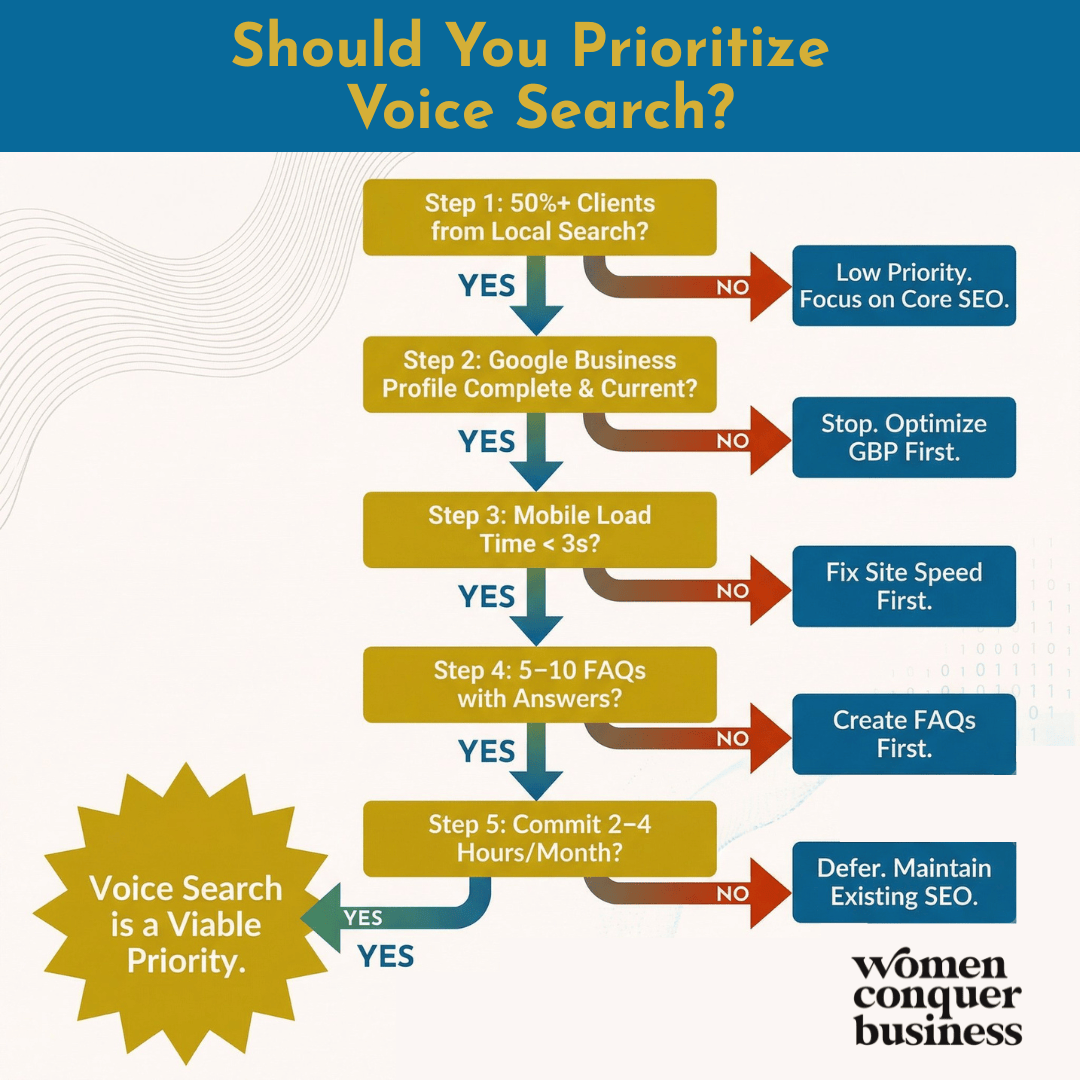
Should You Prioritize Voice Search?
Step 1: Client Discovery Source
Do you get 50% or more of clients come from local searches?
- YES: Voice search is relevant. Continue.
- NO: Voice search is low priority. Focus on core SEO.
Step 2: Google Business Profile Status
Is your Google Business Profile complete and current?
- YES: Continue to voice optimization readiness.
- NO: Stop. Optimize GBP first.
Step 3: Mobile Site Speed
Is your website's mobile load time under 3 seconds?
- YES: Technical foundation is adequate.
- NO: Fix site speed before pursuing voice search.
Step 4: FAQ Content
Does your website include 5–10 FAQ-style questions and answers?
- YES: Content is voice-ready.
- NO: Create FAQs before implementing voice optimization.
Step 5: Ongoing Capacity
Can you commit 2–4 hours per month to voice search?
- YES: Voice search is a viable priority.
- NO: Defer voice search. Maintain existing SEO.
Decision Summary:
Voice search is worth prioritizing if your business relies on local discovery, has a complete Google Business Profile, loads quickly on mobile, includes FAQ content, and can support light monthly maintenance.
"Not now" is a valid answer. Marketing that fits your capacity beats marketing you'll abandon in two months.
Voice Search vs. Basic SEO
Here's the insight that changes the calculation for many service businesses: 75% of voice search results also rank in the top 3 for traditional text search.
Read that again. Three-quarters of the content that wins voice results is already winning at regular SEO.
This means strong basic SEO creates voice search visibility almost automatically. The converse is also true: weak basic SEO undermines voice search efforts.
If your website doesn't rank well for your core services yet, voice search optimization is premature. You're building a second floor before finishing the foundation.
The sustainable approach: Optimize your website for basic SEO first. Then layer in voice-specific optimizations. This isn't the fastest path to voice results. But it's the path that compounds over time.
Voice Search Optimization Implementation Guide
Marketing strategies need to respect your energy levels and mental load. A perfect voice search strategy you'll abandon in six weeks helps no one. A "good enough" approach you maintain consistently? That compounds.
Tier 1: Minimum Viable Voice Optimization (2-4 Hours Total)
This tier covers the fundamentals that benefit both voice and traditional search. If you only have a few hours to spare, do these four things:
1. Claim and optimize your Google Business Profile (60-90 minutes)
- Verify your listing if you haven't
- Complete every section (hours, services, description, photos)
- Add 3-5 frequently asked questions using GBP's Q&A feature
- Respond to existing reviews (yes, this affects voice results)
2. Add 5-10 FAQs to your website (45-60 minutes)
- Write out questions your clients ask
- Answer each in 40-60 words (voice-friendly length)
- Use the exact question as your heading
- Place on a dedicated FAQ page or relevant service pages
3. Check mobile-friendliness (15 minutes)
- Run Google's Mobile-Friendly Test
- Fix any critical errors (text too small, buttons too close)
- Test your site on your own phone
4. Basic page speed check (15 minutes)
- Run PageSpeed Insights on your homepage and key service pages
- If scores are below 50, prioritize fixing before other optimizations
- Common quick wins: compress images, enable caching
That's it. These four tasks create a voice search foundation without overwhelming your schedule. For many service businesses, Tier 1 is enough.
Tier 2: Intermediate Voice Optimization (4-8 Hours + Ongoing)
If voice search is a medium-to-high priority based on your business type, add these elements:
FAQ schema markup (1-2 hours)
- WordPress: Install a schema plugin (Yoast, Rank Math, or similar)
- Other web platforms: Use a free schema markup generator and paste it into the code injection section of the page/post
- Mark up your FAQ content using the plugin interface
- Test with Google's Rich Results Test tool
Conversational keyword integration (2-3 hours)
- Research question-based keywords for your services
- Create content that directly answers those questions
- Target 1-2 question keywords per service page
Local citation consistency (1-2 hours)
- Audit your business listings on Yelp, Bing Places, Apple Maps
- Ensure NAP (name, address, phone) is identical everywhere
- Claim and complete profiles on platforms you've neglected
Featured snippet targeting (ongoing)
- Identify question keywords where you already rank on page one
- Restructure content to better answer those questions
- Monitor Search Console for featured snippet wins
Tier 2 requires ongoing attention. Plan for 1-2 hours monthly to maintain momentum.
Tier 3: Advanced Voice Optimization (8+ Hours + Ongoing)
For businesses where voice search is a primary traffic driver (typically local service providers in competitive markets), consider:
- Multi-assistant optimization (Bing Places, Apple Maps completion)
- Systematic featured snippet campaigns
- Speakable schema testing (still beta, but worth monitoring)
- Quarterly voice search audits
Most service businesses don't need Tier 3. If you're unsure, start with Tier 1, evaluate results after 3-6 months, then decide whether to invest more.
One Thing Everyone Should Do
If you take nothing else from this guide: optimize your Google Business Profile.
GBP is the single highest-ROI voice search activity for local service businesses. Voice assistants pull heavily from GBP data for local queries. A complete, accurate profile with current hours, services, and positive reviews dramatically increases your chances of being the answer.
This applies even if you deprioritize everything else. Even if voice search isn't your focus. Even if you're an online consultant who rarely gets local queries. A complete GBP still helps traditional search and builds credibility.
Our local SEO service includes reviewing your GBP.
The Measurement Problem: What You Can (and Can't) Track
Here's something most voice search guides won't tell you: direct voice search attribution is essentially impossible with current analytics tools.
You cannot look at Google Analytics and see "15 visitors came from voice search last month." That data doesn't exist in any standard reporting.
Google Analytics 4 doesn't distinguish between typed and voice search rankings. Google Search Console shows queries but not whether they were spoken or typed. Voice assistants don't send referral data that identifies them as voice sources.
This is an industry-wide limitation, not a gap in your setup.
Proxy Metrics That Help
Since direct measurement isn't possible, focus on metrics that correlate with voice search success:
| What to Track | What It Indicates | Where to Find It |
|---|---|---|
| Featured snippet wins | Eligibility for voice answers | Search Console → Performance → Filter by position |
| Question-keyword rankings | Conversational query visibility | Search Console → Performance → Filter by queries containing “how,” “what,” “where” |
| “Near me” impressions | Local voice relevance | Search Console → Performance → Filter by “near me” queries |
| GBP calls and direction requests | Voice-to-action conversion | Google Business Profile Insights |
| Direct traffic increases | Possible voice brand searches | GA4 → Traffic Acquisition |
None of these prove voice search specifically drove the result. But improvements across these metrics suggest your voice optimization efforts are working.
When to Evaluate (And When to Pivot)
Voice search optimization is a slow game. Expect 3-6 months minimum before drawing conclusions.
Signs it's working:
- Featured snippet appearances increasing
- Question-based query impressions rising
- GBP engagement (calls, direction requests) trending up
- Local rankings improving
Signs to reassess:
- No movement after 6 months of consistent effort
- Declining metrics despite optimization
- Time investment exceeding results
If you're not seeing progress after six months, the issue may be foundational SEO rather than voice-specific optimization. Consider whether your time is better spent strengthening basic search visibility first.
The inability to track voice search directly frustrates business owners who want clear ROI data. That frustration is valid. But accepting this limitation is better than chasing phantom metrics or abandoning a strategy that might be working. You can't prove it either way.
Voice Search for Your Service Business
Voice search optimization isn’t the revolution we were promised. But it's not irrelevant either. The question was never whether voice search matters. It's whether it matters for you, right now.
Here's the honest assessment:
- Local service businesses with physical presence: Voice search deserves priority. The 76% local intent figure benefits you. Start with Tier 1, expand as capacity allows.
- Online consultants, coaches, and service providers without local clients: Voice search is low priority. Your clients aren't asking Alexa to find you. Focus your limited time on content and basic SEO instead.
- Everyone, regardless of business type: Optimize your Google Business Profile. It takes two hours and benefits both voice and traditional search. There's no downside.
- When in doubt: Strengthen your basic SEO foundation first. 75% of voice results already rank in the top 3 for text search. Good fundamentals create voice visibility almost automatically.
Voice search can wait if it doesn't fit your current capacity. Not everything trending deserves your time. The sustainable approach, doing fewer things consistently, beats the frantic approach of chasing every optimization.
If you're ready to clarify where voice search fits into your bigger picture, our strategic marketing membership provides ongoing support to help you prioritize what moves your business forward.