


Slow marketing is a strategic business framework that prioritizes depth, sustainability, and ethical engagement over speed and volume. It replaces hustle culture with capacity-aware marketing strategy designed to respect the 192-day B2B customer journey. This approach builds long-term brand equity and sustainable revenue.
At a Glance
- What it is: A capacity-aware strategic framework that rejects hustle culture for sustainable digital marketing.
- Who it’s for: Solopreneurs and service-based business owners.
- Time to implement: 3–5 hours per week of focused execution.
- Typical cost: Time-based operational audit and tech optimization.
- Skill level: Intermediate.
- Primary outcome: Reclaiming capacity while building long-term revenue stability
Reality Check
- Setup effort: High (requires an operational audit)
- Ongoing effort: 3–5 hours per week (focused execution)
- Skill level: Intermediate (requires strategic maturity)
- Common misconception: Slow marketing isn't doing "less." Rather, it means doing things that work better.
Hustle culture is a toxic, tactical lie. People built it for teams of 20, not solopreneurs who wear every hat. Do you know the average B2B customer journey is 192 days long?
If you measure success by "daily engagement" when your sales cycle is six months, you're using the wrong clock. You are likely burned out from the "more is better" grind it out all night hustle culture fueled by bro-marketing.
Over 40% of business owners feel exhausted, stressed, and overwhelmed. And let's be real: a new planner or "one simple trick" won't fix it.
In my 25 years as a digital marketing strategist, I’ve seen how a be-everywhere/omnichannel focus creates a mistake tax small businesses can’t afford. That's why Women Conquer Business provides capacity-aware marketing strategy that prioritizes human sustainability over high-frequency noise.
By understanding the economic data behind the marketing ROI time lag and auditing your operations to eliminate tech chaos, you can build a business that scales without consuming your life.
Let’s start by recognizing the signs of burnout and the true cost of hustle culture. By the end, you'll understand why slow is the way to go.
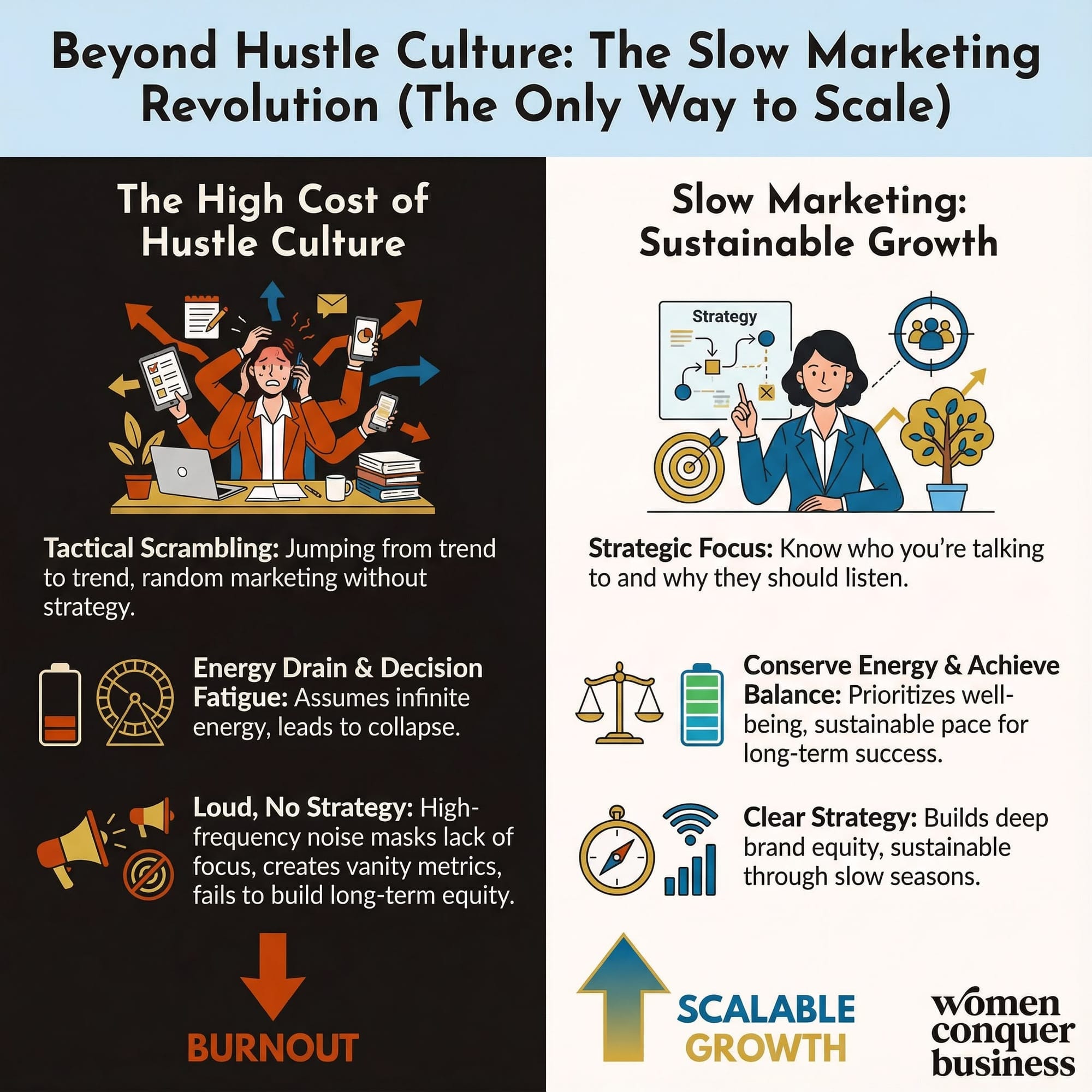
The Diagnosis: The High Cost of Hustle Culture
You're overwhelmed because you're running a business using a hustle culture marketing model that so many influencers tout.
This leads many entrepreneurs to fall into tactical scrambling:
- Jumping from trend to trend
- Performing random acts of marketing (tasks without a strategy)
- Hoping volume will close revenue gaps
It doesn't. Hustle culture assumes energy is an infinite resource. But for people who want any sense of work-life balance, this is a mathematical impossibility. It leads directly to decision fatigue and eventual collapse.
High-frequency marketing often masks a lack of marketing strategy.
When you don't know who you're talking to or why people should listen, you default to being loud. This "noise" may create a spike in vanity metrics (likes, follows, views) but cannot build the long-term brand equity needed to sustain a business through slow seasons.
What is Slow Marketing?
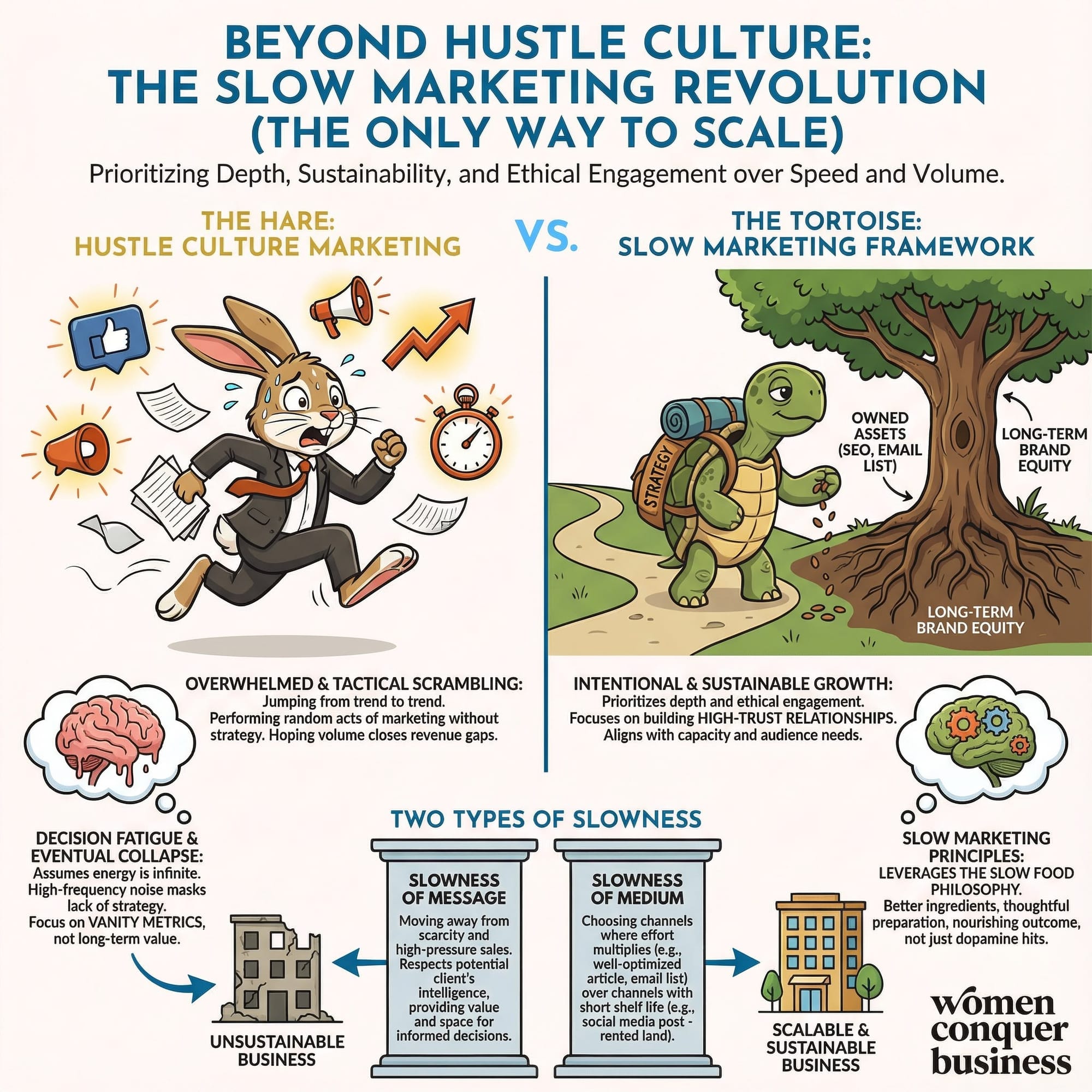
Slow marketing is an anti-hustle culture strategic business framework prioritizing depth, sustainability, and ethical engagement over speed and volume. It focuses on building high-trust relationships through high-quality content (e.g., local SEO, email marketing) and intentional customer journeys, ensuring marketing activities align with your capacity, your audience's needs and long-term revenue goals.
Slow marketing distinguishes between two specific types of slowness:
- Slowness of Message: Moving away from scarcity and high-pressure sales. It respects the potential client's intelligence, providing enough value and space for an informed decision.
- Slowness of Medium: Choosing channels where effort multiplies. A social media post has a shelf life of minutes (rented land); a well-optimized article or an email list (owned assets) can drive leads for years.
The slow marketing approach builds a machine. It still takes work, but the work lasts longer. Slow marketing is derived from the slow food philosophy: better ingredients, thoughtful preparation, and an outcome that is nourishment, not just a quick hit of dopamine.
Why Slow Marketing Works: 192-Day Customer Journey
Most marketing gurus sell the idea that you are one viral post away from a six-figure month. This is predatory mythology. If you sell a high-ticket service or complex B2B solution, you are fighting the laws of physics if you expect instant results.
The average B2B customer journey takes 192 days from first touch to closed deal.
Hustle culture focuses on short-term gains, leaving you reacting to what happened yesterday. Slow marketing acknowledges the marketing ROI time lag. You understand that the newsletter you send today might not yield a contract for six months. This isn't a sign that your marketing is slow; it's a sign that it is synchronized with trust.
Stop measuring success in minutes. If you pivot your strategy because a post didn't go viral, you reset your 192-day clock every single time. Real growth requires the discipline to stay the course.
Capacity-Aware Marketing: Moving from Fantasyland to Real Life
If slow marketing is the what, then capacity-aware marketing is the how.
We consistently see brilliant owners fail because they built a plan for their ideal self instead of their actual self.
Our marketing coaching engagements start with auditing available resources using the 3 C's Framework:
- Capacity: Do you actually have the time, energy, and resources for this? If you hate video, a "3 reels a day" strategy is a recipe for disaster.
- Complexity: Does the strategy require a tech stack so heavy you need an engineering degree to fix a link? High complexity kills momentum.
- Control: Are you building on rented land (social algorithms) or investing in owned assets (email and website)?
Marketing must respect human sustainability. If your strategy treats you like a machine, it will break you. The power of slow marketing is that it pivots to strategies that respect your bandwidth while driving measurable ROI.
Neurodivergence and the Exhausted Tuesday Rule
For clients with ADHD, consistency is often a source of shame. The marketing world tells you to post on LinkedIn every day at 9 AM. But what happens on a rainy Tuesday when the kids are sick and your executive function is zero?
In the slow marketing revolution, we replace linear consistency with seasonal marketing and the good week / hard week plan:
- Good Weeks: Use high-energy times for hyper-focus to batch-create evergreen content.
- Hard Weeks: Perform the absolute minimum viable marketing. Your good week assets do the heavy lifting for you.
By planning for your lowest-energy days, you build a business resilient to your humanity. This shift moves you from being stuck to entering a strategic partnership where you act as a directive strategist who knows when to lean in and when to rest.
Operational Reality: Eliminating Tech Chaos
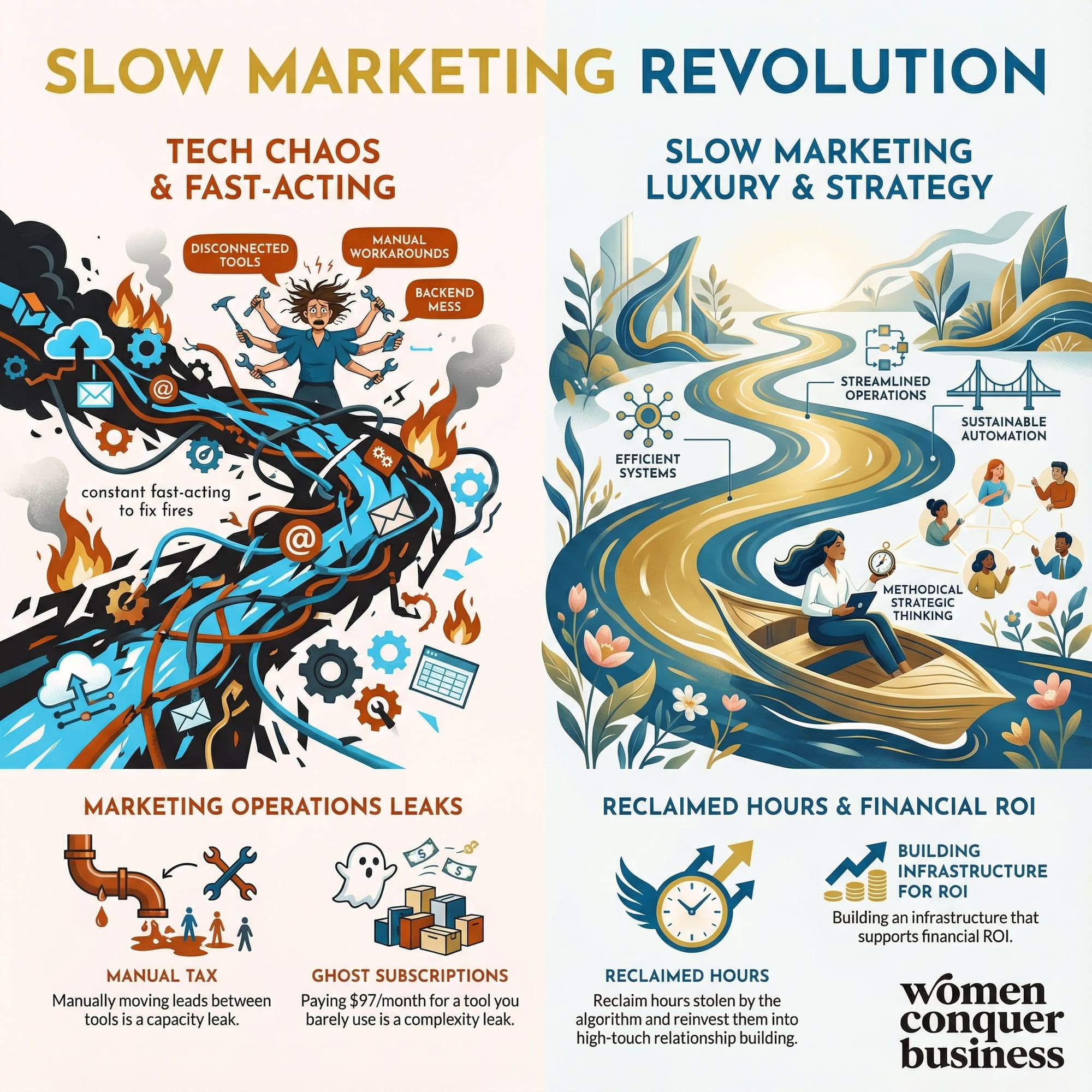
You need efficient systems to afford the luxury of slowness. If your backend is a mess of disconnected tools and manual workarounds, you are constantly fast-acting to fix fires. That leaves no room for methodical strategic thinking.
Before slowing your output, you must perform a marketing operations makeover to eliminate leaks:
- Manual Tax: Manually moving leads between tools is a capacity leak.
- Ghost Subscriptions: Paying $97/month for a tool you barely use is a complexity leak.
Slow marketing thrives on automation that is sustainable—not impersonal. By streamlining operations, you reclaim hours stolen by the algorithm and reinvest them into high-touch relationship building. You're building an infrastructure that supports financial ROI.
ROI of Sanity: Your Path to Sustainable Growth
The slow marketing revolution is about reclaiming your sovereignty from the algorithm. By synthesizing the 192-day buying cycle with a capacity-aware infrastructure, you can finally breathe. You move from hustle anxiety to the quiet confidence of a system that works while you rest.
Transitioning to this model requires the courage to ignore loud, predatory must-haves. Start by auditing your current capacity and identifying the tech chaos leaks draining your energy. Measure success by relationship resonance and revenue stability, not by noise volume.
You have permission to stop running. If you’re ready to move from tactical scrambling to a strategic roadmap, join our marketing membership. The most measurable return isn't just on your balance sheet; it’s in the hours you reclaim for yourself.
But first, take a deep breath. If you're drained, your strategy can wait until you're rested.
FAQs: Slow Marketing
Which companies specialize in slow marketing consulting services?
If you are looking for a directive strategist to help you build a sustainable machine, several firms specialize in this approach:
- Women Conquer Business: Founded by Jen McFarland, WCB is a boutique consultancy specifically focused on "slow marketing" and capacity-aware systems for mission-driven women and neurodivergent entrepreneurs.
- Bain & Company: A global consultancy that employs a customer-centric approach to equip clients with strategies for sustainable, organic growth.
- Fast Slow Motion: While primarily Salesforce and HubSpot consultants, they focus on streamlining operations to allow businesses to move with intentionality rather than chaos.
- Brafton: Specializes in transforming branding into authoritative, expert-led content that highlights a brand’s unique perspective over time.
How can slow marketing improve customer loyalty for subscription companies?
Slow marketing shifts the focus from "getting the sale" to "keeping the human." For subscription models, this looks like:
- Personalized Support: Implementing "high-touch" support can reduce churn by acknowledging the emotional connection subscribers.
- Tiered Community Rewards: Using tiered structures that incentivize long-term commitment and provide exclusive access to members-only events or early launches.
- Continuous Feedback Loops: Actively listening to feedback and adjusting future offers based on specific customer preferences, making them feel genuinely understood.
Where can I find online courses focused on slow marketing for small businesses?
Sustainable marketing education is becoming a standard for founders who want to escape the hustle:
- Jen McFarland, Your Marketing, Your Way: An on-demand guided session focused on creating a marketing plan that supports your life and business because your lived experience, values, and voice matter more than trends.
- Tim Peakman’s Slow Marketing Workshop: An on-demand session focused on escaping the social media grind by building an evergreen content strategy via search engines like Google and YouTube.
- American Marketing Association (AMA), Modern Marketing: A beginner-level course that covers the transition from traditional strategy to effective modern execution for small businesses.
- SBA Learning Platform: Offers development programs like SBA THRIVE, designed to help high-potential small businesses grow through strategic, non-predatory frameworks.
What slow marketing tools do businesses use to build long-term customer relationships?
To afford the "luxury of slowness," you need efficient tools that automate the busywork while preserving the humanity of your brand:
- CRM Systems (e.g., HubSpot, Less Annoying CRM): These act as the "secret weapon" for longevity, helping you analyze usage patterns and reach out to at-risk customers long before they cancel.
- Email Marketing (GetResponse, MailerLite): Unlike social media algorithms, email provides a direct, owned channel to nurture relationships through content-rich correspondence.
- Behavioral Analytics (Microsoft Clarity, Hotjar): Helps you understand how users actually interact with your site so you can make data-driven decisions that improve their experience.