


Marketing coaching is a strategic partnership designed for established business owners who require professional guidance to align marketing tactics with long-term goals. It identifies capacity-aware strategies, streamlines operations, and builds owned audience infrastructure to ensure sustainable, revenue-driving growth without the burnout of trend-chasing or tactical overwhelm.
At a Glance
- What it is: Strategic advisory for scaling marketing systems.
- Who it's for: Solopreneurs and founders (Years 5–10).
- Time to implement: 3–5 hours per week.
- Typical cost: $800 – $5,000+ per month.
- Skill level: Intermediate (Requires a proven business model).
- Primary outcome: Strategic clarity and repeatable marketing infrastructure.
You’ve tried everything. The courses. The templates. The generic advice to post consistently.
Yet you still spend 10+ hours a week on marketing that feels scattered. You're exhausted. Honestly, you're not even sure if you're building a business anymore or feeding a hungry algorithm.
Here’s the truth most marketing coaches won’t tell you upfront: recognizing the signs you need a marketing coach matters far less than knowing whether you have the capacity to use one.
I’ve worked with hundreds of women entrepreneurs, and I spot the pattern immediately. You aren't failing at marketing. You are drowning in tactics without a strategy. This burns precious energy on things that don't move the revenue needle.
Let’s walk through the readiness indicators I use with my own clients. I’ll show you when a coach can help, when it won’t, and how to use the 3 C's decision tool to see if you’re ready for strategic support.
| Feature | Marketing Coach | Marketing Consultant | Marketing Agency |
|---|---|---|---|
| Primary Goal | Developing your strategic judgment | Creating a specific roadmap/plan | Executing the work for you |
| Who Does the Work? | You (with guidance) | You or your team | The agency team |
| Long-Term Value | Strategic self-sufficiency | A finished strategic asset | Immediate task completion |
| Best For | Solopreneurs needing clarity | Businesses needing a launch plan | Businesses needing execution help |
| Focus | Capacity, Strategy, Mindset | Audits, Funnels, Campaigns | Ads, Social Media, Content |
Is This the Right Support for You?
Before you hire a coach, you must decide if you’re at the right stage of business to benefit from strategic guidance. Coaching is a "thinking partnership." It is not a "doing service."
Who This Is For:
- The "Year 5-10" Founder: You’ve moved past the initial hustle and you’re making money, but your marketing feels like it’s held together with duct tape and hope.
- Service-Based Professionals: Coaches, consultants, and creatives who are the face of their brand and need a strategy that respects their human capacity.
- The Systems-Ready Solopreneur: You have a proven offer and happy clients. Now you need the infrastructure to make that success predictable.
Who This Is NOT For (A Hard Pass)
- Day Zero Startups: If you’re still figuring out what you sell, you need a business foundation program, not high-level coaching.
- Anyone Needing "Done-For-You": If you want to hand over your passwords and never look at marketing again, find a marketing agency. That is not what this is.
- The Chronically Overwhelmed: If you're in the middle of a burnout crisis, a coach will be another item on your to-do list. You need rest first.
Ready for Marketing Coaching?
Being ready means you have a viable business model, a few hours a week to do the work, and the guts to make swift decisions. It's about building on a foundation that works.
After 25+ years in project management and marketing, I’ve found that readiness comes down to three conditions. I call them the 3 C's of Coaching Readiness: Capacity, Complexity, and Control.
| Factor | Question to Ask Yourself | "Ready" Signal |
|---|---|---|
| Capacity | Do I have 3 hours of "white space" weekly? | Calendar blocks are protected. |
| Complexity | Do I have a strategy or just a list of tasks? | Tired of guessing what works. |
| Control | Am I ready to make decisions and own them? | Willing to examine long-held beliefs. |
Capacity is about more than time. It’s about mental bandwidth. Do you have protected hours blocked out on your calendar?
According to research from Dominican University, people who wrote their goals and reported progress to an accountability partner achieved 76% of their goals. But that only happens if you have the space to take action between sessions.
Complexity means your challenges require strategic thinking, not execution alone. You’re past "how do I post a Reel?" and into "which channel supports my revenue model?"
Control means you’re ready to own the outcomes. You want guidance, but you’ll be the one to adapt it to your world. If you need constant reassurance that you’re doing things "right," coaching will frustrate both of you.
Biggest Problem: Marketing Overwhelm
Every Monday, you sit down with the best intentions. Then a client project runs over, a kid gets sick, or your brain stops. By Friday, you’ve posted once and sent half a newsletter.
This isn't a discipline problem. It’s a systems problem disguised as a personal failure.
According to small business surveys, 43% of owners spend six hours weekly on social media. That doesn't count email or strategy. When you finally carve out time, you're usually too paralyzed by decision fatigue to do anything meaningful.
Peer-reviewed research shows that making repeated decisions saps your cognitive resources. By 3:00 PM, your brain is fried.
You don't need more tactics. You need a system that fits your capacity.
Do You Need Guidance or Implementation?
Let’s clear this up: a marketing coach is a guide. It's not someone doing your marketing for you.
If you need someone to run your ads, hire an agency. If you want a 50-page PDF plan handed to you, hire a marketing consultant. But if you want to learn how to think strategically so you can adapt as your business evolves? That’s coaching.
A mentor helps you decide what to focus on based on your life and your goals. We look at the trade-offs. Should you launch a podcast or grow your email list? We help you build the judgment to find the answer yourself.
5 Signs You Need a Marketing Coach
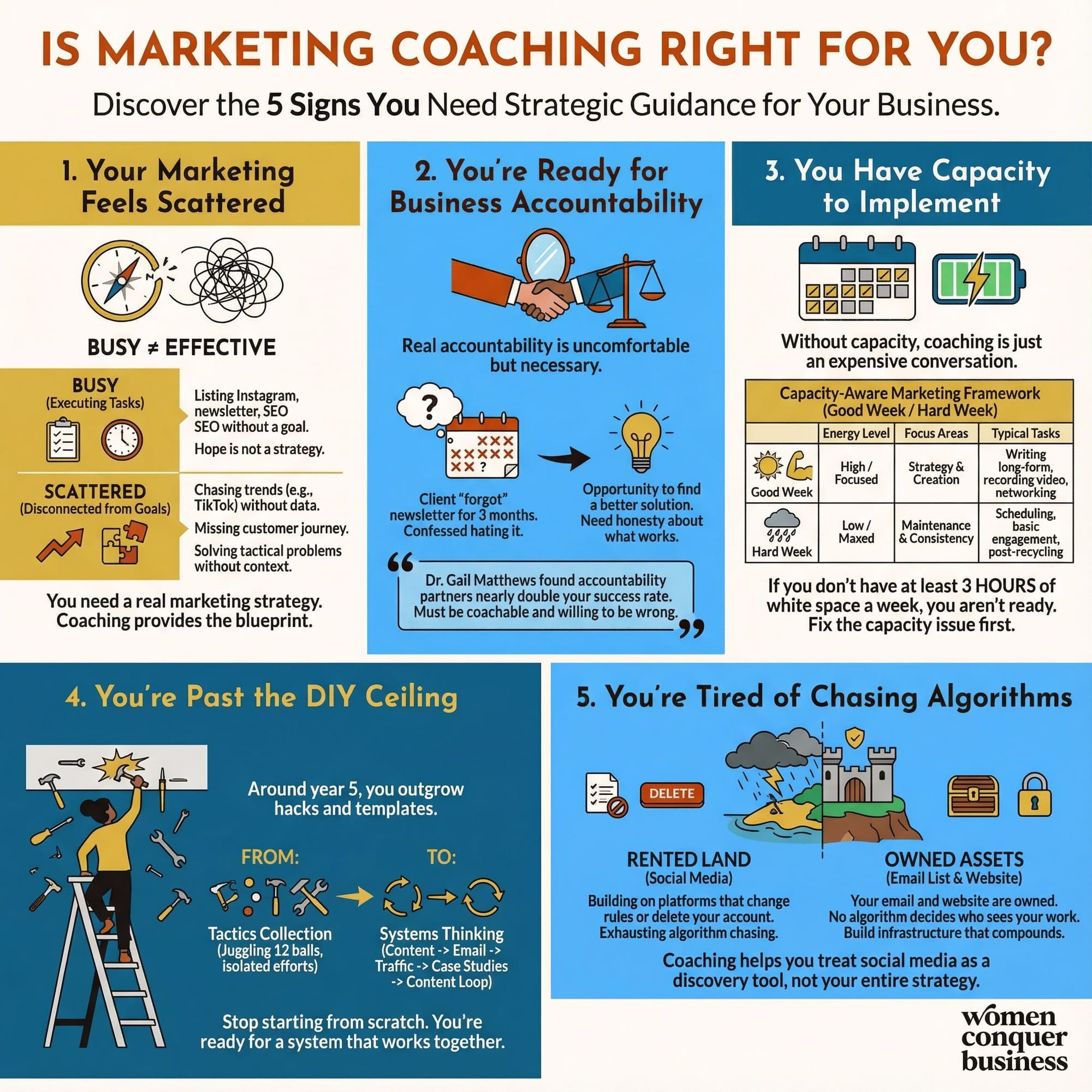
1. Your Marketing Feels Scattered
There is a massive difference between being "busy" with marketing and being "effective." Busy is executing tasks. Scattered is doing tasks disconnected from business goals.
I see it all the time. A business owner lists their week: Instagram, newsletter, Facebook groups, SEO. It sounds great. But when I ask for the strategic goal? Silence. Or the classic: "To get more clients."
That’s not a strategy. That’s hope.
Scattered marketing looks like:
- Chasing trends (LinkedIn last month, TikTok this month) without data.
- A missing customer journey. You aren't sure how people find you or why they buy. You just know they occasionally show up.
If this is you, you're likely missing a real marketing strategy. You're solving tactical problems without context. You might need a marketing operations makeover to fix the plumbing, but coaching provides the blueprint.
2. You're Ready for Business Accountability
Real accountability is uncomfortable. It means examining why you didn’t do the thing you promised.
I once had a client who "forgot" her newsletter for three months. Finally, I asked: "Do you want to send this, or do you think you're supposed to?" She admitted she hated it.
It was an opportunity to discuss a different solution. That’s the kind of honesty you need for coaching to work: insights into which processes are working and which aren't. A great coach has the expertise to provides tradeoffs, so you can do what you love AND maximize your ROI.
Dr. Gail Matthews found that accountability partners nearly double your success rate. But it only works if you're coachable. You have to be willing to be wrong about things you’ve believed for years.
3. You Have Capacity to Implement
If you can’t implement, coaching is an expensive conversation.
| Marketing Mode | Energy Level | Focus Areas | Typical Tasks |
|---|---|---|---|
| Good Week | High / Focused | Strategy & Creation | Writing long-form articles, recording video, networking |
| Hard Week | Low / Maxed | Maintenance & Consistency | Newsletter scheduling, basic engagement, post-recycling |
This is Capacity-Aware Marketing. Your strategy has to fit your life. I use a Good Week / Hard Week Planning framework with my clients because life is messy.
- Good Weeks: You’re rested and focused. You tackle the big strategic projects.
- Hard Weeks: Your kid is sick or you have a migraine. You stick to maintenance-level tasks to keep the momentum alive.
If you don't have at least 3 hours of white space a week, you aren't ready yet. Fix the capacity issue first.
4. You're Past the DIY Ceiling
Somewhere around year five, you hit a wall. You know how to get clients, but you’ve outgrown the hacks and templates.
Your marketing tactics might work in isolation, but they don't work together. It feels like juggling twelve balls at once. The shift you need is from "tactics collection" to "systems thinking."
Marketing is a loop. Your content should feed your email, which drives traffic, which creates case studies, which improves your content. If you're tired of starting from scratch every Monday, you’re ready for a system.
5. You're Tired of Chasing Algorithms
Social media is rented land.
You’re building an audience on a platform that could change the rules or delete your account tomorrow. It’s exhausting. The shift from renting to owning is the most critical move you'll make.
Your email list and your website are owned assets. No algorithm gets to decide if your subscribers see your work. A coach helps you treat social media as a discovery tool rather than your entire strategy. It’s about building infrastructure that compounds.
Cost Transparency & Hidden Costs
How Much Does a Marketing Coach Cost?
| Coaching Model | Typical Monthly Range | What’s Included | Best For |
|---|---|---|---|
| Group / Membership | $97 – $500 | Community, monthly Q&A, shared frameworks | Solopreneurs needing a framework |
| Hybrid / Intensive | $800 – $1,800 | 1–2 sessions/mo + direct support | Scaling your systems |
| High-Touch 1:1 | $2,000 – $5,000+ | Deep strategy, frequent sessions | Complex launches or team management |
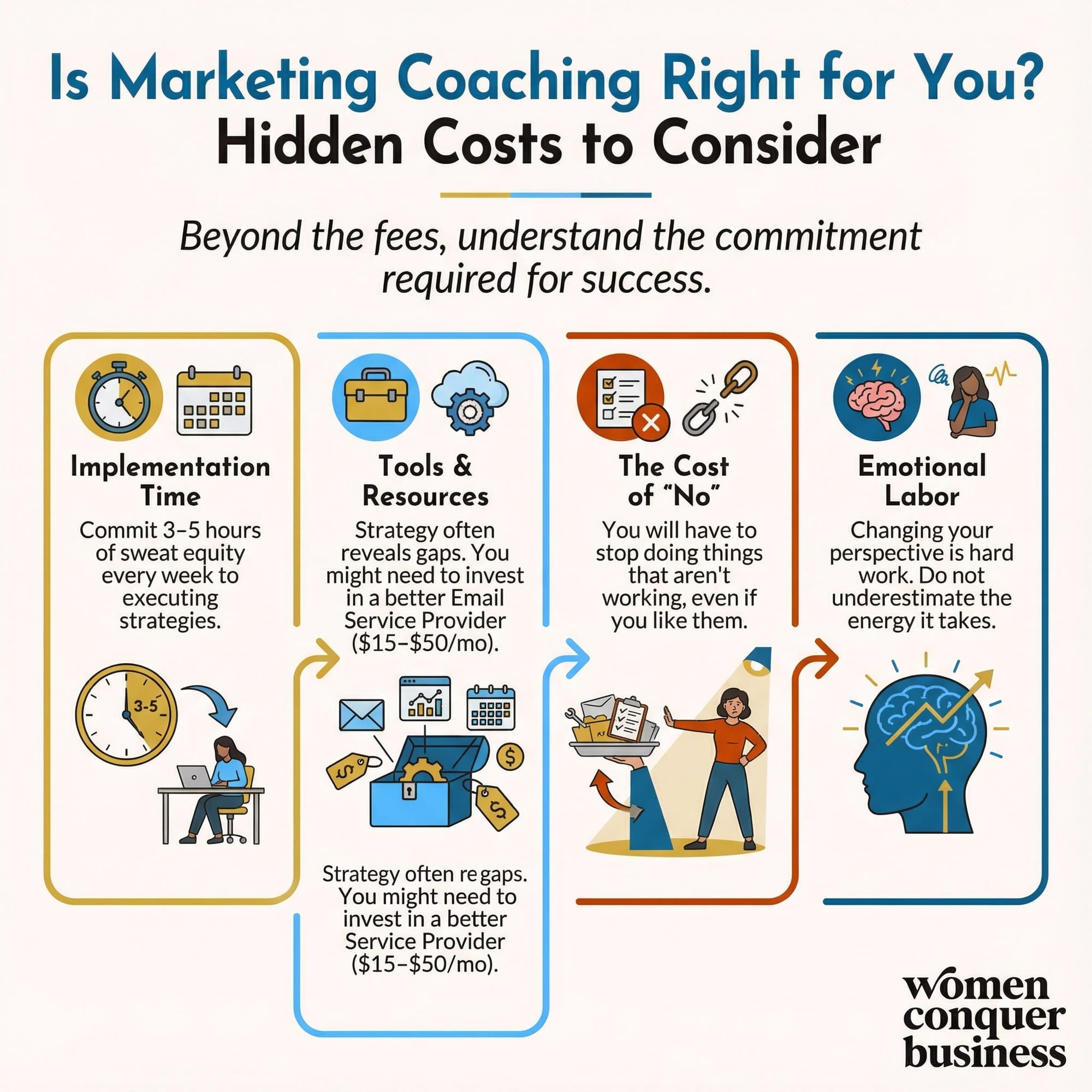
Hidden Costs to Consider
Implementation Time: You need 3–5 hours of sweat equity every week.
Tools: Strategy often reveals gaps. You might need to invest in a better Email Service Provider ($15–$50/mo).
The Cost of "No": You will have to stop doing things that aren't working, even if you like them.
Emotional Labor: Changing your perspective is hard work. Do not underestimate the energy it takes.
Closing Thoughts: Signs You Need a Marketing Coach (or Not)
Recognizing the signs is one thing. Being ready to act is another. If you're scattered, craving accountability, and ready to own your audience, coaching will change your business. It turns tactical noise into focused momentum.
But if you’re burnt out or looking for a magic button? Wait. Fix the foundation first.
If you're unsure where you land, reach out. For those who are ready, coaching provides the strategic clarity to turn marketing into a sustainable system. And if you're somewhere in between, the Strategic Marketing Membership is there to help you grow on your own timeline.
Your marketing should fit your life. Not the other way around.
FAQs: Hiring a Marketing Coach
How can I tell if my business needs a marketing coach?
You need a coach when your business model works, but your growth has stalled because you're overwhelmed by tactics. If you lack a repeatable system, coaching gives you the roadmap to scale.
What are common signs that a marketing coach could improve my strategy?
Look for decision fatigue, a scattered presence across too many platforms, and no clear link between your daily work and your revenue.
When should a small business hire a marketing coach?
Usually between years 5 and 10, when the DIY methods you used to start the business are no longer enough to grow it.
What marketing challenges indicate the need for professional coaching?
A heavy reliance on hope-based marketing and a lack of owned infrastructure (like an email list) are the biggest red flags.
How do marketing coaches help with brand growth issues?
We move you away from tactical scrambling and toward systems thinking, focusing on strategies that respect your capacity.