


Marketing coaching is a collaborative partnership where an experienced strategist helps business owners develop their own marketing skills, systems, and confidence. Unlike agencies that execute tactics or consultants who deliver recommendations, coaches focus on skill transfer, decision-making frameworks, and accountability. The goal is marketing sovereignty: building capabilities that stay with you permanently.
At a Glance
- What it is: Strategic partnership building your marketing capabilities
- Who it's for: Solopreneurs with 5-10 hours weekly, tired of courses that don't stick
- Time to implement: 6-12 months for sustainable systems
- Typical cost: $500-$3,000/month
- Skill level: Beginner to Intermediate
- Primary outcome: Marketing sovereignty and reduced overwhelm
Why Traditional Marketing Advice Fails Women Entrepreneurs
You've bought the courses. Hired the agency. Followed the "proven system" that promised to 10x your revenue. And yet here you are: exhausted, confused, and watching another $5,000 vanish into someone else's marketing machine.
You're not alone. More importantly, you're not the problem.
The marketing industry keeps selling you information when what you need is implementation. There's a difference.
Research from MIT Sloan reports that roughly 70% of development programs cannot produce lasting change. Not because the content is bad, but because the delivery model ignores how actual humans learn and apply new skills.
After 25 years in this work, from managing million-visitor websites for the City of Portland to building marketing strategy systems for solopreneurs, I've watched this pattern destroy talented entrepreneurs.
They get handed roadmaps designed for full marketing teams, then blamed when they can't execute on "Exhausted Tuesdays" when the brain won't cooperate.
This guide covers what marketing coaching is, how it differs from hiring a consultant or an agency, and how to spot predatory practices in this unregulated industry. You'll learn the 3 C's Decision Framework for evaluating your real capacity, not some fantasy version of yourself. And you'll see the true math of ROI.
No manufactured urgency. Clarity on whether marketing coaching is your next right move.
What Is a Marketing Coach? (And Why You Might Not Need One Yet)
Marketing coaching is a collaborative partnership where an experienced strategist helps business owners develop their own marketing skills, systems, and confidence. The coach provides frameworks, accountability, and guidance while the owner retains full control of strategy and execution.
Think of it this way: a consultant diagnoses problems and hands you a plan. An agency executes tactics on your behalf.
A coach? They focus on skill transfer, decision-making frameworks, and accountability.
The goal is a better marketer: you.
The Strategic Triad: Coach vs. Consultant vs. Agency
Before you spend another dollar on marketing help, understand what you're buying.
| Service Model | What They Do | Best For | Typical Investment |
|---|---|---|---|
| Marketing Coach | Builds your capabilities through guidance and accountability | Owners who want marketing sovereignty | $500–$3,000/month |
| Marketing Consultant | Diagnoses problems, delivers strategic recommendations | Specific problems needing expert diagnosis | $2,000–$15,000/project |
| Marketing Agency | Executes tactics on your behalf | Businesses with budget but no time | $2,500–$10,000+/month |
The coaching industry has exploded. ICF's 2025 Study reports $5.34 billion in revenue and 15% year-over-year growth in practitioners. That growth includes both excellent coaches and people who watched one webinar and ordered business cards.
Here's what this table doesn't show: the hidden costs.
Agency relationships often create dependency.
Consulting engagements deliver insight but not implementation. (You get a beautiful strategy document that sits in Google Drive because no one can DO IT.)
Coaching takes longer to show results. But when it works, you've built something permanent: the ability to market your own business without outsourcing your brain.
Who Needs to Hire a Marketing Coach?
Not everyone. And that's okay.
You're likely a good fit if:
- You've tried courses or DIY marketing and hit an implementation wall
- You want to understand your marketing, not just outsource it
- You have 5-10 hours weekly to dedicate to marketing work
- You've been burned by agencies or consultants who overpromised
You're probably not ready if:
- You need someone to handle it with zero bandwidth from you
- You're looking for guaranteed revenue results in 90 days
- You haven't clarified your business model or target audience yet
A good coach will tell you this upfront. The ICF Code of Ethics requires coaches to assess whether a coaching relationship is appropriate before engagement. If someone promises transformation without your active participation, that's a red flag we'll cover later.
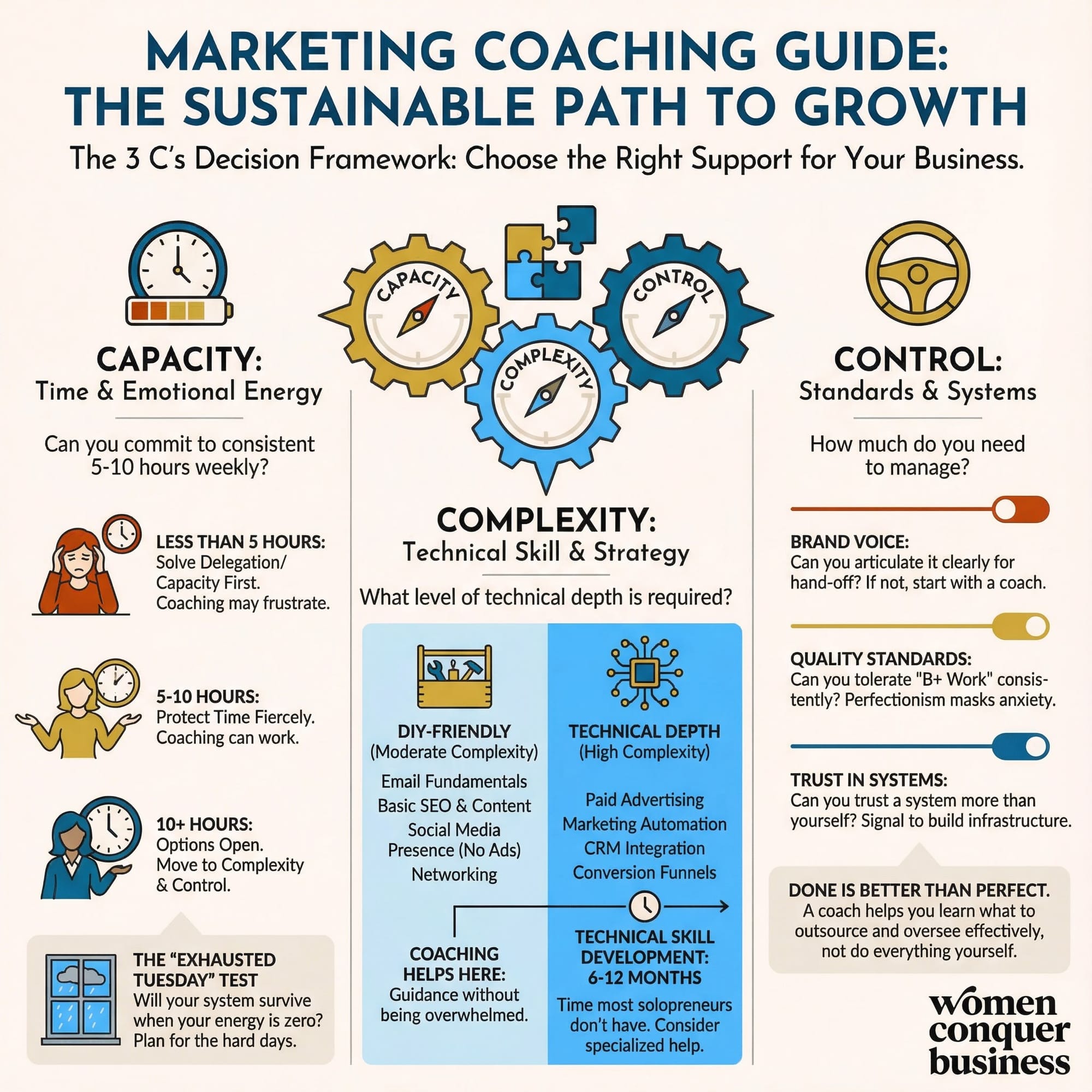
3 C's Decision Framework: Capacity, Complexity, and Control
Before you evaluate cost, before you even Google "marketing coach near me," answer one honest question: Do you have the cognitive and emotional capacity to sustain marketing consistently for 12+ months?
Most bro marketing advice skips this. They expect you to hustle and grind at full capacity with unlimited focus.
That's fantasy.
The 3 C's Decision Framework is a diagnostic tool I developed after watching too many smart entrepreneurs buy the wrong solution. It helps you figure out whether you need a coach, consultant, or agency, or whether you need to solve a different problem first.
The First C: Capacity
Capacity comes down to hours, not intelligence.
Real marketing requires consistent effort. Not heroic bursts of productivity, but steady presence: creating content, analyzing data, adjusting strategy. For most solopreneurs, that means 5-10 hours weekly of focused marketing work.
Be honest with yourself. Not "if I wake up earlier" honest. Right now, this month, what do you have?
- Less than 5 hours weekly: Coaching may frustrate you. Consider solving your capacity problem (delegation, boundaries, systems) before adding marketing to your plate.
- 5-10 hours weekly: Coaching can work, but you'll need to protect that time fiercely.
- 10+ hours weekly: You have options. The question shifts to complexity and control.
The "Exhausted Tuesday" Test: What happens at 3 PM on a rainy Tuesday when the kids are home sick and your executive function is zero? Do you have a system that survives that day? If your plan only works on good days, it's not a plan. It's a wish.
The Second C: Complexity
Some marketing tactics are genuinely DIY-friendly:
- Email marketing fundamentals
- Basic SEO and content strategy
- Social media presence (not ads)
- Networking and referral systems
Other tactics require technical depth that takes months to develop:
- Paid advertising across platforms
- Marketing automation and CRM integration
- Conversion optimization and funnel architecture
The complexity assessment has nothing to do with whether you're smart enough. It's a question of realistic skill-development timelines. There's a meaningful difference between learning to market and doing marketing for your business right now.
A coach helps most when the complexity is moderate. Challenging enough that you need guidance, but not so technical that you'd spend more time learning tools than implementing strategy.
Industry research consistently shows that technical marketing skills like paid advertising and automation take 6-12 months to develop proficiency. Time most solopreneurs don't have while running their business.
The Third C: Control
There are three layers here, and the answers are subjective. What works for your colleagues might not work for you. Take your time, and be honest with yourself.
- Brand Voice: Can you articulate how your business should sound clearly enough to hand it off? If not, you need strategic clarity first. That's a coaching problem, not an agency problem.
- Quality Standards: Can you tolerate "B+ work" done consistently? Sometimes perfectionism masks control as a response to business anxiety, not a genuine quality standard.
- Trust in Systems: Marketing done right is systematic, not heroic. If you can trust a system more than yourself to remember to post every Tuesday, that's the signal to build infrastructure.
I struggle with control sometimes, but I've learned to let some things go because done is better than perfect. If you can't let go then don't hire a consultant or agency because you won't be satisfied.
Sometimes a coach can help you realize there are some marketing things you don't want to learn (outsource those). Learn enough so you can outsource and oversee the projects effectively.
Using the 3 C's to Decide
| Decision Factor | Low Capacity (<5 hrs) | Medium Capacity (5-10 hrs) | High Capacity (10+ hrs) |
|---|---|---|---|
| Primary Goal | Operational Stability | Skill Transfer & Coaching | Execution & Scale |
| Complexity Focus | Simplified Systems | Moderate/Technical Skills | Advanced Multi-channel |
| Control Level | High (DIY Foundations) | Shared (Guided Strategy) | Lower (Delegated Tactics) |
| Recommended Path | Solve Capacity First | Marketing Coaching | Agency or Fractional CMO |
The honest answer might be: "I'm not ready for any of this yet."
That's valuable information. It means you need to work on business foundations (clarifying your offer, defining your audience, building operational stability) before marketing makes sense. A coach worth their fee will help you see this before you've signed a contract.
Beyond Hustle Culture: The Slow Marketing Revolution
The marketing world tells you to post on LinkedIn every day at 9 AM. Batch a month of content every Sunday. Wake up at 5 AM to "get ahead."
And if you can't sustain that pace? You're told you don't want it badly enough.
This is broken thinking.
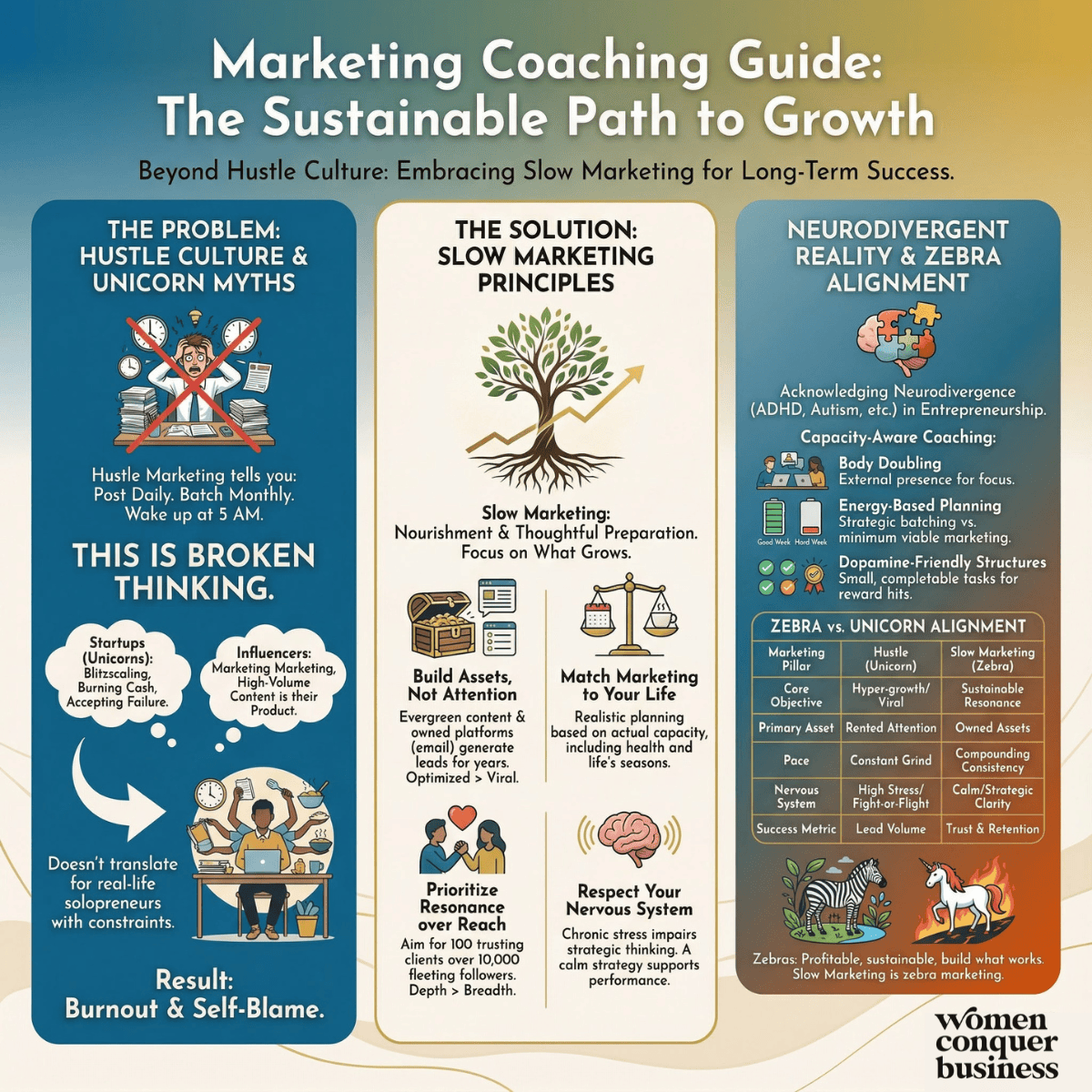
Why "Hustle Marketing" Fails Most Solopreneurs
The dominant marketing advice comes from two sources: venture-backed startups burning cash to acquire users, and influencers whose product is marketing itself. Both are male-dominated and don't consider things like caregiving or cooking dinner.
Neither translates to a service-based solopreneur managing real-life constraints.
Startups operate on "Blitzscaling" logic: grow fast, figure out profitability later, accept 90% failure rates. That math works with investor money. It's catastrophic when you're playing with your mortgage payment.
Marketing influencers have a circular business model: they market marketing. Their high-volume content strategy is their product. When they tell you to post daily, they're describing their job, not giving transferable advice for running a therapy practice.
The result? Solopreneurs adopt tactics designed for different business models, burn out trying to sustain them, and blame themselves.
Slow Marketing: A Sustainable Marketing Experience
Slow Marketing borrows from the Slow Food movement: better ingredients, thoughtful preparation, nourishment rather than filling space. The focus is what grows (like bank account interest), not constant content creation.
Core principles:
Build assets, not attention. A viral post disappears in 48 hours. A well-optimized blog post generates leads for years. Prioritize evergreen content, owned platforms (your email subscribers, your website), and systems that work while you sleep.
Match your marketing to your life. Not the life you wish you had. Your life as it exists, with school pickups, chronic illness flare-ups, and seasons where client work leaves nothing for visibility.
Prioritize resonance over reach. You don't need 10,000 followers. You need 100 people who trust you enough to hire you. Optimize for depth of connection, not breadth of exposure.
Respect your nervous system. Chronic stress degrades cognitive function and decision-making. Research shows elevated cortisol impairs working memory, executive function, and the prefrontal cortex. Those are exactly what you need for strategic marketing. A marketing strategy that keeps you in fight-or-flight sabotages your business performance.
Neurodivergent Reality
Here's something mainstream marketing rarely acknowledges: a significant portion of entrepreneurs are neurodivergent.
ADHD, autism, and other neurological differences are overrepresented among the self-employed, drawn to entrepreneurship precisely because traditional employment doesn't fit their brains.
2018 research found a significant positive connection between ADHD and entrepreneurial intention and action, with entrepreneurs showing ADHD prevalence rates notably higher than the general population.
Standard marketing advice assumes neurotypical executive function: planning ahead, maintaining daily habits, executing boring tasks without external accountability.
For many entrepreneurs, these assumptions are fantasy.
A capacity-aware coaching approach addresses this:
- Body doubling: Working alongside someone (even virtually) to provide external presence that helps focus happen. Some coaches offer co-working sessions specifically for this.
- Energy-based planning: Instead of rigid content calendars, building "Good Week" and "Hard Week" protocols. Good weeks for batch creation and strategic thinking. Hard weeks for minimum viable marketing: the automated email, the pre-scheduled post, the system that keeps you visible without requiring full capacity.
- Dopamine-friendly structures: Breaking marketing into small, completable tasks that provide reward hits. Not "create a content strategy" but "write one headline."
This builds marketing systems that work for how your brain functions, which often produces better results than forcing yourself into ill-fitting productivity frameworks.
Zebra Business Model
| Marketing Pillar | Hustle Marketing (Unicorn) | Slow Marketing (Zebra) | WCB Strategic Alignment |
|---|---|---|---|
| Core Objective | Hyper-growth/Viral reach | Sustainable resonance | Vision-mission alignment |
| Primary Asset | Rented Attention (Social) | Owned Assets (Email/Web) | Evergreen Authority Assets |
| Pace | Constant novelty/Grind | Compounding consistency | Capacity-aware execution |
| Nervous System | High Stress/Fight-or-Flight | Calm/Strategic Clarity | Human-first sustainability |
| Success Metric | Lead Volume/Followers | Trust & Customer Retention | Revenue & Life Harmony |
In venture capital, a "unicorn" is a billion-dollar startup. A "zebra" is something different: profitable, sustainable, beneficial to its ecosystem. Zebras aren't trying to dominate markets. They're trying to build something that works.
Most solopreneurs are building zebras. But they're being sold unicorn marketing strategies.
Slow Marketing is zebra marketing. It prioritizes sustainable growth over growth-at-all-costs, recognizing that steady compound growth beats volatile viral moments for most service businesses.
The right coach helps you build a zebra. The wrong one pushes unicorn tactics that will exhaust you.
ROI of Marketing Coaching (Calculating Your Costs)
Let's talk money.
Because that's the question underneath all the others: Is this worth the investment?
The coaching industry loves impressive statistics. "788% ROI!" "60% higher sales!" Industry research does support significant returns, but primarily for organizational coaching where companies invest in leadership development.
These numbers are real. They're also potentially misleading for solopreneurs. Most coaching ROI research focuses on organizational coaching, which has completely different dynamics than a solo business owner investing their own money.
Capacity-Adjusted ROI Framework
Standard ROI calculations have a fatal flaw: they treat your time as free.
Simple formula: (Revenue Gained - Coaching Cost) / Coaching Cost = ROI
But for a solopreneur, every hour on marketing is an hour not on billable client work. Your time has a cost.
The formula:
Total Investment = Coaching Fees + (Implementation Hours × Your Hourly Rate) + Tool Costs
Let's run realistic numbers:
- Coaching: $1,500/month × 12 = $18,000
- Implementation time: 8 hours/week × 50 weeks × $150/hour = $60,000
- Tools: $200/month × 12 = $2,400
- Total Year 1 Investment: $80,400
For break-even in Year 1, you'd need $80,400 in additional revenue directly from improved marketing. That's a high bar.
Patience then Performance
Marketing (like bank interest) is a compounding function. The systems you build in Year one generate returns in Years two, three, and beyond.
Think orchard, not harvest.
Year one is buying trees, preparing soil, installing irrigation. You don't harvest apples in the same season you plant.
Timeline:
- Months 1-3: Foundation. Clarifying positioning, auditing assets. Minimal revenue impact.
- Months 4-6: System building. Email sequences, content strategy, lead generation. Early traction indicators.
- Months 7-12: Optimization. Refining what works, building momentum. First meaningful attributable revenue.
- Year 2+: Compound returns. Systems mature, content ranks, reputation builds. This is where ROI math works.
OK, so this is a "best case" year one. Life will get in the way: vacations, emergencies, etc. so adjust the timeline based on your realities.
If someone promises you'll "make back your investment in 90 days," they're either lying or defining ROI so loosely it's meaningless.
| Phase | Focus Area | Expected Outcome | Time Commitment |
|---|---|---|---|
| Months 1-3 | Foundation & Audit | Strategic Clarity/Asset Map | 5-10 hours / week |
| Months 4-6 | System Implementation | Lead Gen Early Traction | 8-12 hours / week |
| Months 7-12 | Optimization | Attributable Revenue | 5-8 hours / week |
| Year 2+ | Compound Growth | Sustainable ROI/Sovereignty | 4-6 hours / week |
| Cost Basis | High Initial Effort | Moderate Maintenance | Strategic Autonomy |
Cost of Inaction
Here's the flip side: what does it cost to not get help?
The DIY Tax: How many hours watching YouTube tutorials, reading blogs, taking courses, and still not implementing consistently? Most solopreneurs I work with have spent $2,000-$10,000 on courses they barely use. MIT research shows online course completion rates hover around 3-15%, and that number hasn't improved in years.
The Mistake Tax: The agency that charged $3,000/month and produced nothing. The website redesign that didn't improve conversions. Without strategic guidance, expensive mistakes are almost inevitable.
The Opportunity Cost: Every month "getting ready to market" instead of marketing means potential clients going to competitors. If your average client is worth $5,000 and better marketing brings two additional clients monthly, that's $120,000/year in unrealized revenue.
What Good Coaching Costs
Specific pricing, because hiding this benefits no one:
- Entry-level (group programs): $300-$800/month
- Mid-tier (regular 1:1, email support): $1,000-$2,500/month
- Premium (intensive support): $3,000-$5,000/month
- Fractional CMO: $5,000-$15,000/month
These ranges align with ICF industry data showing average coaching fees around $256/hour, though marketing-specific coaching often commands premium rates because of specialized expertise.
The right investment depends on business stage. A $100K business at $2,000/month is a 24% revenue commitment, significant but potentially transformative. A $500K business at the same investment is 4.8%, much more manageable.
What's the Cost of Staying Stuck?
ROI calculations are useful but incomplete.
If your marketing works and you're growing steadily, coaching might be a nice-to-have optimization. But if you're spinning wheels, posting without a strategy, attracting the wrong clients, burning out on tactics that don't get meaningful results, the cost of continuing is enormous.
Sometimes coaching ROI isn't measurable in revenue. It's measured in hours reclaimed, stress reduced, confidence rebuilt. Those returns don't show up on spreadsheets, but they determine whether you'll still be in business five years from now.
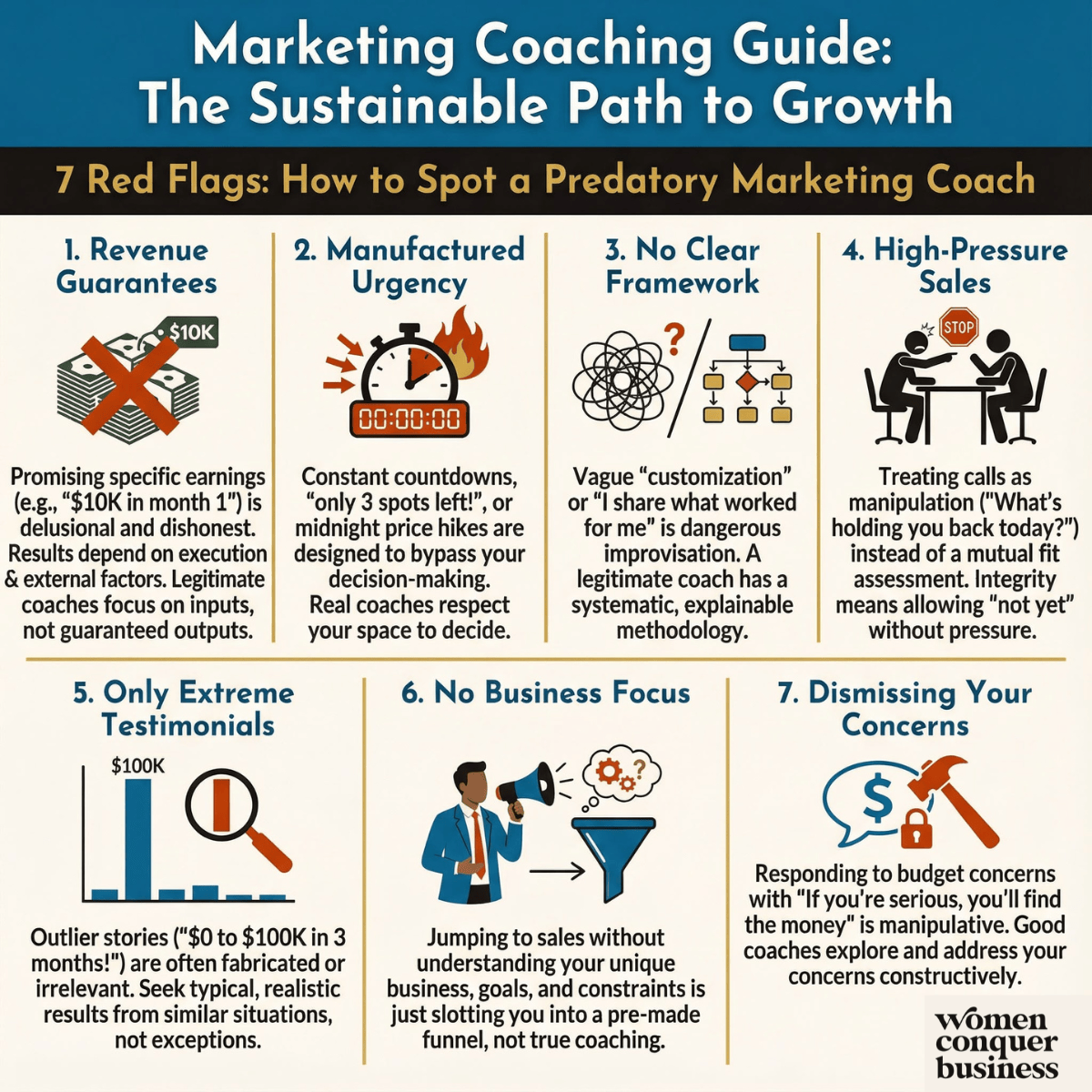
7 Red Flags: How to Spot a Predatory Marketing Coach
The coaching industry is unregulated.
Anyone can call themselves a marketing coach tomorrow. No license, no certification, no consequences for overpromising.
This creates a "Wild West" where talented professionals operate alongside outright predators. After 25 years watching this industry (and cleaning up messes left by bad actors), I've identified seven patterns that consistently signal danger.
1. Digital Marketing Revenue Guarantees
"I guarantee you'll make $10K in your first month."
This sounds reassuring. It's the single biggest red flag.
A legitimate coach knows your results depend on your execution, market conditions, and variables outside anyone's control. Guaranteeing specific revenue is either delusional or dishonest.
The FTC's Endorsement Guides require that income claims represent "generally expected results." Atypical testimonials must include clear disclosure. Revenue guarantees rarely meet this standard.
The pattern I've observed: revenue guarantees are often inversely correlated with coaching quality. The best coaches focus on inputs (strategy, execution, consistency), not promised outputs.
2. Manufactured Urgency
"Only 3 spots left!" "Price goes up at midnight!"
Real scarcity exists. But when every email contains a countdown timer, when you feel pressured rather than informed, that's manufactured urgency designed to bypass your decision-making.
A coach who respects your autonomy gives you space to decide.
3. No Clear Framework or Approach
Ask any prospective coach: "What's your methodology?"
If the answer is vague ("I customize everything" or "I share what worked for me") proceed with caution.
Customization without a framework is improvisation. A legitimate coach has a systematic approach that they can explain clearly.
"What worked for me" is particularly dangerous. What worked for someone with 100K followers doesn't transfer to a service provider starting from zero.
4. High-Pressure Sales Conversations
"What's holding you back from committing today?" "I need a decision before we end this call."
This treats the conversation as manipulation, not mutual fit assessment. A coach operating with integrity wants you to think about it. They'd rather you said "not yet" than sign up ambivalently.
5. Only Extreme Testimonials
"I went from $0 to $100K in three months!"
These outlier stories are either fabricated, cherry-picked, or represent circumstances irrelevant to your situation. FTC 2023 regulations require testimonials to represent typical results, not exceptional outcomes presented as normal.
What you want: specific testimonials from people whose situations resemble yours, describing realistic outcomes and the work required.
6. They Don't Ask About Your Business
A coach who jumps to selling without understanding your business, goals, and constraints isn't coaching. They're slotting you into a pre-made funnel.
Good coaches ask questions. They might even tell you not to hire them if someone else would serve you better.
7. They Dismiss Your Concerns
You mention budget constraints. They respond: "If you're serious, you'll find the money."
Dismissing legitimate concerns is manipulation, not coaching. A good coach engages with your concerns: explores them, addresses them, provides context.
The Ethical Alternative
What does good marketing coaching look like?
- Sales as service: The coach wants to help you make the right decision, even if that's "no."
- Radical transparency: Pricing is clear. Methodology is explained. Limitations acknowledged.
- Consensual engagement: No manufactured urgency. No pressure tactics. Space to decide.
These are the foundation of sustainable business relationships. If someone makes you feel worse about yourself to sell you something, that's manipulation wearing a coaching costume.
Rooted in Reality: Why Local Authority Matters
Here's something that surprises most people: even for digital services, local roots matter.
Google's algorithms favor businesses with a verifiable physical presence. It's an anti-fraud mechanism. Anyone can claim to be an expert on the internet, but anchoring to real-world entities creates accountability.
I'm transparent about my Portland, Oregon, base. It's not just where I live. It's where I built my professional reputation.
The "Home Base" Signal
Before starting Women Conquer Business, I managed large-scale technology projects for the City of Portland, including a website that served over a million visitors. That experience taught me how marketing works at an institutional scale and how to translate those principles for businesses without institutional resources.
Google's Quality Rater Guidelines emphasize the importance of verifiable expertise and real-world experience, what they call "experience" and "expertise" in their E-E-A-T framework. Digital-only credentials don't carry the same weight as institutional track records.
Local credentials do something that an online-only presence can't: they create verification points. If someone claims to have worked with the City of Portland, that's checkable. If they claim to be involved with organizations like Prosper Portland or the Small Business Development Center, those connections either exist or they don't.
For potential clients doing due diligence (as you should), local roots provide a paper trail that pure digital presence lacks.
Why This Matters for You
When evaluating any coach, not only me, look for anchoring.
Where are they based? What organizations have they worked with? Can you verify their professional history through sources other than their own website?
A coach who exists only as a social media presence, with no verifiable history or local connections, might be legitimate. But they might also have emerged fully formed last year with a purchased testimonial package and a rented credibility facade.
Local SEO is a service I offer and a principle I practice. My authority is grounded in specific, verifiable work with specific, verifiable organizations. That's the standard I'd encourage you to apply to anyone asking for your trust and investment.
The internet makes it easy to manufacture expertise.
Local roots make that manufacturing significantly harder.
Reclaiming Your Marketing Sovereignty
Marketing coaching builds your capability to make decisions yourself, with support, accountability, and a system that survives your hardest weeks.
The framework is straightforward: assess your capacity honestly (the 3 C's), choose a model that matches your reality, and protect yourself from predatory tactics. If Year 1 doesn't break even, that's not failure. That's planting an orchard.
What matters most is the philosophy underneath, not the tactics.
Slow Marketing builds something that compounds: owned assets on owned platforms, serving an audience that trusts you, without sacrificing your health or sanity.
That's marketing sovereignty: growing your business without renting your strategy to someone else's algorithm.
You don't need to post every day.
You don't need to hustle harder.
You need a system that works for your life, built by someone who understands that "Exhausted Tuesdays" are part of the deal.
If you're ready to explore whether marketing coaching is your next right move, I'm happy to talk. No pressure, no countdown timers. A conversation about where you are and what might help.
And if you're not ready? That's valuable information too.
The sustainable path will still be here.
Marketing Coaching FAQs
What marketing coaching services can help increase my small business sales?
We don’t believe in "magic pills." Instead, we focus on building sustainable marketing systems through 1-on-1 strategic coaching and our paid community for solopreneurs, the Strategic Marketing Membership. These services help you move away from "hustle marketing" and toward Slow Marketing, which prioritizes resonance and trust over high-pressure tactics. By auditing your assets and clarifying your positioning, we build a foundation where sales become a natural byproduct of your authority.
Which marketing coaching programs include hands-on strategy sessions?
Our 1-on-1 Strategic Marketing Coaching includes hands-on strategy sessions where we focus on skill transfer and decision-making frameworks.
Are there marketing coaches that provide ongoing support after initial training?
Training without implementation is just noise. Our 1-on-1 coaching includes continuous accountability to ensure you stay on track with your systems. For those who need a lower-intensity option, our Strategic Marketing Membership offers a paid community where solopreneurs receive consistent, monthly guidance to maintain momentum.
Which marketing coaching services help with brand positioning and messaging?
We prioritize "clear, not clever" messaging. Our coaching helps you articulate your brand voice so effectively that you can eventually hand it off without losing your identity.
Who provides marketing coaching that integrates SEO?
Jen McFarland integrates over 25 years of experience, including managing million-visitor websites for the City of Portland, into every coaching engagement. We don’t just treat SEO as a checklist; we integrate it into your content strategy so you are building evergreen authority assets that generate leads for years, not just hours. Our coaching ensures you understand the "why" behind your technical SEO decisions.
What marketing coaching options are available for local business marketing?
We offer a local SEO services to anchor your business to real-world entities, which Google’s algorithms favor as an anti-fraud mechanism. This integrates with our broader coaching to help local service-based businesses improve visibility and build local authority through verifiable physical presence and community signals.
Who provides marketing coaching tailored for service-based businesses?
Women Conquer Business is a boutique consultancy specifically built for women solopreneurs, BIPOC, and LGBTQIA2S+ founders in the professional services space. We understand the unique constraints of coaches, consultants, and creatives. Our approach is neuro-inclusive, acknowledging that many entrepreneurs have ADHD or autism and need marketing systems that accommodate fluctuating executive function.
Where to find marketing coaches that assist with marketing funnel optimization?
Optimization starts with our Marketing Operations Makeover, where we audit your current tech stack and customer journey to find "conversion killers." Instead of the predatory "ClickFunnels" hype, we help you build consensual, customer-focused funnels that respect your audience’s autonomy.