


Marketing for solopreneurs is a capacity-aware system built for one-person businesses, not hustle or high-volume tactics. This guide explains how to align marketing with the longer B2B buying cycle, reduce decision fatigue, and build owned, AI-readable authority assets that create consistent visibility without burnout.
At a Glance
- Target: Women and professional services who are solo practitioners
- Core Objective: Bridge the gap between search intent and topical authority
- Primary Frameworks: Slow Marketing, Entity Home, and the 3 C's
- Timeframe: 192-day average for B2B revenue realization
- Key Outcome: Automated AI visibility and reduced decision fatigue
Solopreneur Reality: Beyond the Hustle
Most solopreneurs feel like they're failing at marketing because people teach them tactics best suited for a scaled agency with infinite resources. That's not you.
Solo founders often face the "Sunday Night Scramble" (you're not alone... we all have). That's when decision fatigue turns strategic growth into a series of reactive tasks that drain operational capacity.
Navigating the "Messy Middle" of revenue growth requires deciding which tactics to ignore rather than adding more to a crowded plate.
Let’s address the psychological barriers of ego depletion and the economic reality of the B2B sales cycle.
Research shows that the average B2B customer journey spans 6 months from first touch to close. Yet, hustle-culture narratives often pressure founders for results within 30 days. Failing to account for this lag frequently leads to a panic-pivot, where a founder abandons marketing campaigns or content strategy right before it gains momentum.
The following sections detail the 3 C's Decision Framework to help you audit your resources effectively. We also introduce you to the entity-home strategy to ensure personal branding is easy for potential clients to grasp while being machine readable for AI citation panels.
This roadmap allows you to reclaim sovereignty from the algorithm, ensuring marketing sends trust signals so the brand can transition to AI visibility.
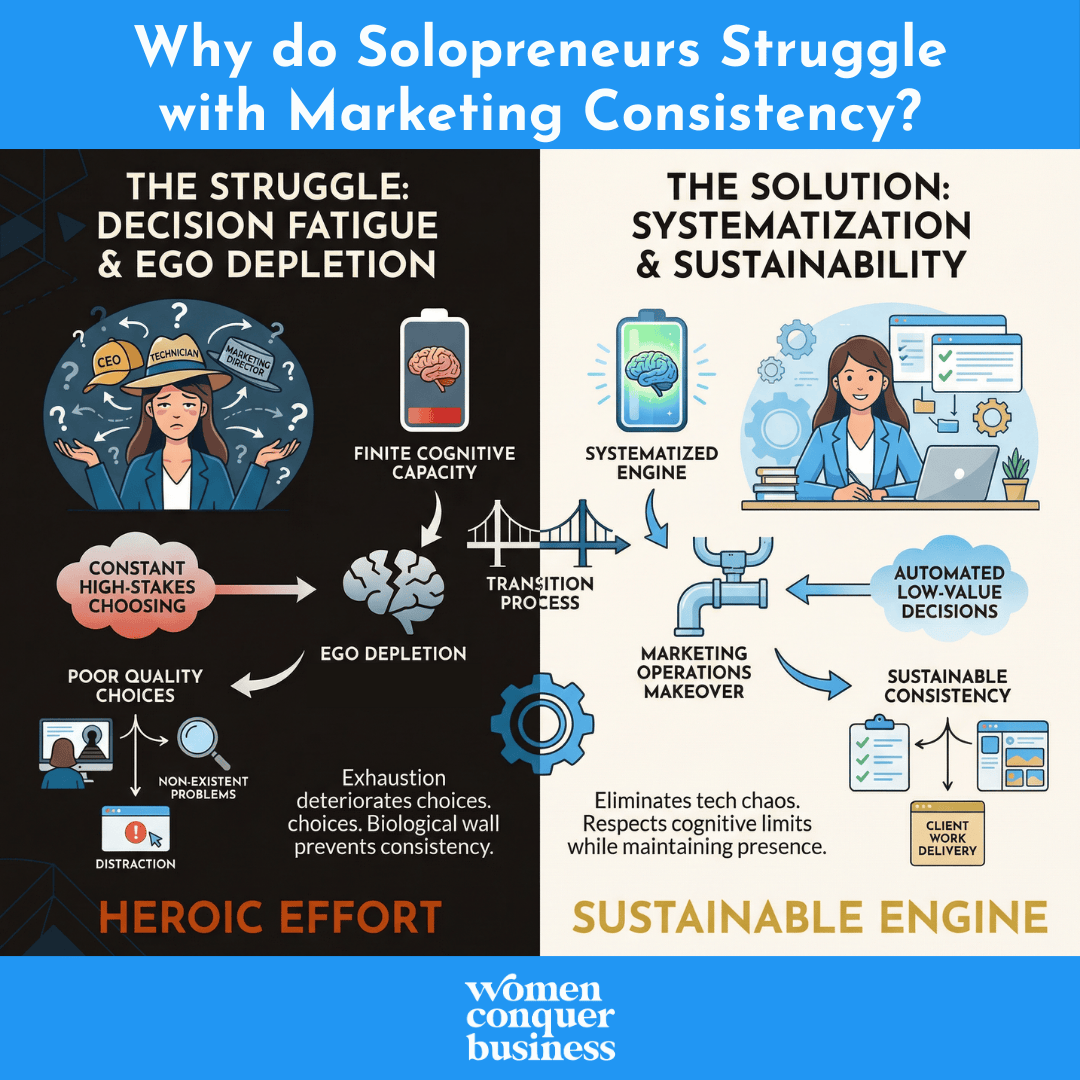
Why do Solopreneurs Struggle with Marketing Consistency?
The primary struggle with consistency in solo businesses often stems from a physiological phenomenon known as decision fatigue. A founder acting as CEO, technician, and marketing director must switch contexts hundreds of times daily.
This constant high-stakes choosing leads to "ego depletion," a resource model of volition popularized by social psychologist Roy F. Baumeister.
The prefrontal cortex has a finite capacity for complex decision-making. When this cognitive resource is exhausted, the quality of choices deteriorates.
Have you ever started going down rabbit holes at the end of the day? Searched for solutions to problems that either don’t exist, or are so small it doesn’t warrant your attention? Heck, once I researched Anderson Cooper because I was worn out and escaping whatever it was I was supposed to do. Exhaustion meant the quality of my choices deteriorated.
This biological wall is what prevents a one-person business from things like maintaining a high-volume social media presence while delivering client work. Systematization is the only sustainable solution.
Transitioning from heroic effort to systematic consistency involves a marketing operations makeover. This process eliminates tech chaos and automates low-value decisions that drain capacity. Building a sustainable engine respects your personal cognitive limits while maintaining your presence.
What is the B2B Customer Journey for Solopreneurs?
Marketing advice for solo businesses often relies on the myth of the "viral hit." However, marketing in the professional services niche is governed by much longer timelines. Evidence-based timelines show that the average contract takes over 190 days to close.
Do you know what this means? No more hustle. You have time.
The journey is complicated by the volume of engagement required. A prospect typically needs 62 touches across nearly four different channels before converting. This sounds like A LOT until you realize 62 touches is about 10 touches a month and it can be spread out across social media, email marketing, follow-ups, etc.
The biggest issue is most marketers push for a 30-day cycle. That’s the hamster wheel. A hustle-and-grind approach that burns you out. Not to mention that evaluating a strategy after only 30 days is a strategic error that ignores the data.
Research reveals that only 37% of marketing revenue impact is realized within a single quarter. Success requires the discipline to stay consistent during the full 192 days. To survive this period, you should:
- Maintain a six-month strategic horizon rather than judging success by weekly metrics
- Build evergreen authority assets that provide value whether you’re online or offline
- Review financial data: SBA statistics show that 82% of small businesses have no employees, making individual capacity your most valuable asset
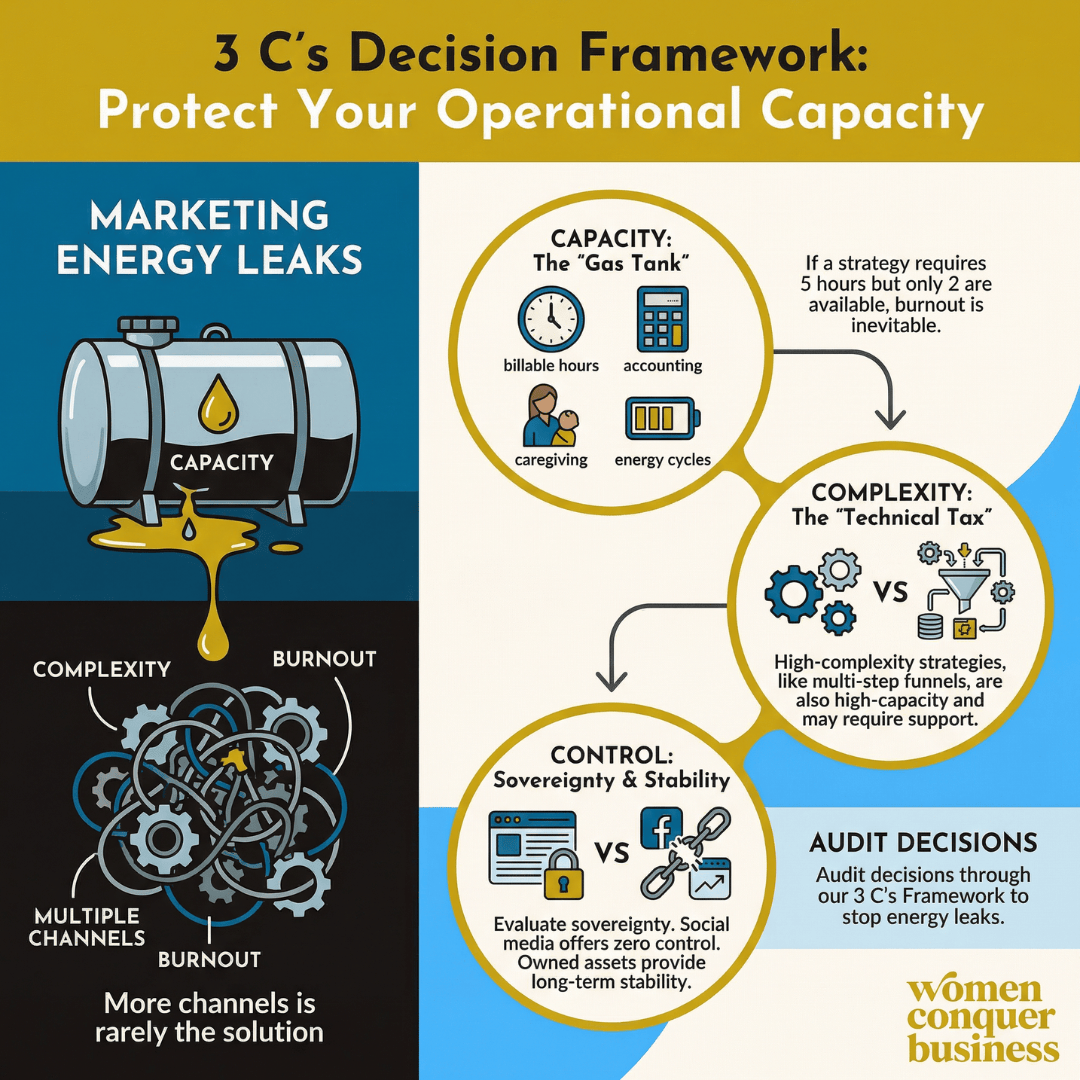
3 C's Decision Framework: Protect Your Operational Capacity
Adding more channels is rarely the solution for a resource-constrained founder. Auditing decisions through our 3 C's Decision Framework (Capacity, Complexity, and Control) helps identify where marketing leaks energy.
- Capacity: This is the "gas tank," accounting for billable hours, accounting, marketing, caregiving, and energy cycles. If a strategy requires five hours but only two are available, burnout is inevitable
- Complexity: This measures the "technical tax." High-complexity strategies, like multi-step automated funnels, are also high-capacity and may require support
- Control: This evaluates sovereignty. How much control do you want over messaging? The intricacies of each Zapier integration? Does it make sense to outsource to freelancers? It also speaks to where you want to place your marketing assets. For example, social media platforms offer zero control. The algorithm can change at any minute. But building owned assets like websites provides long-term stability
Balancing these factors allows for a marketing strategy that feels like a humming system. … but it’s tricky. You must acknowledge your energy levels, your bare minimum marketing efforts, and be willing to let go of some things.
It means you have to stop hopping on trends, pick fewer channels, and pay attention to where your customers are (and commit to being there). Protect your time. Most marketing advice is for teams, not solopreneurs. It ensures the business remains sustainable during "Hard Weeks" while capitalizing on "Good Weeks."
As a marketing strategist, I also recommend prioritizing at least one channel you own (e.g., a website) where you control the message. Dedicate time to high-value, high-trust evergreen videos, audios, or blogs to put on your website. These are compounding marketing assets.
If you have questions about where to find your potential customers, start by asking your current clients, and then embark on in-depth target audience research. Your local SBDC office may have free or low-cost market research to help you learn more about your customers.
Opportunity Cost of DIY: Calculating the Manual Tax
DIY marketing for a solopreneur is never "free." The time spent wrestling with social media or tech chaos has a specific financial cost known as the Opportunity Cost Formula:
Cost = (Effective Hourly Rate x Hours Spent) + Opportunity Cost
For a consultant billing $250 per hour who spends ten hours a month on low-value tasks, the direct cost is $2,500.
However, the true loss is the Opportunity Cost. That’s the revenue lost by not spending those ten hours on client delivery. Over a year, this manual tax can exceed $100,000 in lost billable potential.
This math helps founders evaluate whether to hire a consultant or invest in marketing coaching services. Understanding the financial trade-offs of the opportunity cost formula makes automation a logical business move.
Engineering for AI Visibility: Entity Home Strategy
One of the unfortunate realities is that marketing changes, sometimes incredibly rapidly. This industry is currently undergoing widespread disruption: social media platforms bought and sold, the rise of video, etc., but nothing compares to how AI has changed marketing.
People use AI not only for creating content, but also for search. AI referral traffic is currently growing 165x faster than organic search.
This means understanding enough so that your evergreen content marketing efforts aren’t in vain.
Here’s a quick explanation. Traditional SEO focuses on keywords, but AI search models like ChatGPT and Perplexity prioritize concepts it can cite. These are called entities. An entity is a well-defined person, place, or thing that search engines can identify and relate to other concepts (via machine learning).
I recommend building a source of truth to boost your AI discovery. This is typically your About page, where you showcase who you are, what you do, and where to find you (e.g., LinkedIn), including press mentions.
Capturing this requires a specific format called the semantic triple, a grammatical structure that tells a machine exactly who a person is: Subject + Predicate + Object. For example: Jen McFarland (Subject) is the founder of (Predicate) Women Conquer Business (Object).
To learn more, read our post about how to get cited by ChatGPT.
The best part? Taking these steps will also improve your traditional search results.
More than that, these actions can help your business grow for years (much longer than the fleeting attention you get from a social media post), making it a core strategy for solo business owners who have good weeks and hard weeks.
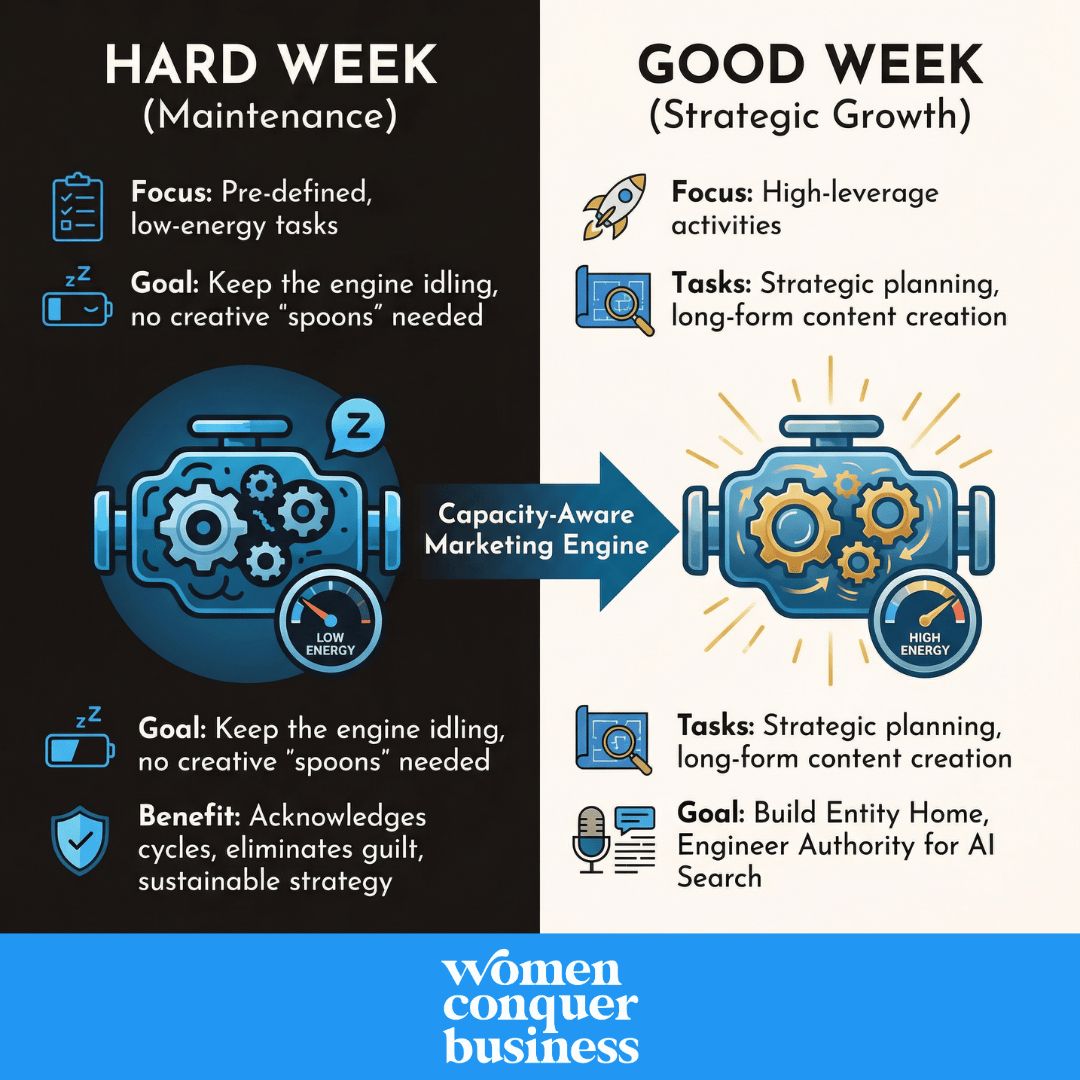
Neuro-Inclusive Marketing Engine: The Good Week vs. Hard Week Plan
Standard marketing advice ignores the reality of neurodivergence, illness, or caregiving. A capacity-aware alternative is the good week, hard week plan.
This system recognizes that energy fluctuates.
During a good week, your focus remains on high-leverage activities: strategic planning and long-form content creation. These are the moments to build the entity home and engineer authority for AI search engines.
During a hard week, the focus pivots to maintenance.
Pre-defined, low-energy tasks keep the engine idling without requiring creative "spoons." Acknowledging these cycles eliminates guilt and ensures that the marketing for solopreneurs strategy remains sustainable. It is about doing the right things at the right time.
Reclaiming Your Marketing Sovereignty
Sustainable marketing requires a capacity-aware system. By balancing the 3 C's, founders protect cognitive resources while building an entity home that AI models can verify. This shift respects the 192-day B2B journey, allowing for trust-building without the pressure of a scramble.
The next step is auditing current efforts. Identify tactics draining billable time through a high manual tax and those building long-term sovereignty. For founders overwhelmed by tech chaos, professional system updates can streamline delivery. Women Conquer Business provides the clarity needed to navigate these strategic trade-offs.
Success in a one-person business is about doing the right things consistently over a six-month horizon. While AI and algorithm shifts appear daunting, focusing on owned assets provides a stable foundation. Reclaim sovereignty from the algorithm and choose a path that respects both humanity and revenue goals.
FAQs: Marketing for Solopreneurs
What is a solopreneur?
A solopreneur is a small business owner who operates without employees and is responsible for all strategy, delivery (products or services), and marketing. Unlike freelancers, solopreneurs typically sell expertise-based services and rely on trust, authority, and long-term visibility rather than volume or virality.
What are the biggest marketing challenges for solopreneurs?
The biggest challenges are decision fatigue, limited capacity, and unrealistic expectations about speed. Most solopreneurs struggle to stay consistent because marketing advice often assumes team support, short sales cycles, and unlimited energy.
What marketing strategies are most effective for solopreneurs with limited resources?
The most effective strategies prioritize owned assets and compounding returns, such as a clear website, email list, evergreen content, and SEO. Fewer channels, systematized workflows, and long-term visibility outperform high-effort, short-term tactics.
How can solopreneurs define and highlight their unique value?
Solopreneurs define their unique value by clearly articulating who they help, what problem they solve, and why their perspective is different. Using entity-based language and consistent positioning helps both humans and AI systems understand and trust their expertise.
How can solopreneurs build and engage an email list?
Solopreneurs build email lists by offering practical, problem-solving lead magnets and sending consistent, low-pressure emails. Email works well because it is an owned channel that supports long B2B decision timelines without requiring constant content creation.
How can solopreneurs effectively use social media for marketing?
Social media is most effective when used as a distribution channel, not the foundation of a strategy. Repurpose your long-form content, set firm boundaries around time spent, and avoid relying on platforms they do not control.
How can solopreneurs use content marketing to attract clients?
Client-attracting content focuses on clarity, specificity, and real-world experience. Instead of chasing trends, solo businesses should create evergreen content that addresses buyer questions across the full B2B journey and shows credibility.
How can solopreneurs manage their time for marketing tasks?
Effective time management requires systemization, not willpower. Separating “good week” strategy work from “hard week” maintenance tasks allows solo businesses to stay visible without relying on constant motivation or high energy.
What tools and platforms can streamline marketing for solo business?
The best tools reduce decisions and automate low-value work, such as email platforms, simple CRMs, scheduling tools, and website analytics. The goal is not more software, but fewer manual tasks competing with billable client work.