


Marketing coach termination is the formal process of ending a professional relationship when strategic outcomes, values, or technical standards are not met. It involves auditing performance data, identifying ethical breaches like "bro marketing," and securing digital assets before professionally exiting a contract to protect business sustainability and reclaim strategic clarity.
At a Glance
- What it is: A diagnostic guide for auditing and terminating failing coaching relationships.
- Who it’s for: Solopreneurs and small team service business owners currently in a coaching contract.
- Time to implement: 2–4 hours for relationship audit and digital asset protection.
- Typical cost: $0 (termination saves future coaching fees).
- Skill level: Intermediate (requires business owner authority and technical account access).
- Primary outcome: Reclaimed marketing budget, protected business assets, and restored strategic confidence.
That tight knot in your stomach after another coaching call? The one that leaves you more confused than when you started? That's not resistance. That's your gut telling you the numbers don't... add... up.
Deciding to fire a marketing coach is about reclaiming your business. Research on cognitive bias shows we double down on losing investments (e.g., business coach) specifically because we've already paid, not because the return makes sense.
The coaching industry (the unethical coaches, that is) has perfected the language to make your valid concerns sound like personal weakness. You ask "Why isn't this working?" and get "You need to work on your mindset." That's deflection, which won't help you grow your business.
This guide covers when it's the right time to fire your coach, and how to catch red flags early. It covers the technical red flags (e.g., vanity metrics vs. cost per lead) and manipulative/predatory psychological tactics that signal poor behavior and an immediate termination conversation.
We close out with guidance protecting your digital assets before ending the relationship.
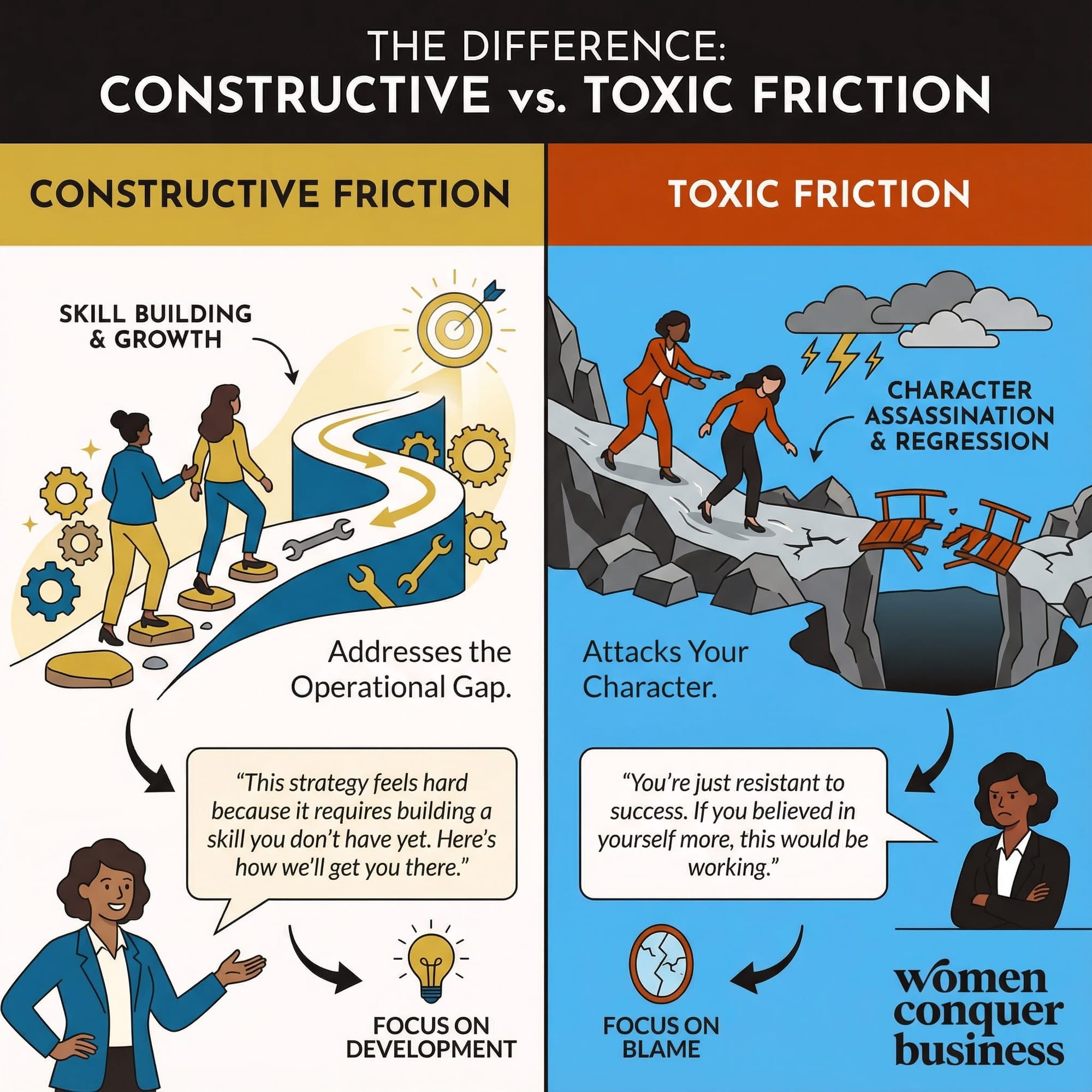
Resistance to Change: Why We Stay in Toxic Coaching Relationships
The sunk cost fallacy makes us keep investing in something (time, money, energy) simply because we've already invested. Not because it's working. Just because walking away feels like "wasting" what we already spent.
Psychologists Arkes and Blumer documented this effect: participants who paid more for theater tickets attended more plays, even when they didn't enjoy them. Sound familiar?
You paid $5,000 for a six-month program. Month three arrives. Nothing has changed. Your coach keeps telling you to "trust the process." The rational move? Cut your losses. But your brain screams: I can't quit now, I've already paid!
This is exactly what predatory coaches count on.
The difference between constructive friction and toxic friction
Good coaching should push you outside your comfort zone. But there's a line.
Constructive friction sounds like: "This strategy feels hard because it requires building a skill you don't have yet. Here's how we'll get you there."
Toxic friction sounds like: "You're just resistant to success. If you believed in yourself more, this would be working."
One addresses the operational gap. The other attacks your character. If your experience feels more like character assassination than skill building, it's time to audit your marketing coaching relationship.
7 Signs It's Time to Fire Your Marketing Coach
1. They Push Bro Marketing Tactics You Hate
You hired them for authentic growth. Now they're demanding countdown timers, fake scarcity, and shame-based sales copy. This is beyond misaligned. It's manipulation.
What is bro marketing?
High-pressure psychological tactics designed to bypass critical thinking and force purchases through fear. The FTC has identified (and cracked down on) these patterns in business opportunity scams: misleading promises, manufactured urgency, and testimonials that don't reflect typical results.
Common tactics include:
- False scarcity: "Only 3 spots left!" (when the product is digital)
- Manufactured urgency: Arbitrary deadlines to trigger panic
- Pain agitation: Making prospects feel "broken" to position the product as the only cure
Sustainable businesses aren't built on manipulation. They're built on marketing strategy that respects your audience's autonomy. If a coach mocks ethical marketing as "playing small," fire them.
2. Hustle Culture Coaching Sessions
Hustle culture and bro marketing walk hand-in-hand. If your coach assumes you have infinite time, they're not the right fit. You know you're working with someone like this when, if you cannot execute a 40-hour-per-week marketing plan while delivering to clients, they blame your commitment.
Research shows that between 70% and 42% of business owners experienced burnout in the past month. The solution isn't "more hustle"; it's a realistic strategy.
Your coach's strategies need to pass the "Hard Week" test: Can this strategy survive if you get the flu for three days? If not, it's a failure of design, not discipline. At Women Conquer Business, we prioritize capacity-aware systems over the "be everywhere" mandate.
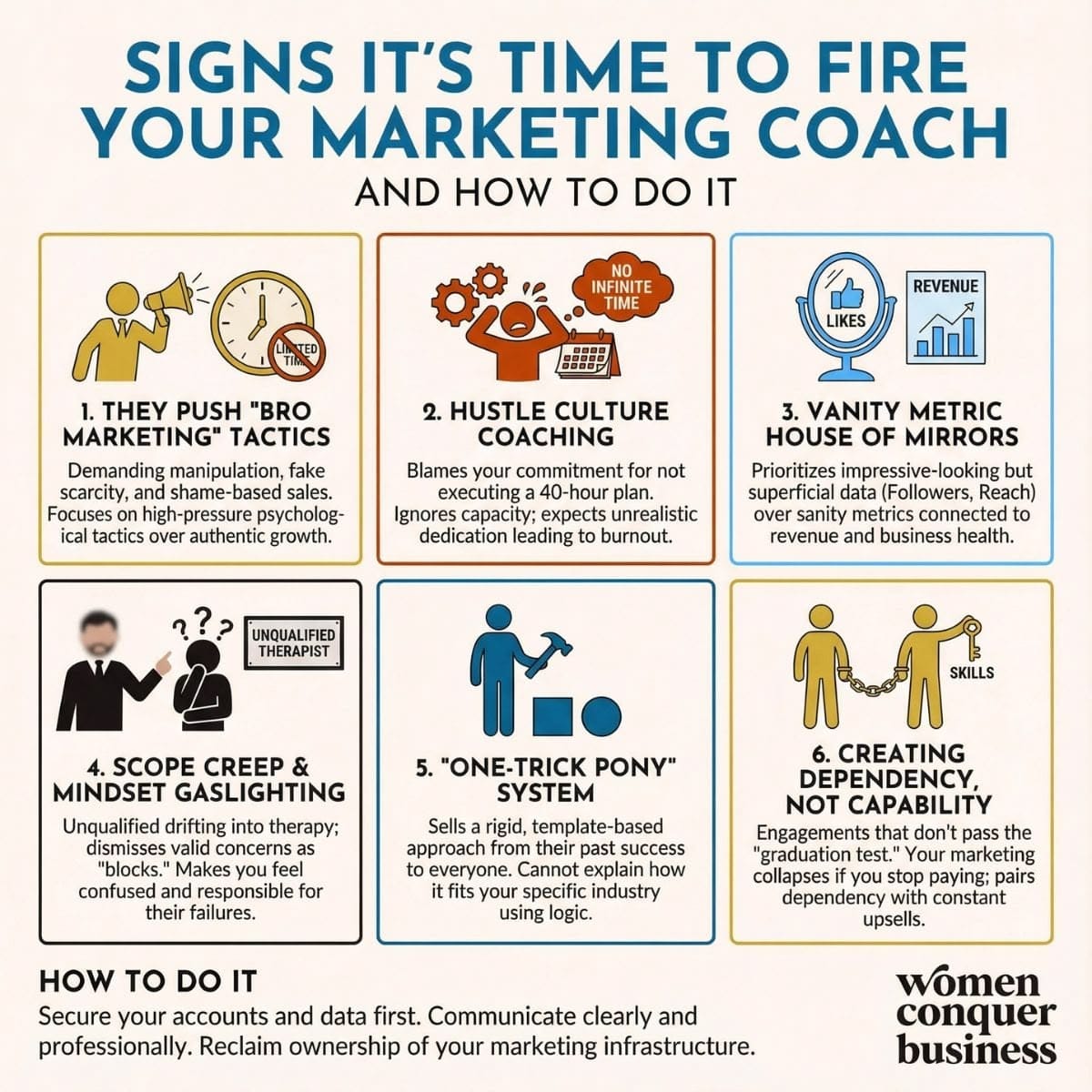
3. Vanity Metric House of Mirrors
Vanity metrics look impressive but don't connect to revenue. Sanity metrics measure business health. Marketing analytics experts define vanity metrics as data points that superficially show performance but don't help you achieve your goals.
| Vanity Metric | Sanity Metric |
|---|---|
| Followers | Engagement rate |
| Reach | Click-through rate (CTR) |
| Views | Watch time + conversions |
| Impressions | Cost per lead (CPL) |
| Likes & comments | Customer acquisition cost |
While a marketing coach rarely manages things like 'cost per lead' (an agency is hands on, a coach builds your capacity), they should guide you through strategies and tactics that do more than impressions or brand awareness.
A good marketing coach sets clear expectations based on your business growth goals. The right coach will steer you away from vanity metrics and help you build capacity around revenue-generating metrics.
4. Scope Creep and Mindset Gaslighting
Marketing coaching draws on performance psychology, but it is not therapy. When coaches drift into processing trauma or mental health issues, they step outside their scope.
APA ethics standards exist to protect people so that properly trained professionals handle mental health concerns. A marketing coach is not qualified to diagnose, treat, or unpack psychological trauma.
Some coaches take it even further and cross the line into gaslighting (e.g., minimizing your concerns to trap you in the coaching engagement).
A 2023 study in Frontiers in Psychology conceptualized workplace gaslighting and found that one of its core dimensions is “trivialization” behaviors that minimize or invalidate someone’s legitimate concerns rather than engaging with them as real and meaningful.
The gaslighting indicators: After sessions, you feel:
- Confused about what's real
- Guilty for questioning the process
- Responsible for failures that aren't yours
If your coach dismisses valid concerns as blocks, you're being controlled, not coached.
5. Top Coaches Aren't One-Trick Ponies
This is the Guru Trap. A coach achieved success in one context and sells it as a "proven system" to everyone.
The introvert gets told to "go live every day."
The B2B consultant gets the B2C social media playbook.
The coaching industry remains largely unregulated. If your coach can't explain why their approach fits your specific industry using logic (not testimonials) they're a template salesperson.
6. They're Creating Dependency, Not Capability
Many coaches create engagements that don't pass the graduation test.
If you stopped paying today, would your marketing collapse?
- If yes, you've bought a dependency
- If no, you've internalized the skills
Predatory coaches pair dependency with new programs to unlock the next marketing "secret."
The FTC regularly identifies these deceptive marketing practices as unlawful when they mislead consumers (e.g., unsubstantiated promises of success, pressure to buy additional products, and the use of testimonials that don’t reflect typical results).
These patterns are often seen in high-ticket coaching offers that rely on mystification and constant upsells instead of clear, evidence-based value.
7. Technical Hostage Taking
If you're in a 'done with you' marketing coaching engagement, and the coach takes over your marketing accounts, this is a firing offense.
You own your data. Your ad accounts, analytics, domain, and email list are business assets. A coach who refuses admin access to your own marketing operations infrastructure is holding your business hostage.
Secure these BEFORE terminating:
- Domain registration (e.g., GoDaddy)
- Website hosting credentials (e.g., Siteground, Squarespace)
- Email list export access (e.g., MailChimp, MailerLite)
- Google Analytics/Meta Ads Manager
You should always be the person paying the bills for core marketing services: domain, website, email, email marketing, etc.
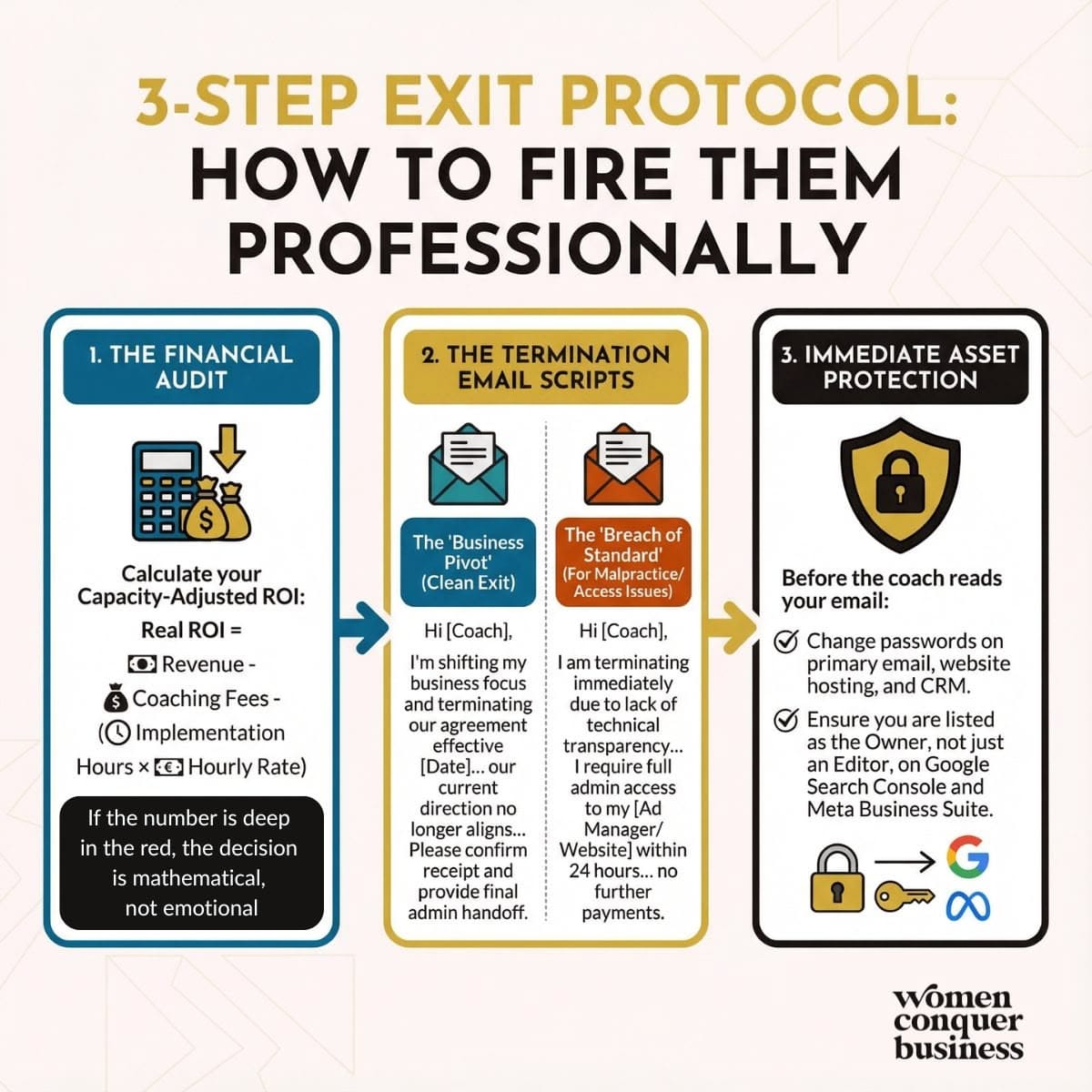
3-Step Exit Protocol: How to Fire Them Professionally
1. The Financial Audit
Calculate your Capacity-Adjusted ROI:
Real ROI = Revenue - Coaching Fees - (Implementation Hours × Hourly Rate)
If the number is deep in the red, the decision is mathematical, not emotional.
2. The termination Email Scripts
The "Business Pivot" (Clean Exit):
"Hi [Coach], I’m writing to let you know that I’m shifting my business focus and will be terminating our coaching agreement effective [Date]. I appreciate the time you've spent, but our current direction no longer aligns with my operational capacity. Please confirm receipt and provide final admin handoff for [Platform X]."
The "Breach of Standard" (For Malpractice/Access Issues):
"Hi [Coach], I am terminating our contract immediately due to a lack of technical transparency regarding [Account Access/ROI Reporting]. Per our agreement, I require full admin access to my [Ad Manager/Website] within 24 hours. I will not be making further payments as the agreed-upon technical standards have not been met."
3. Immediate Asset Protection
Before the coach reads your email, change the passwords on your primary email, website hosting, and CRM. Ensure you are listed as the Owner, not just an Editor, on Google Search Console and Meta Business Suite.
Reclaiming Your Strategic Confidence
Walking away from a bad coach isn't a "waste" of the money you've already spent; it's a protection of the money you have left.
If you're unsure if you need a coach, a consultant, or an agency, our breakdown on marketing coach vs consultant can help you decide. If you want support without the "bro" culture, consider a marketing membership designed for sustainable growth.
Trust your numbers. Trust your nervous system. You and your business deserve better.
FAQs: When It's Time to Get Out
How do I handle a contract with no termination clause?
Most professional services contracts have an implied "performance" standard. If they aren't providing the service promised, they are in breach. Consult with a legal professional, but often, a firm "Pivot" email stops the billing cycle.
Should I hire a new coach right away?
No. Take 30–60 days to audit your own marketing strategy. Reconnect with your "Zebra" goals and reclaim your intuition before inviting a new voice into your business.
Quick Reference: The Red Flags Checklist
| Category | Green Flag | Red Flag |
|---|---|---|
| Values | Ethical, consent-based | Pressure or shame tactics |
| Metrics | Clear KPIs, ROI tracking | Vanity metrics, hidden data |
| Boundaries | Business-focused scope | Pseudo-therapy creep |
| Flexibility | Custom strategy | One-size-fits-all approach |
| Capacity | Respects your time | Hustle-at-all-costs mindset |
| Access | Full admin access | Data gatekeeping |
| Outcome | Clarity and confidence | Confusion and stagnation |
If the right column describes your experience, you have your answer. Reach out if you need help to navigate your next strategic move.