


Streamlined marketing reduces marketing complexity by identifying the fewest activities that drive the most results, then building repeatable processes around them. It prioritizes owned assets like email and website content over scattered platform activity, helping solopreneurs maintain consistent visibility without burnout.
At a Glance
- What it is: A system for cutting marketing noise and focusing on what produces results
- Who it's for: Solopreneurs and small service businesses doing their own marketing
- Time to implement: 2-4 hours for the initial audit, then ongoing
- Typical cost: Time-based (most changes are free or use existing tools)
- Skill level: Intermediate (requires honest self-assessment, not technical skill)
- Primary outcome: Less marketing activity that produces equal or better results
Who this is NOT for: If you're launching a brand new business and need to build awareness from zero, now isn't the time to subtract. You need volume first. This guide is for established owners who already have clients and revenue but whose marketing has become unsustainable.
You don't have a marketing problem. The problem is too much marketing. As in, it's everywhere, overwhelming, and confusing.
In 2024, Constant Contact found more than half of small business owners have an hour or less each day for marketing. And 52% routinely put it off in favor of other work. If that’s you, you’re not alone. Marketing has become this sprawling, guilt-inducing to-do list that never feels done.
Here's what I see in client work: burned out owners running an email newsletter, two or three social platforms, a blog they haven’t updated in months, a podcast they started and stopped, and a nagging feeling that they need to add more channels. The energy goes out, but nothing comes back in a way she can measure.
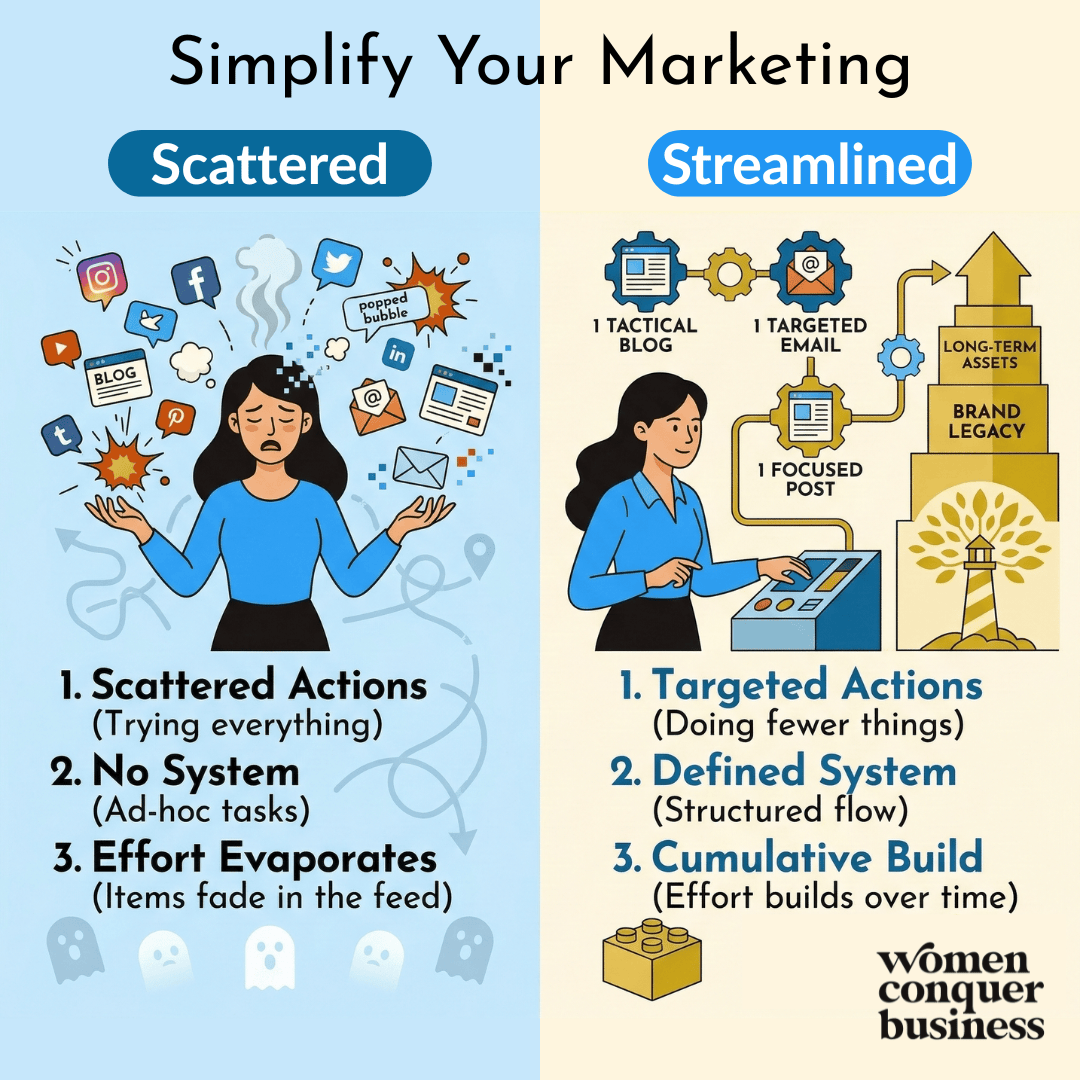
Streamlined marketing means doing fewer things on purpose, with a system behind them, so the effort you put in builds something over time instead of evaporating into the feed.
The Problem With Your Marketing Efforts
Most women I work with are not underperforming because they're doing too little. It’s quite the opposite. They're scattered. Six platforms, four content types, no strategy connecting any of it.
The result looks like effort, and it certainly feels like it. But it doesn't produce results proportional to that effort.
Random acts of marketing is not a marketing strategy.
If the problem were laziness or lack of knowledge, the answer would be "try harder" or "learn more." But when the problem is fragmentation, the answer is subtraction. You need to figure out which two or three activities drive revenue, referrals, or meaningful visibility, and drop the rest.
Does that feel scary? It should, a little. We've been trained to believe that showing up everywhere equals professionalism. That a quiet Instagram means a dying business.
But in client work, I consistently see the opposite: business owners who narrow their focus get more traction, not less. Why? Because once you stop spreading yourself out too thin, you have the time to learn what works. I have clients who rely on SEO and LinkedIn, and couldn’t be happier with the results.
Don’t Confuse Streamlined with Automation (or Easy)
Streamlined does not mean automated. It’s very common for a business owner to read an article about marketing operations and conclude that what they need is a more marketing automation, three new integrations, and a 12-email automation sequence.
More, more, more. No. Simplify. If things aren’t working, don’t add more complexity. That’s like adding salt to a recipe when you accidentally put in too much sugar. It doesn’t work.
Streamlined means: you have identified what works, dropped what doesn't, and created a repeatable rhythm for the things that remain. It's closer to cleaning out a closet than buying a new organizational system for a closet that's full of clothes you don't wear.
It also doesn't mean easy. The hardest part of streamlining your marketing is the audit itself, because it requires you to look honestly at what's working and what you've been keeping alive out of habit or guilt.
That social media account you spent six months building but hasn't generated a single lead? Letting it go feels like throwing away effort, even when the effort wasn't paying off. But it's worth it.
Four Questions to Improve Your Workflow
Before you change your marketing, you have to see it clearly. Set aside two hours (yes, block the time) and answer these four questions in writing.
Reality Check
- Setup effort: Medium (2-4 hours for the full audit)
- Ongoing effort: 15-30 minutes per month to revisit
- Tools required: A spreadsheet or notebook. Nothing fancy.
- When results typically show: Within 30-60 days of implementing changes
- Common misconception: That streamlining means cutting everything to one channel. It means cutting what's not working so you can invest more in what is.
What's producing results right now?
Look at the last 90 days. Where did your last five paying clients come from? Not where you think they came from. Where they told you, in the intake form or on the first call. For most service-based businesses, the answer is some combination of referrals, email, and search traffic. Social media is rarely in the top two, even for people spending hours on it each week.
What are you doing out of guilt or habit?
That LinkedIn posting schedule you don't enjoy and can't connect to a single client? The blog you publish to every other week because someone told you "content is king"? If it's not producing results and it drains your energy, it's an ideal candidate for removal.
What could you stop for 30 days with zero consequences?
Run the experiment. Pause one channel or activity for a month. If nothing changes in your inquiries, traffic, or revenue, you have your answer. I ran a comprehensive review of my 2025 analytics. I was shocked to learn that only 18 people from LinkedIn made it to my website. I dropped LinkedIn like a hot potato. Probably not forever, but it told me I need to recalibrate my approach when I have more energy to circle back to it.
What's the one thing you'd keep if forced to choose?
For most service-based businesses, the answer is email. And the data backs that up. Litmus research found email generates an average return of $36 for every $1 spent, outperforming social media, paid search, and display ads. Email is an owned asset. Nobody can throttle your reach with an algorithm change, and no platform sunset takes your subscriber list with it.
Streamline Processes, Not the Schedule
Once you've finished the audit, resist the urge to create a new content calendar. Calendars are a symptom of scattered marketing. What you need instead is a system: a small set of repeatable marketing processes that connect to a logical outcome.
For most solopreneurs, a streamlined marketing system looks something like this:
- Platform for producing consistent content (blog, podcast, or YouTube, choose one, not all three)
- Email list you send to regularly (biweekly or monthly, whatever you can sustain during a terrible week)
- One social channel used for distribution, not as a primary platform
- Referral or networking rhythm that you can maintain without burning out
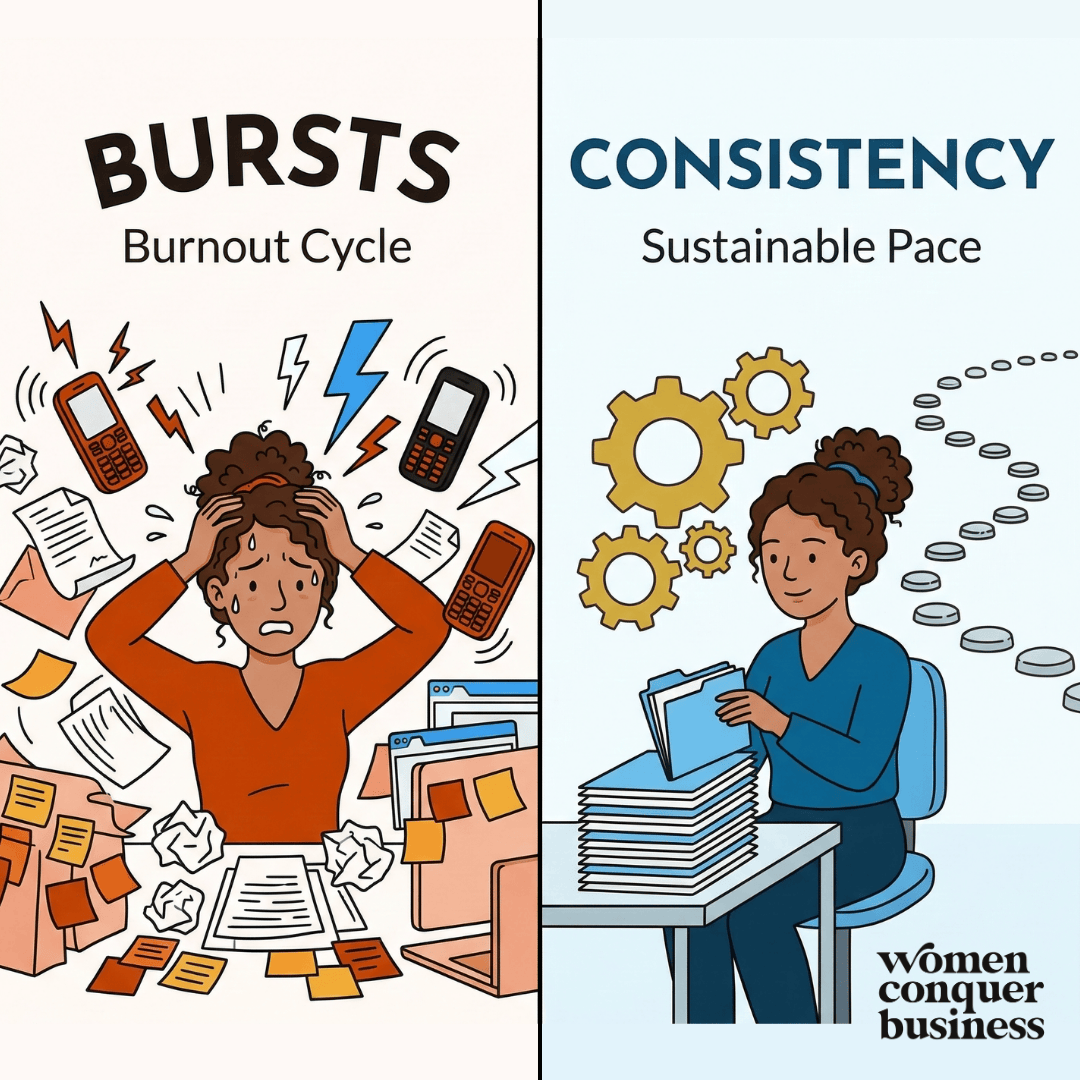
That's it. You don't need to do more within each category. Consistency at a pace you can sustain, even during a slow week, beats volume.
This is the core of what I call slow marketing. It sounds counterintuitive to business owners who've been told speed matters. But marketing that respects your capacity, that you can maintain through a bad month or a family emergency or a week where you don't feel like being visible, produces better results over 12 months than a burst of activity followed by silence.
Research shows that only 18% felt “very confident” in the effectiveness of their marketing. That makes sense when you consider how many channels they're trying to maintain.
Narrowing to two or three commitments doesn't sound like a confidence-builder, but it's the first thing that makes marketing feel manageable again.
When Streamlining Your Marketing Goes Wrong
Streamlining isn't risk-free. There are a few common ways it breaks down.
- Cutting email for social. Some people "streamline" by dropping their newsletter and focusing on Instagram because it's easier. Easier, yes. But you've traded an owned asset for rented space. If Instagram changes its algorithm (and it will), your visibility disappears. Your email list doesn't have that problem.
- Automating without strategy. Automation is useful after you've identified what works. Before that, it speeds up the wrong things. I've seen business owners spend weeks building an email automation sequence for leads who would never convert because the lead magnet didn't match the offer. The automation wasn't the issue. The thinking behind it was.
- Confusing "less visible" with "less effective." When you stop posting on three platforms and narrow to one, your reach numbers will look smaller. That's fine. Reach without conversion is a vanity metric. What matters is whether the right people find you, and what they do next. If your website traffic stays steady and inquiries hold, a smaller audience footprint is doing its job.
- Dropping everything at once. Don't make several changes in one week. Phase out one thing, wait 30 days, evaluate. Then decide on the next cut. Gradual change lets you see what each piece was (or wasn't) contributing.
Streamlining your marketing won't feel productive at first. It'll feel like you're doing less. You are. The question is whether "less" means fewer random activities that weren't working, or fewer strategic ones that were. If you did the audit honestly, it's the former. Start there. Cut one thing this week, give it 30 days, and see what happens. If you want help figuring out where to start, reach out.
Frequently Asked Questions
How do I know what marketing to cut?
Start with the 90-day audit. Look at where your last 5-10 clients came from. If a marketing channel isn't on that list, it's a candidate. Pair that with an honest energy check. If something drains you and doesn't produce results, drop it. If something drains you but produces results, consider outsourcing it before cutting it. Marketing coaching can help you sort through this if you feel stuck.
Can I streamline marketing if I only have 3-5 hours a week?
Yes, and honestly, that's the person this is designed for. With 3-5 hours a week, you can write and send one email, publish one blog post or repurpose existing content, and show up briefly on one social platform. The structure matters more than the volume. One email a week to 200 subscribers will do more for your business than scattered posts across five platforms that nobody responds to.
What's the minimum marketing a solopreneur needs?
An email list and a way to get found (search, referrals, or one active platform). Everything else is optional. That sounds aggressive, but the solopreneurs I've seen grow steadily over years share this in common: they picked one or two channels, committed to them, and ignored the noise. If you want ongoing support and accountability for building that focused approach, our marketing membership is built for it.