


The best marketing support isn’t the cheapest option. It’s the one you’ll actually finish. DIY and courses often fail due to low completion and high opportunity cost. For established solopreneurs, expert-led communities or coaching usually deliver the highest ROI because they provide accountability, reduce decision fatigue, and protect your time.
At a Glance:
DIY Marketing
Best for: Pre-revenue businesses
Tradeoff: Lowest cash cost, highest time and burnout risk
Online Courses
Best for: Learning a single, specific skill
Tradeoff: Low completion rates and little personalization
Paid Communities
Best for: Accountability, peer support, and consistency
Tradeoff: Requires expert leadership to avoid bad advice
Marketing Coaching
Best for: Established businesses needing custom strategy
Tradeoff: Higher cash cost, lower risk of wasted time
Choosing between marketing coaching and courses isn't about which one costs less. It’s about which one you’ll finish (and benefit from the most).
After working with over 200 solopreneurs at Women Conquer Business, here's what we've learned: most business owners invest in three or four courses before admitting they need something different. It's not that the courses are bad. They're often excellent. It’s just that completion rates for self-paced marketing programs hover around 10-15%.
That means 85-90% of people who buy courses don’t finish them.
Think about that. A $297 course becomes significantly more expensive when you calculate the cost per lesson actually implemented. (And let's be honest, we've all got a few "shelf-help" modules gathering digital dust. ... myself included)
Choosing a support modality isn't just about education. It's about matching a structure to what we call the 3 C's: capacity, complexity, and control. Most advice assumes you have 15 hours a week for implementation and perfectly stable energy. But if you're an experienced solopreneur, you're likely stretched thin. You're juggling a lot. And you're tired.
This guide explores four popular marketing support options: DIY marketing, online courses, paid communities, and coaching, providing you with a framework for making the best choice for you.
Solopreneur Marketing in 2026
We've moved from a lack of information to an overwhelming noise problem. The challenge isn't finding tactics, but deciding which ones to ignore.
The Noise-to-Signal Problem and Decision Fatigue
The human brain has a finite capacity for high-quality decision-making. Research in behavioral psychology Baumeister et al., demonstrates that "decision fatigue" leads to poor strategic choices. Or, more commonly, total paralysis.
For a solopreneur, this shows up as the Sunday Night Scramble. That’s the panic of not knowing what to post or who to email. It leads to a flurry of disconnected actions that yield zero results. It’s exhausting.
Hustle Culture vs. Slow Marketing
We are seeing a massive pushback against "hustle culture." You know the vibe: that you must be on every platform, every day, and grind yourself up at the expense of your sanity. At Women Conquer Business, we advocate for a Slow Marketing approach. This philosophy emphasizes sustainability over speed. We prioritize owned assets (e.g., your email marketing list) over rented land like social media.
The goal is to build marketing systems that fit your real life.
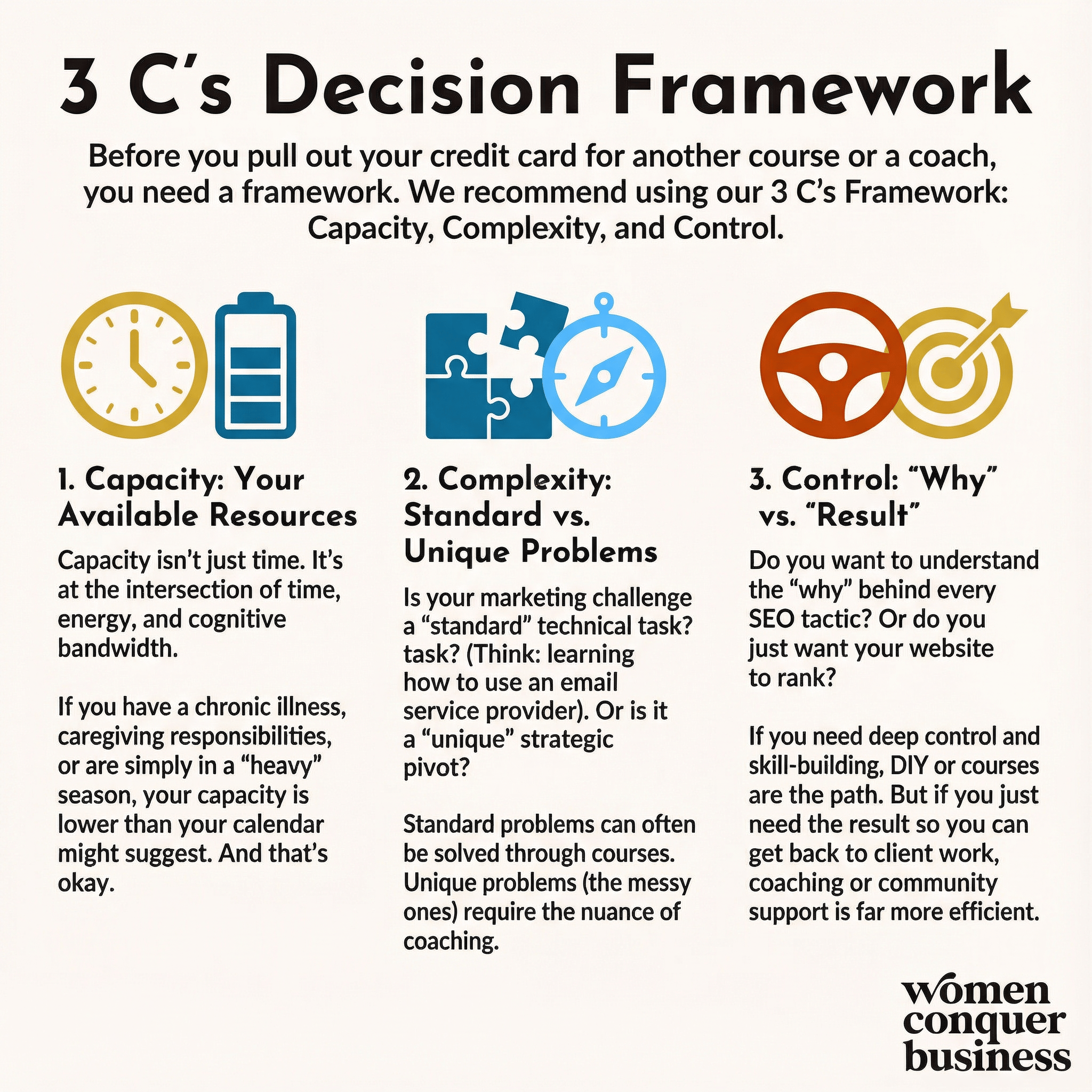
3 C's Decision Framework
Before you pull out your credit card for another course or a coach, you need a framework. We recommend using our 3 C's Framework: Capacity, Complexity, and Control.
1. Capacity: Your Available Resources
Capacity isn't just time. It’s at the intersection of time, energy, and cognitive bandwidth. If you have a chronic illness, caregiving responsibilities, or are simply in a "heavy" season, your capacity is lower than your calendar might suggest. And that’s okay.
2. Complexity: Standard vs. Unique Problems
Is your marketing challenge a "standard" technical task? (Think: learning how to use an email service provider). Or is it a "unique" strategic pivot? Standard problems can often be solved through courses. Unique problems (the messy ones) require the nuance of coaching.
3. Control: "Why" vs. "Result"
Do you want to understand the "why" behind every SEO tactic? Or do you just want your website to rank? If you need deep control and skill-building, DIY or courses are the path. But if you just need the result so you can get back to client work, coaching or community support is far more efficient.
1. DIY Marketing: Hidden Costs of Free
DIY marketing requires you to be the researcher, strategist, technician, and analyst. While it preserves cash, it's often a false economy for established businesses.
Financial Illusion of Free
For example, if you bill $150/hour and spend 15 hours a week Googling things like "how to set up an email funnel," DIY is "costing" you $117,000 a year in lost billable time. That’s a massive salary you’re paying yourself to do something you might not even like.
Start-Stop Cycle
In our work with over 200 clients, we consistently see the DIY start-stop cycle. It starts with enthusiasm for two or three weeks. Then comes the inconsistency. Finally? Complete abandonment within three to six months. Without external accountability, marketing is usually the first thing to drop when you get busy.
Freemium Trap
Free tools often hit hard limits exactly when your business grows. The "cost" of migrating data from three different free tools to one professional system is usually higher than the subscription would have been.
Reality Check: DIY Marketing
- Setup effort: Very High
- Ongoing effort: 10-15+ hours per week
- Best For: Pre-revenue businesses with more time than money
2. Online Business & Marketing Courses: Shelf Help
Marketing courses are the "shelf-help" of digital marketing. People who may or may not be experts create a course (or free resource) promising a transformation for a relatively low price, but they rarely address the implementation gap.
The Completion Crisis
Multiple studies confirm that completion rates for self-paced online courses hover around 10-15%. If you spend $1,000 on a course and only complete 10%, you aren't saving money. You're paying for a digital bookmark.
Online Course Contextual Blindness
Digital courses teach "best practices" for a hypothetical business. They can't tell you whether a strategy won't work for your specific industry. For example, if a course creator tells you to "post five times a day" but you're a therapist with a full caseload, that advice is useless. (And frankly, a little insulting to your schedule.)
Courses vs Neurodiversity: Dopamine + Self-Paced Struggles
For the about 30% of entrepreneurs who are neurodivergent, self-paced learning is often a setup for a shame spiral. ADHD brains often crave the dopamine hit of buying a course. But they lack the executive function support to initiate the modules without external structure. It's just how your brain is wired.
Reality Check: Online Courses
- Typical cost: $97–$2,000+
- Best For: Learning a very specific, discrete technical skill (like "How to use Canva")
3. Paid Communities for Solopreneurs (Online Courses and Coaching)
Communities like our Strategic Marketing Membership combine peer support with expert frameworks. They bridge the gap between "I'm doing this alone" and "I have a team."
ROI of Peer Accountability
According to research from the American Society of Training and Development (ASTD), your probability of completing a goal increases to up to 95% when you have a specific accountability appointment with someone.
Great paid communities for solopreneurs provide this "peer pressure" in a supportive, helpful way.
Beware the Echo Chamber
The risk to communities is the "blind leading the blind." A peer might suggest a tactic that worked for them but is wrong for your business model. You need a community that is expert-led and includes group coaching (like the Strategic Marketing Membership) to ensure the advice you're getting is sound. Otherwise, you're just trading one type of noise for another.
Reality Check: Communities
- Ongoing effort: 2-5 hours per week
- Typical cost: $27–$500/month
- Best For: Solopreneurs who feel isolated and need a "marketing team" of peers
4. Marketing Coaching: Business Model Specific Partnership
Marketing coaching sessions are personalized, accountability-driven support. Think of a coach as a personal trainer, not a surgeon.
Marketing Consulting vs Coaching
A consultant is a surgeon. They do the work for you.
A coach is a personal trainer. They design the program. They watch your form. They push you to finish the sets.
But? You still do the "push-ups." This is critical because it builds your own marketing strategy muscles so you can eventually work independently.
Courses vs Coaching: Multiplier Effect and ROI
Studies from the International Coaching Federation reveal that 86% of organizations report a high ROI from one-on-one coaching. This ROI comes from "mistake avoidance." It’s about avoiding a $5,000 spend on ads that won't convert because your landing page isn't ready.
Compare this to completion rates for self-paced marketing programs, that hover around 10-15%, that might not even fit your business model.
Coaching Program and Body Doubling
For neurodivergent entrepreneurs, a coach also acts as executive function support. The real-time feedback helps you prioritize. They break complex projects into small steps, giving you a strategic roadmap. Most importantly, they provide the "body doubling" effect needed to actually start a task.
Reality Check: Marketing Coaching
- Ongoing effort: 2-4 hours per week
- Typical cost: $500–$3,000/month
- Best For: Established businesses ($100k+) looking to scale without burning out
12-Month Cost Projection: Economic Analysis
Standard cost-benefit analysis only looks at the cash outlay. Our total economic cost model factors in opportunity cost and implementation risk.
Cost Projections by Modality
| Modality | Cash Cost (Avg) | Time Investment | Opportunity Cost | Total Economic Cost | Risk of Failure |
|---|---|---|---|---|---|
| DIY | $600 | 15 hrs/week | $117,000 | $117,600 | Very High |
| Course | $1,500 | 10 hrs/week | $78,000 | $79,500 | High |
| Community | $1,200 | 8 hrs/week | $62,400 | $63,600 | Moderate |
| Online Coaching | $12,000 | 5 hrs/week | $39,000 | $51,000 | Low |
Assumptions: Consultant billing: $150/hr, 52-week year.
For established businesses, hiring a coach is often the cheapest option. Why? Because it protects your most valuable asset: your time.
Human Cost: Neurodiversity and Mental Health
About 40% of entrepreneurs identify as neurodivergent. If you have ADHD, the "Boom and Bust" marketing cycle is likely your biggest enemy. Psychwire attributes this to the frequent ADHD pattern of hyper-focus → overexertion → burnout/crash. If this is you, awareness is the first step.
Boom and Bust Cycle
You hyper-focus for two weeks. You flood the world with content. Then? You go silent for two months because you're burnt out. This "boom" destroys your audience's trust. It makes the algorithm ignore you. A coach or an expert-led community provides the "stabilizer" needed to maintain a sustainable rhythm.
Cognitive ROI
We often ignore cognitive ROI, the return of mental energy to the founder. When you stop worrying about "what to do next" because you have a coherent plan, that energy returns. It goes back to your client work, your family, and your self-care.
Difference Between Online Courses and Coaching: The Decision Matrix
Use the table below to map your situation to the best modality.
| Your Situation | Best Modality | Why? |
|---|---|---|
| Pre-revenue / Testing | DIY or Community | Preserve cash while you validate your offer. |
| $50k–$100k / Overwhelmed | Strategic Membership | Guided frameworks at an accessible price. |
| $100k+ / Growth plateau | Marketing Coaching | You need custom strategy to break through. |
| Fast scaling / No time | Coaching + Marketing Operations | You need systems that run without you. |
| Neurodivergent / Stuck | 1:1 Coaching | External structure is a necessity for your brain. |
The Value of Thinking
Consistent marketing compounds like interest. If you buy a course in January, join a mastermind in March, and hire a coach in June, you’re resetting your progress. Every. Single. Time.
Pick the option you can sustain for 12-24 months.
What a solopreneur pays for in coaching is more than a plan. It’s the development of strategic thinking. In a world of AI and automation, the ability to think strategically is your most priceless asset.
If you're tired of guessing, Women Conquer Business can help you figure out your path. Whether it's through our paid community for solopreneurs or one-on-one coaching, the goal is a business that sustains you, not one that drains you.
Ready to stop scattered marketing? Reach out today.
FAQs: Online Course vs Coaching Program
How much should I spend on marketing support based on my revenue?
While every business differs, we generally see these patterns:
- Under $50k revenue: $500–$2,000 annually.
- $50k–$100k revenue: $2,000–$5,000 annually.
- $100k–$250k revenue: $5,000–$15,000 annually.
- $250k+ revenue: $15,000–$30,000+ annually.
What is the biggest mistake people make when choosing support?
Choosing based on where they are now instead of where they are heading. A Year 3 business investing in Year 1-level courses won't get the strategic depth required to scale. The second biggest mistake is "modality-hopping"—switching every 3 months before any single strategy can compound.
What if I’ve bought courses before and never finished them?
You aren't lazy. You likely lacked the external accountability your brain needs to start complex tasks. Shift to a modality with live appointments or "body doubling" to bypass this barrier.
Key Takeaways
- Completion is the metric: Don't buy what you won't finish.
- Opportunity cost is real: DIY "free" marketing is often the most expensive option.
- Neurodiversity matters: ADHD entrepreneurs often need external accountability.
- Consistency compounds: Stick with one modality for at least 12 months.