Coaching vs Consulting: Leaving You Confused?
Most business owners choose the wrong type of support. Not because they picked a poor provider, but because they didn't understand what they needed.
The confusion makes sense. When you search "marketing coach vs consultant," you'll find a dozen different definitions, all contradicting each other. Some coaches do consulting. Some consultants offer coaching. Agencies promise everything.
And everyone's trying to convince you that their model is the one that works.
I've spent 25+ years on every side of this equation. I started as an in-house marketer, moved into public service websites, fixed agency messes as a consultant, and now run marketing coaching and consultancy specifically for established solopreneurs.
This guide breaks down three options: marketing coach, marketing consultant, and marketing agency, with transparent pricing, real timelines, and a decision framework that helps you figure out which one (if any) makes sense for your business right now.
By the end, you'll know exactly which type of marketing support matches where you are today. Not where you "should" be.
Where you are today.
What Is a Marketing Coach?
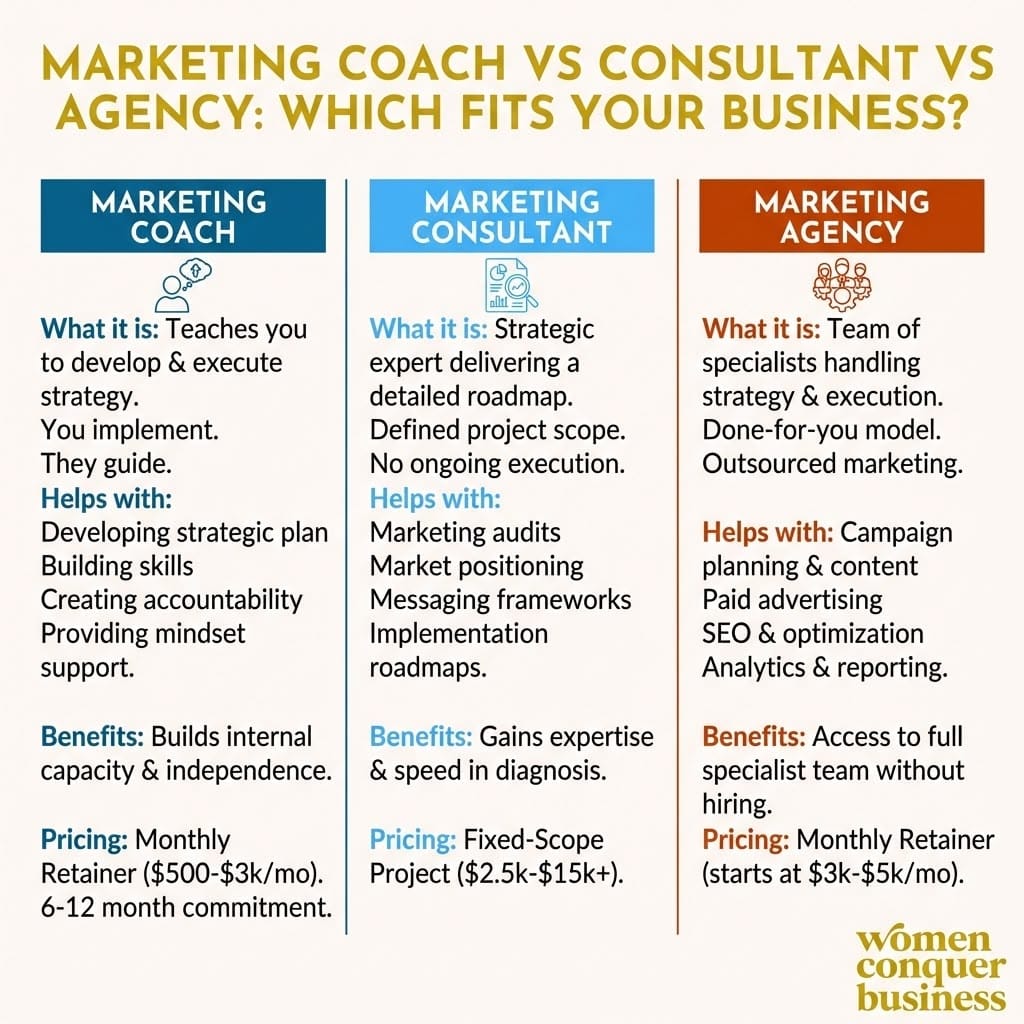
A marketing coach is a professional who teaches you how to develop and execute your own marketing strategy through one-on-one guidance, skill-building, and accountability support. You remain responsible for all implementation work while the coach provides strategic direction, personalized training, and consistent feedback to help you market more effectively.
Think of it like having a personal trainer for your business visibility.
The trainer doesn't do your push-ups. They show you proper form, design your workout plan, spot you when things get heavy, and hold you accountable when you'd rather skip leg day. Marketing coaching works the same way. You're doing the work, but you've got an expert in your corner making sure you're not wasting effort on exercises that don't build the muscles your business needs.
What a marketing coach typically provides:
- Strategic marketing plan tailored to your business goals and capacity
- Skill development in specific areas (SEO, email marketing, content strategy, social media)
- Accountability structures that keep you consistent
- Feedback on your marketing execution and messaging
- Mindset support around visibility, selling, and sustainable marketing
- Frameworks and systems you can maintain long-term
What a marketing coach does NOT do:
- Write your blog posts, emails, or social media content
- Manage your accounts or campaigns
- Create your graphics or videos
- Build your funnels or automations
- Take over your marketing tasks
The fundamental difference? You're learning to fish, not being brought fish. This matters because marketing skills compound. The systems you build with a coach stay with you after the coaching relationship ends. You're not dependent on someone else to keep your marketing running.
Typical engagement structure: Monthly retainer ($500-$3,000/month) with weekly or bi-weekly calls, email or messaging support between sessions, and access to proprietary frameworks or training materials. According to the International Coaching Federation, professional coaches average $272/hour, with business and marketing coaches typically charging higher rates. Most coaching relationships run 6-12 months minimum because skill-building and behavior change take time.
What Is a Marketing Consultant?
A marketing consultant is a strategic expert hired to analyze your current marketing, identify specific problems or opportunities, and deliver a detailed roadmap or solution within a defined project scope. Consultants provide specialized expertise and strategic thinking but rarely handle ongoing implementation. You receive the strategy and execute it yourself or with your team.
Here's the key distinction from coaching: consultants are project-based problem-solvers, not ongoing skill-builders.
You bring them a specific challenge. They analyze it, apply their expertise, and hand you a solution. Then they're done (unless you hire them for another project). There are no weekly accountability calls or "how do I do this?" hand-holding. You get expert thinking, not training wheels.
Common consulting projects include:
- Comprehensive marketing audits identifying what's working and what's broken
- Marketing strategy development from scratch or strategic pivots
- Competitive analysis and market positioning
- Funnel optimization and conversion rate improvement
- Messaging and brand clarity projects
- SEO audits and implementation roadmaps
- Product launch strategy and planning
What marketing consultants deliver:
- Strategic documents (marketing plans, positioning statements, messaging frameworks)
- Analysis and recommendations (audit reports, competitive research, data analysis)
- Implementation roadmaps (step-by-step plans with priorities and timelines)
- Initial setup support (campaign structure, tracking implementation, tool configuration)
- Expert problem-solving on specific challenges
What marketing consultants typically do NOT provide:
- Ongoing execution after deliverables are complete
- Training you to execute the strategy yourself
- Day-to-day marketing management
- Long-term accountability or check-ins
- Content creation or campaign management
The value proposition is expertise and speed. A good consultant can diagnose problems and create solutions in weeks that might take you months to figure out yourself. But once they hand you the roadmap, implementation success depends entirely on your capacity to execute (or your ability to hire someone else to execute).
Typical engagement structure: Fixed-scope projects ranging from $2,500-$15,000+ depending on complexity, delivered over 4-12 weeks. Industry data shows that 30% of consultants use project-based rates, with 52% of specialists charging at least $10,000+ per project. Some consultants offer retainer arrangements for ongoing strategic support, but the core model is project-based with clear deliverables and timelines.
What Is a Marketing Agency?
A marketing agency is a team of specialists that handles both marketing strategy and execution on your behalf, managing campaigns, creating content, and optimizing performance across multiple channels. You're essentially outsourcing your entire marketing function to experts who do the work for you while you focus on running your business and serving clients.
This is the "done-for-you" model.
Not "done-with-you" like coaching. Not "here's-the-plan-now-you-do-it" like consulting. Done. The agency team becomes your marketing department (strategizing, creating, publishing, managing, reporting, and optimizing) while you provide brand oversight and final approvals.
What agencies typically handle:
- Marketing strategy development and campaign planning
- Content creation (blog posts, social media posts, videos, emails, landing pages)
- Paid advertising management (Google Ads, Facebook/Instagram ads, LinkedIn ads)
- SEO and content optimization
- Email marketing and automation
- Social media management and community engagement
- Analytics, reporting, and performance optimization
- Creative services (graphic design, video production, copywriting)
The agency advantage: You get access to a full team of specialists (strategists, copywriters, designers, ad managers, SEO experts, analysts) without hiring them as employees. Good agencies bring cross-industry experience, established systems, and the capacity to execute consistently across multiple channels simultaneously.
The agency tradeoff: You're paying premium prices for that team and expertise. Agencies need to be profitable, so you're covering salaries, overhead, and profit margins. You also give up some control and deep business knowledge. There's always a learning curve as the agency gets to know your brand, voice, and customers. What they gain in execution speed, they sometimes lack in intimate business understanding.
What agencies do NOT provide (despite what some promise):
- Deep understanding of your business on day one (expect a 30-90 day ramp-up period)
- Guaranteed results (ethical agencies set realistic expectations based on industry benchmarks)
- Cheap services (you're paying for quality, experience, and capacity)
- 24/7 availability or instant pivots (good agencies manage multiple clients with structured processes)
Typical engagement structure: Monthly retainer contracts starting at $3,000-$5,000/month for small businesses, scaling to $10,000-$25,000+/month for comprehensive services. Most agencies require 6-12 month minimum commitments to allow enough time for strategy, implementation, optimization, and measurable results. According to Credo's industry pricing survey, 50.97% of marketing agencies have retainer minimums between $1,000-$3,000 per month, with more established agencies commanding higher rates.
The fundamental question with agencies: do you have the budget to pay a team to execute your marketing, or do you need to be the person (or build the internal capacity) to do it yourself?
5 Critical Differences: Marketing Coach vs Consultant vs Agency
Most comparison articles stop at "coaches teach, consultants plan, agencies execute."
That's surface-level and doesn't help you decide anything.
The differences that impact your business are deeper—and they determine whether you'll succeed with the help you hire or end up frustrated six months from now.
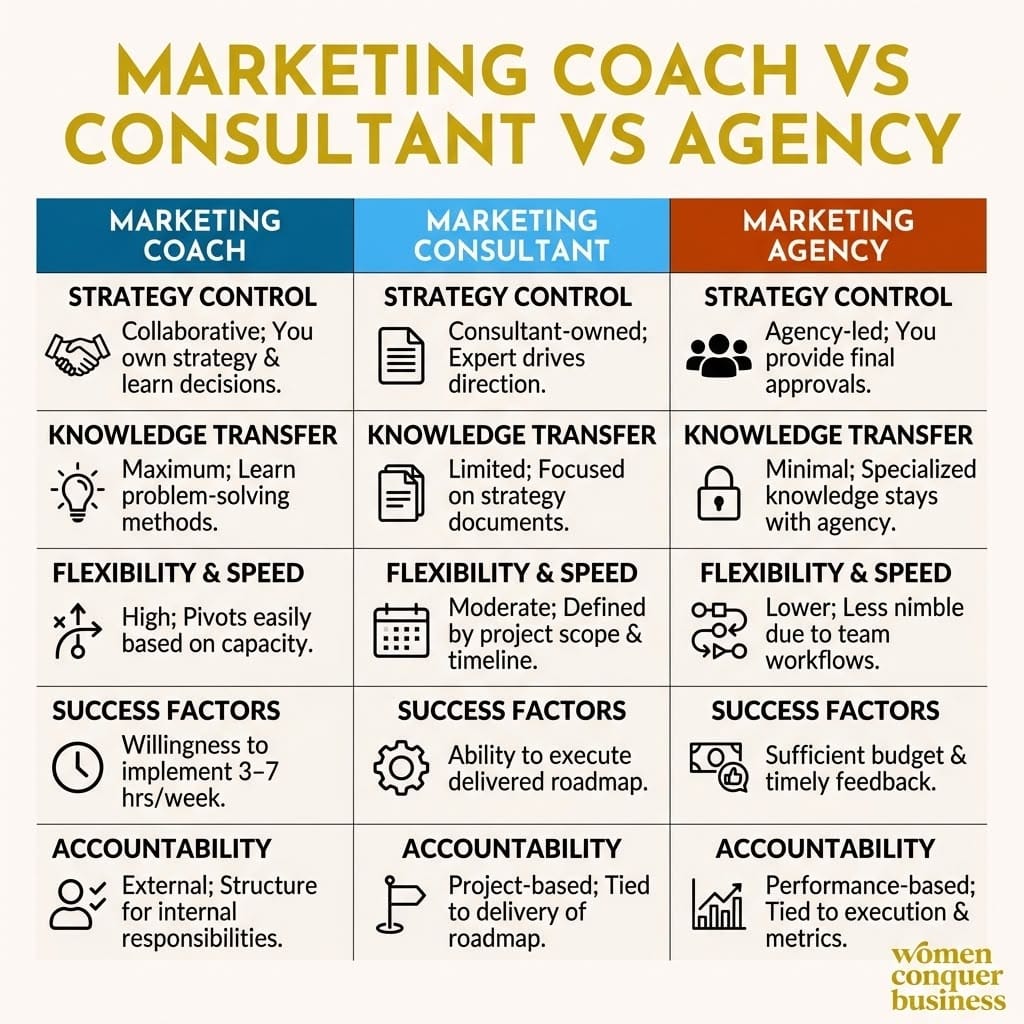
1. Who Controls the Strategy?
Marketing Coach: You own the strategy collaboratively. The coach guides you in developing strategic thinking, but you're learning to make strategic decisions yourself. This builds internal capacity that stays with you long term.
Marketing Consultant: The consultant owns the strategy development during the engagement. They analyze, recommend, and deliver—but the strategic thinking comes from their expertise, not yours. You implement what they create.
Marketing Agency: Strategy is typically collaborative but agency-led. Good agencies involve you in strategic decisions, but they're driven based on their experience across multiple clients. You approve the direction but rely on their strategic judgment.
Why this matters: If your goal is to understand marketing deeply enough to make confident decisions, coaching builds that muscle. If you need expert strategic thinking right now without the learning curve, consulting or agency support delivers faster.
Neither is better. They serve different long-term business goals.
2. The Knowledge Transfer Model
These three options have different relationships to knowledge transfer.
Coaching is designed for maximum knowledge transfer. The entire model is built on you learning to think strategically, execute effectively, and problem-solve independently. You're paying to build internal marketing capacity that compounds. When the coaching relationship ends, you keep the frameworks, skills, and strategic thinking ability.
Consulting provides limited knowledge transfer. You get the deliverables (strategy documents, audit reports, implementation roadmaps) and the strategic thinking captured in those documents, but you don't learn how the consultant arrived at those conclusions. You're buying the solution, not the problem-solving method. Some consultants include training as part of their scope, but that's not the default model.
Agency provides minimal knowledge transfer. You're paying for execution expertise, not education. The agency's systems, processes, and specialized knowledge stay with them. When the relationship ends, your marketing often stalls unless you hire another agency or build internal capacity to replace what they were doing.
This creates a critical decision point: Do you need to own this marketing skill long-term, or are you okay staying dependent on external support?
For solopreneurs 5-10 years into business, this question matters more than most people realize. If you're building a sustainable business that doesn't collapse when you stop paying someone. You don't have to be a marketing expert, but some knowledge transfer helps you keep the lights on.
BUT... if you're in a growth phase where speed matters more than self-sufficiency, execution support might be the right trade-off.
3. Flexibility and Adaptation Speed
Marketing Coach: High flexibility. You can pivot strategies mid-month based on what you're learning or how your business reality shifts. Coaching adapts to your capacity, seasonality, and changing priorities. If you need to slow down during a client-heavy month, the coach adjusts expectations without contractual penalties.
Marketing Consultant: Moderate flexibility within project scope. Consultants work with defined deliverables and timelines. Minor adjustments are normal, but major scope changes typically require contract amendments. Once the project ends, there's no ongoing flexibility. You'd need to hire them again.
Marketing Agency: Lower flexibility. Agencies operate on retainer contracts with scoped services. Pivoting strategy mid-campaign is possible but often incurs additional costs or timeline extensions. The larger the agency, the less nimble they are. Bureaucracy increases with team size.
The real-world impact: Life happens. Client work gets intense. Family needs shift. Your energy and capacity fluctuate. If you need marketing support that bends with your reality rather than demands you bend to contractual obligations, that favors coaching. If you need consistent execution regardless of your personal capacity fluctuations, that favors agency support.
4. Successful Engagements: Key Differences
This is the question nobody asks until they've already hired the wrong type of help.
Marketing Coach success depends on:
- Your willingness to do the implementation work consistently
- Your capacity to dedicate 3-7 hours per week to marketing execution
- Your coachability and openness to feedback
- Your tolerance for learning curves and imperfect initial results
- Your ability to maintain momentum between coaching sessions
If you're already buried and can't add more to your plate, coaching won't work. The coach can't do the work for you, and if you don't have capacity to implement, even the best strategy sits unused.
Marketing Consultant success depends on:
- Your ability (or your team's ability) to execute the delivered strategy
- Your understanding of the strategic recommendations enough to implement correctly
- Your organizational capacity to prioritize the consultant's roadmap
- Your willingness to invest time in the project even though you're not implementing yourself
If you can't translate strategy documents into action, consulting deliverables become expensive shelf-ware.
Marketing Agency success depends on:
- Your budget to sustain monthly retainer costs (minimum 6-12 months)
- Your ability to provide timely feedback and approvals
- Your trust in external team managing your brand voice
- Your business having enough complexity/volume to justify the investment
- Your patience during the 30-90 day agency learning curve
If your budget is uncertain or you need to micromanage every detail, agency relationships create friction on both sides.
I've seen brilliant marketing strategy work fail because the business owner chose support that didn't match their actual execution capacity. Strategy without execution capacity is just expensive documentation.
5. The Accountability Structure
Marketing Coach: External accountability with internal responsibility. The coach holds you accountable to goals you've committed to, but you're responsible for follow-through. This works well if you're self-motivated but need structure and someone to notice when you're avoiding the hard stuff.
Marketing Consultant: Deliverable-based accountability during the project. The consultant is accountable for delivering the agreed-upon strategy or analysis on time. You're accountable for providing information they need and implementing after delivery. Once the project ends, accountability disappears unless you structure ongoing check-ins.
Marketing Agency: Performance-based accountability with contractual obligations. The agency is accountable for executing agreed-upon services and hitting performance benchmarks (if specified). You're accountable for timely approvals and feedback. This works when you need external parties motivated by contract and performance metrics.
The pattern I see in client work: Solopreneurs who struggle with self-accountability thrive with coaching structure. Business owners who are disciplined but lack strategic clarity benefit from consulting's expert thinking. Established businesses with budgets but no internal marketing capacity succeed with agencies.
The mistake is choosing based on what sounds good rather than honestly assessing your actual working style, capacity, and follow-through patterns.
Hidden Costs of Coaching and Consulting
Pricing transparency is weirdly rare in the marketing services industry. Everyone publishes vague ranges like "$2,000-$10,000" without explaining what drives costs up or down.
But first, the costs that don't show up on invoices. The hidden ones that determine whether hiring help helps or creates expensive complexity.
Your Time Investment
Marketing Coach:
- Setup phase: 5-10 hours (onboarding, audit, strategy development)
- Ongoing weekly commitment: 3-7 hours (execution work + prep for coaching calls)
- Mental load: High (you're learning, deciding, implementing)
Most people underestimate the execution time required. Business coaching data shows clients typically need to invest 5-10 hours per week to see results. If you're paying $1,500/month for coaching but don't have 5+ hours per week to implement, you're paying for advice you won't use. The coaching helps you use that time more effectively, but it doesn't reduce the time requirement.
Marketing Consultant:
- Setup phase: 10-15 hours (briefing, information gathering, interview time)
- During project: 5-10 hours (feedback, review, clarification meetings)
- Post-delivery implementation: 20-50+ hours depending on complexity
- Mental load: Medium during project, high during implementation
The surprise cost: implementation after the consultant leaves. That gorgeous 40-page marketing strategy? It represents 40-60 hours of work to execute. If you don't have that capacity internally, the consultant's work sits unused.
Marketing Agency:
- Setup phase: 10-20 hours (onboarding, brand guidelines, approvals, access setup)
- Ongoing monthly commitment: 2-5 hours (review meetings, approvals, feedback, strategy sessions)
- Mental load: Low (they're handling execution)
Agencies minimize your time investment. But you still need capacity for timely approvals and strategic input. If you're too busy to review their work and provide feedback within 48-72 hours, projects stall and performance suffers.
Learning Curve Costs
Marketing Coach: Steep learning curve, but you're building transferable skills. The first 90 days are often frustrating as you learn new platforms, develop new habits, and make inevitable beginner mistakes. Your marketing results might initially decline as you're focused on learning instead of executing what you already know (poorly).
The upside: After 6-12 months, your marketing competence compounds. You're making better decisions, executing faster, and you own the knowledge.
Marketing Consultant: Consultant's learning curve about your business. The first 2-4 weeks are information-gathering. Their recommendations are only as good as their understanding of your business, market, and customers. If they don't ask great questions or you don't provide deep context, the strategy might be generically "good" but specifically ineffective for your situation.
Marketing Agency: Longest learning curve (30-90 days minimum). They need to understand your brand voice, customer language, industry nuances, competitive landscape, and business goals before their execution hits the right tone. Expect the first 2-3 months of content to need heavier revision until they nail your voice.
Time to competence: You're paying during the learning curve period whether you're learning (coaching) or they're learning (consulting/agency). Factor this into your timeline expectations and budget allocation.
Opportunity Cost of Wrong-Fit Support
This is the big one that ruins marketing efforts more than any other factor.
Hiring a coach when you need execution support: You're paying for guidance but drowning in implementation work you don't have capacity to do. Your marketing stays inconsistent, you feel guilty for "not using what you're learning," and the coach relationship becomes demoralizing.
Six months later, you've spent $6,000-$12,000 with minimal results because the bottleneck wasn't knowledge—it was execution capacity.
Hiring a consultant when you need ongoing accountability: You get a beautiful strategy document, feel motivated for two weeks, then implementation stalls because nobody's checking in. The $8,000 strategy becomes expensive shelf-ware.
You needed structure and accountability, not more strategic thinking.
Hiring an agency when you need to own the marketing knowledge: You're dependent on external support for basic marketing functions. When budget gets tight or you want to bring marketing in-house, you realize you have no internal systems or knowledge to take over what the agency was doing.
You either keep paying or your marketing collapses.
The opportunity cost compounds because you're not just losing the money spent; you're losing the time you would have spent building the right capability with the right support model.
Tool and Platform Costs That Compound
Marketing Coach: Usually recommends tools you'll need, but you're buying and managing them. Budget for:
- Email marketing platform ($29-$89/month for services like Kit or MailerLite depending on list size)
- Social media scheduling tools ($15-$50/month) for services like Buffer or Metricool
- SEO tools if doing content marketing ($99-$200/month)
- Analytics and tracking tools (many free options available)
- Design tools like Canva Pro ($15/month)
Total additional monthly costs: $50-$500/month depending on business size and channels.
Marketing Consultant: May recommend new tools as part of their strategy. If their roadmap requires platforms you don't currently use, factor in:
- Setup costs (migration, integration, learning curve)
- Ongoing subscription costs
- Training time to use new platforms effectively
Consultants often recommend "best-in-class" tools that might be overkill for solopreneurs. Ask for appropriate-scale recommendations.
Marketing Agency: Typically includes tools in their retainer (part of why agencies are more expensive). But clarify:
- Do you own the accounts or does the agency?
- What happens to content/data if you leave?
- Are there setup fees for proprietary tools?
- Will they train you on platforms if you decide to in-house later?
Some agencies hold your assets hostage in their accounts. Get ownership clarity in writing before signing.
The hidden insight from 25+ years of watching businesses hire marketing help:
The most expensive decision isn't choosing the pricier option. It's choosing the wrong-fit option and discovering it six months and $10,000-$15,000 later. Taking two extra weeks to assess your capacity, timeline, and learning goals before hiring anyone saves more money than negotiating hourly rates.
The 3 C's Framework: How to Choose the Right Support
Here's the framework I've used to help clients who ask, "Should I hire a coach, consultant, or agency?"
It's based on three questions that matter more than budget, industry, or business size.
The 3 C's: Capacity, Complexity, and Control.
Answer these honestly, and the right choice becomes obvious.
C1: Capacity (Do You Have the Time, Energy, and Mental Space?)
This is the first filter because it eliminates options immediately.
High Capacity (10+ hours/week available for marketing):
- Marketing coach is viable (you can implement what you learn)
- Marketing consultant is viable (you can execute their roadmap)
- Marketing agency is viable but potentially wasteful (you're paying for execution you could do yourself)
Medium Capacity (5-9 hours/week available):
- Marketing coach works if focused on one channel/skill at a time
- Marketing consultant works for strategy, but implementation will be slow
- Marketing agency becomes more cost-effective (they handle execution while you handle delivery)
Low Capacity (less than 5 hours/week available):
- Marketing coach likely won't work (not enough implementation time)
- Marketing consultant creates shelf-ware (strategy without execution capacity)
- Marketing agency is the only option that functions (or accept marketing will remain minimal)
No Capacity (currently buried, can't add anything):
Don't hire anyone yet. Fix capacity first or accept marketing stays minimal.
The mistake I see most often: hiring a coach when capacity is low. You're paying for expertise you don't have time to implement. That creates guilt, wasted money, and a demoralized coach who watches you struggle.
Capacity isn't just hours. It's cognitive load and emotional energy. If you're already managing client delivery, operations, family responsibilities, and everything else solopreneurs juggle, adding "learn marketing strategy" to your plate might be the thing that breaks you.
Be honest about this.
Nobody gives out awards for pushing through when you don't have the bandwidth.
C2: Complexity (How Complicated Is Your Marketing Challenge?)
Not all marketing problems require the same level of expertise.
Low Complexity (Getting started, one-channel focus, straightforward business model):
- Marketing coach is ideal (you're building foundational skills)
- Marketing consultant is overkill (you don't need expert-level strategy yet)
- Marketing agency is expensive for simple needs (templated solutions work fine)
Examples: Setting up email marketing, creating consistent social media presence, basic SEO, developing content calendar, establishing brand messaging.
Medium Complexity (Multi-channel coordination, established business pivoting, competitive market):
- Marketing coach works if you're willing to learn through trial and error
- Marketing consultant speeds up results (expert diagnosis saves months of guessing)
- Marketing agency appropriate if budget supports (coordinated execution across channels)
Examples: Launching new product line, improving conversion rates, developing content strategy, managing multiple marketing channels, repositioning brand.
High Complexity (Technical implementation, sophisticated funnels, large-scale campaigns, compliance requirements):
- Marketing coach alone is insufficient (you need specialized expertise)
- Marketing consultant provides strategy, but execution requires specialized skills
- Marketing agency ideal (access to specialists: SEO experts, ad managers, conversion optimizers)
Examples: Enterprise SEO, multi-stage automated funnels, paid advertising at scale, attribution modeling, marketing in regulated industries.
The nuance competitors miss: Complexity isn't about business size, it's about the specific marketing challenge. A solopreneur service business might have low marketing complexity (local SEO, referrals, simple email nurture) even if the business generates $500K/year. A startup with a complex B2B sale might need high-complexity support even though revenue is still under $100K.
Match the support level to the problem complexity, not your revenue or team size.
C3: Control (How Much Do You Need to Own This Long-Term?)
This is a biggie. How much control and ownership do you want?
High Control Needs (You want to own marketing knowledge, reduce dependency, build internal capability):
- Marketing coach is ideal (maximum knowledge transfer)
- Marketing consultant provides strategy but limited skill development
- Marketing agency creates dependency (when they leave, marketing capability leaves with them)
Medium Control Needs (You want strategic understanding but okay outsourcing execution):
- Marketing coach works for strategic foundation, then outsource tactical execution
- Marketing consultant perfect (you own strategy, delegate execution to freelancers or junior support)
- Marketing agency works if you maintain strategic involvement (don't abdicate all decision-making)
Low Control Needs (You want marketing handled, don't need to understand how it works):
- Marketing coach is wrong fit (you're paying to learn what you don't want to know)
- Marketing consultant leaves you with strategy you might not understand how to manage
- Marketing agency ideal (they own both strategy and execution)
The long-game question: What happens if budget gets tight in 12 months and you need to reduce marketing expenses?
If you've worked with a coach, you can continue marketing yourself (maybe slower, but functional). If you've worked with a consultant, you have the roadmap but need execution capacity. If you've worked with an agency, your marketing likely stops unless you've built internal capability or can hire replacements.
For solopreneurs building sustainable businesses (the kind that don't collapse when you stop paying someone) high control needs matter. You're not building a business to sell in five years. You're building a business that supports your life for 10-20+ years. That changes the calculus.
Own your audience. Own your systems. Own your marketing knowledge. That's been my philosophy for 25+ years, and it's why I eventually moved from consulting into marketing coaching, I want to build capability, not create dependency.
How to Use the 3 C's Framework
Step 1: Answer each C honestly (not aspirationally)
- Capacity: What do you actually have, not what you wish you had
- Complexity: What does this specific challenge require
- Control: What matters for your long-term business model
Step 2: Look for alignment or conflicts
- All three pointing same direction = clear choice
- Mixed signals = might need hybrid approach or staged strategy
Step 3: Check your budget reality against your answers
- High capacity + low complexity + high control = coach (most cost-effective)
- Low capacity + high complexity + low control = agency (necessary investment)
- Medium everything = consultant or hybrid model
Example Decision Flows:
Sarah (7 years in business, service-based, $200K revenue):
- Capacity: Medium (6-8 hours/week, but inconsistent)
- Complexity: Low-medium (needs better email marketing, content consistency)
- Control: High (wants to own her marketing, reduce dependency)
- Decision: Marketing coach focused on sustainable systems, not aggressive growth tactics
Michael (5 years in business, product-based, $450K revenue):
- Capacity: Low (4 hours/week maximum, client delivery consuming everything)
- Complexity: High (needs SEO overhaul, paid ads, conversion optimization)
- Control: Medium (wants strategic input, okay delegating execution)
- Decision: Marketing agency with clear strategic involvement requirements, or consultant + skilled virtual assistant for execution
Jennifer (10 years in business, consulting firm, $800K revenue):
- Capacity: Medium-high (has junior team member who could execute under guidance)
- Complexity: Medium (needs positioning clarity, systematic lead generation)
- Control: High (building team capability for long-term)
- Decision: Marketing consultant for strategy + internal team training, then ongoing coach for junior team member
The framework works because it forces you to look at your actual situation, not what marketing gurus say you "should" do.
The Fourth Option: Why Traditional Categories Don't Work for Everyone
Here's what I realized after years of watching solopreneurs struggle with the coach-consultant-agency choice: none of these models fit most established solopreneurs perfectly.
Coaching requires implementation capacity many don't have. Consulting creates shelf-ware without accountability. Agencies price out solopreneurs or deliver enterprise-level complexity they don't need.
What if you need the knowledge transfer of coaching, the strategic frameworks of consulting, the community support of neither, and the flexibility to work at your own pace without weekly commitment pressure?
That's the gap that led me to create something different.
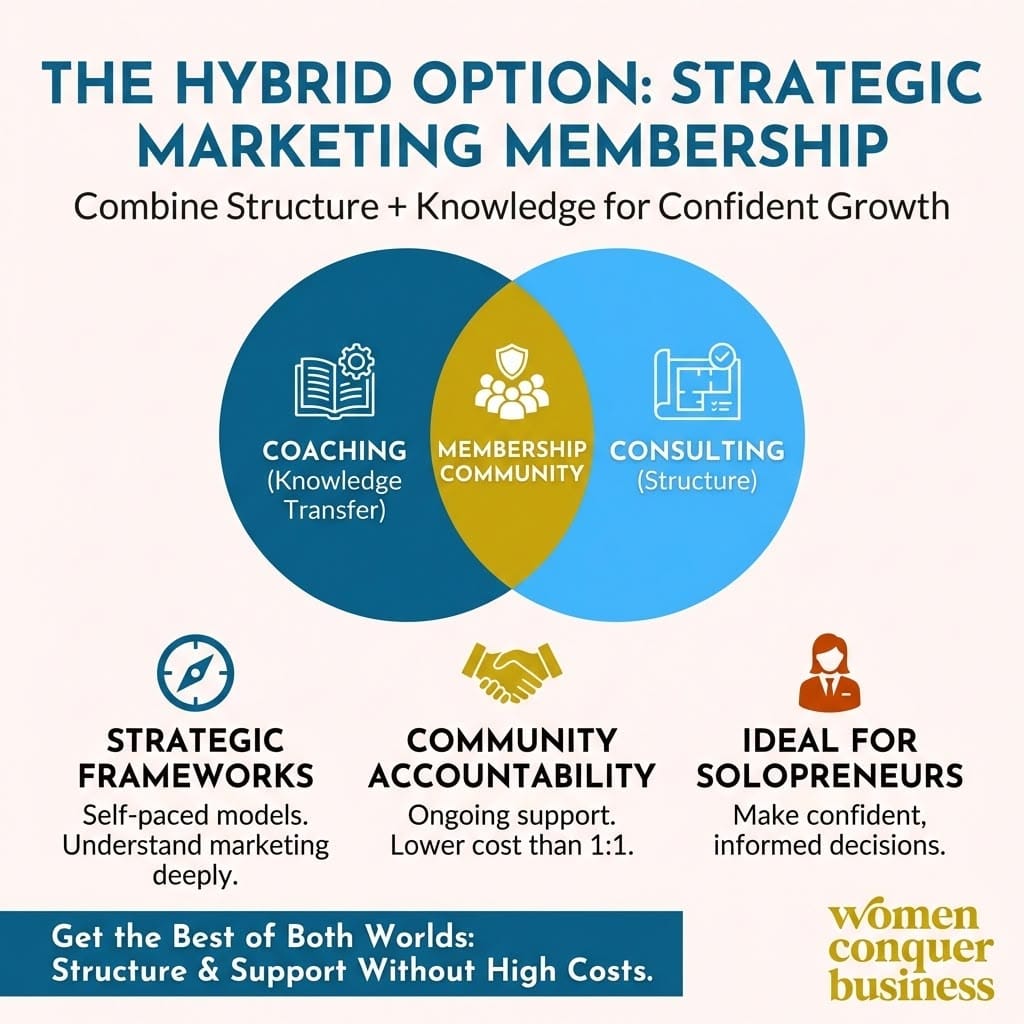
The Strategic Marketing Membership Model
Joining a membership is a hybrid that doesn't fit traditional categories.
What it provides:
- Self-paced strategic frameworks (consultant-style structure)
- Skill-building resources (coach-style knowledge transfer)
- Community accountability and peer learning (what coaching and consulting both lack)
- Flexibility to engage when you have capacity (no weekly call pressure)
- Long-term sustained support without ongoing high costs
Who this serves:
- Established solopreneurs (5-10+ years in business) tired of starting over with new strategies
- Service-based business owners who need marketing systems, not hacks
- People undersupported and carrying too much in their brains who need frameworks, not more tactics
- Business owners who want to understand marketing deeply enough to make confident decisions without becoming marketing experts
- Anyone tired of hustle culture, bro-marketing, and unrealistic "6-figure launch" promises
The strategic difference:
Traditional coaching, consulting, and agencies all operate on a scarcity model. You're buying someone's limited time, so costs scale with time investment. The strategic membership model operates on knowledge leverage: the frameworks, systems, and peer learning scale infinitely without requiring more of my time per person.
That shifts the economics. Instead of $2,000-$3,000/month for weekly coaching calls, you get access to the same strategic frameworks for $67/month (or add-on quarterly coaching for $1,800/year). Instead of $8,000 for a consultant to analyze your business and deliver a strategy, you learn the strategic thinking process and apply it yourself with community support.
BUT (and this is a big but!)... it only works if you're self-directed and have some implementation capacity.
The membership model isn't "coaching light" or "consulting on demand." It's a different animal entirely. You're trading personalized hand-holding for flexibility, affordability, and community learning. If you need someone telling you exactly what to do every week, this isn't the right fit. If you can apply frameworks to your specific situation with strategic guidance and peer accountability, this might be perfect.
When Hybrid Models Make Sense
Beyond the Strategic Marketing Membership, hybrid approaches can work well, combining a marketing coach with freelance execution support, hiring a consultant for strategy and then executing internally, or using an agency for one complex channel while handling simpler channels yourself.
The pattern: Hybrid models work when you're honest about what you need external expertise for versus what you can handle internally with the right frameworks and support.
The Decision Is Yours (And That's Exactly How It Should Be)
The marketing coach vs consultant vs agency question doesn't have a universal "right answer." Anyone telling you otherwise is selling something.
Use the decision framework: the 3 C's. Your Capacity (time, energy, cognitive load). Your Complexity (how sophisticated is the marketing challenge). Your Control needs (how much do you need to own this long-term).
Take the time to assess your actual situation. Not where you think you should be. Not where some marketing guru says you need to be.
Where YOU are right now, with the capacity YOU have, for the business YOU'RE building.
If you're an established solopreneur tired of scattered tactics and ready for strategic clarity, I'd love to help. Women Conquer Business offers marketing coaching for one-on-one support, comprehensive marketing strategy development, and our Strategic Marketing Membership for community-based learning at your own pace.
Marketing is a marathon, not a sprint. Choose support that helps you build sustainable momentum, not temporary wins that disappear when the support ends.
You deserve marketing that fits your life, not marketing that demands you fit its expectations.