


Landing page copy for lead generation focuses on persuading visitors to share their contact information in exchange for something useful. Unlike sales pages, these pages prioritize building trust and providing upfront value, such as free guides or consultations.
Effective copy addresses audience problems, offers clear benefits, and includes a strong call-to-action (CTA) to boost conversions.
Key Takeaways:
- Headlines: Address specific problems and highlight benefits immediately.
- Value Proposition: Communicate what visitors gain and why it matters.
- Call-to-Action (CTA): Use clear, action-oriented language like "Get My Free Guide."
- Trust Signals: Include testimonials, privacy assurances, and social proof to build credibility.
- Simple Forms: Limit fields to essentials (e.g., name and email) to improve conversion rates.
- Lead Magnets: Offer targeted resources (e.g., checklists, consultations) that solve specific problems.
Quick Stats:
- Average landing page conversion rate: 9.7% (top performers exceed 20%).
- Personalized CTAs convert 202% better than generic ones.
- Reducing form fields can boost conversions by up to 120%.
By combining audience-focused copy, simple forms, and tailored offers, you can turn visitors into leads and create long-term client relationships.
Core Components of Best Landing Page Designs
A high-performing lead generation landing page combines several key elements to turn visitors into leads. These components work together to guide visitors from initial curiosity to taking action. Let’s break down the essentials.
Attention-Grabbing Page Headline
The headline is your first chance to make an impression, and it has to work fast. In just a few seconds, visitors will decide whether to stick around or leave. A strong headline connects with your audience by addressing their specific pain points and highlighting the main benefit of your offer.
The most effective headlines speak directly to your ideal customer. For instance, "Marketing Support for Women Solopreneurs Who've Already Tried Everything" not only identifies the target audience but also acknowledges their struggles. This creates an instant sense of understanding and empathy, encouraging visitors to stay engaged.
To make your headline resonate, reflect a common problem your audience faces. When people see their challenges mirrored in your message, they’re more likely to feel understood and keep reading. Focus on clarity and outcomes - avoid vague promises. For example, a headline like "Get a Free 15-Minute Marketing Audit to Uncover Hidden Growth Opportunities" is specific, benefit-driven, and builds trust by setting clear expectations.
Keep the language simple and relatable. Skip the jargon and use the words your audience uses. If they often say, "I'm overwhelmed with marketing", mirror that language instead of relying on technical terms. This connection builds rapport right from the start.
Once your headline hooks them, the next step is to deliver a clear value proposition.
Boost Conversion Rates with a Clear Value Proposition
Your value proposition tells visitors exactly what they’ll gain from your offer and why it stands out. It’s not just about listing features - it’s about showing how your solution addresses their problems and delivers meaningful results.
Position your value proposition prominently, ideally above the fold, so visitors see it immediately. Use concise bullet points or short paragraphs to highlight the benefits. For instance, if you’re offering professional services, mention specific outcomes you’ve achieved or unique methods you use.
What sets your offer apart? If it’s a free consultation, explain why yours is better - perhaps it includes a detailed action plan or focuses on a niche industry. These details help visitors understand why your offer is worth their time.
Visuals can strengthen your value proposition. If you’re promoting an ebook, show the cover. If it’s a consultation, include a professional photo of yourself to establish a personal connection. Images make your offer feel more tangible and relatable.
Don’t forget to include trust signals near your value proposition. Statements like "Helped 2,000+ marketers double sign-ups" or client testimonials add credibility and ease any doubts. Social proof reassures visitors that your offer delivers real results.
Now that your value is clear, the final step is to motivate action with a strong call-to-action.
Call-to-Action Best Practices
Your call-to-action (CTA) is where the magic happens - it’s the nudge that turns interest into action. A great CTA is specific, action-oriented, and focused on the benefit visitors will receive.
Avoid generic phrases like "Submit" or "Click Here." Instead, use language that clearly communicates value, such as "Get My Free Guide", "Book a Strategy Call", or "Request Your Audit." This kind of wording reduces hesitation by telling visitors exactly what they’ll get when they click.
Make your CTA impossible to miss. Use contrasting colors to make it pop, and place it above the fold for immediate visibility. Repeating the CTA throughout your page - especially after key sections - can capture visitors at different moments in their decision-making process.
Keep your page focused on a single goal. Research shows that having one clear CTA can boost conversions by up to 371% compared to pages with multiple competing options. Too many choices can overwhelm visitors, so guide them toward one specific action that moves them closer to becoming a lead.
Finally, address any concerns that might hold visitors back. For example, adding a simple reassurance like "No spam, unsubscribe anytime" near your email form can ease privacy worries and build trust.
Copywriting Frameworks for Lead Generation
When crafting landing pages to generate leads, using structured copywriting frameworks like PAS and AIDA can make a big difference. These methods help you organize your message and present your offer in a way that’s clear and persuasive.
Using PAS (Problem-Agitate-Solution)
The PAS framework focuses on addressing your audience’s pain points directly. It’s effective because it reflects how people naturally think about their problems and search for solutions.
Start by identifying the problem your audience is facing. This isn’t about guessing - it’s about understanding their real frustrations. Talk to your customers, read online reviews, or chat with your sales and support teams to uncover what’s bothering them most. For example, solopreneurs might feel overwhelmed by marketing tasks and struggle to see results.
Next, agitate the problem by emphasizing the emotional and financial toll it takes. Highlight what’s at stake, like missed revenue opportunities or the stress of feeling stuck. This step makes the problem feel urgent and personal.
Finally, offer your solution as the way forward. Show how your product or service directly addresses their pain points. Use their language to make your message relatable. For instance, a marketing consultant could say, "Our consulting process eliminates guesswork and provides a clear roadmap to attract your ideal clients."
While PAS zeroes in on pain points, AIDA takes a step-by-step approach to guide prospects toward action.
Applying AIDA (Attention-Interest-Desire-Action)
The AIDA framework leads your audience through four stages: grabbing their attention, sparking interest, building desire, and driving action.
Attention comes first. Your headline and opening statement need to stand out. For example, "Grow Your Email List in 30 Days" is specific and aspirational, making it hard to ignore.
Interest is built by sharing benefits, facts, or stories that spark curiosity. You could say, "Learn the strategies top consultants use to attract high-value clients, even in competitive markets." This positions your offer as both valuable and exclusive.
Desire grows when you emphasize results and include social proof. Paint a picture of success, like an inbox full of leads eager to work with you. Add testimonials or metrics to back up your claims.
Action is the final step. Use a clear, benefit-focused call-to-action (CTA). Instead of something generic like "Submit", try "Download Your Free Checklist" or "Get My Free Guide." Place your CTA strategically throughout the page to catch visitors when they’re ready to act.
Adding Trust Signals
Even the best copy can fall flat if visitors don’t trust your offer. That’s where trust signals come in - they help reassure potential leads.
Testimonials are powerful, especially when they highlight specific results. Instead of vague praise, use detailed accounts, like how a particular strategy helped a client double their leads. Place these testimonials near your lead capture form for maximum impact.
Privacy assurances can reduce hesitation. Simple statements like "We’ll never share your data" or "Unsubscribe anytime" can ease concerns and lower form abandonment rates.
Social proof adds credibility. Display client logos, success metrics, or credentials prominently. For example, a statement like "Helped 2,000+ marketers double their sign-ups" provides concrete evidence that your solution works. If you’re offering professional services, showcase your expertise and highlight client success stories to build confidence.
Where you place these trust signals matters. Put testimonials near decision points, include privacy statements by forms, and display credentials where they’ll catch the visitor’s eye early on.
| Framework | Key Steps | Example Application |
|---|---|---|
| PAS (Problem-Agitate-Solution) | 1. Identify problem 2. Agitate problem 3. Present solution |
1. "Struggling to get leads?" 2. "You're losing revenue every day you wait." 3. "Download our free guide and double your leads." |
| AIDA (Attention-Interest-Desire-Action) | 1. Grab attention 2. Build interest 3. Create desire 4. Drive action |
1. "Ready to grow your business?" 2. "See how others have doubled their leads." 3. "Imagine your inbox full of qualified prospects." 4. "Get your free checklist now." |
The success of these frameworks depends on how well you understand your audience. The more you know about their challenges, goals, and preferences, the better you can tailor your message to convert visitors into leads.
Lead Capture Forms and Offers That Convert
Creating a successful lead-generation strategy goes beyond just writing great copy. You need a streamlined form and an offer that genuinely appeals to your audience. Even the best-written content won't convert if the form is clunky or the offer feels lackluster. The goal? Make it as simple as possible for visitors to take action while offering something they actually want. Here's how to design forms and craft lead magnets that drive results.
Simple Form Design
For forms, less is more. Adding extra fields can hurt your conversion rates - each additional field can reduce conversions by up to 11%. For example, a form asking for a name, email, phone number, company, and job title is likely to perform much worse than one that only asks for a name and email.
For most campaigns, stick to just the essentials: name and email. This keeps things simple and ensures you can follow up personally. You can always gather more details later as your relationship with the prospect grows.
Research backs this up. HubSpot found that landing pages with fewer than five fields convert 20–25% better than those with more fields. One marketing agency saw a dramatic boost in conversions after reducing their form from six fields to just two and adding a privacy statement like, "We'll never share your data.”
If you need more info, consider a multi-step form. Start with basic contact details, then ask for additional information on a second page. This gradual approach feels less overwhelming and encourages people to commit step by step.
Don't forget about mobile optimization. Many users will encounter your forms on their phones, so make sure the fields are easy to tap and the form displays correctly on smaller screens. Test your forms on various devices to ensure they’re user-friendly.
Privacy concerns are also a big deal, especially for U.S. audiences. A simple reassurance like "Your information is secure" near your form can ease worries and reduce abandonment rates.
High-Value Lead Magnets
Pair it with a lead magnet that's too good to pass up once you've optimized your form. A lead magnet is what you offer for someone’s contact details, so it needs to feel worth the trade. Generic signups like “Join our newsletter” don’t cut it anymore; people want something specific and useful right away.
Checklists and templates are excellent options, especially for solopreneurs and service providers. They offer quick, actionable wins. Women Conquer Business launched a Small Business AI Marketing Plan Generator in September 2025. Users could input their business details and instantly receive a custom marketing strategy complete with goals, channels, and costs. This kind of interactive tool delivers immediate value while capturing leads.
Free consultations are another effective option for service-based businesses. Women Conquer Business, for example, features a "Free Consult" option on their homepage. It gives potential clients a no-risk way to discuss their needs while allowing the business to showcase its expertise.
Educational content like eBooks or webinars appeals to those eager to learn and take action. A coach might offer a "7-Day Productivity Checklist", while a consultant could provide a "Free 30-Minute Strategy Session." The key is to ensure your lead magnet solves a specific problem your audience is facing.
Tailored guides perform much better than generic ones. Instead of offering "Marketing Tips for Small Businesses", try something more specific like "Marketing Strategies for Therapists" or "Lead Generation for Consultants." The more targeted your offer, the more valuable it feels to your ideal audience.
When presenting your lead magnet, use benefit-driven headlines and include visuals like eBook covers or webinar graphics. Adding testimonials near the offer can provide social proof. And instead of using a generic "Submit" button, opt for more engaging text like "Get My Free Guide" or "Reserve My Spot."
Lead Magnet Comparison Table
Here’s a quick breakdown of common lead magnets and how they perform:
| Lead Magnet Type | Best For | Required Info | Conversion Rate | Engagement Level |
|---|---|---|---|---|
| eBook | B2B, Education | Name, Email | High | Medium |
| Webinar | Professional Services, Training | Name, Email, Job Title | Very High | High |
| Checklist | Quick Wins, All Audiences | Medium | Medium | |
| Free Consultation | Professional Services | Name, Email, Phone | Medium | High |
| Template/Tool | Solopreneurs, DIY Approach | Name, Email | High | Medium |
- eBooks work well for audiences that want in-depth information they can refer to later. They’re especially effective for B2B buyers who need to share insights with their teams or justify decisions.
- Webinars generate high conversion rates because they offer live interaction and immediate value. They’re perfect for explaining complex topics and answering questions in real time.
- Checklists appeal to those looking for quick, actionable steps. They’re less intimidating than longer content and offer immediate usefulness.
- Free consultations foster engagement through direct interaction. While they require more commitment, they’re highly effective for service-based businesses.
- Templates and tools, like the AI Marketing Plan Generator, provide hands-on value that’s practical and easy to use. These are ideal for solopreneurs who prefer a do-it-yourself approach.
Ultimately, the success of your lead magnet depends on how well it aligns with your audience’s needs and learning preferences. Experiment with different options to see which resonates most with your target market.
Copy for Professional Services and Solopreneurs
Professional services businesses face a distinct challenge: they’re selling expertise, trust, and transformation. Your copy needs to address your audience’s specific struggles while building confidence in your ability to guide them toward success.
Identifying Audience Pain Points
The best landing page copy starts with a deep understanding of what’s keeping your ideal clients up at night. For solopreneurs in professional services, it’s not just about finding clients - they’re often battling overwhelm, burnout, and a lack of efficient tools.
Your headline should reflect these challenges. Instead of a generic phrase like "Grow Your Business", try something more specific: "Finally Stop Juggling Overwhelm and Burnout While Building a Thriving Practice." This shows you truly understand their reality.
To get this right, research is key. Talk to your current and past clients, dive into testimonials, and pay attention to the language they use. For example, if a therapist says they’re "overwhelmed by administrative tasks", use that exact phrasing in your copy instead of defaulting to corporate jargon.
A great example of this approach is from KlientBoost, which saw a 37% increase in landing page conversions in 2024 simply by using client-inspired language in their copy.
Recognize the time pressures solopreneurs face by including phrases like "designed for your actual capacity" or "strategies that work even when you're already stretched thin." Address skepticism with lines like: "Tired of cookie-cutter programs that promise everything but deliver nothing? This isn't another generic course."
By acknowledging these specific struggles, you set the stage for messaging that feels personal and empathetic.
Writing with Empathy and Personalization
Empathetic copy goes beyond listing problems: it makes your audience feel genuinely seen and supported.
Use a warm, conversational tone that avoids placing blame. Instead of suggesting your audience is doing something wrong, frame your solution as the missing piece they’ve been searching for. For example: "You're not failing at marketing - you just haven't found the right strategy for your unique situation."
Client testimonials can help reinforce this.
Small personalized touches, like dynamic text replacement to include the visitor’s profession or segmenting your audience by role, can make a big difference. After all, a coach’s challenges aren’t the same as a therapist’s, even though both operate in the professional services space.
Highlight that your solutions are "customized to your business needs and capacity" instead of cookie-cutter approaches.
Storytelling can also help humanize your brand. Share a brief client success story or even your own journey as a solopreneur. For instance: "Three years ago, I was working 60-hour weeks, stressed about finding my next client, and wondering if I’d made a huge mistake starting my own practice."
This type of feedback shows that effective copy doesn’t just solve business problems - it connects with the deeper desire for meaningful, sustainable work.
Conclusion: High-Converting Landing Page Copy
Creating landing page copy that drives conversions starts with understanding your audience and addressing their specific needs. The best landing pages combine clear, strategic messaging with a genuine understanding of the challenges visitors face.
Key Elements for Success
A high-performing landing page balances four critical elements. First, craft headlines that directly address pain points while highlighting the value your service or product offers. Second, ensure your value propositions clearly communicate the immediate benefits visitors will gain. Third, use call-to-actions (CTAs) that are specific and benefit-focused - phrases like "Download My Free Guide" outperform vague options like "Submit." Lastly, trust signals such as testimonials, privacy assurances, and social proof help reduce hesitation and build credibility. Position these trust signals near forms where visitors decide whether to take action. Research shows that simplifying forms, such as reducing the number of fields, can boost conversions by as much as 120%.
When these elements work together seamlessly, they set up your landing page for success.
Steps to Put It Into Action
To implement these strategies effectively, start by auditing your landing page. Ask yourself: Does the headline clearly communicate the benefit? Are you asking for only the most essential information on your form?
Next, refine your copy. Rewrite headlines and CTAs to emphasize benefits rather than focusing solely on features. Experiment with different versions to find what resonates most with your audience. Add or update trust signals - such as testimonials or privacy microcopy - and place them strategically near forms. Simplify your forms by limiting fields to essentials like an email address and one qualifying question.
A/B testing is key. Test variations of your headlines, CTAs, and form designs. Use analytics to pinpoint where visitors drop off and focus your optimizations there. Ensure your landing page messaging aligns with the ads, emails, or other sources driving traffic to your page. This consistency builds trust and reinforces your message.
Finally, use language that mirrors the way your audience speaks. Interview current clients, review feedback, and incorporate their exact words and phrases into your copy. This relatability can make a big difference in connecting with your visitors.
Women Conquer Business Services
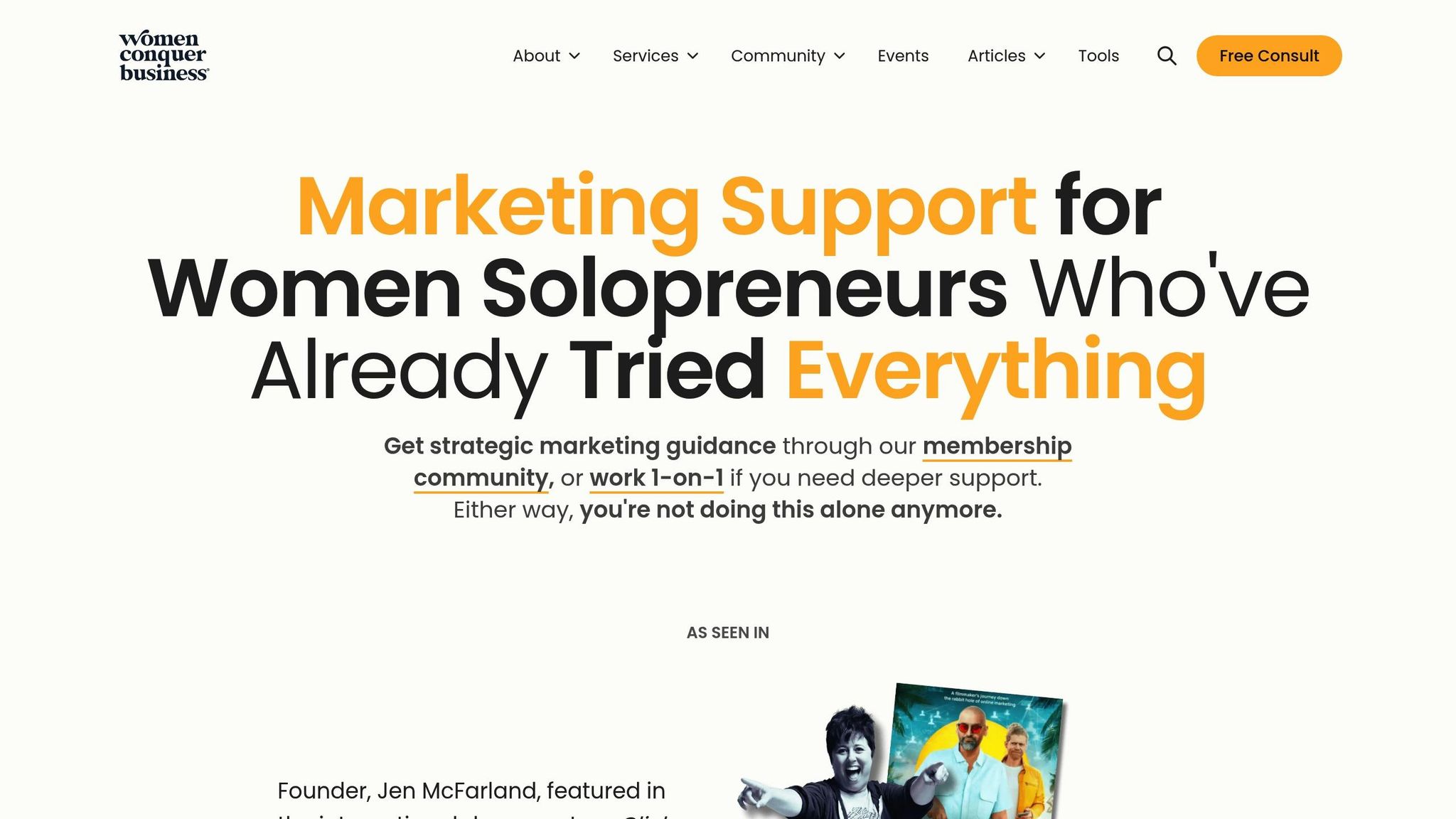
To take these strategies further, Women Conquer Business offers services tailored to solopreneurs looking to master lead generation and landing page optimization.
- Strategic Marketing Membership: At $67/month or $670/year, this membership provides access to curated marketing events, group coaching, and actionable frameworks designed to solve real-world business challenges.
- Digital Marketing Coaching: Starting at $397/month, this program delivers tactical support and accountability to help you implement these strategies step by step.
- Marketing Operations Makeover: For $2,500 and up, this service streamlines your lead generation process, positioning your business for long-term growth.
Women Conquer Business offers a blog and newsletter filled with actionable marketing tips specifically for coaches, consultants, therapists, and other service professionals. These services help you understand the best ways of doing things, and they provide the advice and support you need to turn visitors into potential customers.
FAQs
What are the best strategies for writing headlines that grab attention on a landing page?
Go straight for clarity and benefit. Your reader is skimming, tired, and trying to figure out if what you offer will finally help them stop spinning their wheels. Lead with the core problem they’re stuck in or the outcome they desperately want.
Say it simply. Say it plainly. No fluff.
Focus on what your service does for them. Use strong, direct language that shows you understand what they’re dealing with.
If you can quantify the result, great. If not, keep it grounded in real-life outcomes.
Then test it. Most solopreneurs assume the first version is “fine” because they’re busy. But swapping a few words can significantly change conversions.
How can I create a call-to-action (CTA) that drives more leads and conversions?
Tell them exactly what to do, and why it helps them. A good CTA is clear, specific, and rooted in the real benefit (not generic commands like “Learn More.”)
Think:
“Get the checklist”
“Start your reset”
“Save your spot”
“Download the plan that saves you 5 hours a week”
These kinds of CTAs answer the question your reader is secretly asking: “Why should I bother clicking this?”
Make sure the CTA stands out visually, too. High contrast, easy to spot, and repeated in a few key places (top, mid-page, bottom). Then test the wording and placement. Tiny changes often make a tremendous difference.
What are the most effective lead magnets for different audiences?
It depends on what your people actually want (and how overwhelmed they already are).
If your audience is busy and stretched thin, short, actionable resources win: checklists, cheat sheets, templates, scripts.
If they're hungry for deeper clarity or strategy, guides or mini-workshops work well.
If they’re hands-on learners who need to see or try something, offer a webinar, a tool, or a short interactive challenge.
The key: your lead magnet should solve one very specific problem quickly. Not everything they’ll ever need. Not a 40-page “ultimate guide” they’ll never read. Give them something that creates relief, momentum, or an immediate win, and they’ll trust you with the next step.
Related Blog Posts
- How to Build an Email List Without Paid Advertising
- Building Customer Trust: 7 Digital Marketing Success Strategies
- Customer Testimonials: 10 Strategic Approaches for Business Growth
- Personalize Your Checkout Experience with Customizations