


AI SEO for professional services is about making your expertise easy for AI-powered search tools like ChatGPT, Perplexity, and Google AI Overviews to understand and trust. Instead of chasing keywords, it focuses on clear explanations, original insight, and proven expertise, so your content can be cited, summarized, and surfaced, whether or not people click through to your website.
At a Glance
AI Search Optimization is recommended for established consultants and coaches who have a solid foundation of content but struggle to get cited in modern "answer engines." This approach works best when integrated into a broader marketing strategy rather than treated as a standalone "hack."
Final Verdict: Recommended with Caveats
Overall Rating: ★★★★☆
- Who it’s for: Practitioners with 15 or more high-quality articles who want visibility in LLMs.
- Who it’s NOT for: New businesses without a content foundation.
- Time to implement: Two to three hours per week for three to six months.
- Typical cost: $0–$50/month (DIY) or $1,000–$3,000+/month (hiring an SEO specialist).
- Primary Outcome: Improved citations in ChatGPT, Perplexity, and Google AI Overviews.
Google: Only Part of the SEO Picture
After 25 years of helping service businesses navigate digital shifts, I realized that focusing entirely on Google's "blue link" is officially over.
AI-powered SEO (search engine optimization) has officially arrived. If your business doesn't appear in the synthesized answers provided by ChatGPT or Google AI Overviews, you are invisible to a new generation of clients. These people prioritize speed over scrolling.
You are likely exhausted by conflicting advice and "game-changing" tactics that promise SEO results but ignore your capacity. At Women Conquer Business, we lead with strategy over software.
We know you are juggling client delivery with admin tasks. You do not have forty hours a week to master a new tool. According to recent zero-click search data, nearly 60% of Google searches now end without a visit to a website.
That means your content optimization efforts may lead to NO ONE visiting your website. So why even bother?
It's not as bleak as it sounds. Why? Because what's changed is right up your alley. You're an expert. Today, the best SEO focuses on being cited, instead of ranked. What gets cited? Content and expertise that's aligned with what people want (AKA search intent). You deliver that to clients all.day.long.
In this guide, we explore the insights required to rank in AI search. You will learn how to organize your practitioner experience to satisfy emerging best practices for Google and AI search results. You won't find generic checklists with endless, confusing AI SEO tools. Instead, we provide a practical roadmap to transform your expertise into a machine-readable asset.
By the end, you will have the clarity to decide what to ignore. This allows you to focus on the few strategic moves that build long-term, ethical authority in a sea of AI content.
What SEO Strategies Changed?
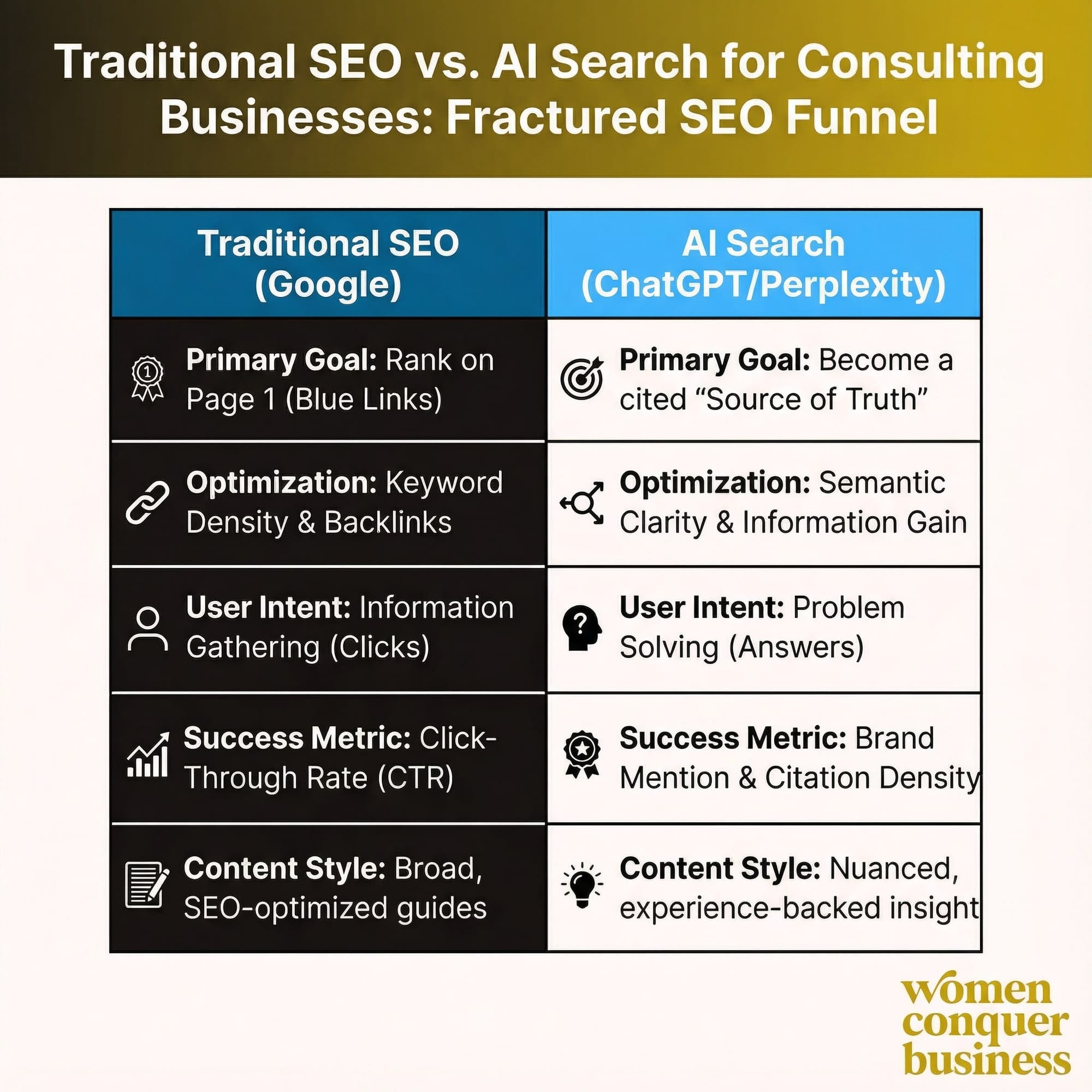
The traditional search funnel, where a user types a keyword and clicks on a link, has fractured. BrightEdge research shows Google AI Overviews now show up on a significant and growing portion of queries (e.g., over 40% in some industry analyses), highlighting how AI-generated summaries are reshaping search visibility.
Fractured SEO Funnel
| Feature | Traditional SEO (Google) | AI Search (ChatGPT/Perplexity) |
|---|---|---|
| Primary Goal | Rank on Page 1 (Blue Links) | Become a cited "Source of Truth" |
| Optimization | Keyword Density & Backlinks | Semantic Clarity & Information Gain |
| User Intent | Information Gathering (Clicks) | Problem Solving (Answers) |
| Success Metric | Click-Through Rate (CTR) | Brand Mention & Citation Density |
| Content Style | Broad, SEO-optimized guides | Nuanced, experience-backed insight |
Many of these queries are "zero-click," meaning the user gets their answer without ever visiting a website. It means you can't win on search volume alone. If AI can help answer the search query simply, your SEO performance will suffer because no one will reach your site.
Most guides on AI search optimization for service businesses assume you have an enterprise marketing team. They tell you to "create more SEO content," but they don't account for your daily work delivering for clients.
For a solopreneur or small team, the goal is winning the citation for what their ideal clients need.
What's old is new: you don't need more traffic; you need the right traffic. ... BUT, instead of focusing on Google's page 1, we also need to consider SEO strategies that help your company show up in AI search.
When an AI model synthesizes an answer for a potential client, you want your name and unique methodology mentioned as the authoritative source. This requires a shift from keyword stuffing to "semantic clarity." You must organize your expertise so that Large Language Models (LLMs) can easily extract and trust your information.
We prioritize strategy over tool-chasing because software cannot fix a lack of authority. Move beyond the "checklist" mentality. Start thinking about how AI models perceive your professional reputation.
Before You Do Anything: The 3-Minute AI SEO Readiness Check
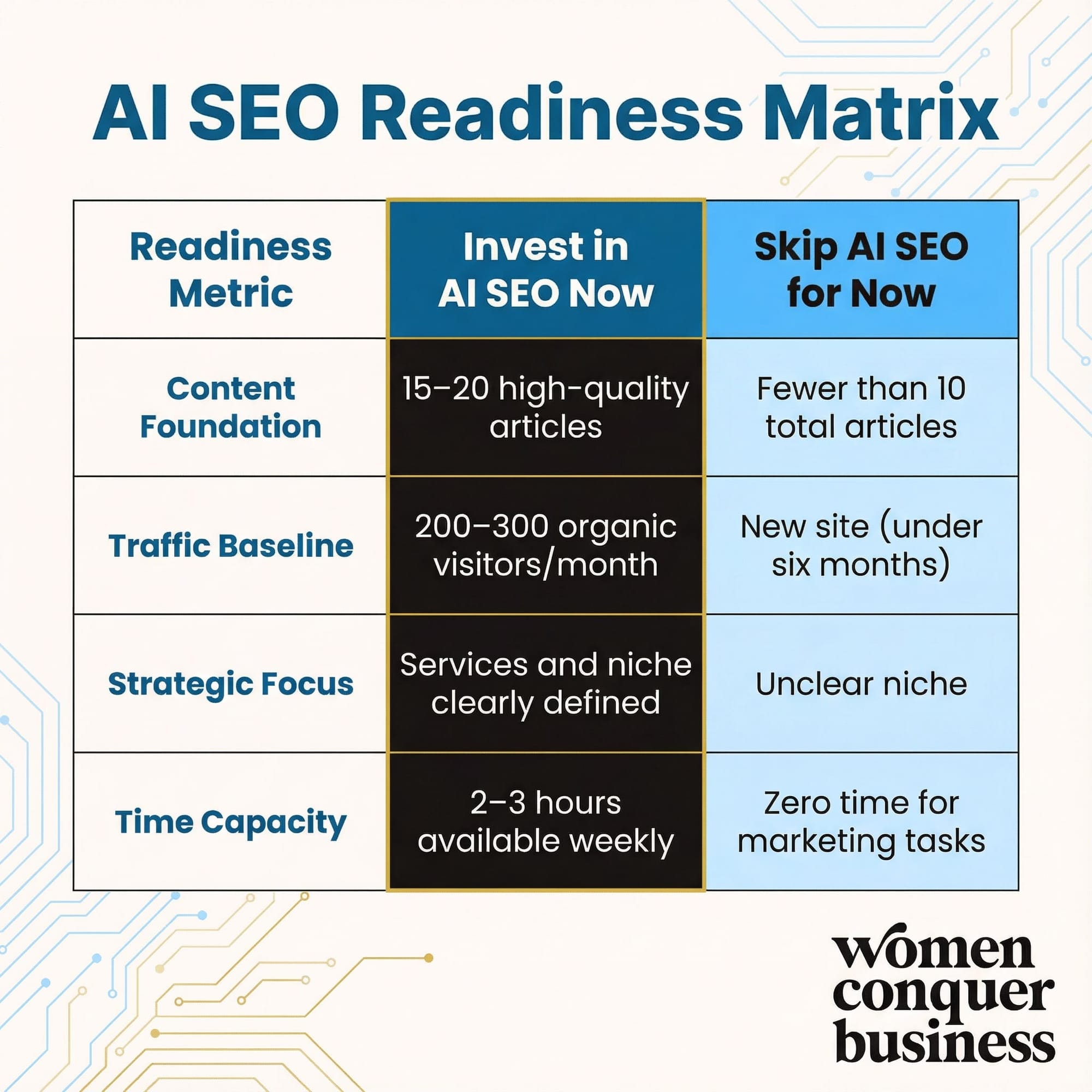
Not every service business needs to prioritize ChatGPT SEO for consultants right now. If you are in your first year, focusing on AI citations might be a distraction from finding your product-market fit. Use this comparison to determine if you should invest your limited capacity here or focus on the basics.
AI SEO Readiness Matrix
| Readiness Metric | Invest in AI SEO Now | Skip AI SEO for Now |
|---|---|---|
| Content Foundation | 15–20 high-quality articles | Fewer than 10 total articles |
| Traffic Baseline | 200–300 organic visitors/month | New site (under six months) |
| Strategic Focus | Services and niche clearly defined | Still experimenting with niche |
| Time Capacity | 2–3 hours available weekly | Zero time for marketing tasks |
Not Ready Yet? Do This Instead.
If you aren't ready to invest in marketing coaching services, that is smart self-awareness. Focus on creating one "deep-dive" article every month that answers the top five questions your clients ask. This builds the E-E-A-T signals (Google's Experience, Expertise, Authoritativeness, and Trustworthiness framework for people-first content) you will need without the pressure of mastering technical SEO platforms or tools for SEO optimization.
What AI Search Means (In Plain English)
To understand how to rank in AI search, you must stop thinking about Google as a filing cabinet. See it instead as a librarian with a brief attention span. Google now uses AI systems that focus on understanding meaning, not just keywords. Instead of counting how often a phrase appears, it looks at how well your content actually addresses the problem someone is trying to solve.
When a potential client asks a chatbot for the "best marketing consultant for solopreneurs," the AI evaluates if your content consistently solves that specific problem. A cohesive strategy is the foundation of AI visibility. If your website tries to be everything to everyone, the AI perceives you as "noisy." It skips you for a source with a tighter relationship to the question.
Think of it like this: if you are at a crowded coffee shop and someone asks for a dark roast recommendation, they listen to the person who describes the specific notes of a Sumatran bean. They ignore the person shouting, "I have coffee!" AI models operate with the same preference for specific, nuanced depth.
Exposing AI SEO "Snake Oil" and Predatory Promises
The AI SEO world is full of hype and overpriced tools. I have seen solopreneurs spend over $3,000 on technical SEO and AI automation before they had a clear marketing operations plan. That is a waste of your resources.
Headed for Model Collapse?
Research published in Nature shows that repeatedly training AI systems on content created by other AI systems leads to a degradation in output quality. This effect, known as model collapse, happens because the information becomes more repetitive and less connected to real human experience.
In practical terms, using AI to mass-produce content without real insight or originality doesn’t build authority. It adds more noise to an already crowded internet (the very thing search engines are trying harder to filter out). You can skip the AI-powered tool to automate SEO articles at scale (unless you plan to edit the articles to include your expertise and personal experience).
Google's 'Information Gain' Requirement
Google has a patent that describes a way to score content based on how much new and additional information it offers compared to what a user has already seen. This suggests that search technology is evolving toward rewarding content that adds meaningful insight on a topic rather than repeating exactly what’s already widely available online.
You must provide a signature perspective, or a unique way of solving a problem that only exists because of your professional experience. I once worked with a client who bought a high-end AI SEO course. She created about 50 articles in 30 days. Her traffic stayed flat. The content lacked personal insight. We conducted on-page optimization, including AI SEO optimization like FAQs, AI summaries (TL;DR), and infused case studies into the articles. Within a few months, she appeared in a Perplexity answer as a recommended resource.
Strengthen Your Entity Signals (Without Burning Hours)
If this guide made you realize your business needs stronger online citations, consistent listings, and clearer entity signals for AI and search ... start with a Local SEO tune‑up.
My Local SEO Service helps you:
• Fix inconsistent directory listings
• Build out the citations AI tools trust
• Strengthen your Knowledge Graph signals
• Set up the structured data Google (and ChatGPT) read
• Increase visibility without hustling harder
Capacity-Aware AI for SEO Strategy: Your Marathon Pace
Most marketing "experts" will tell you that to rank in AI search, you need to publish content daily. This ignores the reality of being a busy professional services business owner. For you, SEO tasks typically fall into the 'someday' category. SEO isn't an all-or-nothing proposition: you don't need to publish daily to get significant results.
Capacity-to-Citation Ratio
At Women Conquer Business, we use the Capacity-to-Citation Ratio. This framework suggests that value is measured by "extraction density," not volume. If you write one deeply researched, experience-backed article per month, you are more likely to be picked up in AI algorithms than if you publish four forgettable, generic posts.
Power of Emotional Reality
Stop trying to win the sprint against corporate content teams. Your competitive advantage is lived experience. A corporate blog cannot talk about the time you spent two hours fighting with a client’s API documentation. That emotional reality makes your content a primary source for an AI looking for nuanced answers.
AI Era: Turning Trust Into a Machine-Readable Asset
Trust is a measurable data signal in AI search. When an AI chatbot scans your site, it looks for "Honest to a Fault" markers. These include disclaimers, acknowledgments of limitations, and transparent sourcing.
Building Trustworthy Anchor Points
We call this The Ethical Citation Loop. When you prioritize ethical, values-based marketing, you feed the AI the data it needs to verify your E-E-A-T signals. Explicitly stating "this approach works until you hit production scale" is a massive authority signal for an LLM. It shows you understand the boundaries of your expertise. By being vulnerable about where a strategy failed, you create "Trustworthy Anchor Points" that AI models use to validate your information.
Using AI for SEO: What to Do First
You don't need expensive AI-powered SEO tools or a marketing team to begin. Strategic success relies on three pillars that cost nothing but your focused attention (and will help with visibility in AI search results AND traditional SEO (Google)). Use this implementation roadmap to build your foundation without the pressure of an unnecessary software subscription.
1. Expertise-First Content
AI search engines prioritize depth over breadth. Instead of publishing generic tips, focus on answering the five toughest questions your clients ask. If you’re struggling to choose a focus, use your client conversations as your filter; they naturally point you toward the topics where your expertise is deepest.
For example, AI platforms let you upload transcripts from your meetings. Ask AI to analyze it for themes or topics that boost your credibility and could improve your ranking in search.
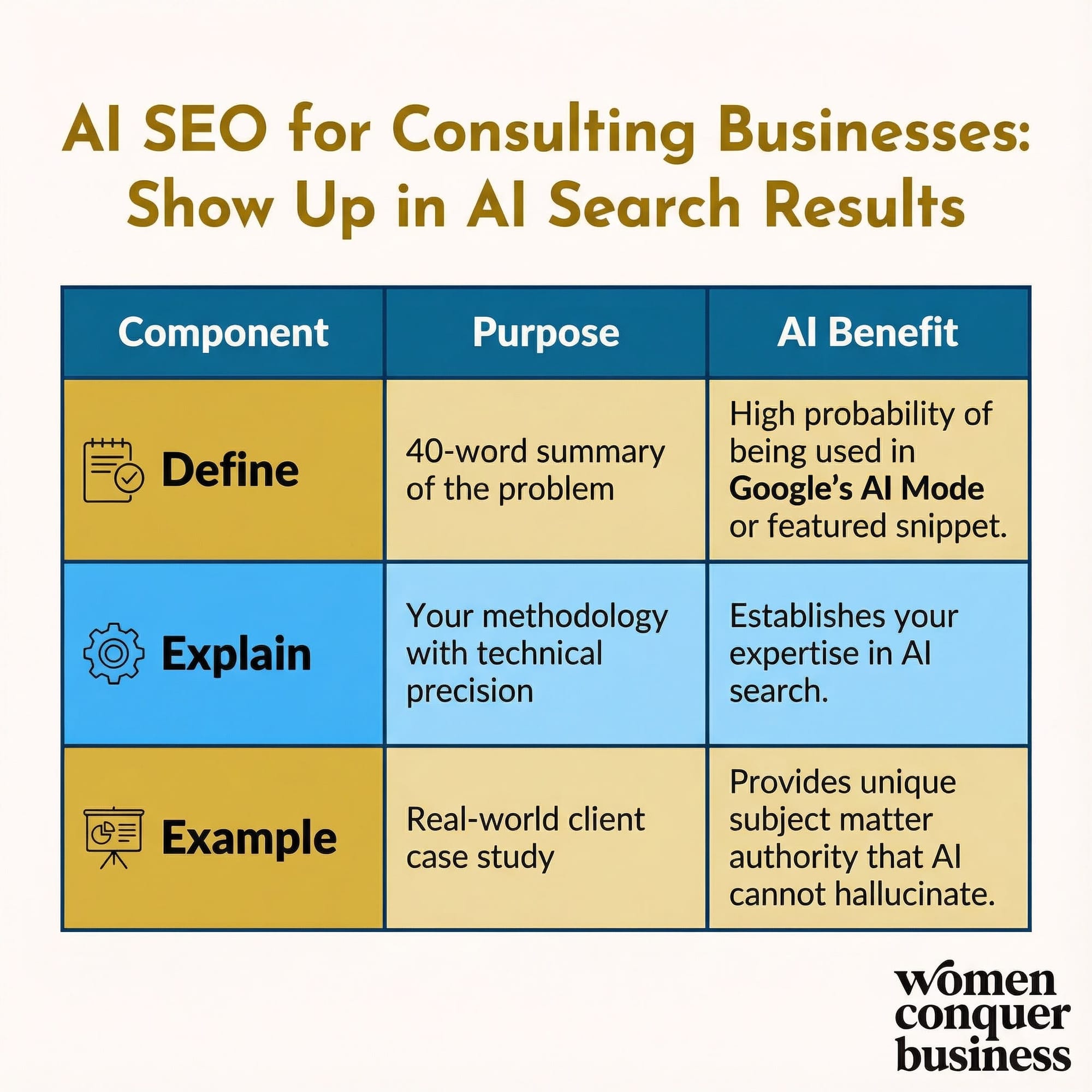
Once you have a topic, AI platforms like ChatGPT love content that follows a Define → Explain → Example pattern:
| Component | Purpose | AI Benefit |
|---|---|---|
| Define | 40-word summary of the problem | High probability of being used in Google's AI Mode or featured snippet. |
| Explain | Your methodology with technical precision | Establishes your expertise in AI search. |
| Example | Real-world client case study | Provides unique subject matter authority that AI cannot hallucinate. |
This structure allows AI and SEO search engines to parse your content and establish your content strategy as one built on original insight rather than recursive AI slop. As a coach or consultant, Define → Explain → Example is what you do all day with clients. This means the future of search is built for expertise.
2. Expertise Signals That Build Trust
Large language models look for author credentials to verify the "Expertise" portion of E-E-A-T. Your author bio is now a critical search asset.
- The "About" Connection: Ensure every article links to a comprehensive author page.
- Credentials: List certifications, speaking engagements, and years in the field.
- Proof of Work: Include specific outcomes and methodology names.
By making these signals visible, you move from being an anonymous writer to a cited practitioner. This transparency turns your lived experience into a machine-readable authority marker.
3. Technical Basics: Free AI SEO Tools
You do not need to be a developer to handle technical foundations.
- Google Search Console (15 minutes): Set this up to monitor how search engines see your pages.
- Schema Markup (30 minutes): Use a free online schema generator (or a top AI SEO plugin like RankMath) to add Local Business, Person and Organization schemas to your website.
- Page Speed: Ensure your site loads quickly on mobile (use Google PageSpeed Insights (free)). Answer engine optimization prioritizes sources that provide a smooth user experience.
If these basics feel overwhelming, remember that a solid basic SEO foundation is more valuable than any advanced "hack." Mastering these free elements ensures you own your audience data. If you need help, we offer local SEO services infused with AI SEO.
Beyond Basics: The Next Level (When You're Ready to Level Up)
Once your foundation is secure, you can transition to advanced techniques that improve your "extraction probability." These tactics focus on how Answer Engines synthesize your expertise relative to your competitors. Implementing these strategies requires a consistent commitment but provides compounding authority.
1. Optimize for AI Answer Extraction
To increase the likelihood that ChatGPT or Perplexity cites you, you must reduce the computational cost for the model to understand your value. AI models preferentially extract information from specific formatting patterns.
- Quotable Sections: Ensure every H2 section begins with a 40–60 word "Answer Block."
- Comparison Tables: AI systems excel at parsing Markdown tables. Use them to compare features, pricing, or methodologies.
- FAQ Sections: Use FAQ schema to target "People Also Ask" queries. Not sure what people ask? Part of Google's search experience is a box titled "people also ask." Or, AI-powered tools can automate the process by providing AI prompt ideas to help you create FAQs (Ubersuggest is a low-cost option for this).
2. Build Citations and Backlinks
In traditional search, any link was a good link. In AI search, only citations from "Trustworthy Anchor Points" matter. Chatbots look for corroboration across credible sites to verify your expertise.
- Guest Articles: Focus on high-authority industry publications where your perspective provides information gain.
- Podcasts and interviews create diverse semantic signals that link your name to specific expertise entities.
- Community Authority: taking part in Reddit or Quora threads as a verified practitioner creates data that AI models use to validate your reputation.
3. Track Your AI Search Visibility
Traditional rank tracking is becoming obsolete. You need to know if you are being "mentioned" rather than just ranked.
| Tracking Method | Tool Example | Estimated Cost | Best For |
|---|---|---|---|
| Manual Verification | SearchGPT / Perplexity | Free | Periodic check of key queries |
| Small Businesses | Ubersuggest | $29+/mo | AI search visibility, AI keyword overviews |
| Enterprise Insights | Semrush AI Toolkit | $199+/mo | Deep visibility and gap analysis |
Reality Check: Advanced Strategy Commitment
- Setup Effort: HIGH (Requires learning new tracking and formatting patterns).
- Ongoing Effort: 3–5 hours per week beyond content creation.
- Tools Required: Optional paid tracking (Ubersuggest or Semrush).
- Learning Curve: Steep; requires strategic reasoning.
- Budget: $0–$200/mo DIY | $1,000–$3,000/mo Professional Support.
- Results Timeline: 6–12 months for compounding authority.
- Common Misconception: "Advanced tactics shortcut the timeline." False. They amplify a strong foundation.
| Strategy Level | Estimated Time | Primary Task | Expected Outcome |
|---|---|---|---|
| Foundation | 1 hr / month | Update author bio & schema | Machine-readable authority markers |
| Active | 2-3 hrs / week | 1 in-depth article | Increased organic traffic & trust |
| Advanced | 5+ hrs / week | Partner guest posts and citation building | Dominance in AI-synthesized answers |
Should You DIY This or Hire Someone?
Deciding whether to manage your own AI search optimization or delegate it to a professional is a significant strategic choice. While many guides push toward one path, the correct answer depends on your unique intersection of time, budget, and business stage. For a deeper analysis of this general business crossroads, you can read our comprehensive guide on DIY marketing vs. hiring.
| Tracking Method | Tool Example | Estimated Cost | Best For |
|---|---|---|---|
| Manual Verification | SearchGPT / Perplexity | Free | Periodic check of key queries |
| Small Businesses | Ubersuggest | $29+/mo | AI search visibility, AI keyword overviews |
| Enterprise Insights | Semrush AI Toolkit | $199+/mo | Deep visibility and gap analysis |
Red Flags When Hiring AI SEO Help
The AI search landscape is currently a magnet for predatory marketing. Before signing any contract, watch for these specific warning signs.
- Guaranteed Rankings: No one can guarantee a citation in ChatGPT. AI models are non-deterministic.
- Tool-First Approach: If they insist you must buy a software before they even look at your content, they are tool salesmen.
- Proprietary Secrets: Good help should be transparent about their methodology. If they claim a "secret algorithm hack," walk away.
- Fast Results: Anyone promising significant visibility in 30 to 60 days is ignoring how LLMs verify authority.
What Good Help Looks Like
A legitimate partner should lead with a strategy audit. They should tell you if you aren't ready for AI SEO. Professional marketing coaching or SEO services should focus on surfacing your unique expertise and case studies. They will prioritize your ethical authority and the long-term sustainability of your business.
Moving from Invisible to Authoritative
Success in AI SEO for business isn't about chasing chatbot updates. It is about the intersection of expertise and radical transparency. We moved from a world of keyword-driven "blue links" (Google) to AI-driven search results where your reputation is a machine-readable asset.
Your content creation and optimization efforts must be client-first (deep, experience-backed content) rather than trying to "hack" the system with volume.
Your first move is the Readiness Check at the beginning of this article. If you have the foundation, audit your content for fluff. Replace generic paragraphs with your client stories. Prune out old content unrelated to your current offerings.
Whether you are refining your plan or need group support through a marketing membership, we are here to help you build a business that fits your life. Marketing is a marathon. If you are ready to start, please reach out and let's simplify your path forward.
Strengthen Your Entity Signals (Without Burning Hours)
If this guide made you realize your business needs stronger online citations, consistent listings, and clearer entity signals for AI and search ... start with a Local SEO tune‑up.
My Local SEO Service helps you:
• Fix inconsistent directory listings
• Build out the citations AI tools trust
• Strengthen your Knowledge Graph signals
• Set up the structured data Google (and ChatGPT) read
• Increase visibility without hustling harder
AI SEO FAQs
How long does it take to see results in AI search?
Typically, citation patterns emerge in four to six months. This depends on your existing authority and the depth of your content updates.
Do I need expensive software to rank in Perplexity?
No. Strategic clarity and semantic structure are more important than any paid tool. Most solopreneurs can begin with free tools like Google Search Console.
What is the biggest risk of using AI for content creation?
The primary risks are model collapse (too many people using AI recursively) and a lack of information gain (you have nothing new to offer on a topic). If your content provides no new perspective, AI engines have no reason to cite you as a source.