


At a Glance: Will AI Kill SEO?
No, AI will not kill SEO, but it is changing it from a traffic-generation game to a brand-visibility strategy. For service businesses, this means shifting focus from high-volume generic content to deep, experience-based insights that AI cannot replicate.
The Elephant in the Room
You’ve seen the headlines. You’ve heard the whispers in Facebook groups. If you’re like most of the women I work with, you’re probably wondering if all that time you spent sweating over your website was a waste.
Let’s get the big question out of the way: Will AI kill search engine optimization (SEO)?
It’s one of the biggest fears I hear from service providers right now. You’re already exhausted from wearing all the hats in your business: CEO, accountant, social media manager. The last thing you need is a robot coming for your marketing strategy.
I get it. The AI/marketing/tech environment feels like it’s shifting under our feet daily. It’s disorienting.
But here is the truth the bro marketers aren’t telling you: AI is only killing "lazy" marketing.
Analysts at Gartner predict that search engine volume will drop by 25% by 2026 because of chatbots. That sounds scary until you realize which searches are disappearing. The searches vanishing are the simple, generic questions; the ones that never turned into paying clients anyway.
For a service business built on trust, this isn’t an apocalypse. It’s an opportunity to stop chasing vanity metrics and start building real authority.
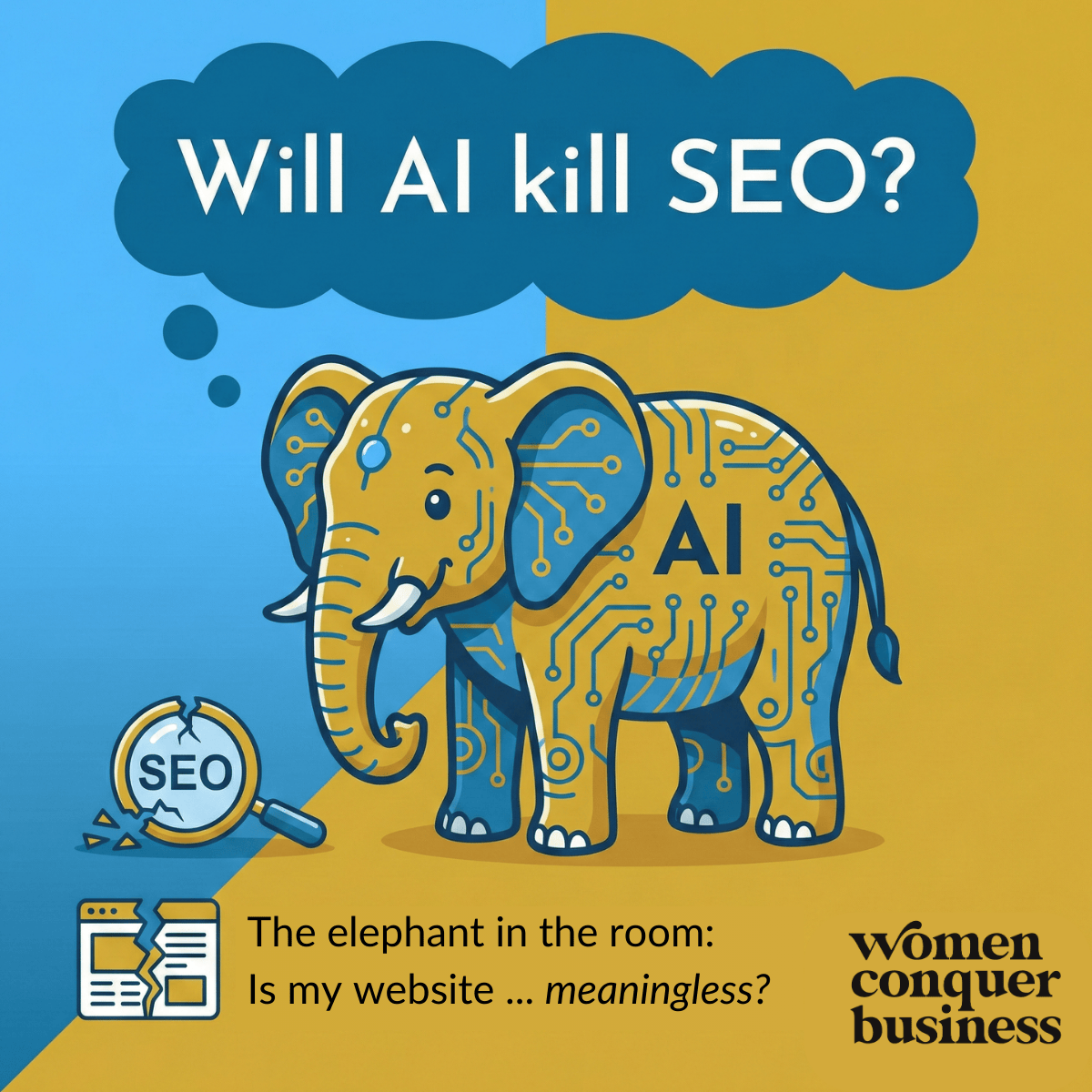
Commodity Content Search is Dead
If your marketing strategy relied on churning out generic 500-word blog posts that summarize what everyone else is saying, then yes, your SEO strategies are in trouble.
This is what we call Commodity Content. It is technically accurate, sure. But it offers no unique perspective, no experience, and zero value beyond what a Wikipedia page could tell you.
For years, the "hustle culture" advice was to publish volume. We were told to feed the algorithm. But the game has changed.
This means users are getting their answers directly from Google’s AI Overviews or chatbots without ever visiting a website. If your content creation focuses on generic topics, like "what is a [insert your common industry term here]," you are fighting a losing battle against tools like Google AI Mode or ChatGPT that can summarize that answer instantly.
This sounds like bad news, but for service businesses, it is a liberation. It means we can stop writing for the robots and start writing for the humans who hire us.
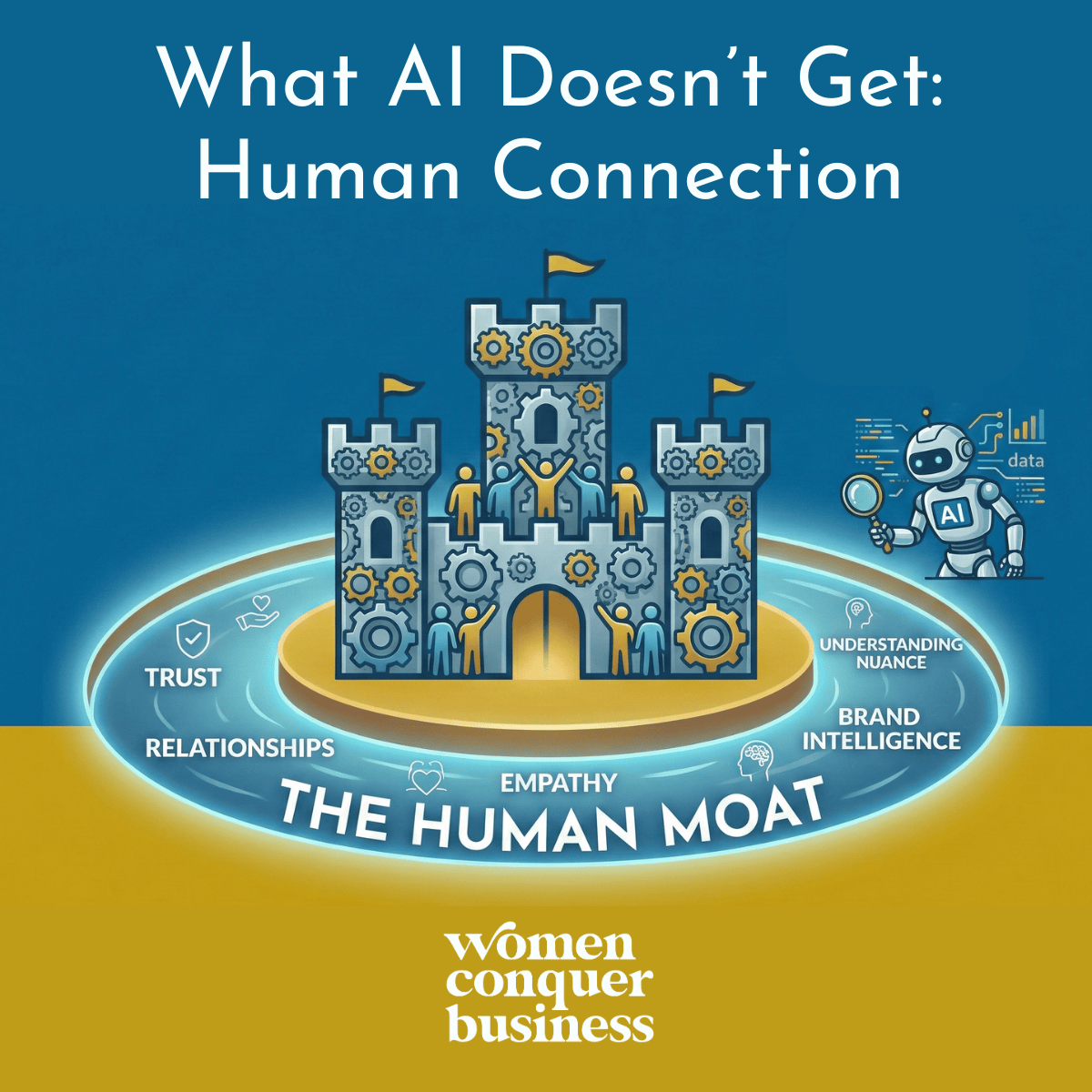
The Human Moat: Why Service Businesses Are Safe
Here is the critical distinction: AI can aggregate data, but it cannot build relationships.
When my clients are looking for a marketing strategy consultant, they aren't looking for a list of tactics. They seek someone who understands the nuanced reality of running a business while juggling family, burnout, and life. They are looking for trust.
Brand Intelligence: The Evolution of SEO
This is your Human Moat. It is the protective barrier around your business built on things AI cannot replicate.
- Lived Experience: AI has never navigated a client crisis or pivoted a business model.
- Local Context: AI doesn't understand the specific vibe of a Portland networking event.
- Empathy: AI cannot validate your exhaustion.
Google’s own ranking systems have evolved to prioritize this. They recently updated their quality rater guidelines to include an extra "E" for Experience. They want to rank content that clearly comes from a human who has "walked the walk."
What does this mean? Telling more stories about what you know.
While marketing bros panic about traffic drops, sustainable service businesses are doubling down on connection. We don't need millions of visitors; we need the right visitors who resonate with our values.
Strengthen Your Entity Signals (Without Burning Hours)
If this guide made you realize your business needs stronger online citations, consistent listings, and clearer entity signals for AI and search ... start with a Local SEO tune‑up.
My Local SEO Service helps you:
• Fix inconsistent directory listings
• Build out the citations AI tools trust
• Strengthen your Knowledge Graph signals
• Set up the structured data Google (and ChatGPT) read
• Increase visibility without hustling harder
Shift to Answer Engine Optimization (AEO)
So, if generic keywords are losing power, what replaces them? The answer is Answer Engine Optimization (AEO).
What is AEO?
AEO is the practice of structuring your content to provide direct, authoritative answers that AI models can easily cite. Instead of "optimizing for clicks," you are "optimizing for visibility."
In this new paradigm, your goal isn't to get someone to your website immediately. It is to be cited as the authoritative source within the AI's answer. For example, if you’re a marketer who helps coaches (like me), you want ChatGPT to answer questions about "sustainable marketing for coaches," to reference your frameworks and your philosophy.
This requires a shift in how we create content:
- Be the Source, Not the Reporter: Don't curate other people's stats. Share your own client results.
- Structure for Clarity: Use clear headings and direct answers (like we do in our local SEO services). Inside our marketing membership, I remind people it’s now clear over clever. That means no more cute services or program names (I know…) because AI doesn’t understand them.
- Focus on Entities: Ensure the search engines clearly understand who you are (The Entity) and what you do (The Service).
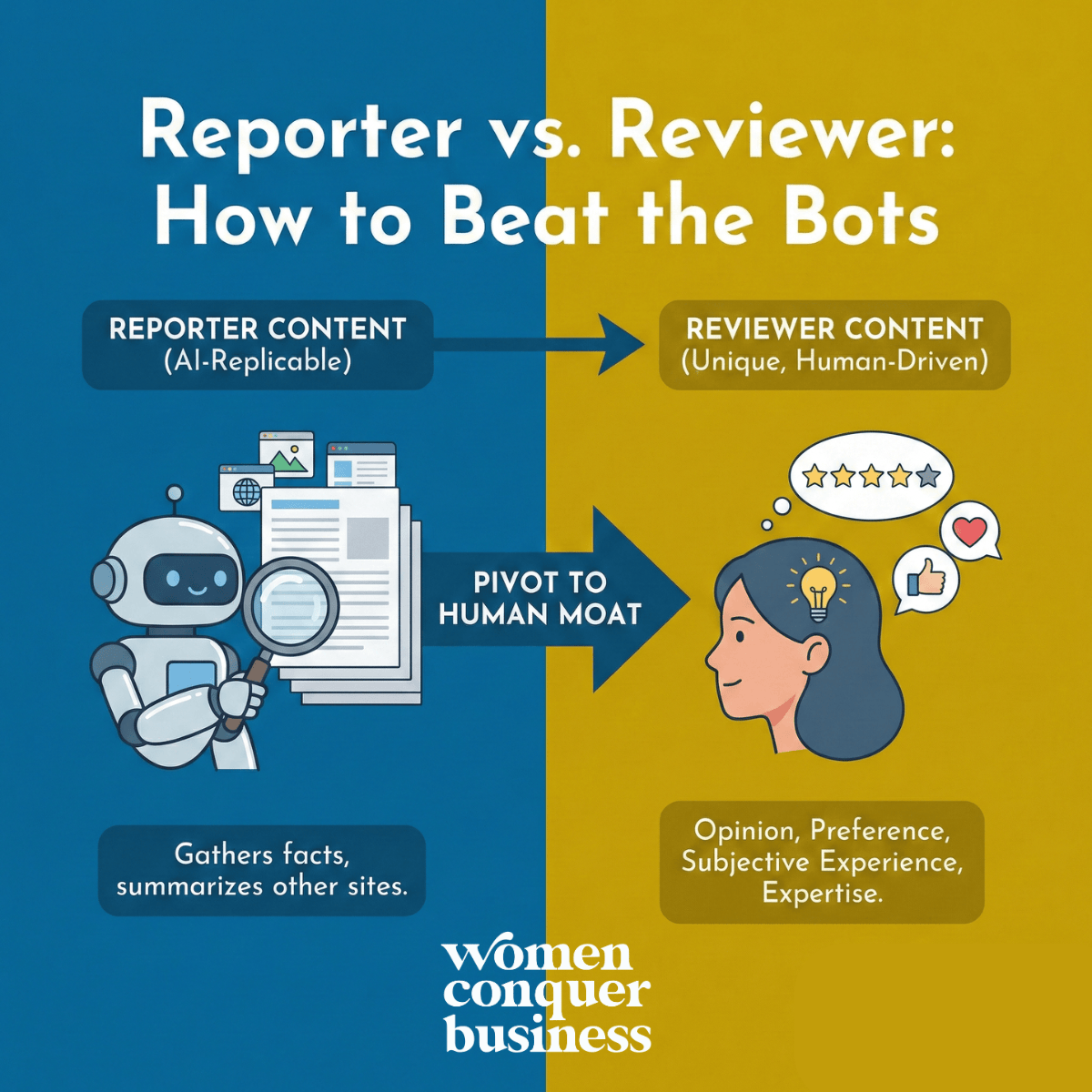
Reviewer Framework: How to Beat the Bots
Most content on the web today is what I call "Reporter" content. It simply gathers facts from other websites and rewrites them. This is exactly what AI models are designed to do. If your blog post is a summary of three other blog posts, an AI can replicate your work in seconds (and for free).
To differentiate yourself, you need to pivot to "Reviewer" content.
Reviewer content is based on opinion, preference, and subjective experience (backed by expertise). AI models are probability engines; they predict the most likely next word based on the average of the internet. They struggle with unique, contrarian, or highly personal takes because those patterns don't appear in the "average" data.
How to Implement the Reviewer Framework:
- Don't list tools or options; rate them. Instead of "Top 5 Email Tools," write "Why We Switched from Mailchimp to Kit (and Why It Was a Headache)." This signals deep engagement with the topic.
- Share the failure. AI rarely hallucinates failure unless prompted. Sharing what didn't work in your marketing operations adds a layer of authenticity that signals "Human Written" to both readers and algorithms.
- Use "Information Gain." Google holds a patent for Information Gain Scores. Simply put, if your article adds something new to the conversation (e.g., a new data point, a new perspective, or a new framework) it ranks higher. If it repeats what is already there, it gets ignored.
From Keywords to Entities: Owning Your Digital Footprint
We talk about this more in-depth in our article about getting mentioned by ChatGPT and what is generative AI optimization, but here’s a brief summary about what’s going on.
In the past, traditional search matched the word (e.g., "digital marketing") on your page to the word "digital marketing" in a search bar. Today, Google search is far more sophisticated. When people search for you, Google uses a Knowledge Graph to understand Entities. An Entity is a person, place, or thing that Google recognizes as distinct.
For you, this means YOU are the keyword.
When you use AI to ask about a business, it traverses this Knowledge Graph to see what is connected to your brand name. Does it see "Marketing Strategy"? Does it see "Portland"? Does it see "Women-Owned Business"?
If your website says you offer "Holistic Coaching," but your LinkedIn says "Life Coaching," and your Instagram bio says "Wellness Mentor," you are confusing the AI. It dilutes your authority score.
The Fix: Audit your digital presence. Ensure your name, address, phone and your core service descriptions are identical everywhere. Train the robots to know exactly who you are, so when potential clients ask for a "holistic coach near me," the AI knows you are the answer.
Library vs. Newsroom Mindset (Sustainable Visibility)
Most SEO advice treats your website like a Newsroom. You are told to publish daily, chase trends, and "break the news." This is a recipe for burnout. It’s also a losing strategy in the AI era, because AI will always be faster at reporting news than you are.
At Women Conquer Business, we teach the Library Mindset.
A library doesn't need 10,000 mediocre books; it needs a curated selection of definitive resources. In the Library model, you build Assets, not just "content."
- Newsroom (Old Way): "Here are 5 quick tips for Instagram today." (Expires in 24 hours).
- Library (New Way): "The Core Principles of Relationship Marketing That Never Change." (Lasts for 5 years).
When you build a Library, you are creating what we call Compounding Content. One high-quality, deep-dive article (like the one you’re reading) continues to work for you for years.
How do I know this? Because an article I wrote 4 years ago landed me in a documentary two years after it was written and still gets me clients today.
It frees you from the hamster wheel. You can take a month off, and your "Library" is still there, serving your clients and answering their questions. This is the heart of marketing coaching and consulting, building systems that work for you, not the other way around.
Operational Gap: Why More Traffic Can Hurt You
There is a hidden danger in SEO that almost no one talks about: Operational Fragility.
We assume that if we rank #1 and get 100 new inquiries, our business will explode (in a good way). But if you haven't fixed your backend systems, that traffic will break you. I have seen it happen. A client goes viral, their inbox floods, they drop the ball on responses, and their reputation tanks.
This is the "Traffic-to-Trust" Paradox.
In the AI era, where traffic is harder to get, conversion is everything. You cannot afford to lose a single lead to a broken form or a messy onboarding process. Before you spend thousands on SEO, you need to audit your Marketing Operations Makeover.
- Is your intake form automated?
- Do you have a clear "next step" for every visitor?
- Can your calendar handle 10 strategy calls next week?
Sustainable SEO requires more than keywords; it demands a business structure that can hold the success you are asking for. Don't build a skyscraper on a sinkhole.
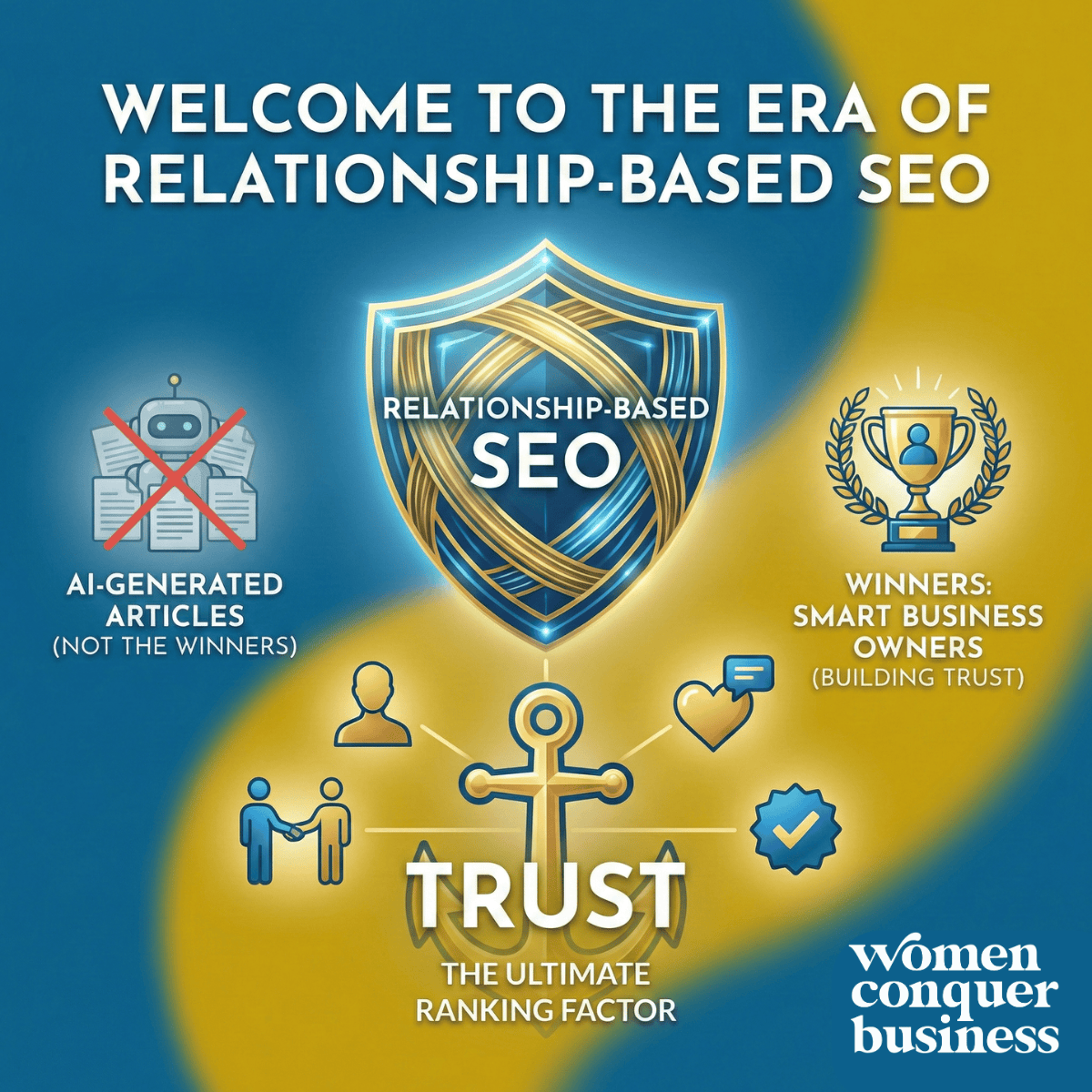
Will AI Kill SEO? Nah, the Future is Human
Will AI kill SEO? No. But it is certainly killing the version of SEO that treated people like data points. And frankly, I’m glad to see it go.
AI tools can help A LOT. But....
We are entering an era of Relationship-Based SEO. The algorithms are finally catching up to what smart business owners have known all along: Trust is the ultimate ranking factor. The winners in this new playing field won’t be the ones with the most AI-generated articles. They will be the ones who build the deepest Human Moat.
Your job isn't to out-write the robots. Your job is to be so undeniably you (so grounded in your specific expertise and your "Library" of assets) that no algorithm can replace you.
It’s time to stop chasing traffic and start building a legacy. If you’re ready to build a marketing foundation that fits your real life (and doesn't require posting 3x a day), come join us in the Strategic Marketing Membership. We’re navigating this brave new world together, one sustainable step at a time.
Strengthen Your Entity Signals (Without Burning Hours)
If this guide made you realize your business needs stronger online citations, consistent listings, and clearer entity signals for AI and search ... start with a Local SEO tune‑up.
My Local SEO Service helps you:
• Fix inconsistent directory listings
• Build out the citations AI tools trust
• Strengthen your Knowledge Graph signals
• Set up the structured data Google (and ChatGPT) read
• Increase visibility without hustling harder