Skip to content
16 min read Marketing

When to Hire a Marketing Consultant: 9 Signs You've Outgrown DIY (2026 Guide)

Marketing chaos? Learn the 9 signs you need to hire a marketing consultant, costs and red flags to avoid.

Learn the 9 signs you need to hire a marketing consultant, costs and red flags to avoid.
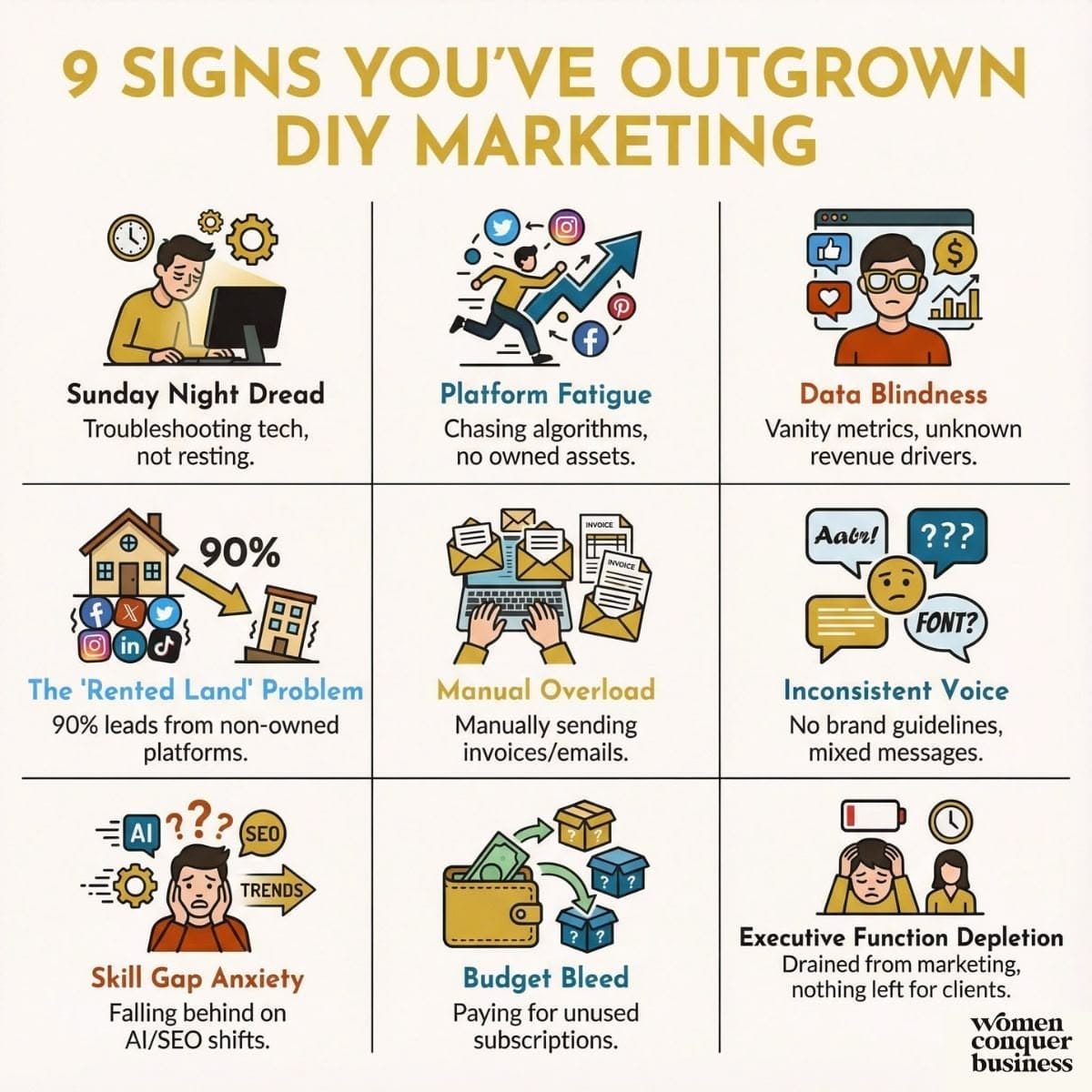
9 signs it might be time to hire a marketing consultant.

You're not lazy. You're not failing.

But Sunday night has felt different. Instead of planning your week, you're staring at seven browser tabs trying to figure out why your email sequences broke again, flustered because Google Analytics looks like a foreign language, and wondering if you can afford to keep pretending you know what you're doing with marketing.

By the time you're searching "when to hire a marketing consultant," you've likely needed one for a while. Digital marketing has become genuinely complex, and running it well while also delivering client work is increasingly impossible for one human brain.

After 25 years building marketing systems for everyone from city governments to solopreneurs, I've watched hundreds of smart business owners hit the same wall. They're exceptional at their craft but drowning in marketing operations. Their tools don't talk to each other, their data tells conflicting stories, and the "gurus" selling $2,000 courses keep implying the problem is their discipline, not their infrastructure.

This guide breaks down the signals that show it's time to bring in outside help: operational and strategic realities that separate sustainable growth from expensive chaos.

At certain times, hiring help recognizes that modern marketing is a full-time operational discipline, and treating it like a side hustle is why it's not working.

The "Sunday Night Dread": Why You're Reading This

The problem isn't your creativity or work ethic. Modern marketing has become a full-time operational job requiring systems architecture, not just content creation.

According to recent small business research, many small business owners report spending about 20 hours per week on marketing tasks. What used to require a website and email list now demands integrated CRM systems, multi-platform tracking, automation sequences, and constant platform updates that break workflows.

The real signal you need help? When your marketing effort stops growing your business and becomes the thing preventing you from running it.

When I work with new clients through marketing coaching, they didn't come to "scale." They came because they're drowning in tactical execution and can't see the strategy. They're maintaining systems, not building momentum.

That wall isn't a character flaw. It's a capacity constraint.

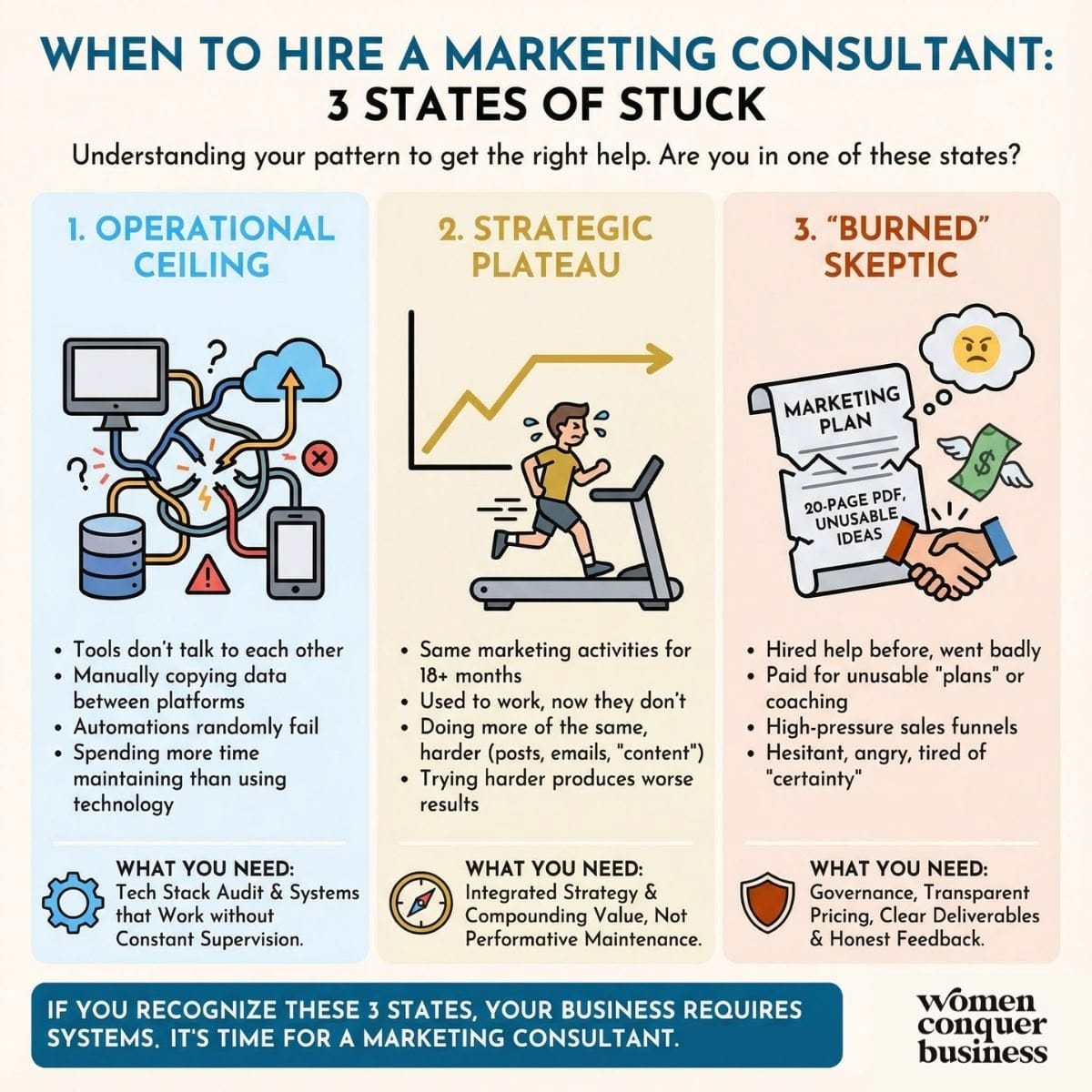
The 3 States of "Stuck": Which One Are You In?

Understanding which pattern you're experiencing changes what kind of help you need.

State 1: The Operational Ceiling (Tech Chaos)

Your tools don't talk to each other. You're manually copying data between platforms. Your automations randomly fail and you don't know why. You built your marketing stack one tool at a time without thinking about integration.

The breaking point: You spend more time maintaining your marketing technology than using it to acquire customers.

According to marketing operations research, knowledge workers toggle between applications over 1,200 times per day, potentially costing countless hours of productive time.

What you need: Not another tool. You need someone who can audit your tech stack, identify redundancies, and build marketing operations that work without you babysitting them.

State 2: The Strategic Plateau

You've been doing the same marketing activities for 12-18 months. They used to work. Now they don't, and you can't figure out why. You responded by doing more of the same thing, harder.

More posts. More emails. More "content." Same results (or worse).

The breaking point: When "trying harder" produces worse results than doing less.

Here's what I see in marketing strategy audits: the tactical execution is often fine. What's missing is the connective strategy, or understanding which activities create compounding value versus performative maintenance.

If you can't explain in 60 seconds how each marketing activity connects to revenue, you're not strategically stuck. You're strategically blind.

State 3: The "Burned" Skeptic

You've already hired help. It went badly. You paid thousands for a "marketing strategy" that was really just a 20-page PDF full of ideas you couldn't implement. Or you signed up for a "coaching program" that was actually a high-pressure sales funnel.

Now you're hesitant and angry.

The marketing industry has a credibility problem. Unlike licensed professions, there's no standardized credentialing. Anyone can call themselves a marketing consultant, creating a market flooded with unqualified practitioners selling certainty they can't deliver.

What you need: Governance. Transparent pricing, clear deliverables, measurable outcomes, and someone who'll tell you when something won't work.

This is where experience matters more than charisma. Someone who's built marketing systems for city governments, nonprofits, and small businesses over 25 years will not promise you'll be a millionaire in 90 days.

Consultant vs. Coach vs. Agency: Big Differences

The marketing industry deliberately blurs these distinctions because ambiguity allows practitioners to charge premium prices for junior-level work.

The decision should be driven by three operational factors:

Marketing Consultant: The Strategic Architect

What they do: A consultant can help diagnose problems, design solutions, and provide strategic counsel(no execution).

A legitimate consultant will:

When this works: You (or your team) can execute, but you need strategic direction and systems design. You have operational capacity but lack marketing expertise.

When this fails: You expect the consultant to "do your marketing." Consultants advise; they don't execute.

Typical engagement: Initial audit ($1,500-$5,000 for 2-4 weeks), followed by ongoing retainer ($500-$2,000/month) or project-based work ($3,000-$8,000 for operations implementation).

Marketing Coach: The Accountability Partner

What they do: Coaches focus on your behaviors, decisions, and capacity for you to build systems and execute campaigns.

Real coaching addresses the human factors that block implementation: decision paralysis, perfectionism, lack of follow-through, fear of visibility.

What coaches should NOT do: Build your CRM. Write your automations. Design your website. If someone calls themselves a "coach" but their primary deliverable is tactical execution, they're misusing the term.

When this works: Your marketing knowledge is decent, your systems are functional, but you struggle with consistency or confidence.

When this fails: You have genuine skill gaps or broken infrastructure. Coaching can't fix a tech stack that doesn't work.

Be very careful. The online course industry has weaponized the "marketing coach" label. If someone's primary credential is "I made $100K with my course about coaching," not "I built content marketing systems for 200+ businesses." The online hype could mean you're buying a one-size-fits-all methodology, not the best marketing expert.

Typical engagement: $500-$3,000/month for 6-12 month commitments.

Marketing Agency: The Execution Engine

What they do: Agencies typically have a marketing team that executes your marketing plan, manages ongoing activities, and provides specialized skills (design, paid ads, SEO, content production).

When this works: You have a budget ($3,000-$15,000+/month), clear direction, and need hands-off execution. Your business model supports the investment, and you value time over cost control.

When this fails: You don't have strategy clarity, or your budget is under $3,000/month (you'll get junior talent managing your account while paying for senior expertise).

The Hybrid Reality (What Most Small Businesses Need)

Most small businesses need a strategic consultant with selective execution support: someone to audit and fix broken infrastructure, build a coherent strategy, implement technical components you can't handle, train you for ongoing execution, and provide quarterly strategic check-ins.

This isn't standard because it doesn't scale. But this hybrid model solves the problem for established small businesses.

At Women Conquer Business, marketing coaching addresses this: strategic counsel with the option of hands-on systems work, designed to build your capability, not create dependency. For ongoing support, the Strategic Marketing Membership provides peer accountability and continuous education.

What a Marketing Consultant Costs

Let's talk about money. 

The reason most consultants refuse to publish pricing isn't because "every project is different." It's because price opacity allows them to charge based on your budget rather than the value delivered.

Realistic Project Pricing

Strategic Marketing Audit:

Operations Implementation:

Ongoing Retainer (Strategic Counsel):

Fractional CMO Services:

One-Time Project Work:

How to Structure Payment

Best practices:

Red flags:

The ROI Reality Check

Be skeptical of anyone promising specific revenue outcomes. Marketing works, but it's not a vending machine.

A consultant may improve your marketing system. They can't guarantee your revenue will double in 90 days.

But the right analysis, when implemented, can make a tremendous difference. For example, over 12 months, a $2,500 audit investment that saves you 8 hours/week and increases conversion by 25% will generate far more value than it costs. The mechanism is operational efficiency, not magic.

When the Investment Doesn't Make Sense

Honest answer: if you're doing under $50-$75K in annual revenue, hiring a consultant probably isn't your best use of capital.

Why? Because at that stage, you need market validation more than operational optimization. Your constraints are likely product-market fit or pricing.

Better path at early stages:

Once you're consistently generating $75K+/year, strategic marketing investment makes economic sense.

The industry won't tell you this because it reduces their addressable market. I'm telling you this because Women Conquer Business serves established business owners who've already validated their model.

What a Marketing Operations Audit Examines

When you hire a legitimate marketing consultant, the first deliverable should be an audit: diagnostic work that creates clarity.

Here's what a proper marketing operations audit examines:

Technology Architecture Your consultant should map every tool, integration point, data flow, and identify which system serves as your "source of truth" for customer data. The goal is eliminating redundancy and creating reliable automation.

Customer Journey Orchestration How do prospects move through your marketing? What's the intended path versus the actual path? Where are the drop-off points? What's automated versus manual?

Content-to-Conversion Efficiency Which content drives business outcomes versus what just feels productive? What's your ROI per content piece? Are you building on owned assets or rented platforms?

Measurement & Attribution Can you track which marketing activities contribute to revenue? Do you have decision-relevant metrics or just vanity metrics?

Team Capacity & Skill Alignment Is your current marketing sustainable given your time and bandwidth? Are you working on marketing or constantly in marketing firefighting?

These layers are interdependent. You can't optimize content if your tracking is broken. You can't build effective automation if you don't understand the customer journey. Good consultants think in systems, not tactics.

Why Your Marketing Feels Like Chaos: The Executive Function Problem

Here's a perspective you won't find in other consultant hiring articles, but it explains why smart, capable business owners struggle with marketing consistency.

Often, it's not discipline, but executive function, your brain's management system for planning, task initiation, working memory, cognitive flexibility, impulse control, and self-monitoring.

Every single one of these is required for effective marketing. And if you're also delivering client work, managing operations, handling finances, and dealing with fires, your executive function capacity is depleted before you even think about marketing.

Why "Just Be Consistent" Is Ableist Advice

The marketing industry loves to preach consistency. Post every day. Email your list weekly.

That advice assumes unlimited executive function capacity. For people with ADHD, chronic illness, caregiver responsibilities, or high-cognitive-demand businesses, "just be consistent" is like telling someone to "just bench press 300 pounds."

The issue isn't motivation. It's capacity.

A good consultant doesn't hand you a strategy that requires cognitive abilities you don't have. They design systems that reduce executive function load:

Your marketing should fit your brain, schedule, and energy levels, not theoretical best practices.

The "Rented Land" Problem: Why Platform Dependence Is Risky

Every marketing consultant will tell you to "build your social media presence."

Very few will tell you the uncomfortable truth: if your primary marketing asset is your social media following, you don't own a marketing system. You're a tenant on someone else's platform, subject to their rules, algorithm changes, and business priorities.

The Historical Pattern

Social platforms follow a predictable cycle:

  1. Attract creators with high organic reach 
  2. Build massive user base
  3. Limit organic reach to monetize through ads 
  4. Force creators to pay for access to audiences they built

Instagram followed this pattern. LinkedIn is following it now. Every platform will eventually prioritize revenue over creator reach.

The Math on Rented Land

Imagine spending 1,000 hours over three years building 5,000 Instagram followers. With current organic reach rates of about 3-5%, each post reaches 150-250 people. To consistently reach the full audience can cost several thousand dollars per year in ad spend.

Compare that to this email marketing scenario: 120 hours/year maintaining a 2,000-subscriber list, with 25-50% open rate, at $20-100/month in tool costs.

The Owned-Asset Strategy

A legitimate consultant will help you build this hierarchy:

Fully Owned:

Controlled:

Rented Land:

The goal: social media drives people to owned assets. You're using platforms for discovery, not dependency.

This infrastructure thinking comes from my MPA background in project planning. Build systems that last, not trendy tactics that disappear when the platform changes its mind.

When to Hire a Marketing Consultant

You need outside help when:

The right consultant won't sell you certainty or guaranteed outcomes. They'll properly audit your marketing operations, design systems that match your capacity, help you build on owned assets, and provide strategic counsel as your business develops. Avoid anyone who creates dependency.

Most importantly: you don't need marketing that impresses other marketers.

You need marketing operations that work for your brain, schedule, your business model, and your life.

If you're still not sure whether you need strategic guidance, operational systems work, or both, that's why a marketing operations audit creates clarity. It's diagnostic before prescriptive.

And if you're wondering whether Women Conquer Business might be the right fit, reach out. I'm happy to have an honest conversation about whether working together makes sense, or point you toward better options if it doesn't.

Your marketing should reduce overwhelm, not create it.

Everything we build starts there.

Frequently Asked Questions

How do I know if I need a marketing consultant versus a coach or agency?

Use the "3 C's" decision framework:

Hire a Consultant when:

Hire a Coach when:

Hire an Agency when:

Most established small businesses need the hybrid: strategic consultant with selective implementation support.

What specific questions should I ask before hiring a marketing consultant?

Essential questions:

  1. "Walk me through your audit process. What specifically will I receive?"
  2. "Can you show me examples of marketing infrastructure you've built?" (Ask to see systems, not strategy decks)
  3. "What happens if the strategy doesn't work? How do you adjust?"
  4. "What's your experience with businesses at my revenue level in my industry?"
  5. "Can you provide references from clients who hired you 2+ years ago?" (Tests for long-term results, not just initial excitement)
  6. "What's your refund policy or performance guarantee?"
  7. "How do you measure success, and how will I know if this is working?"

Red flags in their answers:

What does the five-layer marketing operations assessment include?

A comprehensive operations audit examines:

Layer 1: Technology Architecture

Layer 2: Customer Journey Orchestration

Layer 3: Content-to-Conversion Efficiency

Layer 4: Measurement & Attribution

Layer 5: Team Capacity & Skill Alignment

These layers are interdependent: fixing one without addressing others creates new problems.

How can I reduce the cognitive load of my current marketing system?

Six specific strategies:

1. Eliminate Decision Fatigue Create rotating content frameworks instead of starting from scratch. Example: Week 1 = educational, Week 2 = case study, Week 3 = FAQ, Week 4 = behind-the-scenes. The framework makes decisions for you.

2. Automate Task Initiation Use scheduled triggers that start tasks automatically. Calendar blocks that create draft emails, project management automations that generate content briefs, social media scheduling that populates templates.

3. Externalize Working Memory Build documentation systems: content banks, swipe files, process checklists, decision trees. Your systems remember so your brain doesn't have to.

4. Reduce Context Switching Batch similar tasks. Research shows it takes 23 minutes to refocus after switching tasks. One day for content creation, one day for analytics review, one day for campaign setup.

5. Build Forcing Functions Create automations that run regardless of your mental state. Email sequences that deploy automatically, social posts that schedule in batches, review requests that trigger based on customer behavior.

6. Right-Size Your Strategy Do less, better. One consistent email weekly beats sporadic multi-channel chaos. Permission to stop activities that don't drive measurable results.

What's the difference between owned, controlled, and rented marketing assets?

Fully Owned Assets:

These can't be taken away by platform changes. Investment here compounds indefinitely.

Controlled Assets:

You don't fully own these, but they're more durable than pure social media.

Rented Land (Use for Discovery, Not Foundation):

Platforms control visibility, algorithm, and rules. Your 10,000 followers can become worth nothing overnight if the platform limits reach or changes policies.

The Strategy: Balance your efforts among owned assets, controlled assets, and on rented land for discovery (the balance depends on your strategy and budget). Always drive people from rented platforms to owned assets (social → email list).

How long should it take to see results from working with a marketing expert?

Realistic timeline:

Weeks 1-4 (Audit Phase):

Months 2-3 (Implementation Phase):

Months 4-6 (Optimization Phase):

Months 6-12 (Compounding Phase):

Red flags:

Real consulting is infrastructure work. It's not fast, but it compounds. A year from now, you want systems that work without constant intervention (not tactics that require you to keep pedaling).

What if I've been burned by a consultant before? How do I hire the best marketing consultant this time?

Verify credentials through specificity:

Protect yourself with engagement structure:

Assess their diagnostic approach:

Warning signs during sales process:

The trust test: Do they tell you things you don't want to hear? Good consultants will tell you if your budget is insufficient, if your offer needs work before marketing will help, or if your timeline is unrealistic. Anyone who agrees with everything you say is selling, not consulting.

Is there a minimum business revenue before hiring a consultant makes sense?

Honest answer: Under $50K annual revenue, consultant investment usually doesn't make economic sense.

Why?

Better alternatives under $50K/yr revenue:

The $75K+ threshold: Once you're consistently generating $75K-$100K+/year:

The exception: If you're under $50K but experiencing rapid growth and operational chaos is limiting that growth, an operations-focused consultant (not strategy) might make sense for 1-2 specific projects. But be very selective.

Most consultants won't tell you this because it reduces their addressable market. I'm telling you because working with businesses that aren't ready yet creates bad outcomes for everyone.

What's the difference between a digital marketing operations consultant and a marketing strategist?

Marketing Operations Consultant (What I specialize in):

When you need operations: Your tools don't work together, you're drowning in manual tasks, you can't track what's working, you're spending more time maintaining marketing than using it to grow.

Marketing Strategist:

When you need strategy: Your systems work fine, but you're not sure what to do with them. You need direction on messaging, positioning, audience, and channel selection.

The reality: Most small businesses need both, which is why hybrid consultants (like Women Conquer Business) provide strategic counsel and operational implementation. You can't build effective strategy on broken infrastructure, and perfect systems executing weak strategy don't drive results.

Ask potential consultants: "Are you stronger on strategy or operations?" Their honest answer helps you decide if they match your primary need.


Written by Jen McFarland, MPA

Marketing strategist featured in the online marketing documentary "Click the Link Below," Business Insider, Yahoo Finance, and Apple News. Founder, Women Conquer Business. 25+ years of helping solopreneurs and small businesses grow.