


Generative Engine Optimization (GEO) is formatting your content and online presence so AI systems like ChatGPT, Perplexity, and Google's AI Overviews can retrieve, understand, and cite your expertise when generating answers. It shifts focus from ranking in search results to being included in AI-generated responses.
At a Glance
- What it is: Optimizing content structure, technical markup, and authority signals for AI citation
- Who it's for: Service-based solopreneurs and consultants seeking passive lead generation
- Time to implement: 20-40 hours initial setup; 2-4 hours monthly maintenance
- Typical cost: DIY (time-based) or $500-2,000 for professional implementation
- Skill level: Intermediate (content work DIY-friendly; schema requires technical help)
- Primary outcome: Reduced manual lead generation through increased AI visibility
AI engines like ChatGPT, Perplexity, and Google's AI Overviews aren't ranking websites like Google. They're citing them. With AI Overviews now appearing on over 50% of searches, this shift matters. When someone searches for your services, it writes an answer. And either your business gets mentioned, or your leads won’t see you.
In this article, we’ll cover the Princeton research showing visibility boosts of up to 40%, then translate that into a framework that respects your time and resources.
Search engine optimization in 2026 sounds a lot like alphabet soup (an alternative rendition of Old MacDonald Had a Farm: E-I-E-I-O): GEO, AIO, etc. As of now, if you create content that's valuable and helpful to your audience, you're already 90% there. GEO is about structure (like the yellow box, above, an "AI Summary" for machine learning purposes).
Unlike most guides, we're focusing on what solopreneurs and small teams can do to understand and compete in this space.
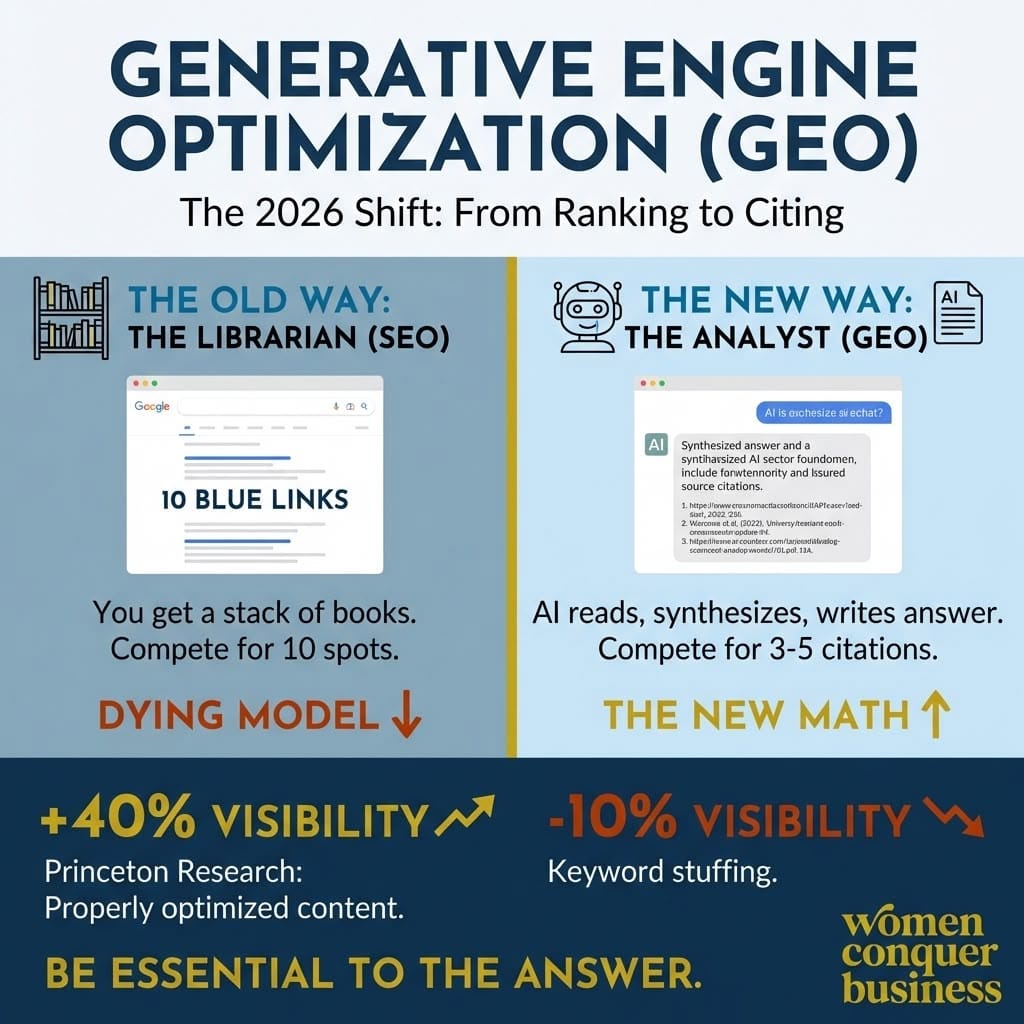
How Search Has Changed: The Librarian vs. The Analyst
For twenty-five years, Google worked like a librarian. You asked a question; it handed you a stack of books (ten blue links) and left you to do the reading yourself.
That model is shifting.
People still use Google's search engine results, but now it's typically done further down the funnel. Generative search (e.g., ChatGPT) is replacing early search visibility like the initial search to find your services. Then, they go to Google right before contacting you (or your competitors).
What's changed? Today's AI-powered search engines work more like research analysts. You ask ChatGPT or Perplexity a question, and they don't hand you sources. Generative AI reads the sources. Synthesizes the information. And writes you a direct answer, citing what best fits the question.
The new math is brutal. Traditional search rankings? You competed for one of ten organic positions (Google page one). In an AI-generated answer, there are typically three to five citations. The real estate shrank by half while competition intensified.
Visibility is no longer about ranking for a keyword. The practice of optimizing for AI is about covering a topic so completely that AI regards it as so essential to the answer that the response cannot be constructed without citing you.
The Princeton University research found that properly optimized content can increase AI visibility by up to 40%. That means as business owners you need to understand enough to hire people who know it's no longer the 2010s.
We're not replacing SEO with search engines like Perplexity. SEO fundamentals still apply, but now it's about structure and depth.
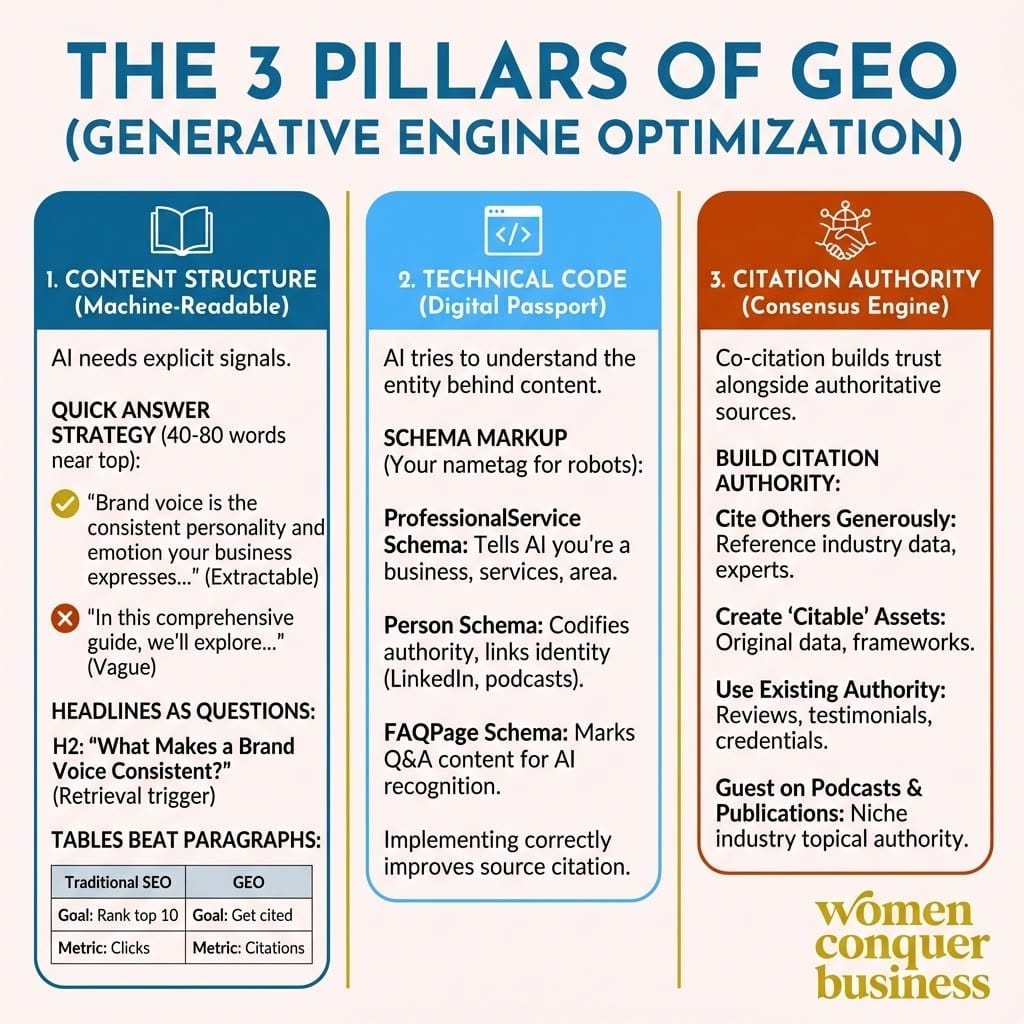
3 Pillars of GEO: Content, Code, and Citations
I think of GEO as resting on three pillars: Content Structure, Technical Code, and Citation Authority. Each pillar does something different. All three need to be standing for the system to work.
1. Content That Machines Can Read
Human readers tolerate ambiguity. They follow your train of thought even when you meander. AI systems don't have that flexibility. They need explicit signals.
The "Quick Answer" strategy.
Every page on your site that targets an informational query should have a Quick Answer block: a 40-80 word section near the top that directly answers the question your audience is asking.
Not this: "In this comprehensive guide, we'll explore the many facets of..."
This instead: "Brand voice is the consistent personality and emotion your business expresses across all communications. It distinguishes your brand in the market, builds trust with your target audience, and ensures a cohesive experience from social media to customer service."
That second version is extractable. An AI can pull it directly into an answer.
Structure your headlines as questions.
Not the title, but the secondary headlines (called H2, or headline 2). When the AI is retrieving chunks, it's often looking for question-answer pairs. If your H2 says "Understanding Brand Development," that's vague. But "What Makes a Brand Voice Consistent?" creates a natural retrieval trigger.
This connects directly to your brand voice work.
Tables beat paragraphs for comparisons.
The Princeton research showed that structured data formats significantly increase citation probability. When comparing options, put it in a table.
| Factor | Traditional SEO | Generative Engine Optimization |
|---|---|---|
| Goal | Rank in top 10 links | Get cited in AI answers |
| Primary metric | Click-through rate | Citation frequency |
| Content format | Keyword-optimized pages | Extractable answer blocks |
| Authority signal | Backlinks | Co-citation with trusted sources |
| Failure mode | Algorithm penalty | Invisibility |
Strengthen Your Entity Signals (Without Burning Hours)
If this guide made you realize your business needs stronger online citations, consistent listings, and clearer entity signals for AI and search ... start with a Local SEO tune‑up.
My Local SEO Service helps you:
• Fix inconsistent directory listings
• Build out the citations AI tools trust
• Strengthen your Knowledge Graph signals
• Set up the structured data Google (and ChatGPT) read
• Increase visibility without hustling harder
2. Technical Signals (Your Digital Passport)
AI systems don't read your content. They try to understand the entity behind it. Is this a business or a blog? Is the author credible? What services are offered?
Schema Markup: Your nametag for robots.
Schema markup is code you add to your website that explicitly tells search engines and AI systems what your content means.
For service-based businesses, three schema types matter most:
ProfessionalService schema tells the AI you're a business. It includes your service area, price range, and specific offerings.
Person schema codifies your authority. It links your website identity to your LinkedIn, your speaking appearances, your podcast. This builds what I call "entity triangulation": the AI sees the same person confirmed across multiple trusted platforms and assigns higher confidence to content from that person.
FAQPage schema marks up your question-answer content so AI systems recognize it as Q&A format.
Implementing schema correctly requires either technical skills or professional help. I won't pretend it's a casual afternoon project. But the ROI is significant, and source citation improves when schema markup is included.
3. Authority and Citations (The Consensus Engine)
Traditional SEO treated backlinks as the primary authority signal. GEO still values backlinks, but adds a new dimension: co-citation.
Co-citation means being mentioned alongside other authoritative sources in the same context. When an AI generates an answer about marketing strategy and cites both Harvard Business Review and Women Conquer Business, that association transfers trust.
Research analyzing AI citation patterns shows that different AI systems have distinct preferences. ChatGPT favors Wikipedia and authoritative sources, while Perplexity and Google's AI Overviews cite a broader range including Reddit and user-generated content.
How to build citation authority without a PR budget:
- Cite others generously. When you reference industry data, expert opinions, or research, you create semantic connections.
- Create "citable" assets. Original data, unique frameworks, proprietary methodologies give other content creators reasons to cite you.
- Use your existing authority. Your reviews, testimonials, and professional credentials are authority signals.
- Guest on podcasts and contribute to industry publications. Niche industry publications often have higher topical authority for your specific expertise.
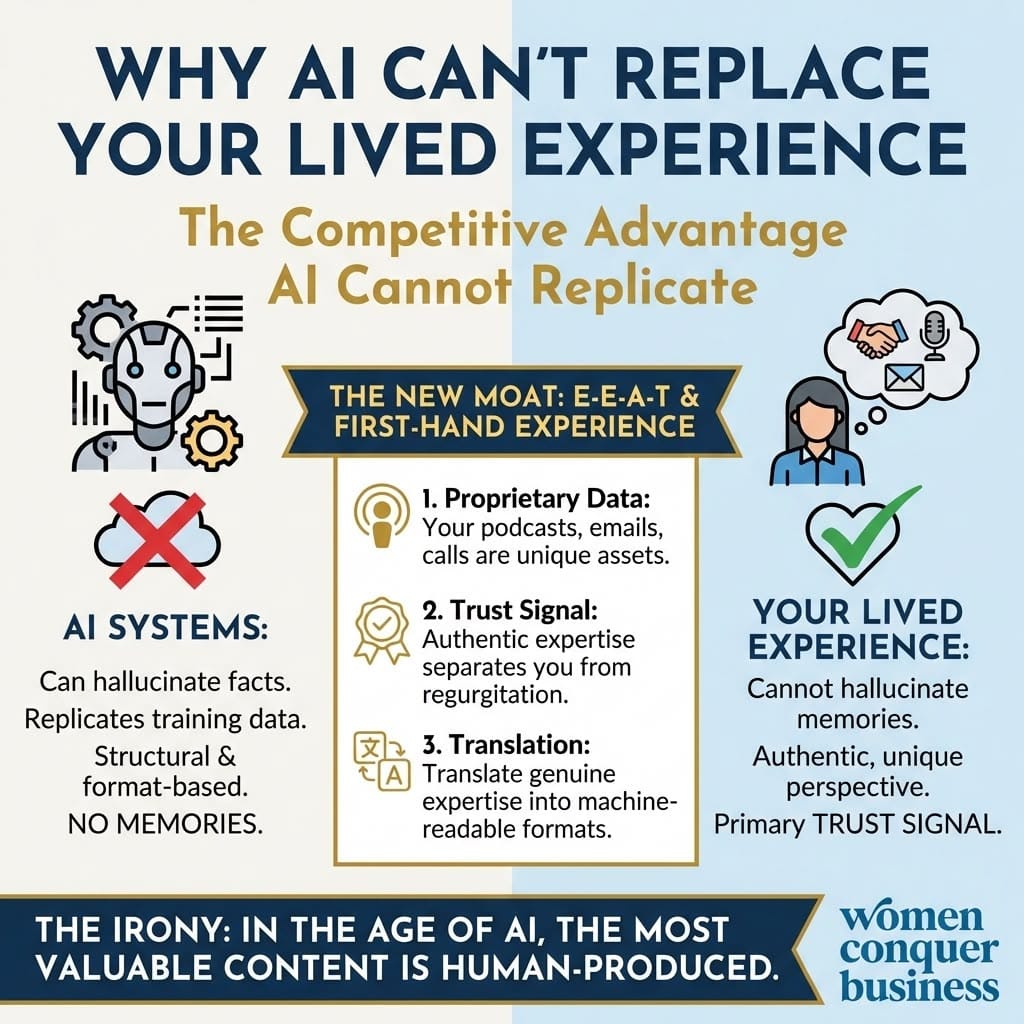
Why AI Can't Replace Your Lived Experience
Everything I've covered so far is structural. Format your content this way. Add this code. Build these signals.
But here's the piece that every technical GEO guide misses: AI systems hallucinate facts, but they cannot hallucinate memories.
Your lived experience is the one competitive advantage that AI content farms can never replicate.
The Peace Corps lesson in technology adaptation.
When I was a Peace Corps volunteer in Kazakhstan, I learned something that applies directly to this AI transition.
You cannot force a culture to adapt to you. The volunteers who burned out fastest were the ones who kept insisting that things should work the way they worked back home. The ones who thrived? They asked what the community needed, and created projects based on those needs.
AI is the same.
Learning the language doesn't mean losing your identity. The most effective Peace Corps volunteers were the ones who could translate their skills into the local context, not the ones who abandoned their expertise entirely.
GEO is about translating your genuine expertise into formats that machines can understand and transmit. The human part (your knowledge, your experience, your authentic perspective) remains essential.
Why "Experience" is the new moat.
Google's E-E-A-T framework added "Experience" as the first E in 2022. That wasn't accidental.
As AI-generated content floods the internet, first-hand experience becomes the primary trust signal that separates authentic expertise from sophisticated regurgitation.
When you write "In my 25 years of working with small business owners, I've found that..." you're creating content that AI cannot generate from training data alone.
Here's something I tell marketing coaching clients that surprises them: you're already generating the raw material for AI authority.
Every podcast episode you record. Every email you write. Every discovery call you take. That's proprietary data.
Most of this content is trapped in formats AI can't easily access. Part of GEO is identifying these "dark assets" and translating them into machine-readable formats.
The irony is beautiful: in the age of AI-generated everything, the most valuable content is the stuff only humans can produce.
When GEO Breaks Down (And What to Do Instead)
I promised no snake oil. So let's talk about failure modes.
GEO is not a magic solution. Understanding when it breaks down is as important as understanding how to implement it.
Failure Mode 1: Your foundations aren't ready.
GEO amplifies existing authority. If you don't have clear positioning, consistent messaging, or defined services, optimization amplifies the confusion.
If you're struggling to articulate what you do and for whom? That's a strategy problem, not a visibility problem.
Failure Mode 2: Your topic is too volatile.
AI systems are trained on historical data. For rapidly changing topics (cryptocurrency regulations, breaking news, emerging technology), the AI may confidently cite outdated information, including yours.
Failure Mode 3: You're optimizing for the wrong AI.
Different AI systems prioritize different signals. ChatGPT, Perplexity, Google's AI Overviews, and Bing Copilot don't all work the same way.
The capacity-aware response: focus on fundamentals (clear structure, accurate schema, genuine authority) that work across systems.
Failure Mode 4: You've forgotten the human.
If you optimize only for machines, you often create content that humans don't want to read. Clunky "Quick Answer" blocks. Robotic keyword placement. Endless FAQ sections that no one scrolls through.
The best GEO serves both audiences.
The "Manual Tax" calculation.
Calculate roughly how many hours per week you spend on manual lead generation (networking, cold outreach, social media engagement, follow-up emails). That's your current Manual Tax.
Now estimate how many hours upfront GEO implementation would require. For most solopreneurs, somewhere between 20-40 hours.
If your Manual Tax exceeds 5 hours per week, you'll likely recoup the GEO investment within two to three months. If your Manual Tax is lower (maybe you're referral-based with minimal active marketing), the ROI timeline stretches significantly.
Strategic Alignment: Where GEO Belongs
Here's a pattern I see constantly: a business owner reads about GEO, gets excited (or anxious), and immediately starts implementing tactics. Schema markup here, FAQ restructuring there, maybe an llms.txt file because someone on LinkedIn said it was important.
Three weeks later? Exhausted. And nothing feels different.
The problem is that GEO got bolted onto a business without checking whether it aligns with the business's goals.
I use a framework called the Strategic Alignment Mountain to diagnose this kind of tactical chaos.
The Summit: Your Vision, Mission, and Values
At the top of the mountain sits your business identity. Why does this business exist? Who does it serve? What kind of work do you want to be doing in three years?
Every marketing decision, including GEO, needs to trace back to this summit.
If your vision is building deep, long-term relationships with a small number of high-value clients, aggressive AI visibility might not serve you. You don't need to be cited by ChatGPT if your business thrives on referrals and reputation.
But if your vision involves scaling expertise through courses, memberships, or productized services? AI visibility becomes critical.
The Slopes: Goals and Projects
GEO is a project on the slopes, not a summit-level priority. It serves goals like "increase qualified leads by 30%" or "reduce time spent on manual outreach."
If you can't connect your GEO work to a specific goal, you're probably climbing someone else's mountain.
The "Shiny Object" test for AI visibility.
Before implementing any GEO tactic, ask:
- Which specific goal does this support?
- Does that goal serve my business vision?
- Am I doing this because it's strategic, or because I'm afraid of being left behind?
Read that third question again. The AI hype cycle has created genuine anxiety among business owners. But fear-based marketing decisions almost always lead to misaligned effort.
For some businesses, GEO absolutely makes sense. For others, the same energy would be better spent on referral systems, speaking engagements, or doing excellent work for existing clients.
Your mountain. Your route.
Deciding How to Approach GEO
Once you've confirmed that GEO aligns with your business summit, the next question is implementation: DIY, hire help, or some hybrid?
I use a 3 C's Decision Framework: Capacity, Complexity, and Control.
Capacity: Honest Starting Point
Do you have the cognitive and emotional capacity to sustain this work?
GEO isn't a one-time project. The initial setup takes somewhere between 20-40 hours. Maintaining your optimization requires ongoing attention, probably 2-4 hours monthly.
If you're already stretched thin managing client delivery, bookkeeping, and basic operations, adding another system to maintain might break something more important.
If capacity is constrained, the honest answer might be "not yet." GEO will still be here when your capacity shifts.
Complexity: What's DIY-Friendly?
DIY-Friendly GEO Tasks:
- Writing Quick Answer blocks
- Restructuring headlines as questions
- Adding statistics and citations to existing content
- Identifying "dark assets" in your business to repurpose
Requires Technical Help:
- Implementing schema markup correctly
- Debugging schema validation errors
- Advanced structured data for complex service offerings
Control: The Voice and Trust Questions
Brand Voice Control: Can you articulate your brand voice clearly enough to hand it off?
Vague direction ("professional but friendly") produces generic results. Specific voice documentation produces content that sounds like you.
Quality Standards Control: Can you tolerate "B+ work" done consistently?
Consistent B+ implementation often outperforms sporadic A+ efforts. If you can trust systems more than you trust yourself to "remember to update the schema when I have time," that's a signal to build infrastructure rather than rely on willpower.
The Future? Data + Heart
Generative Engine Optimization isn't a hack. It's not a shortcut to visibility you haven't earned.
What it is: a translation layer. A way to help AI systems understand the genuine expertise you've already built, so that expertise can reach people who need it.
The core equation: Structure your content for retrieval. Code your identity for recognition. Build citation authority through quality.
Your lived experience (the specific, verifiable, first-hand knowledge that no AI can hallucinate) remains your irreplaceable competitive advantage. The Manual Tax you pay for invisibility is real. But so is the burnout tax of implementing strategies that don't fit your business.
AI search is changing how businesses get discovered.
But the businesses worth discovering? They're still built on expertise, trust, and genuine value.
Lead with heart. Track the numbers. Let the machines handle the translation.
Have questions about implementing GEO for your specific business? Get in touch. I'm happy to point you in the right direction.
Strengthen Your Entity Signals (Without Burning Hours)
If this guide made you realize your business needs stronger online citations, consistent listings, and clearer entity signals for AI and search ... start with a Local SEO tune‑up.
My Local SEO Service helps you:
• Fix inconsistent directory listings
• Build out the citations AI tools trust
• Strengthen your Knowledge Graph signals
• Set up the structured data Google (and ChatGPT) read
• Increase visibility without hustling harder
Frequently Asked Questions
What is the llms.txt standard and should I implement it?
A new tactic called llms.txt is gaining traction as a way to communicate directly with AI crawlers. It's a text file you place on your website that summarizes your brand, points to your most important content, and provides direct navigation for AI systems.
Few small businesses have implemented this yet. According to recent analysis, major AI platforms haven't committed to honoring the standard, but that's starting to change. My take: the cost of implementation is low enough that the potential upside justifies it, but prioritize schema markup first.
How do I know if I have capacity for GEO right now?
You may have capacity if:
- You have consistent blocks of focused work time (not reactive firefighting)
- Your current marketing systems run without constant intervention
- You're not in a cash-flow crisis requiring immediate revenue
- You have genuine curiosity about the technical side (not obligation)
You may not have capacity if:
- You're regularly working evenings and weekends on client work
- Basic business tasks (invoicing, email) are chronically behind
- You're in a season of high personal demands (caregiving, health, major life transitions)
- The thought of another "thing to learn" creates dread rather than interest
What's the difference between GEO and traditional SEO?
Traditional SEO focused on ranking in search results. GEO focuses on being cited in AI-generated answers. The key differences:
- SEO optimizes for click-through rate; GEO optimizes for citation frequency
- SEO relies on backlinks for authority; GEO relies on co-citation with trusted sources
- SEO penalizes with algorithm drops; GEO penalizes with complete invisibility
- SEO rewards keyword optimization; GEO rewards extractable answer blocks and structured data
How does GEO fit with "slow marketing" philosophy?
GEO, done correctly, is slow marketing. Unlike social media algorithms that demand constant feeding, GEO infrastructure compounds. Your Quick Answer blocks don't expire. Your Person schema doesn't need weekly updates.
The frameworks in this guide are built around sustainable effort. AI search isn't going anywhere. You don't have to sprint. You need to build systems that work while you rest.
What "dark assets" might I already have for GEO?
You're probably already generating raw material for AI authority:
- Podcast episodes capturing specific insights and real client scenarios
- Email sequences explaining your methodology
- Client testimonials documenting specific transformation stories
- Workshop recordings demonstrating your teaching approach
- Discovery call notes revealing common questions and concerns
Most of this content is trapped in formats AI can't easily access. Part of capacity-aware GEO is identifying these assets and translating them into machine-readable formats.