


Solopreneurs compete with big companies through strategic agility, niche focus, AI-native operations, professional validation, and relationship depth that corporate structures cannot copy.
At a Glance
- Core edge: 24-hour pivots vs. 3-6 month corporate cycles
- Key strategy: Porter’s Focus for defensible niche positioning
- Trust equalizer: ISO certification, WOSB status, documented results
- Sustainability check: Capacity-first decision-making
Solopreneurs can compete with larger companies not despite being small, but because of it. While corporate teams spend three months waiting for approval on a single change, you’ve tested four variations and moved on to what works.
If you’ve spent years building your business and still feel you’re fighting uphill against companies with huge teams, you’re not imagining things. Keep reading to learn how to turn your speed into a competitive edge so your business thrives while building lasting authority.
Inside, you’ll find Porter’s Focus Strategy adapted for solo operations, the ISO standards that neutralize the “trust gap” with enterprise clients, and the AI-native workflows that half of solopreneurs are already using to multiply their output. Discover why algorithms cannot replicate your emotional intelligence and why our “capacity question” differentiates sustainable businesses from burnout.
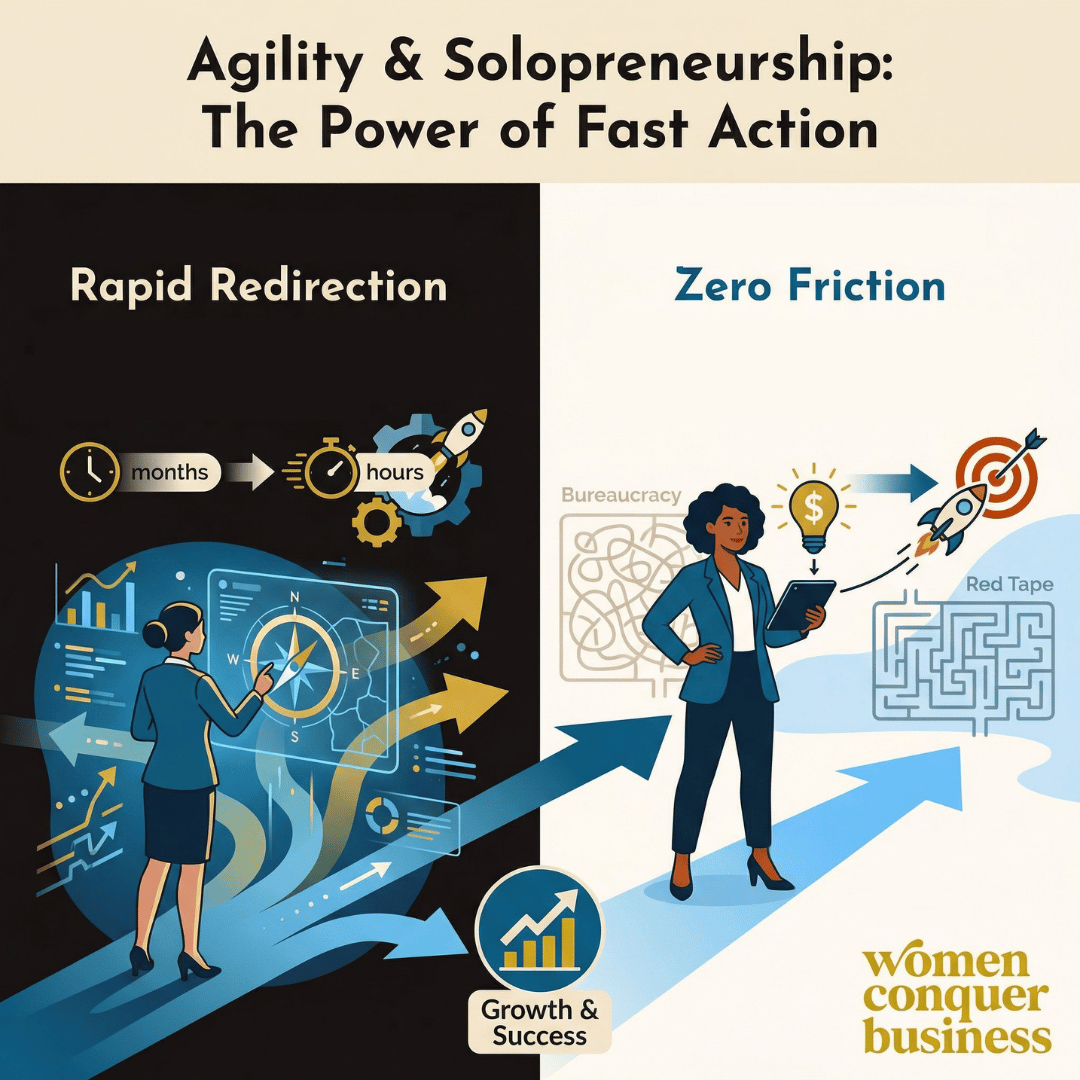
Agility: Moving Faster Than Corporate Committees
- Quick Answer: Agility means sensing market changes and redirecting resources within hours rather than months. Solopreneurship means zero bureaucratic friction between recognizing an opportunity and acting on it.
- Core Edge: No approval chains or committee reviews
- Speed Differential: 24-hour pivots vs. 3-6 month corporate cycles
- Result: First-mover positioning in emerging niches
If a new regulation drops on Tuesday that affects your industry, by Wednesday morning, you’ve updated your service offerings, published a blog post explaining the implications, and emailed your client list with a simple action plan.
Your corporate competitor? They’re scheduling a meeting to discuss who should schedule the meeting about it.
Organizational research confirms this isn’t an exaggeration. In traditional corporate environments, a simple product change can require months of committee reviews, stakeholder alignment, and legal vetting.
Meanwhile, leadership studies show that 25% of employees in large teams experience “pseudo-engagement” (appearing involved while feeling unable to influence decisions).
When you’re the CEO, marketing director, and lead strategist rolled into one, there’s no translation loss between vision and execution. That’s operational efficiency.
But speed without direction is chaos. The real question is whether you can move fast on the right things.
Why Being the ‘Obvious Choice’ Beats Being the ‘Generic Giant’
Michael Porter identified three generic strategies: cost leadership, differentiation, and focus. Freelancers can’t compete on cost leadership. You’ll never out-discount Amazon. But focus? That’s where you dominate.
What is Porter’s Focus Strategy?
According to Cambridge research, a focus strategy involves selecting a narrow competitive scope and tailoring every aspect of your business to serve that specific segment exceptionally well. Rather than competing for everyone, you become indispensable for someone.
When you narrow your focus, something counterintuitive happens to your pricing power. The more specific your expertise, the fewer clients compare you to generic alternatives. You stop being “a [industry] consultant” competing against thousands on Upwork. You become “the [industry] strategist who helps holistic practitioners in their fifth year build [specific service].”
That specificity changes the sales conversation entirely. Instead of justifying your hourly rate against the market average, you’re showing value to people who recognize their exact situation in your positioning.
Bigger companies struggle with this. Their infrastructure demands scale. A Fortune 500 consulting firm can’t profitably serve a market segment of 10,000 potential clients. You can. And you can serve them better than any generalist, because you understand nuances that don’t appear in market research reports.
Niche vs Moat: Finding Your Focus
A strategic marketing approach isn’t about finding the most profitable niche. It’s about finding where your genuine interest, existing knowledge, and realistic capacity intersect. Will you still want to read about this topic in three years? Do you have existing expertise to build on? Are there enough people with this problem who can pay for solutions?
The intersection creates what Porter would recognize as a defensible competitive position: a market too small for giants, too specialized for generalists, and too aligned with your strengths for easy replication. That’s a moat.
Scaling Revenue Without Hiring
Gusto’s survey data shows that half of all new solopreneurs integrated generative AI tools into their operations, with 47% using it to reclaim time from repetitive administrative tasks. Among professional services providers, AI adoption for business functions reached 75%. This isn’t early-adopter territory anymore. It’s the new baseline.
What is an AI-native solo business?
An AI-native solo business integrates artificial intelligence as default infrastructure rather than an optional enhancement. Marketing, customer service, data analysis, and administrative functions operate through AI-assisted workflows, allowing a single founder to maintain output that previously required three to five employees.
Early AI adopters treated tools as assistants for specific tasks. AI-native operators build their entire business logic around what AI enables. The difference is like using a calculator versus building a spreadsheet model.
Think of your business as an operating system. In the old model, you were the CPU handling every process. In the AI-native model, you’re the executive function deciding what matters while automated systems handle execution. AI drafts, you refine. AI-powered systems handle initial inquiries and schedule meetings while you sleep. Productivity research suggests one hour of focused, AI-leveraged work can match 50 hours of traditional labor.
Retrofitting AI into an existing business is harder than starting AI-native.
If you’ve spent five years building processes around manual execution, you’re rebuilding AI automation infrastructure while simultaneously running the business. The learning curve is real. For those ready to explore how AI changes search visibility, understanding generative optimization is becoming essential. But sustainable integration beats rushed implementation.
Neutralizing the Size Deficit
When a potential client compares your one-person operation to a company with 200 employees and a downtown office, you start at a perceived disadvantage. Can you handle my project? Will you still be in business next year? This is the trust deficit. Ignoring it won’t make it disappear.
But the same professional validation systems that large companies use are available to you. In some cases, you can implement them faster.
How does ISO certification help solopreneurs?
Industry research shows ISO standards like 9001 (quality management) provide third-party verification that your processes meet enterprise-grade requirements. Because solopreneurs have shorter decision-making chains, a certification that takes a large company 12-18 months can often be achieved in three to six months.
Think of trust signals as concentric rings. The outermost ring is visibility: can prospects find evidence of your expertise? Building a strong local search presence matters more than social media followers. You control the narrative and the longevity of that authority.
The middle ring is validation. For women founders specifically, WOSB and WBE certifications open additional doors. Federal guidelines mandate at least 5% of contracting dollars for women-owned businesses, and Fortune 500 companies actively seek diverse suppliers.
The inner ring is proof. Testimonials build genuine trust with their specificity: “Increased qualified leads by 40% in 90 days while reducing my marketing time from 10 hours to 3 hours weekly,” builds a case.
The trust moat multiplies. Search visibility leads to speaking opportunities, which generate testimonials, which attract media coverage, which improves search visibility. Once this flywheel spins, it becomes difficult for competitors to outperform you.
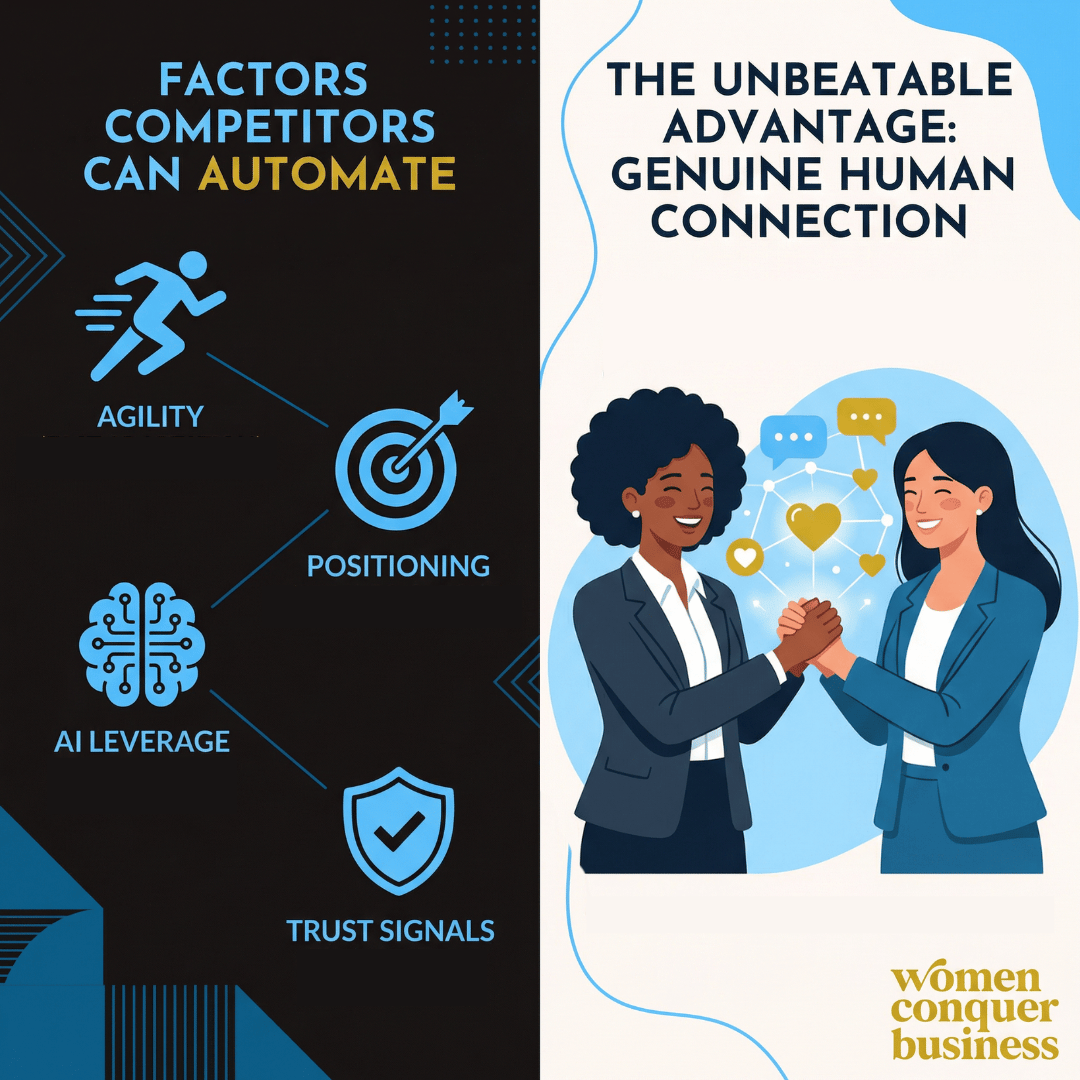
Personalized Customer Relationships: The Algorithm Killer
Agility, positioning, AI leverage, and trust signals all matter. But the factor that ties everything together, and that no competitor can automate away, is your capacity for genuine human connection.
Business psychology research shows that women show measurable advantages in 11 of 12 key emotional intelligence competencies, including empathy, adaptability, and conflict management. This differentiates you in an economy where clients grow weary of corporate “pseudo-engagement.” People want personalized experiences and problem-solving customer support.
Leadership research describes the emerging priority for 2026 is creating “human moments” through small, intentional acts of connection. Many solopreneurs do this naturally. When you remember a client’s daughter started college last month, or that they prefer Tuesday calls because Mondays are hectic, you’re being present, not following a playbook.
Human connection creates three specific business outcomes algorithms cannot reproduce. First, switching costs through relationship depth: when clients feel genuinely known, they’re reluctant to start over with someone new.
Second, referral quality through authentic advocacy: connected clients don’t give lukewarm referrals; they explain how you made them feel. Third, insight access through psychological safety: clients who trust you share the real problems, not sanitized versions.
This is where reconnecting with purpose shows its value. Sustainable businesses are built on consistent presence over years, on becoming the person clients think of first when a relevant challenge arises.
Financial Architecture for Independence
Strategy means nothing without financial sustainability. Industry surveys show 42% of solopreneurs have gone without income for a month or longer at some point.
Cash flow volatility isn’t a flaw of solo business models. It’s a feature you must engineer around.
Your lean structure that feels like a disadvantage is a financial fortress when managed intentionally. While corporations carry massive fixed costs, payroll obligations, and investor expectations, you can pivot your cost structure in days.
Unlike traditional entrepreneurs who chase venture capital, recent data shows 84% of solopreneurs fund their businesses personally. This preserves creative control and eliminates the growth-at-all-costs pressure that destroys funded startups. But self-funding requires discipline.
- Revenue Architecture: The most resilient solo businesses layer income streams. A core service provides stability. What does this look like? A productized offer (course, template, subscription) adds scalability. Project work fills gaps. No single client should represent more than 30% of revenue.
- Capacity-Based Pricing: Here’s where ethical marketing intersects with sustainability. Value-based pricing means charging what your work is worth. Capacity-aware pricing goes further: it factors in the cognitive and emotional cost of the work.
The 77% of solopreneurs who reported profitability in their first year share a common pattern: they prioritized margin over revenue. They charged enough, kept overhead low, and said no to work that drained disproportionate energy.
Capacity Framework
Rather than focusing on what you should do, let’s ask the broader question: Do you have the capacity to do it?
Capacity is the most important question.
Given your current cognitive load, emotional capacity, and time constraints, what can you sustainably do without burning out?
Keep it lean. Solopreneurs who implement sophisticated strategies, see initial results, then collapse under the maintenance burden. They built for “fantasy productivity,” where everything goes according to plan instead of accounting for the ebbs and flows of business.
Capacity isn’t just one thing. It’s three intersecting constraints: cognitive (complex decision-making before quality degrades), emotional (relational labor you can sustain), and time (rarely calculated honestly, including administrative overhead and recovery).
Contrarian Insight: Hustle culture advice to “push through” treats your brain like a machine with infinite runtime. Cognitive research shows decision quality degrades measurably after sustained mental effort. The freelancer making choices at 10 PM after a full client day isn’t being dedicated. They’re making worse decisions than they would with adequate recovery.
Before completing any strategy from this article, ask:
- What does this require during my lowest-energy weeks?
- What will you stop doing to make room?
- Does this build on platforms you control or algorithm-dependent platforms that can evaporate overnight? (See the FAQ for the complete 15-Minute Capacity Audit.)
It’s the difference between sustainable marketing and generic advice designed for fictional founders with unlimited resources.
Owned vs. Rented Problem (Blog or LinkedIn?)
So how do you do it? Create a marketing budget that doesn’t break the bank while building meaningful business relationships? “Guru marketers” recommend building on platforms you don’t control (e.g., social media).
More followers.
More engagement.
More visibility on someone else’s algorithm.
Can it work? Yes, social media marketing strategies can work when paired with an ads budget. There’s nothing wrong with this approach, but we recommend also investing time in owned assets that aren’t susceptible to algorithm shifts, platform buyouts, and account suspensions.
Owned Assets vs. Rented Land
Owned assets are platforms where you control the rules: your website, your newsletter, your client relationships, your intellectual property. Rented land is everywhere else: social media, marketplace platforms, even search rankings (which Google can change without notice).
When you invest effort in business growth, ask: Where does the equity accumulate? Posting on Instagram builds Instagram’s database. If your account disappeared tomorrow, you’d have nothing but screenshots. That same creative effort invested in your website builds a searchable archive that multiplies in value.
This doesn’t mean abandoning social media. It means treating social as distribution, not destination. Create once for owned assets. Distribute excerpts to rented platforms. Let social drive traffic back to properties you control.
Corporate competitors have teams dedicated to platform-specific content. You don’t.
So every hour on platform-native content that can’t be repurposed is an hour a corporation can outspend you on.
But corporations rarely invest deeply in individual founder authority. Their content is committee-approved and interchangeable. Your website, your email voice, your published perspective? That’s yours. No competitor can replicate it.
The implication? Invest first in your digital foundation where your unique voice becomes a moat. Use rented land to amplify, not originate.
Building a Business That Competes with the Giants
The question was never whether a solopreneur can compete with big companies. The evidence is clear: 29.8 million Americans are already doing it, contributing $1.7 trillion to the economy while maintaining autonomy that corporate employment rarely offers.
The real question is whether you’ll compete strategically or exhaustively.
Your Calculated Foundation
- Lead with capacity. Sustainable beats impressive.
- Build on owned assets. Let rented land amplify, not originate.
- Protect the human moment. Your ability to connect is the one advantage no algorithm or corporate team can replicate.
None of this is simple, and anyone claiming otherwise is selling something. Building competitive authority takes time, patience, and honest self-assessment about what you can sustain. But the structural advantages are real. You can pivot faster, connect deeper, and serve niches corporations cannot profitably address.
Start where you are.
If the capacity audit reveals you can only complete one thing this quarter, that’s the right number. One strategy executed well compounds faster than five strategies abandoned halfway.
The corporations aren’t your competition. Burnout is. Build accordingly.
For solopreneurs ready to move from strategy to implementation, the Strategic Marketing Membership provides monthly training, live Q&A, and a community of founders navigating these same challenges.
If your tech stack needs attention before strategy can take hold, the Marketing Operations Makeover creates the foundation for everything else to work.
FAQs: Solopreneurs Competitive Advantages
How long does it take for a solopreneur to respond to market changes versus a corporation?
The speed differential is significant across every business function:
| Function | Solopreneur | Corporate |
|---|---|---|
| Pricing adjustment | Same day | Quarterly review cycle |
| New service launch | 1-2 weeks | 6-12 months |
| Client feedback integration | Next interaction | Next product roadmap |
| Technology adoption | Single afternoon | IT security audit (months) |
What is the 15-Minute Capacity Audit?
Before implementing any strategy, run it through these five questions:
- What does this strategy require during my lowest-energy weeks? If it falls apart when you’re at 60% capacity, it’s not sustainable.
- What am I going to stop doing to make room for this? Addition without subtraction is a recipe for overwhelm.
- How long until this strategy compounds rather than costs? Some investments pay off in weeks; others take years.
- What’s the cognitive complexity, and can I simplify it? Simpler strategies executed well beat sophisticated strategies executed poorly.
- Does this build on owned assets or rented platforms? Effort invested in your website compounds. Effort on algorithm-dependent platforms can evaporate overnight.