


The ROI of marketing coaching is the measurable financial and operational return gained from investing in professional marketing guidance, calculated by comparing revenue growth, time savings, and strategic clarity achieved against the total costs including coaching fees, implementation time, and required tools.
At a Glance
- What it measures: Financial return and strategic value of coaching investment
- Who it's for: Women solopreneurs earning $100K+ with validated offers
- Time to positive ROI: 12-18 months with consistent implementation
- Typical total cost: 3-4x the coaching fee (includes tools, time, opportunity cost)
- Skill level required: Willingness to track metrics and implement consistently
- Primary outcome: Revenue growth plus strategic clarity and reduced overwhelm
You're staring at a $10,000 proposal for marketing coaching, wondering if you're making a smart investment or buying expensive hope.
After 25 years in marketing, here's my take: it depends. I know, I know. … but hear me out.
The ROI of coaching is the sum of its parts. Here are a few factors. Does it make sense for your business…
- Type?
- Revenue right now?
- Time to learn?
- Capacity to implement what you learn?
By the end of this guide, you’ll understand what marketing coaching costs (including hidden expenses), how to calculate your potential ROI, and the truth about when marketing coaching isn't worth the investment.
What is ROI of Coaching?
Most ROI discussions focus purely on dollars: "I spent $10,000 on coaching and made $50,000 more in revenue, so my ROI is 400%."
On the surface, that math checks out. But it misses critical factors that determine whether coaching is worth it for solopreneurs.
The complete picture includes:
- Direct costs: Coaching fees ($1,500 to $50,000+ depending on engagement length and coach expertise)
- Hidden costs: Marketing tools ($200-500/month), implementation time (5-10 hours/week at your hourly rate), opportunity cost of billable work you're not doing
- Quantitative returns: Revenue increase, customer acquisition improvement, conversion rate gains
- Qualitative returns: Strategic clarity, reduced overwhelm, time saved from trial-and-error
The International Coaching Federation (ICF) 2023 study shows businesses report measurable improvements in productivity, goal achievement, and self-confidence. Those results assume you can implement what you learn.
Don’t overlook the additional costs. It adds up. If your coach helps you build an email nurture sequence, you still need the email platform ($40-100/month), the time to write emails (8-12 hours), and the consistency to maintain it.
Why Measure Coaching ROI?
Because if you're going to spend the money, make sure it’s worth it.
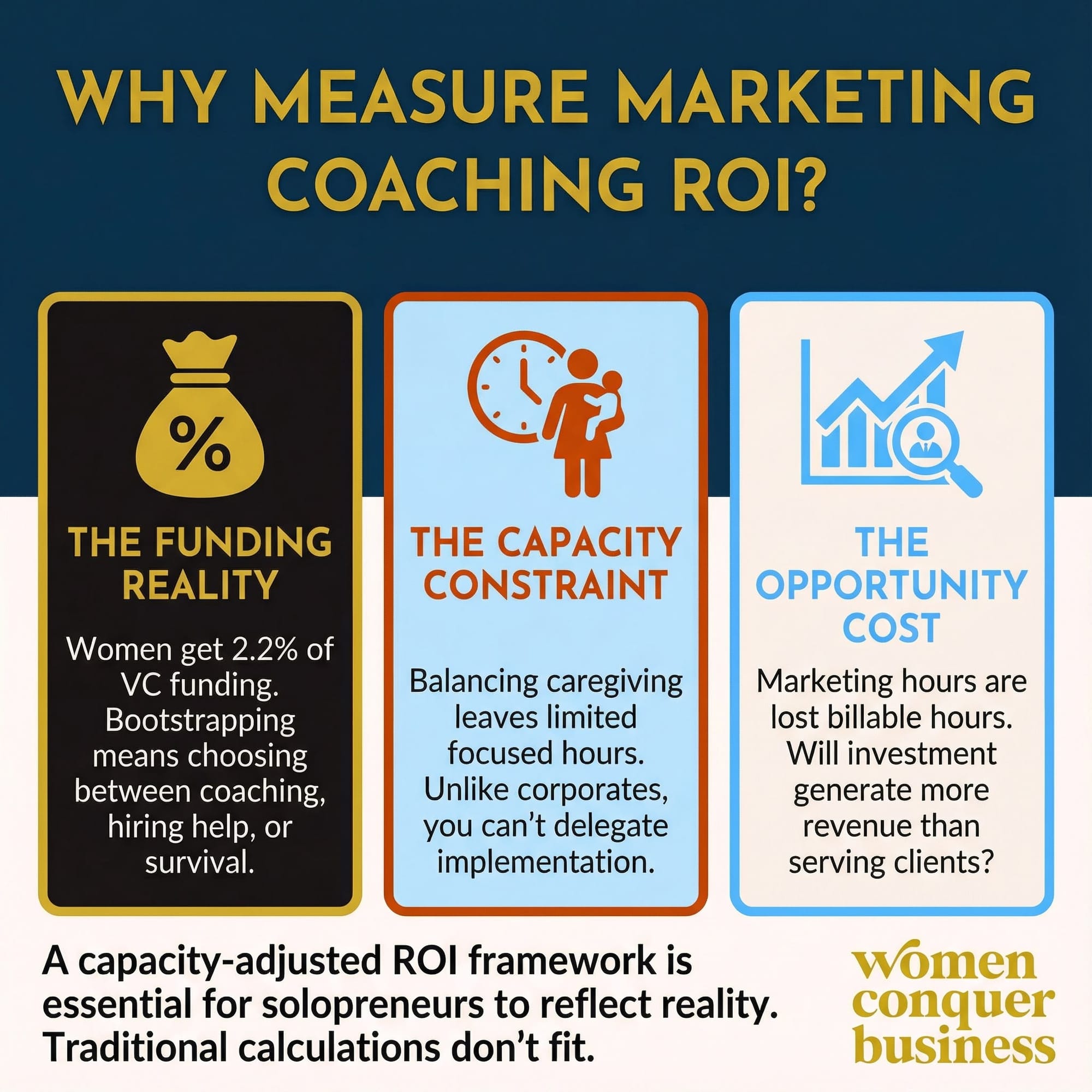
The funding reality. Women-owned businesses receive 2.2% of venture capital funding. You're likely bootstrapping. When corporate clients evaluate a $25,000 executive coaching investment or employee engagement program, they're allocating budget. When you evaluate it, you're choosing between coaching, hiring help, or staying afloat another quarter.
The capacity constraint. Research shows women business owners manage caregiving at higher rates than men. You might have 15 focused hours weekly after client work and family. Corporate employees can delegate implementation. You can't.
The opportunity cost. Every hour implementing marketing strategy is an hour not billing clients. The question becomes: "Will this investment generate more revenue than serving more clients?"
Sometimes yes. Sometimes "not yet." Sometimes "yes, but over 18 months, not 90 days."
This is why I built a capacity-adjusted ROI framework for solopreneurs. Traditional calculations assume corporate speed with corporate resources. We need honest financial analysis that reflects our reality.
Total Cost of Ownership Framework
I developed this framework after watching too many clients get blindsided by expenses they didn't budget for. Here's every dollar you need to account for when calculating your marketing coaching investment ROI.
Direct Coaching Fees:
- Group Coaching Programs: $1,500 - $5,000 for 3-6 month programs
- One-on-One Coaching: $3,000 - $15,000 for 6-month engagements
- Premium/Specialized Coaching: $15,000 - $50,000+ for intensive programs or high-level strategists
- Hybrid Models: $5,000 - $10,000 combining group support with individual sessions
Those numbers vary based on coaching experience, specialization (general marketing vs niche expertise like SEO or conversion optimization), engagement length, and level of access (weekly calls vs on-demand support).
Hidden Cost #1: Marketing Tools and Software
Your coach will likely recommend tools for marketing operations. Budget $200-500/month minimum for a basic marketing stack:
- Email marketing platform: $40-150/month (e.g., Mailchimp, Kit, ActiveCampaign)
- Website/landing page builder: $25-80/month (e.g., Squarespace, WordPress, Shopify)
- Analytics and tracking: $0-50/month (e.g., Google Analytics, Plausible)
- Social media management: $0-30/month (e.g., Native scheduling, Later, Metricool)
- CRM for client management: $20-100/month (HubSpot, Dubsado, Suitedash, 17hats)
Over a 6-month coaching engagement, that's about $1,200-3,000 in software expenses not included in your coaching invoice.
Hidden Cost #2: Implementation Time
Your time has value, either as billable hours you're not doing, or as a calculated hourly rate for your work.
Realistic time investment:
- Coaching sessions: 1-2 hours/week (calls, prep, review)
- Implementation work: 5-10 hours/week (building what you're learning)
- Total weekly commitment: 6-12 hours minimum
If you bill at $150/hour and spend 8 hours/week on coaching-related work, that's $1,200/week in opportunity cost. Over 6 months (26 weeks), that's $31,200 in time you're not billing to clients.
Yes, you read that right. The implementation time can exceed the coaching fee.
Hidden Cost #3: Opportunity Cost
Every hour you spend building your email funnel is an hour you're not:
- Serving existing clients (direct revenue loss)
- Pitching new clients (future revenue impact)
- Delivering your core offer (revenue generator)
- Managing operations that keep your business running
For solopreneurs, you have finite hours. Marketing implementation competes directly with revenue generation, especially in the first 3-6 months before new systems start producing results.
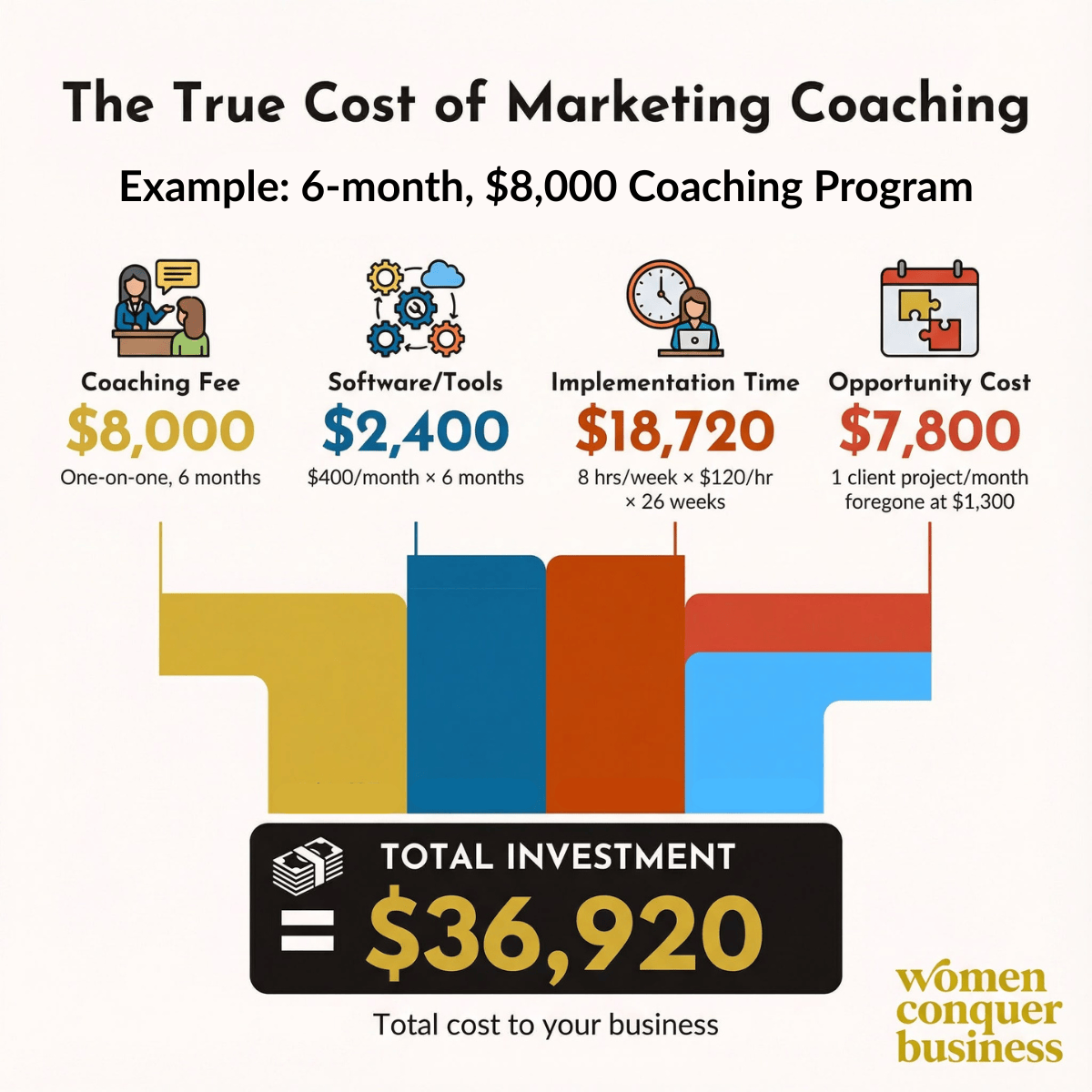
Example: 6-month, $8,000 Coaching Program
| Cost Category | Amount | Notes |
|---|---|---|
| Coaching Fee | $8,000 | One-on-one, 6 months |
| Software/Tools | $2,400 | $400/month × 6 months |
| Implementation Time | $18,720 | 8 hrs/week × $120/hr × 26 weeks |
| Opportunity Cost (Conservative) | $7,800 | 1 client project/month foregone at $1,300 |
| Total Investment | $36,920 | Total cost to your business |
The coaching fee is $8,000. The total cost of ownership is $36,920.
Reality Check:
- Setup effort: High (6-12 hours/week minimum for first 3 months)
- Ongoing effort: Medium (4-6 hours/week maintenance after setup)
- Tools required: Email platform, website, analytics, CRM
- Learning curve: What trips people up: underestimating implementation time, expecting instant results, not tracking metrics from day one
- Budget: Plan for 3-4x the coaching fee when accounting for tools and time
- When results usually show: 6-12 months for measurable revenue impact; strategic clarity immediate
- Common misconception: "I'm paying for coaching, so the work will be easier." Coaching gives you the strategy; you still do the building.
This isn't meant to scare you. It helps you budget accurately and set realistic expectations.
When you know the true investment upfront, you can make a clear-eyed decision about whether it makes sense for your business right now.
Calculate Your Marketing Coaching ROI (Capacity-Adjusted Method)
Traditional ROI formulas assume you can implement at full speed with unlimited time. That’s not your reality. This capacity-adjusted framework accounts for your available hours and energy.
The Basic ROI Formula
Standard calculation: (Revenue Gained - Investment Cost) ÷ Investment Cost × 100 = ROI%
Example: You invest $10,000 in coaching and generate $30,000 in additional revenue.
ROI = ($30,000 - $10,000) ÷ $10,000 × 100 = 200%
That looks great on paper. But it misses the implementation reality.
Capacity-Adjusted Marketing ROI Calculator
This framework multiplies your expected timeline by a capacity factor based on your available implementation hours.
Step 1: Calculate Your Implementation Capacity
How many focused hours per week can you consistently dedicate to marketing implementation?
- Full-time capacity (20+ hours/week): Capacity Factor = 1.0 (no adjustment)
- High capacity (15-20 hours/week): Capacity Factor = 1.3
- Medium capacity (10-15 hours/week): Capacity Factor = 1.8
- Low capacity (5-10 hours/week): Capacity Factor = 2.5
- Very low capacity (<5 hours/week): Capacity Factor = 4.0
If your coach says "This strategy typically takes 3 months to show results" and you have low capacity (8 hours/week), your realistic timeline is 3 months × 2.5 = 7.5 months.
Step 2: Account for Your Business Stage
Your business maturity affects how quickly marketing improvements translate to revenue.
- Established business (2+ years, steady revenue): Revenue Impact Factor = 1.0
- Growing business (6 months - 2 years, inconsistent revenue): Revenue Impact Factor = 0.7
- New business (<6 months): Revenue Impact Factor = 0.4
An established business converting 3% of leads might improve to 5% within weeks. A new business might need 6+ months to see similar percentage improvements because systems aren't mature yet.
Step 3: Calculate Realistic Revenue Projections
Work backwards from your revenue goal using conservative conversion improvements.
Example scenario:
- Current monthly revenue: $8,000
- Current email list: 500 subscribers
- Current conversion rate: 2%
- Goal after coaching: Improve to 4% conversion
Initial projection:
- 500 subscribers × 4% conversion = 20 sales/month
- If average sale = $500, that's $10,000/month revenue (up from $8,000)
- Additional revenue = $2,000/month = $24,000/year
But apply capacity factor:
Low capacity (2.5 multiplier) means this improvement takes 2.5× longer to achieve.
If full-capacity timeline is 6 months, your timeline is 15 months.
First-year additional revenue: $24,000 ÷ 12 months × 9 months (15-month timeline means 9 months of results in year 1) = $18,000
Step 4: Calculate Capacity-Adjusted ROI
Using our Total Cost of Ownership example ($36,920 total investment) and realistic revenue projection ($18,000 first year):
Year 1 ROI: ($18,000 - $36,920) ÷ $36,920 × 100 = -51% (negative)
Year 2 ROI (assuming full $24,000/year from month 4 onward):
($42,000 total revenue - $36,920 investment) ÷ $36,920 × 100 = 14% (positive)
Marketing coaching often requires 18-24 months to break even when you account for:
- Total cost of ownership (not coaching fees alone)
- Realistic implementation capacity
- Business maturity stage
- Conservative conversion improvements
Qualitative ROI: What the Numbers Don't Show
Revenue isn't the only return. Qualitative gains are harder to measure but equally valuable.
Strategic Clarity:
- Confidence in marketing decisions (reduces analysis paralysis)
- Clear priorities (stops scattered effort across 7 platforms)
- Understanding of what NOT to do (prevents expensive mistakes)
Time Efficiency:
- Reduced trial-and-error (avoids months of testing wrong approaches)
- Faster decision-making (framework for evaluating opportunities)
- Better delegation if you hire help later (you understand what to outsource)
Emotional ROI:
- Less overwhelm about marketing (you have a plan)
- Increased confidence in your expertise (you can articulate your value)
- Reduced impostor syndrome (external validation of your business model)
In my work with clients over 25 years, I've seen the qualitative ROI show up first. The revenue follows, but the confidence and clarity are immediate.
When to Weight Qualitative Data Over Quantifiable ROI
If you're experiencing any of these, the emotional and strategic ROI might outweigh pure revenue calculations:
- Chronic marketing overwhelm preventing you from acting at all
- Constantly second-guessing your offers or messaging
- Unable to articulate your unique value to potential clients
- Spending money on ads/tools without a coherent strategy
- Feeling perpetually behind competitors who "get it"
That clarity has a dollar value. It's harder to measure than revenue gains.
The Realistic ROI Expectation
Based on working with hundreds of solopreneurs and industry research on marketing timelines, here's what "good ROI" looks like:
- Months 1-6: Negative ROI (investment period, implementation heavy, revenue impact minimal)
- Months 7-12: Neutral to slightly positive (systems working, covering ongoing costs)
- Months 13-24: Positive ROI 50-150% (compounding effects, established systems generating consistent returns)
- Year 3+: High ROI 200-400% (mature systems requiring minimal maintenance, focused optimization)
The people selling "10x your revenue in 90 days" are selling fantasy.
The realistic path is slower, steadier, and sustainable.
6 Factors That Make or Break Your Coaching ROI
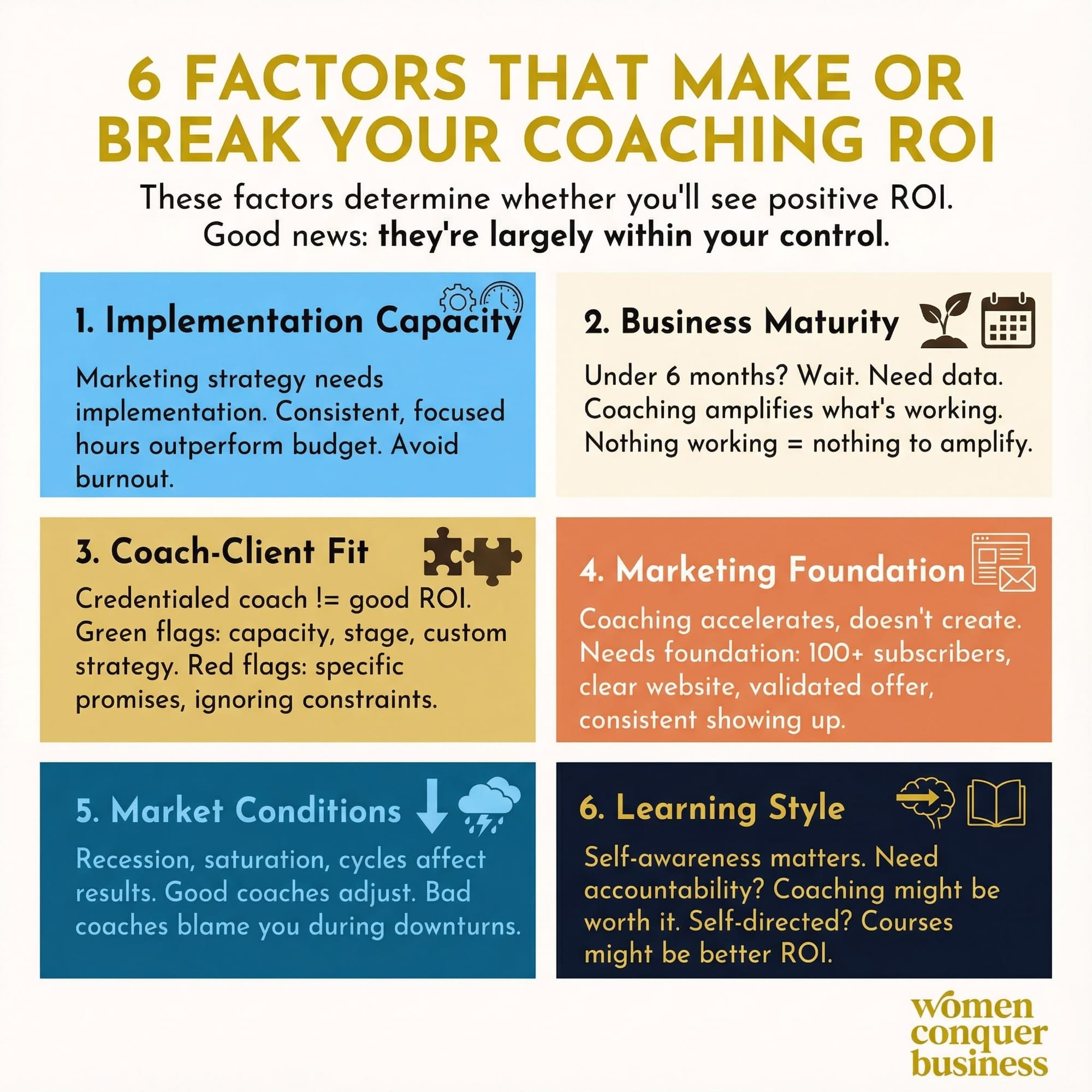
These factors determine whether you'll see positive ROI. The good news is they're largely within your control.
1. Implementation Capacity
Marketing strategy only produces results when implemented. Clients with $3,000 budgets and 15 focused hours weekly consistently outperform those with $50,000 budgets and 5 hours weekly. If you're already working 50-hour weeks with no margin, adding marketing implementation creates burnout, not ROI.
2. Business Maturity
If you're under 6 months in business, you probably shouldn't invest yet. You don't have enough data. SBA data shows 20% of businesses fail year one, 50% by year five. Marketing coaching amplifies what's working. If nothing's working consistently, there's nothing to amplify.
3. Coach-Client Fit
The most credentialed coach produces terrible ROI if they're wrong for your business. Green flags: they ask about your capacity constraints, they've worked with your business stage, they customize strategy. Red flags: they promise specific revenue outcomes, dismiss capacity constraints, or require buying their tech stack.
4. Marketing Foundation
Coaching accelerates progress but doesn't create from nothing. Minimum foundation: 100+ email subscribers, website communicating your offer, one validated offer sold multiple times, basic customer journey understanding, willingness to show up consistently.
5. Market Conditions
Sometimes poor ROI isn't about effort or expertise. Recession, competitive saturation, or seasonal cycles affect results. Good coaches adjust strategy. Bad coaches blame you for not executing during a downturn.
6 Learning Style
Self-awareness makes a massive difference. If you need accountability, coaching might be worth it even with modest revenue gains. If you're self-directed and consistent, a $200 course might produce better ROI than $10,000 coaching.
When Marketing Coaching ISN'T Worth the Investment
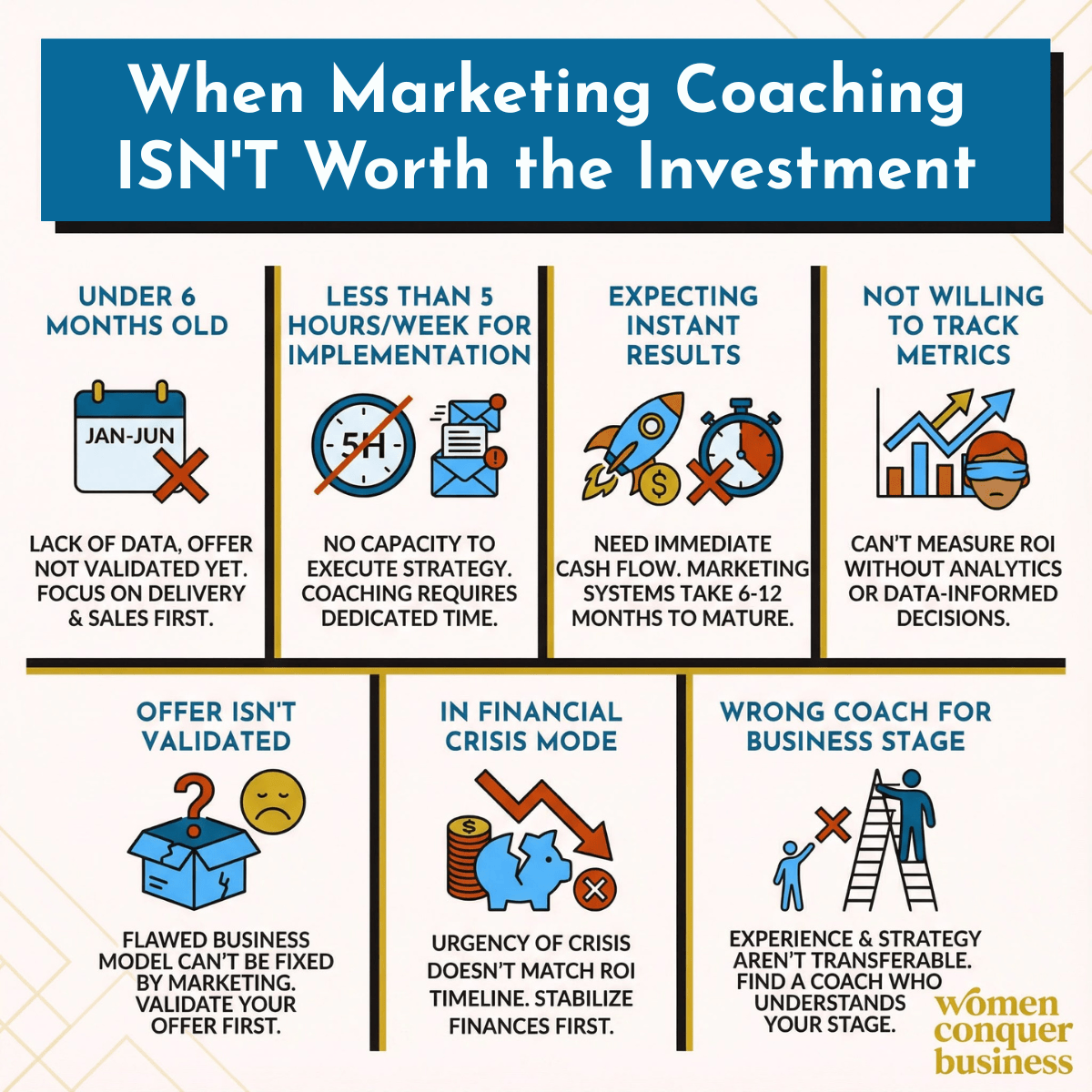
There are specific situations where marketing coaching is a poor investment, not because coaching is ineffective, but because the timing, capacity, or business foundation isn't there yet. Investing anyway creates frustration, wasted money, and the false conclusion that "marketing doesn't work for my business."
Here's when you should wait, choose a different path, or focus elsewhere first.
When Your Business is Under 6 Months Old
You don't have enough data yet. You haven't validated your offer through real market feedback. You're still figuring out who your ideal client is versus who you hoped they'd be.
What to do instead: Spend 6-12 months focusing on delivery and sales. Make 20-50 sales of your core offer. Talk to every customer about why they bought and what almost stopped them. Build your email list to 100+ subscribers through consistent valuable content. Once you have data and patterns, coaching ROI improves dramatically.
When You Have Less Than 5 Hours Per Week for Implementation
I've watched clients pay $10,000 for coaching they couldn't implement. Not because the strategy was bad. It was excellent. But they had 3 hours per week between client delivery, family responsibilities, and running their business.
Marketing strategy only generates ROI when implemented. If you can't protect 8-12 hours weekly for the first 3 months (heavy setup period) and 4-6 hours ongoing, you're paying for advice you can't use.
What to do instead: Focus on one marketing channel you can maintain in 2-3 hours weekly. Build consistency there first. Consider a strategic marketing membership where you learn at your own pace without the pressure of expensive 1-on-1 sessions. Once your capacity expands (kids start school, you hire admin help, your business stabilizes), then invest in intensive coaching.
When You're Expecting Instant Results
If your internal timeline is "I need this to work in 60 days or I'm giving up," coaching will disappoint you.
Marketing systems take 6-12 months to mature. Email funnels need testing and optimization. SEO improvements require months to show ranking changes. Content marketing compounds slowly. Paid ads need budget to test, fail, and refine.
The realistic timeline for positive ROI is 12-18 months when you account for total cost of ownership and implementation time. If you need immediate cash flow, coaching isn't the solution.
What to do instead: Focus on direct sales activities that generate immediate revenue. Reach out to your warm network. Offer limited-time services with quick delivery. Run flash promotions to existing clients. Get cash flowing, then invest in long-term marketing systems when you have breathing room.
When You're Not Willing to Track Metrics
If you refuse to look at analytics, track conversions, or measure what's working, you can't calculate ROI. You also can't make data-informed decisions about where to focus effort.
I've worked with brilliant business owners who were creatively gifted but allergic to numbers. They wanted to "create" without tracking performance. Coaching didn't work because they couldn't implement the feedback loop: test → measure → adjust → improve.
What to do instead: Start with one simple metric. Email open rates. Website visitors per month. Sales calls booked. Track it consistently for 3 months. Building this habit takes time, but if you can't maintain that discipline, you're not ready for coaching that requires multi-metric tracking and optimization.
When Your Offer Isn't Validated
Coaching can't fix a flawed business model. If nobody wants what you're selling at the price you're charging, better marketing won't solve that.
Symptoms of unvalidated offers:
- You've pitched to 50+ qualified prospects and gotten zero sales
- Your pricing is so low you can't afford to market (competing on price alone)
- Your service delivery is unsustainable (you're already burned out serving 5 clients)
- You're still figuring out what you want to sell
What to do instead: Validate first. Sell your offer to 10-20 people before investing thousands in marketing it. Adjust your pricing until it's profitable and sustainable. Make sure you can deliver excellent results consistently. Then market the proven offer.
When You're in Financial Crisis Mode
If you're behind on rent, considering closing your business, or unable to pay yourself consistently, coaching is not the investment to make right now.
Financial stress destroys your ability to implement effectively. You can't focus on building email sequences when you're panicking. The timeline for marketing ROI (12-18 months) doesn't match the urgency of your financial crisis (need money this month).
What to do instead: Stabilize first. Cut expenses. Focus on immediate revenue generation through direct outreach and existing client upsells. Once you have 3-6 months of operating expenses saved and consistent revenue, then invest in growth marketing.
There's no shame in waiting until the timing is right.
When the Coach Is Wrong For Your Business Stage
A coach who's brilliant at scaling 7-figure businesses to 8 figures might give terrible advice for a solopreneur trying to hit their first $100K year. Their experience isn't transferable to your constraints.
Warning signs of wrong-fit coaching:
- They've never worked with businesses under $500K revenue
- Their case studies are all venture-funded startups or established corporations
- They assume you have a team, marketing budget, and growth infrastructure
- They dismiss capacity constraints as "mindset blocks" instead of legitimate resource limitations
- Their strategy requires tools, platforms, or expenses you can't afford
What to do instead: Find a coach who specializes in your business stage and model. Someone who's helped 50 solopreneurs go from $75K to $150K understands your challenges better than someone who helps Fortune 500 companies optimize their marketing departments.
Making Your ROI Decision
We’ve weighed the pros and cons, and discussed readiness factors. The question you have to answer: "Is marketing coaching worth it for me, right now, given my constraints and goals?"
Only you can answer that.
Choose the path that builds a business you can sustain. That's the ROI that matters most.
If you don't meet those criteria, consider alternatives: our strategic marketing membership for flexibility and lower cost, focused courses for specific skills, or strategic DIY with foundational resources. Learn more about us, or contact us when your timing and capacity align.