


Choosing between marketing coaching services and a digital marketing agency is a strategic decision between building internal capability and renting external execution capacity. The 3 C's Decision Framework (Capacity, Complexity, and Control) diagnoses which model aligns with a business's operational reality to achieve marketing sovereignty and sustainable growth.
At a Glance
- What it is: A strategic decision framework comparing "building" internal skills versus "renting" external execution.
- Who it's for: Experienced solopreneurs and service-based business owners evaluating growth partners.
- Time to implement: 1–2 hours for initial assessment; 3–6 months for engagement results.
- Typical cost: $1,500 – $10,000+ per month depending on the chosen model.
- Skill level: Intermediate (requires established business fundamentals and offers).
- Primary outcome: Strategic clarity and a sustainable marketing execution system that respects founder capacity.
The "Agency Refugee" Crisis
I see it a few times a year.
A business owner comes to us frustrated with marketing chaos (AKA agency trauma).
They signed a $3,500/month retainer, got a flood of deliverables they didn't understand, and watched their bank account drain while their business stayed flat. The agency promised "full-service strategy" but delivered cookie-cutter templates and a dashboard full of vanity metrics. When they asked questions, they got jargon. When they wanted changes, they got upsells.
Sound familiar?
The marketing coach vs. agency decision is about choosing between renting someone else's capacity or building your own capability. An agency handles execution for you (they run your ads, creating content, manage your social media) but you're paying for ongoing access to their team and systems. A digital marketing coach teaches you to do internal marketing, building skills and assets that compound.
This guide walks you through the decision criteria using our 3 C's Decision Framework (Capacity, Complexity, Control), a model we developed after 25 years in digital marketing. You'll learn the hidden costs both options won't advertise, the prerequisites most businesses skip, and the "third way" that might be the smarter starting point.
Most importantly, you'll understand which model supports your actual business reality, not the highlight reel version everyone pretends to have.
You don't need more marketing tactics.
You need marketing sovereignty. And that starts with knowing what you're actually buying.
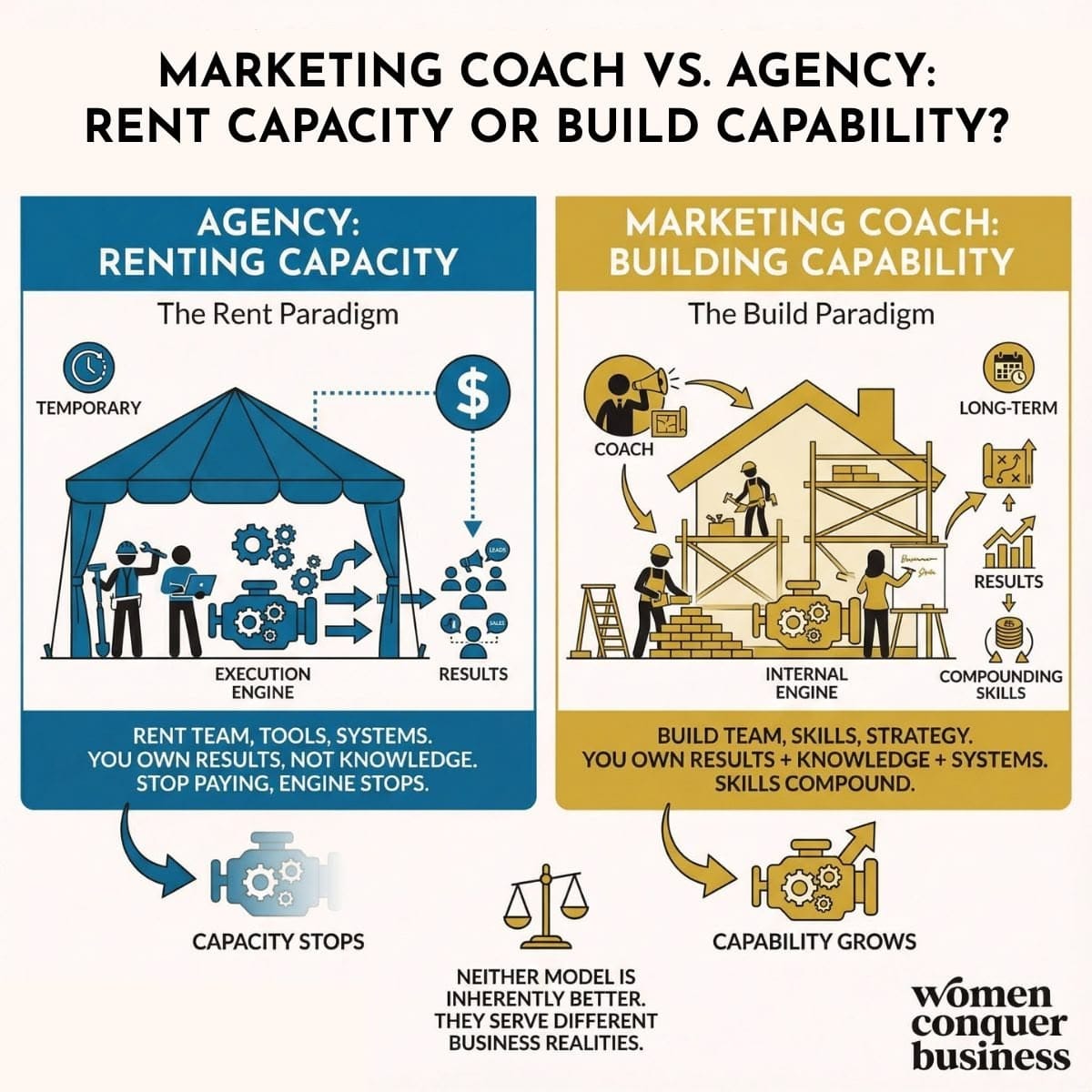
Build vs. Rent Paradigm
When you hire an agency, you're renting capacity. They bring a team, tools, and systems that handle execution while you're paying. As long as the retainer checks clear, the work continues. Stop paying, and the engine stops running. You own the results (hopefully), but not the knowledge or systems that created them.
When you work with a marketing coach, you're building capability. The coach teaches you and your team to execute the strategy yourselves. You learn how to structure campaigns, write effective content, analyze metrics, and make strategic decisions. The engagement ends, but the skills compound. You own both the results and the intellectual property that generates future results.
Neither model is inherently better. They serve different business realities.
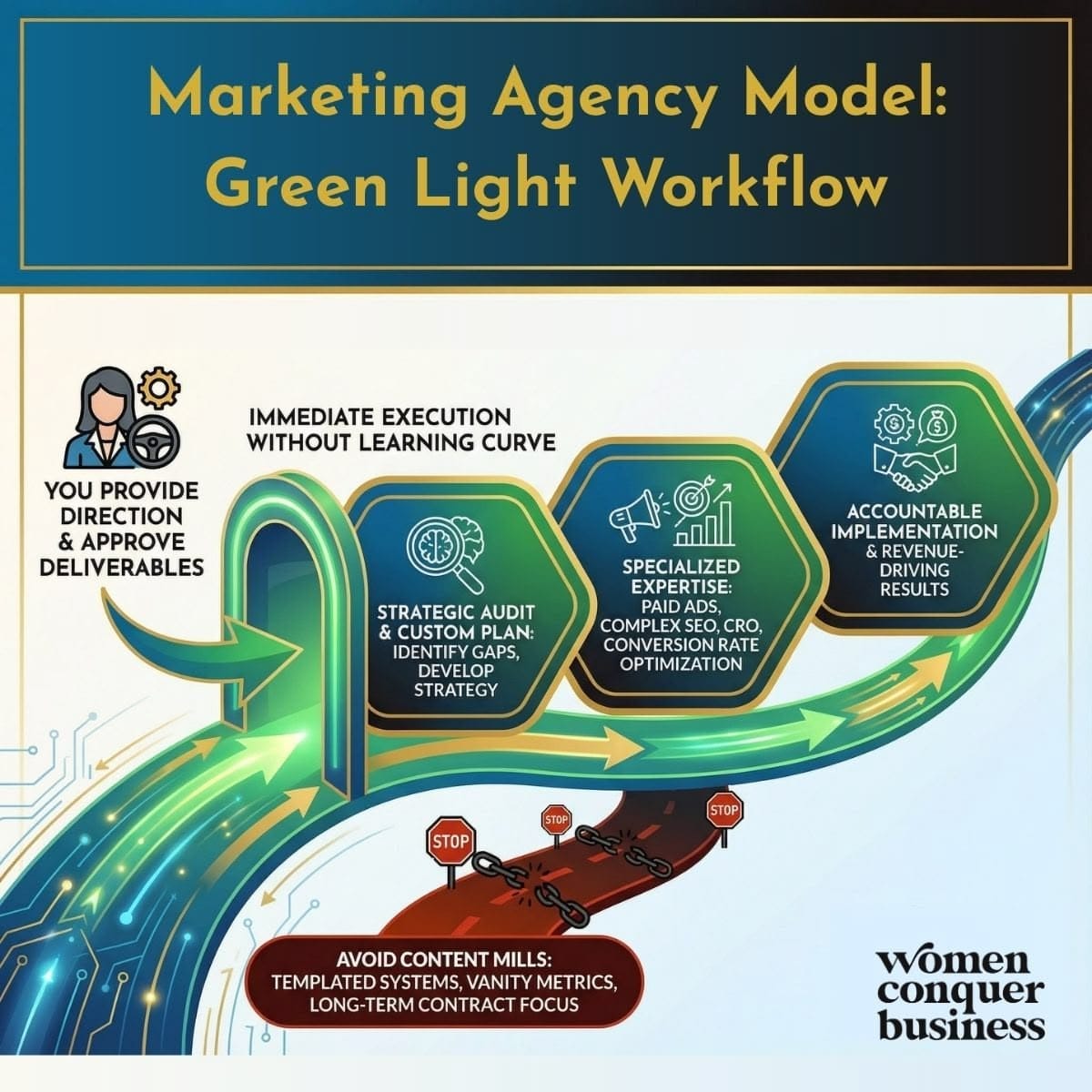
Agency Model: The "Green Light" Workflow
An agency is ideal when you need immediate execution without the learning curve. You provide strategic direction (or they develop it with you), approve deliverables, and they handle implementation.
Think of it as hiring a marketing department without the overhead of full-time salaries, benefits, and management.
The best agencies operate as true strategic partners. They audit your current efforts, identify gaps, develop custom strategies, and execute with accountability. They bring specialized expertise you'd struggle to build in-house, like advanced paid advertising strategies, complex SEO campaigns, or conversion rate optimization.
The worst agencies operate like content mills. They plug your business into templated systems, deliver cookie-cutter strategies, and measure success through vanity metrics that look impressive but don't drive revenue. They prioritize retention over results because their business model depends on long-term contracts regardless of your outcomes.
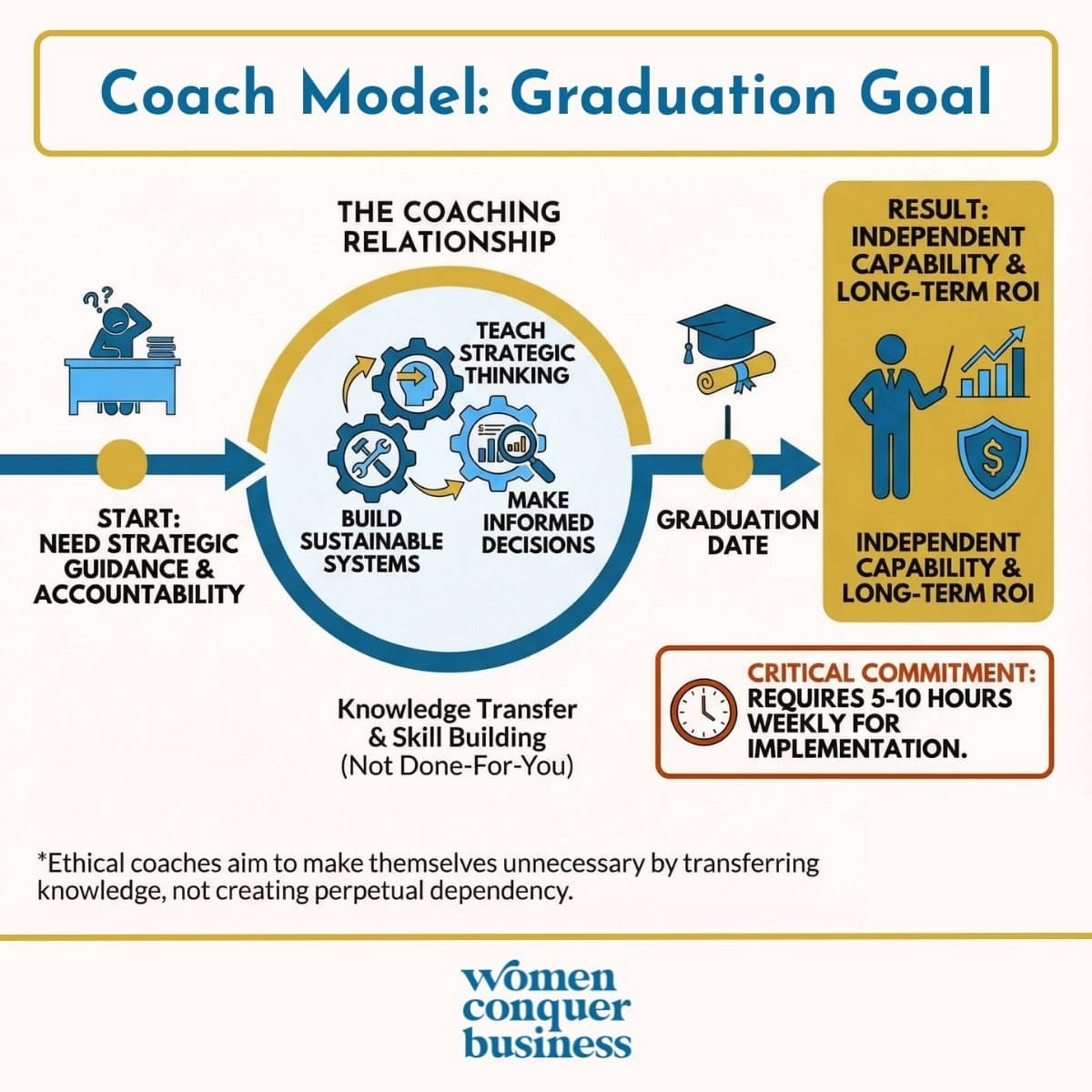
Coach Model: Graduation Goal
Marketing coaching works when you can execute but need strategic guidance and accountability. A good coach doesn't do the work for you, they teach you to think strategically, build sustainable systems, and make informed decisions even after the engagement ends.
The coaching relationship should have a graduation date. If your coach wants you dependent on weekly calls indefinitely, that's not coaching; that's consulting with a subscription model. Ethical coaches aim to make themselves unnecessary by transferring knowledge, not creating perpetual dependency.
You learn to develop your own marketing strategy, evaluate channels, interpret analytics, and adapt tactics as markets shift. The ROI extends beyond the engagement period because the capability remains.
But ... coaching requires a significant time investment from you. Industry experts note you need 5-10 hours weekly to implement what you're learning. If you don't have that capacity, you're wasting money on advice you can't execute. The knowledge is of zero value sitting in a notebook while your business struggles.
The Marketing Agency Model: Economics & Risks
Let's talk about what agencies cost in 2026. Not the marketing brochure pricing, but the total cost of ownership. Industry data shows the average monthly retainer hovers around $3,500, though actual costs depend heavily on scope and expertise.
Entry-level agencies ($1,500-$2,500/month) typically offer basic execution: social media management, blog content, email marketing. Recent surveys show many smaller agencies charge below $1,000/month, often staffed by junior practitioners learning their craft on your budget. These engagements rarely include custom strategy, just templated tactics.
This is what we call the "Valley of Death" for agency relationships. The pricing's too low to support strategic work or senior talent, but too high to be a learning investment. Most businesses in this range would get better results investing that money in education and doing it themselves.
Mid-tier agencies ($3,000-$7,500/month) can deliver solid execution if they specialize in your industry or channel. You're paying for experienced strategists, regular reporting, and some customization. Pricing data confirms this tier makes sense when you have proven offers and need skilled execution to scale what's already working.
The hidden cost here is management overhead. Even with "full-service" agency support, you'll spend 5-10 hours monthly reviewing deliverables, providing feedback, approving content, and ensuring the agency understands your brand voice. Agencies can't read your mind.
Premium agencies ($10,000+/month) bring senior strategists, dedicated account teams, and comprehensive campaign management across multiple channels. At this tier, you're buying sophisticated expertise, advanced paid advertising strategies, conversion optimization testing, and integrated omnichannel campaigns. This investment makes sense when you have significant marketing budgets (typically $50k+/month in ad spend) and complex go-to-market strategies.
But even premium agencies fail when plugged into broken systems.
Hidden Costs Nobody Advertises
Ad spend percentage fees can quietly double your actual costs. Research shows many agencies charge 10-20% of your advertising budget on top of their retainer. PPC management typically follows this model, with percentages ranging from 10-30% depending on ad spend volume. Spend $10,000/month on Facebook ads? Add another $1,000-$2,000 to your agency bill. This creates a perverse incentive: agencies profit more when you spend more.
Platform and tool costs often appear as surprise line items. The agency uses its premium accounts for analytics, scheduling, design, and project management, then passes those costs on to you at marked-up rates. A $500/month retainer can balloon to $800 after invoicing all the "necessary tools."
Asset ownership clauses in agency contracts can hold your marketing hostage. Some agencies retain ownership of ad accounts, website code, email templates, and content they create with your money. Leave the relationship, and you lose access to assets you paid to build.
Always negotiate ownership rights before signing.
The agency model can work brilliantly when you choose strategically and protect your interests. But it's renting, not building.
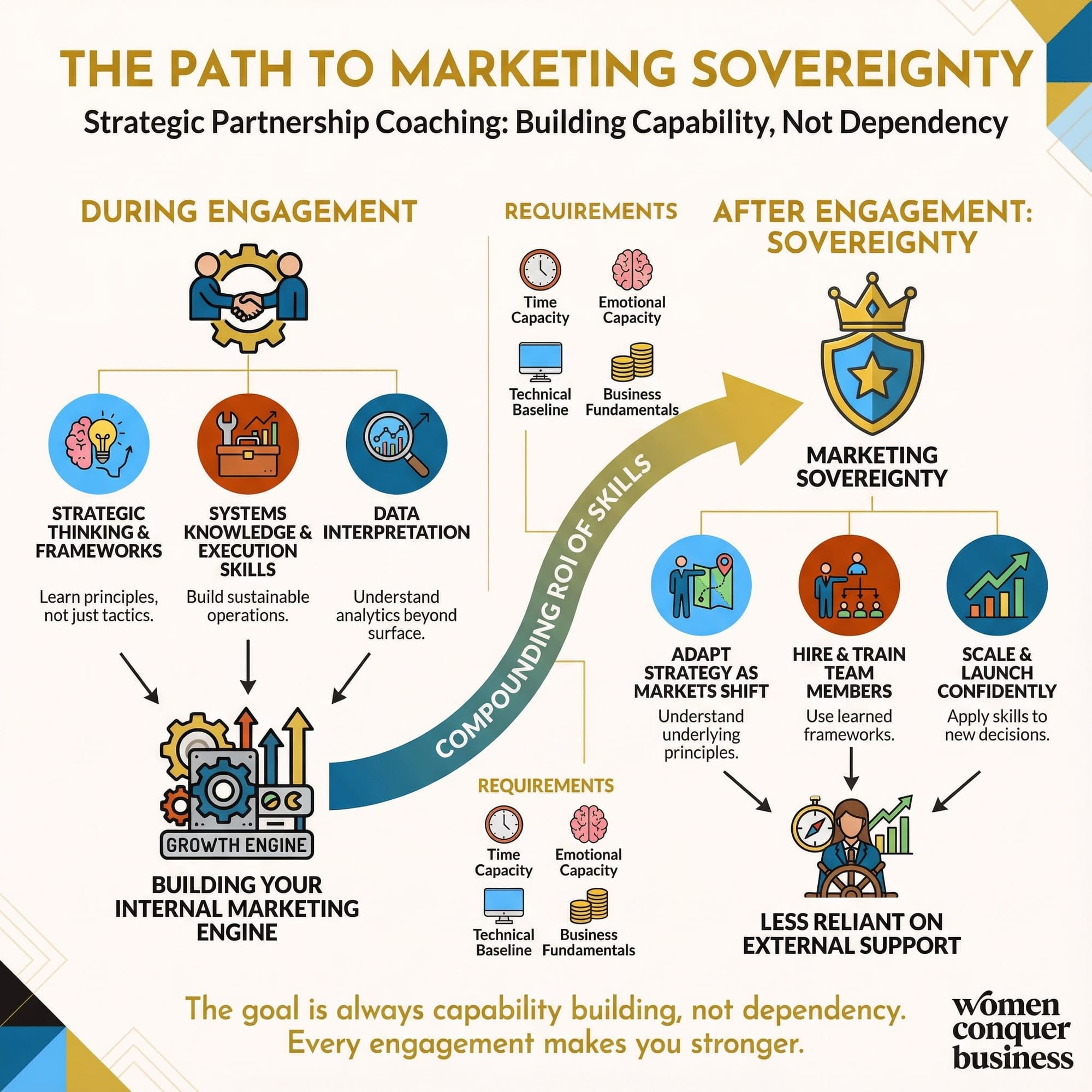
Marketing Coach Model: Sovereignty & Skills
Here's what makes coaching different: the ROI extends beyond the engagement.
When you pay an agency $5,000/month for six months, you've spent $30,000. Stop paying, and the execution stops. You have results from that period (hopefully), but no capability to generate future results without continued investment.
When you pay a coach $2,000/month for six months, you've spent $12,000. Business coaching typically ranges from $500-$5,000 monthly depending on expertise level. After the engagement ends, you keep the strategic thinking, systems knowledge, and execution skills. You can hire team members and train them using the frameworks you learned. You can adapt tactics as markets shift because you understand the underlying principles.
This is what we mean by marketing sovereignty.
Compounding ROI of Skills
Marketing coaching teaches you to evaluate marketing channels based on your actual business model, not what's trending on social media. You develop frameworks for testing messaging without burning your budget on random experiments. You understand how to interpret analytics beyond surface-level metrics.
The skills transfer to every future marketing decision: launching products, entering new markets, scaling operations. But coaching isn't magic. It requires showing up with time, energy, and willingness to implement.
Strategic Partnership vs. Simple Mentorship
Not all coaching is equal. There's a crucial difference between strategic partnership coaching and motivational mentorship.
Motivational coaches focus on mindset, confidence, and overcoming mental blocks. They're valuable when psychological barriers limit your actions. But they rarely provide the technical marketing knowledge needed to execute campaigns, interpret data, or build sustainable systems.
Strategic partnership coaching combines mindset support with practical skill transfer. You're learning psychology and methodology. The coach helps you develop strategy, build systems, and make execution decisions while also addressing the capacity and confidence challenges that derail implementation.
At Women Conquer Business, we focus on a strategic partnership model. We don't just encourage you to "think bigger" or "show up consistently." We teach you to build marketing operations that match your capacity, develop strategies that align with your business model, and create systems that work even when you're not at peak performance.
This means sometimes coaching looks like consulting. We might audit your tech stack, map your customer journey, or help you restructure your offer suite. But the goal is always capability building, not dependency. Every engagement should make you less reliant on external support, not more.
Hidden Prerequisites of Coaching
Coaching fails when prerequisites aren't met. You need:
- Time capacity (5-10 hours weekly for implementation)
- Emotional capacity (mental energy to learn new systems)
- Technical baseline (basic tool competency), and
- Business fundamentals (proven offers and operational systems).
If you're already working 60-hour weeks with no margin, in survival mode managing crises, or lacking product-market fit, coaching becomes expensive advice you can't implement.
Decision Matrix: The 3 C's Framework
After watching businesses choose between agencies and coaches, we've distilled the decision into three factors: Capacity, Complexity, and Control.
This framework helps you diagnose which model matches your actual business reality.
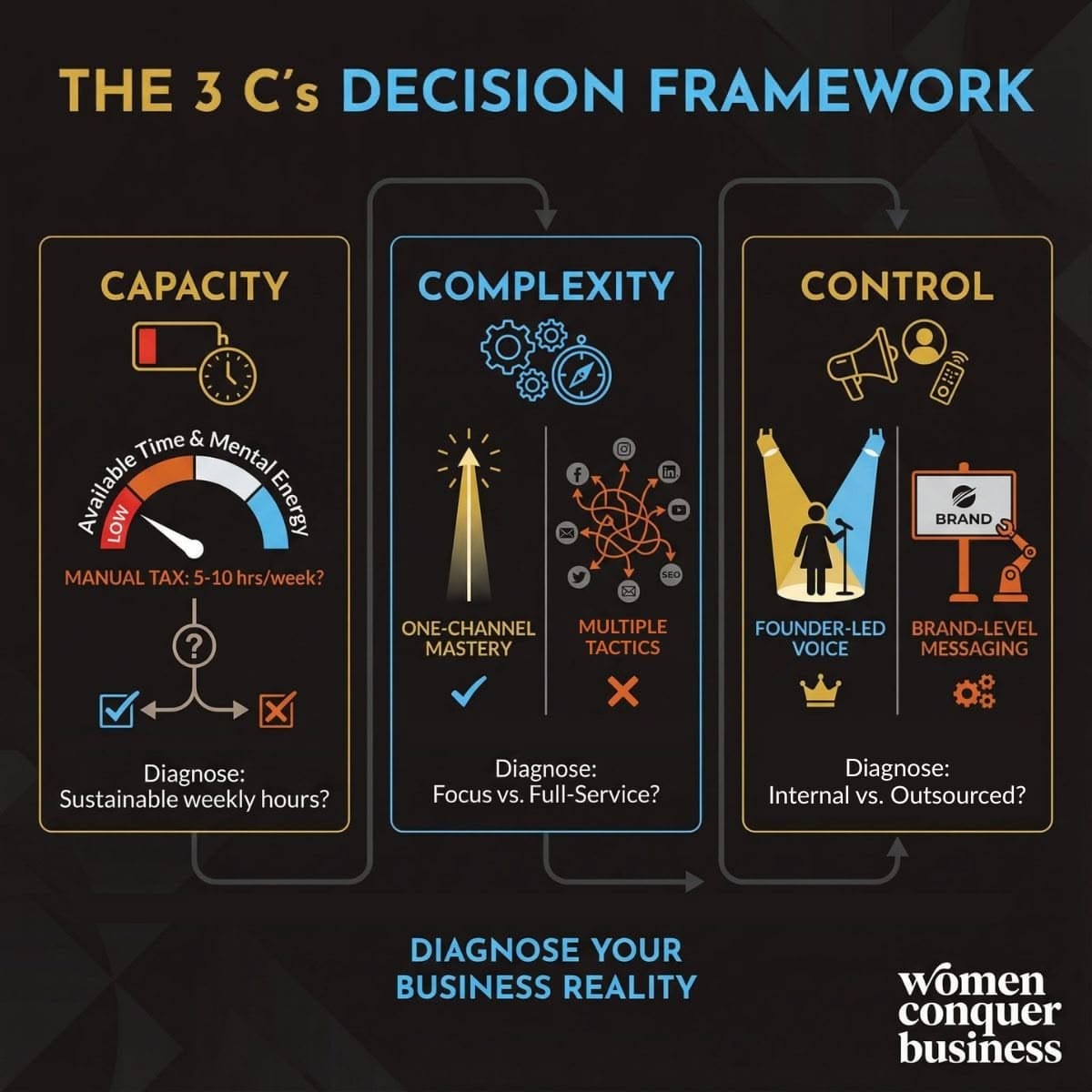
Capacity: "Manual Tax" Reality
Capacity measures your available time and mental energy to execute marketing work yourself. Not aspirational capacity, or what you wish you had when you're better organized.
Real capacity, measured in hours you can sustainably dedicate weekly.
This is what we call the "Manual Tax": the hidden time cost of doing marketing yourself, even with coaching support. Writing weekly emails, creating social content, managing ad campaigns, analyzing metrics, adjusting tactics. These tasks require consistent execution. If you don't have 5-10 hours weekly with mental clarity to focus on marketing, coaching won't help.
You'll pay for advice you're too depleted to implement.
We see this constantly with neurodivergent founders and business owners juggling caregiving responsibilities. The coaching insights are brilliant. The capacity to execute them simply doesn't exist. The gap between knowing what to do and having energy to do it creates shame, not growth.
How to Choose
- Agency makes sense when: You're working at capacity in delivery, don't have time to learn new skills, or need immediate execution while you handle other business priorities. The agency becomes your marketing department without the overhead.
- Coaching makes sense when: You have 5-10 hours weekly for implementation, enjoy learning new skills, and can maintain consistency over 3-6 months while capability builds.
Complexity: One-Channel Mastery Approach
Complexity refers to how many marketing channels and tactics your business needs to run effectively. More channels = more coordination, more tools, more specialist knowledge.
Here's the contrarian truth: most small businesses need to master one channel deeply, not dabble in six poorly.
If you're spreading budget and attention across SEO, paid ads, social media, email, content marketing, and partnerships, you're probably doing all of them at 60% effectiveness. One channel at 100% would generate better results.
This matters for the coach vs. agency decision because agencies often pitch "full-service" multi-channel strategies. They'll run your ads, manage social, write blog content, send emails, and optimize your site. Sounds comprehensive.
Usually means you're paying premium rates for mediocre execution across too many fronts.
Coaches typically help you identify your highest-leverage channel and build deep competency there before expanding. It's less sexy than omnipresent marketing campaigns, but it's how sustainable growth actually happens for businesses under $5M in revenue.
How to Choose
- Agency may make sense when: You have complex sales funnels, need coordinated campaigns across multiple channels, or have proven offers that require sophisticated execution to scale.
- Coaching may make sense when: You need to identify and master your core channel before expanding, or you're rebuilding strategy after scattered tactics failed.
Control: Founder-Voice Question
Control measures how much your brand voice, strategic direction, and marketing execution need to reflect founder personality and expertise. Some businesses run on founder-led sales. The founder's perspective, story, and authority are the primary marketing asset.
Others can operate with brand-level messaging that doesn't require founder involvement.
If your business depends on founder-led content marketing (e.g., podcasts, thought leadership, LinkedIn presence, speaking) you can't outsource that to an agency. (Don't believe it; people don't respond well to AI slop.) Agencies can handle distribution, production, and promotion. But the creative work and strategic thinking must come from you.
An agency can't replicate your 20 years of industry expertise or personal story.
Coaching helps you build systems that leverage founder authority while minimizing the "always-on" content creation burden. You learn to batch content, repurpose strategically, and build distribution systems that amplify your voice without consuming all your time.
How to Choose
- Agency makes sense when: Your marketing can run on brand-level messaging without requiring founder involvement, or you have team members who can represent the brand authentically.
- Coaching makes sense when: Your expertise and voice are primary marketing assets, or you're building founder-led authority in your market.
The 3 C's Decision Table
| Decision Factor | Agency (Rent) | Coach (Build) |
|---|---|---|
| Weekly Time Capacity | Under 5 hours available | 5–10+ hours available |
| Marketing Complexity | Multiple channels to manage | One primary channel |
| Voice & Messaging | Brand voice is sufficient | Founder voice is required |
| Typical Investment | $3,000–$10,000+ per month | $1,500–$3,000 per month (3–6 months) |
| Primary Outcome | Execution without skill transfer | Skill building with guidance |
| Value Over Time | Results stop when service ends | Results compound over time |
| Main Risk | Ongoing dependency on vendors | Limited ROI without implementation time |
Use this table honestly. The "right" answer isn't which model sounds better; it's which one matches your actual capacity, complexity, and control needs right now.
Recommendation: Fix Tech Chaos First
Here's the thing: both agencies and coaches fail when plugged into broken systems.
We audit businesses that hired expensive agencies or talented coaches and saw zero results. Not because the agency was incompetent, or the coach was ineffective, but because the underlying marketing operations were too chaotic to support any strategy.
We call this Tech Chaos: marketing tools that don't talk to each other, data in disconnected silos, and campaigns requiring manual workarounds that break constantly.
Why Marketing Fails on a Broken Infrastructure
Imagine hiring a brilliant agency to run Facebook ad campaigns. They create compelling creative, target the right audiences, and drive quality traffic to your website. But your website form doesn't connect to your CRM. Leads sit in an inbox nobody monitors. Follow-up emails trigger sporadically because your automation broke three months ago.
The agency reports "great click-through rates" and "strong engagement." Your bank account says nothing changed. The problem was either ineffective execution, or a broken infrastructure.
Or consider coaching. Your coach teaches you to build an email nurture sequence for new leads. The strategy is solid. But your email platform doesn't integrate with your scheduler, which doesn't sync with your payment processor, which isn't connected to your project management system. Building the sequence requires duct-taping six tools together with Zapier workflows that break whenever a platform updates its API.
You spend 10 hours implementing a 2-hour task. The mental load is crushing. You quit before the sequence ever goes live.
Marketing Operations Prerequisite
Before hiring an agency or coach, audit your marketing operations. Ask these questions:
- Can you track a lead from first contact to closed sale? If data lives in disconnected silos, you can't measure ROI on anything.
- Do your tools actually integrate, or are you manually moving data? Manual processes create bottlenecks, errors, and burnout.
- Can someone other than you access and understand your marketing systems? If everything lives in your head or requires you to manually intervene, you're the bottleneck.
- Are you paying for "ghost subscriptions" (tools you signed up for but don't use)? Tech bloat creates confusion and waste.
The third way (the option most businesses should choose before hiring anyone) is fixing the operations foundation. Get your tech stack integrated, your data flowing correctly, and your systems documented. Then, strategy and execution work.
At Women Conquer Business, we call this the Marketing Operations Makeover. It's not sexy. It won't show up in case studies about viral campaigns. But it's the prerequisite that determines whether expensive agency retainers or valuable coaching insights actually generate results.
Hybrid Path Forward
Once operations are clean, many businesses benefit from a hybrid approach: coaching to build strategic capability + specialized agency support for technical execution you don't need to master.
For example: work with a coach to develop your content strategy, brand voice, and editorial calendar. Hire an agency to handle SEO technical optimization, ad platform management, or graphic design production. You're building the strategic thinking while outsourcing specialized execution. This gives you marketing sovereignty. You understand the strategy and could execute if needed, while leveraging external expertise where it makes economic sense.
The key is getting operations right first.
Your Next Move: Marketing Coach vs Agency
The marketing coach or agency decision isn't about which model is "better." It's about which one matches your current reality across three dimensions:
- Capacity (your available time and energy)
- Complexity (your channel strategy needs)
- Control (your brand voice requirements)
If you're under 5 hours/week available for marketing, need multi-channel coordination, and can run on brand-level messaging... an agency makes sense. You're renting execution capacity to handle what you don't have time to do.
If you have 5-10+ hours weekly, need to master one core channel, and rely on founder-led authority, coaching builds the capability you'll use for years. You're investing in sovereignty, not dependence.
But if your marketing tools don't talk to each other, your data lives in disconnected silos, and every campaign requires manual workarounds, neither option will work. Fix your marketing operations first. Then hire strategically.
The businesses that succeed long-term don't rent their marketing future indefinitely. They build capability, leverage expertise where it makes economic sense, and own their marketing sovereignty.
That's not hustle culture. That's sustainable growth.
FAQs: Hire an Agency or a Coach
What are the biggest red flags when evaluating an agency service?
"Guaranteed results" promises are the most obvious red flag. No ethical agency can guarantee specific outcomes. They can't control market conditions, competitive actions, or your product-market fit. Guarantees usually come with impossible-to-meet conditions that void the promise when you don't hit targets.
Proprietary technology claims that lock you into their platform should raise alarms. If the agency insists you can't access your data outside their "proprietary dashboard," you don't own your marketing infrastructure. You're building their business, not yours.
Long-term contracts (12+ months) with early termination penalties trap you in bad relationships. Ethical agencies prove value monthly. If they need a year-long commitment to make the economics work, their model probably depends on clients who stop caring about results after the honeymoon period ends.
How do I know if I have the prerequisites for coaching to work?
Coaching requires four key prerequisites:
Time capacity: Can you dedicate 5-10 hours weekly for implementation? If you're already working 60-hour weeks with no margin, coaching adds stress without adding results. You'll learn brilliant strategies you can't execute, which creates shame and wastes money.
Emotional capacity: Do you have mental energy to learn new systems and tolerate the discomfort of change? If you're in survival mode managing business crises, coaching becomes another task on an impossible list.
Technical baseline: Are you comfortable with basic tools you're already using? A coach can teach you advanced email segmentation, but not if you're still struggling to log into your email platform.
Business fundamentals: Do you have proven offers and basic operational systems? Coaching can help you scale what works. It can't create product-market fit or fix broken business models.
If more than one of these prerequisites is missing, fix those foundational issues before investing in coaching.
Can I use a marketing consultant, agency and a coach at the same time?
Yes, use a consultant to audit and update operations (as a project). At the same time, you can work with a coach to build strategic capability and decision-making frameworks. Hire a marketing agency for specialized technical execution you don't need to master (like SEO technical optimization, ad platform management, or graphic design production).
The key is understanding the strategy yourself while outsourcing implementation where it makes economic sense. This gives you marketing autonomy (you could execute if needed) while strategically using expertise efficiently. You're orchestrating resources strategically, not dependent on either relationship.