


Getting mentioned by ChatGPT depends on how clearly your expertise is articulated and how content is structured. AI tools cite businesses it can understand and trust. A single authority page, supported by light technical structure, helps experienced solopreneurs turn scattered content into AI visibility that compounds.
At a Glance
- What it is: A practical system for helping AI tools understand and reference your expertise
- Who it’s for: Established solopreneurs and service-based business owners (not beginners, not hype-chasers)
- Time to implement: One focused setup (8–14 hours), then light weekly upkeep
- Typical cost: $0-50/month using tools you likely already have
- Skill level: Beginner-friendly with some strategic thinking required
- Primary outcome: Your business gets cited, summarized, and recommended in AI-powered search results
| Factor | Google Search | ChatGPT / AI Search |
|---|---|---|
| Goal | Rank in top results | Get cited as a source |
| Primary signal | Keywords + backlinks | Entity clarity + structure |
| Success metric | Clicks | Mentions, citations, recommendations |
| Content preference | Long SEO guides | Extractable definitions + evidence |
| Authority signal | Domain strength | Consistency + third-party validation |
The shift from traditional SEO (Google) to rank on ChatGPT, Perplexity, and other platforms, is the biggest change in how customers find businesses since mobile search went mainstream.
A Princeton research study found that implementing AI-driven search strategies can increase visibility by up to 115% for smaller websites, specifically the ones typically ranked lower in traditional search results.
Why should you care? Because between 800 million and 1 billion people use ChatGPT weekly, and AI Search traffic converts at 14.2% compared to traditional search engines 2.8%. Not only do people use AI to search, it may generate higher conversions if ChatGPT ranks you.
This guide walks through AI visibility, focusing first on what gets meaningful results for solopreneurs. You'll learn how to build the single source of truth that teaches AI who you are, how to structure content machines can understand, and how to create authority signals that get you cited rather than ignored.
No jargon-heavy technical manuals. No 40-hour-a-week strategies. Foundational work that can generate leads for years.
Why Don’t Keywords Matter as Much for ChatGPT?
Keywords matter less for ChatGPT because AI systems organize information around entities and relationships, not rankings. Instead of indexing pages by keyword frequency, LLMs evaluate whether a business entity is clearly defined, consistently referenced, and supported by trusted external sources.
Here's what's happening under the hood when tools like ChatGPT mentions a business. You don't rank in ChatGPT, you get cited (like a journal or research paper).
AI platforms don't see your website as a collection of pages with keywords. It sees entities: people, organizations, concepts, and the relationships between them. These entities live in something called a Knowledge Graph, a massive database mapping how things connect.
Think of the Knowledge Graph like the song “Dem Bones,” the “Hip bone connected from the thigh bone / Thigh bone connected from the knee bone,” and so on. The same is true with your information.
Here’s an example: ”Jen McFarland" is a person (entity). "Women Conquer Business" is a business (entity). "Marketing consultant" is a concept that can link to both.
Jen McFarland is also connected as the owner of Women Conquer Business not only on her website but with backlinks high-value external websites like LinkedIn and IMDB. … but sometimes you need to help the computers build the knowledge and make the connections.
When people search Google and see that information box on the right side (the Knowledge Panel), that's the Knowledge Graph surfacing what it knows about an entity. ChatGPT visibility uses similar logic, but instead of showing a panel, it weaves that knowledge into conversational responses.
The problem? Most small business websites are disorganized.
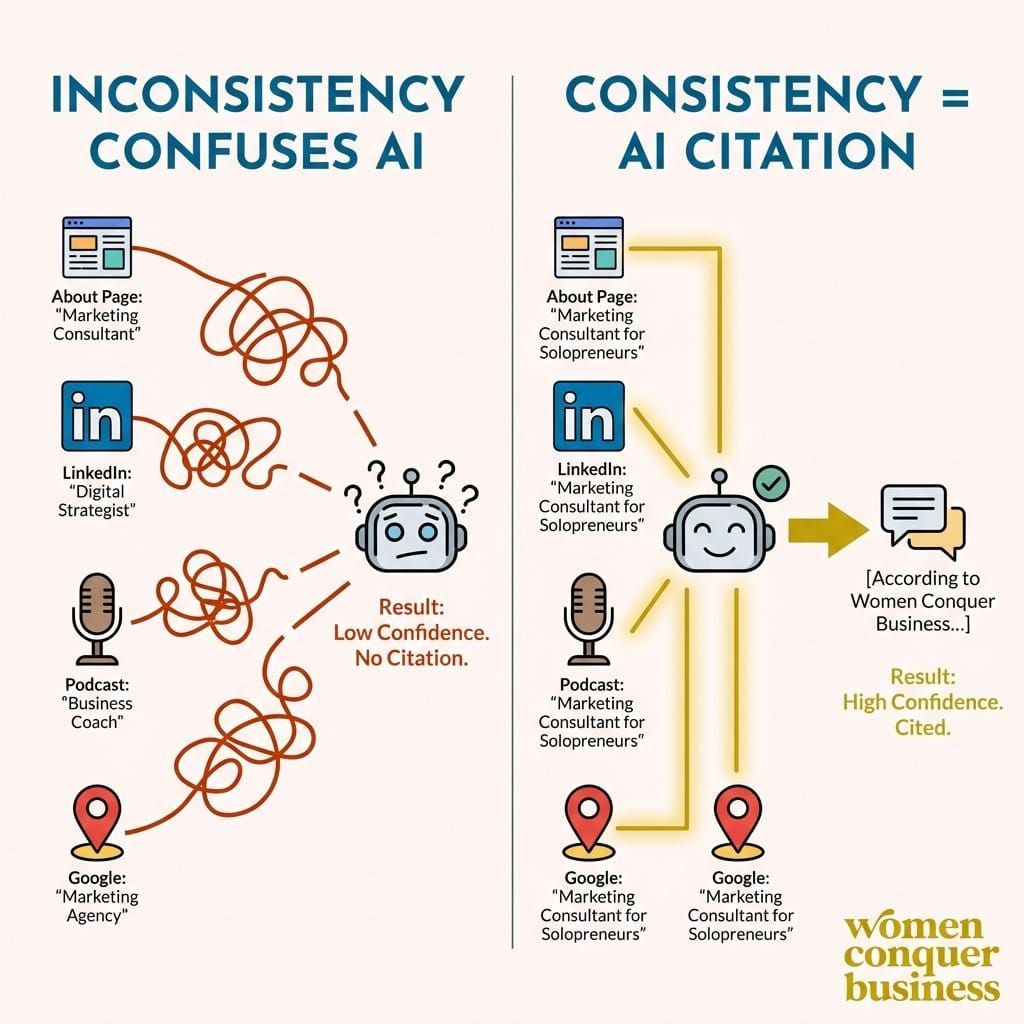
I've audited hundreds of small business sites over the years. The pattern is consistent: the About page says one thing, the LinkedIn profile says something slightly different, the podcast bio adds another variation, and the Google Business Profile uses yet another description. This inconsistency is especially damaging for local SEO and entity recognition.
To a human, these differences seem minor. To an AI trying to build confidence about who you are, it gets confused, resulting in a lower "entity score."
The solution is what experts call an "Entity Home."
Think of it this way: if Google or ChatGPT could only read one page to understand your entire business, which page would you want that to be?
For most solopreneurs, that's the About page.
But here's the catch. Most About pages are written for humans browsing, not machines parsing. They tell stories. They use metaphors. They bury the facts under personality.
The AI needs both. Personality keeps humans engaged. Clear, factual statements ("Jen McFarland is the founder of Women Conquer Business, a marketing consultancy based in Portland, Oregon") give the machine something to index with confidence.
You don't have to choose between being human and being machine-readable. Structure the page so both audiences get what they need.
Strengthen Your Entity Signals (Without Burning Hours)
If this guide made you realize your business needs stronger online citations, consistent listings, and clearer entity signals for AI and search ... start with a Local SEO tune‑up.
My Local SEO Service helps you:
• Fix inconsistent directory listings
• Build out the citations AI tools trust
• Strengthen your Knowledge Graph signals
• Set up the structured data Google (and ChatGPT) read
• Increase visibility without hustling harder
How ChatGPT "Learns" About Your Business
Understanding the mechanics helps you work smarter. Not harder.
Large Language Models like ChatGPT are trained on massive datasets, primarily text scraped from the open web. The largest of these is Common Crawl, a nonprofit that's archived over 9.5 petabytes of web data since 2008, making it freely available for AI training. According to Mozilla's research, it's become one of the most important sources of training data for generative AI.
When ChatGPT "knows" about a business, it's because that business appeared frequently enough, in high-enough-quality contexts, within the training data.
The model doesn't "remember" your website the way you remember a conversation. It learned statistical patterns. For example, "When the tokens 'marketing consultant Portland' appear, the token 'Women Conquer Business' often appears nearby."
Put another way, your business wants to be proximate to other terms (tokens) related to who you are and what you do.
This has two practical implications.
First, volume matters, but context matters more. Getting mentioned on 50 low-quality directories does less than getting mentioned once in a respected industry publication. The AI weights sources differently based on their own authority signals. Research from Princeton confirms this: a mention in Search Engine Journal carries more weight than a mention on some random blog.
Second, consistency compounds. If every mention of your business uses the same name, same description, same core facts, the AI builds a stronger association. Inconsistency (even small variations) dilutes the signal.
This is why the Entity Home strategy matters so much. It anchors everything else.
There's also a newer mechanism called Retrieval-Augmented Generation (RAG). The name isn’t important, but what it does, _is. _
When you use ChatGPT's "Browse" feature or ask Perplexity a question, the AI doesn't rely solely on training data. It will query the web, retrieve relevant pages, and synthesize an answer from what it finds in real time.
This is where traditional content quality still matters. If Bing or Google rankings favor your content, it's more likely to be retrieved by a browsing AI. If your content is structured clearly (direct answers, defined terms, scannable formatting), the AI can extract and cite it more easily.
The intersection of training data authority and real-time retrieval is where visibility happens. You need both: a strong entity presence in the AI's "memory," and well-structured content it can find and use in the moment.
For solopreneurs, this is encouraging.
You can't compete with large corporations on content volume. But you can absolutely compete on entity clarity and content structure. Those are strategy problems, not budget problems. And strategy is something you can learn, especially with the right support.
Step 1: Create and Optimize Your Source of Truth
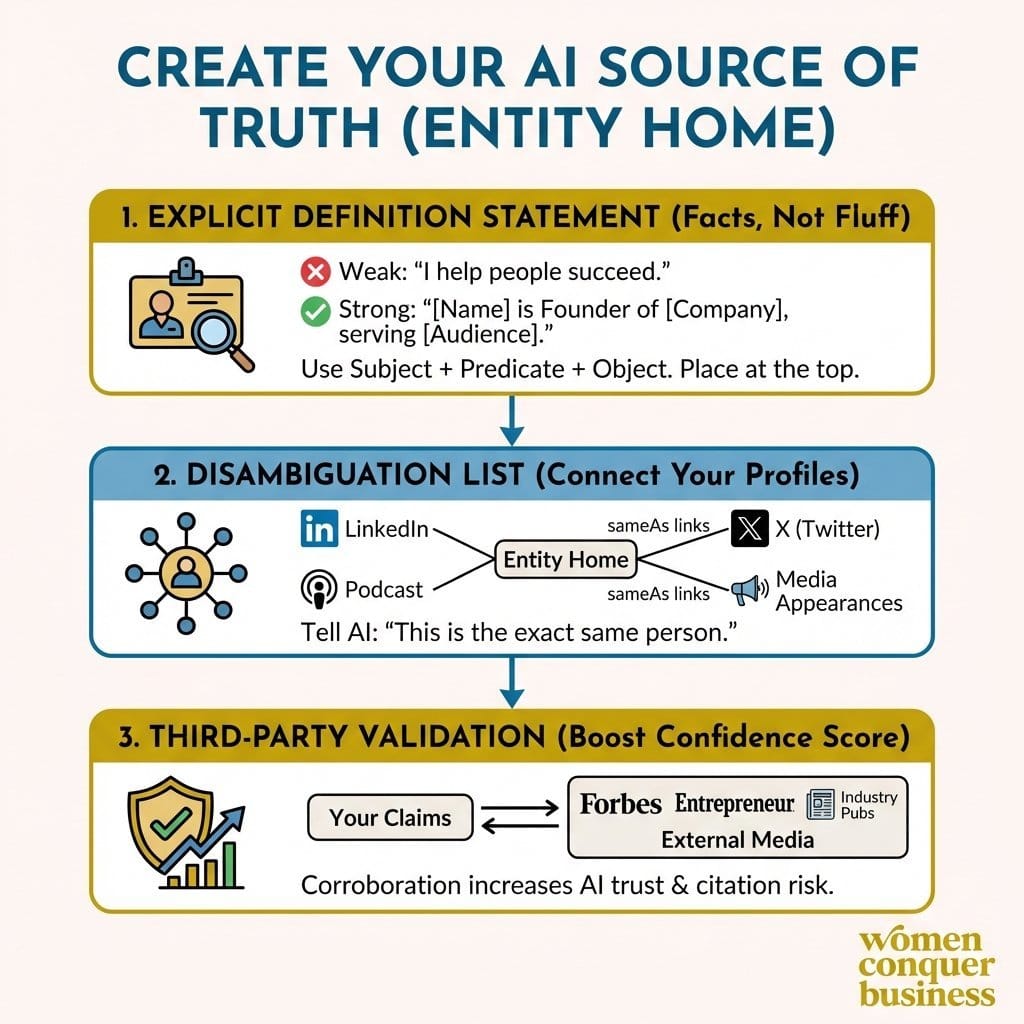
If your source of truth (we’ll call it your Entity Home) is the single page that answers one question: "If an AI could only read one page to understand who you are, what would it learn?"
The Non-Negotiable Elements:
1. The Explicit Definition Statement
Most About pages open with something like "I help women build businesses they love."
That's nice. It's also useless for entity recognition.
The AI needs a semantic triple, a statement with a clear Subject, Predicate, and Object. Not marketing copy. Facts.
- Weak: "I'm passionate about helping entrepreneurs succeed."
- Strong: "Jen McFarland is the founder of Women Conquer Business, a marketing consultancy based in Portland, Oregon, serving women solopreneurs."
Notice the difference. The second version contains five indexable facts: name, role, company name, location, and target audience. The first contains zero.
Put this statement in your first paragraph. Above the fold. Before your story, before your credentials, before your photo. The machines read top-down, and attention mechanisms weight early content more heavily.
2. The Disambiguation List
Here's a problem you might not have considered: you're probably not the only person with your name.
When I search "Jen McFarland," Google has to figure out which one. The marketing consultant? The nurse in Ohio? The author? Without clear signals, the AI hedges, or worse, conflates your identity with someone else's.
The fix is a visible list of everywhere you exist online, linked from your Entity Home:
- LinkedIn profile
- Twitter/X account
- Podcast directories (Apple, Spotify)
- Professional associations
- Media appearances
These links aren't only for humans clicking through. They create what schema experts call "sameAs" relationships. They tell the machine: "The Jen McFarland on this website is the exact same person as the Jen McFarland on LinkedIn." Dem Bones. …
That disambiguation is worth more than a dozen blog posts.
3. Third-Party Validation Anchors
The AI doesn't believe what you say about yourself. It looks for confirmation from other sources.
An "As Featured In" section with links to media appearances, podcast guest spots, or industry publications serves two functions. For humans, it's social proof. For machines, it's corroboration. The AI sees your website claiming expertise, then sees Forbes or Entrepreneur confirming it.
Confidence score goes up.
Business owners who skip this foundation work spend years creating content that never gets cited because the AI doesn't have enough confidence in who they are to risk recommending them.
Before you write another blog post, audit your Entity Home (I recommend it being your About page). Does it contain clear factual statements? Does it link to your other profiles? Does it include third-party validation?
If not, that's your first project. Everything else builds on this.
Step 2: Get Cited with Schema & Structured Data
Schema markup is where most solopreneurs tap out.
I get it. It sounds technical. It involves code. It feels like something you need a developer for.
Here's the reality: basic schema implementation takes about an hour, and it's one of the highest-leverage activities for AI visibility. You're essentially handing the machine a business card written in its native language.
What Schema Does
Your website has two audiences: humans and machines. The text on your page is for humans. Schema markup is invisible code that translates that text for machines.
Without schema, the AI has to interpret your content. "This page mentions Jen McFarland and marketing consulting. I think she's a consultant?"
With schema, you're declaring it: "This entity is a Person. Her job title is Marketing Strategist. She works for this Organization. Her expertise includes these topics."
Declaration beats interpretation. Every time.
The Essential Schema Types for Consultants
You don't need to implement everything. Focus on these three:
Person Schema (for your bio/About page)
- Name, job title, employer
- "knowsAbout" property (explicitly lists your expertise areas)
- "sameAs" links to all your profiles
- Educational credentials (the AI weights .edu associations heavily)
Organization Schema (for your homepage)
- Business name, type, location
- Founder (linking to your Person schema)
- Services offered
- "sameAs" links to business profiles
Google's structured data documentation provides detailed guidance on implementing these properties correctly.
FAQPage Schema (for content pages)
- Marks up questions and answers explicitly
- Makes content extractable for voice search and AI assistants
- Dramatically increases Featured Snippet eligibility
Implementation Without a Developer
If you're on WordPress, plugins like Yoast or RankMath handle basic schema automatically. For more control, Schema Pro or custom JSON-LD works.
If you're on Squarespace, you'll add JSON-LD code blocks to your page headers. It sounds scarier than it is. You're copying structured text from a free schema generator (like this one) into a designated field.
The validation step matters. After implementation, run your pages through Google's Rich Results Test and Schema.org's validator. Syntax errors are invisible to humans but break the machine's ability to parse your markup.
One warning: your schema must match your visible content. If your schema says you're based in Portland but your footer says Seattle, that damages trust signals rather than building them.
The machines check for consistency.
You need to build authority first, and use schema as a foundational infrastructure. It's part of the marketing operations work that pays dividends for years. Not exciting. Not creative. But the difference between hoping the AI understands you and ensuring it does.
Step 3: Show up in ChatGPT with Citation-Worthy Content
Here's where we bridge the technical foundation to content strategy.
Most content marketing guidance says "create valuable content consistently." That's true but incomplete. For AI visibility specifically, you need content the machine can extract and cite, not content that's only helpful to humans.
The difference is structural.
The Inverted Pyramid for AI
Journalists learn to write with the most important information first. AI optimization requires the same discipline.
When ChatGPT retrieves your page to answer a question, it doesn't read like a human. It scans for the passage most likely to contain the answer, extracts it, and synthesizes a response.
If your answer is buried in paragraph seven after a long personal story, it might never find it.
Structure content like this:
- Query-matching header (H2): Use the exact question your audience asks. Not "Understanding Burnout" but "What Are the Signs of Business Burnout?"
- Definition block (40-60 words): Immediately answer the question. This is your "paragraph zero," optimized for extraction.
- Elaboration: Now add nuance, stories, and the personality that makes your content distinctly yours.
The AI gets what it needs in the first 100 words. The human gets the full experience by reading further. Both audiences served.
The "Differentiator Term" Strategy
This is where thought leadership pays off in AI visibility.
Generic content gets filtered. If you write the same advice as 50 other marketing blogs, you're adding noise, not signaling something new. The AI has no reason to cite you.
But proprietary frameworks, unique terminology, and original data? Those force citation.
When someone asks ChatGPT about decision-making frameworks for your industry, and you've published extensively about your particular frameworks, AI learns to associate that specific term with your business entity.
For example, if you ask about the "Mistake Tax" of bad marketing consulting hiring decisions? That concept traces back to Women Conquer Business.
These aren't branding exercises. They're "Information Gain" signals, unique contributions that don't exist elsewhere in AI training data. The Princeton GEO study found that content with high information gain significantly outperforms derivative content in generative citations. Methods like adding statistics and unique data boosted visibility by up to 40%.
Primary Data: The Ultimate Authority Signal
AI cannot generate new facts. They can only retrieve and synthesize existing ones.
This creates an opportunity most solopreneurs miss entirely.
If you publish original research (even a simple survey of your audience) you become the source of that data. When someone asks ChatGPT for statistics on solopreneur burnout, and your "State of Solopreneur Marketing" report is the only place that data exists, the AI must cite you.
This doesn't require a research budget. Survey your email list. Aggregate insights from client work (anonymized). Track patterns across your podcast conversations. Publish the findings with clear methodology.
Original data is the single most effective guarantee of AI citation.
And for capacity-constrained solopreneurs, one well-executed annual survey beats 52 mediocre blog posts. Quality over quantity. Steak over sizzle. The machines are rewarding what should have mattered all along.
Build Authority and Rank on ChatGPT Without Burnout
Here's where I break from every other guide you'll read on this topic.
Most AI optimization advice comes from agencies with teams of 15 people, six-figure budgets, and clients who can afford to publish daily. Their strategies assume resources you don't have.
Worse, they assume energy you don't have. And that's the part nobody talks about.
I've worked with businesses for over 25 years. The pattern is consistent: they don't fail at marketing because they lack information. They fail because they take on strategies designed for different businesses with different constraints.
Then they burn out. Then they blame themselves.
That stops here.
Top AI Search Priorities: Week 1 to Month 4+
Based on capacity constraints typical of solopreneurs, here's the implementation order that delivers maximum authority signal per unit of energy:
Week 1-2: Entity Home Audit (4-6 hours total)
- Rewrite your About page with explicit factual statements
- Add visible links to all your other profiles
- Create or update your "As Featured In" section
- This is one-time work with compounding returns
Week 3-4: Basic Schema Implementation (2-4 hours total)
- Add Person and Organization schema to key pages
- Validate with Google's testing tool
- Again, one-time work, not ongoing effort
Month 2-3: Content Structure Retrofit (ongoing, 1-2 hours/week)
- Update your top 5 existing posts with query-matching headers and definition blocks (That’s the yellow box at the top of this blog post.)
- Add FAQ schema to these pages
- You're improving what exists, not creating from scratch
Month 4+: Strategic Content Creation (sustainable pace)
- One piece of citation-worthy content per month
- Focus on differentiator terms and original data
- Quality beats frequency every time
Notice what's not in the first three months: massive content production.
The agencies telling you to "publish 3x per week" are selling you a strategy that serves their billing model. Not your business.
The Entity Home and schema work is foundational. It's also finite. You do it once, maintain it occasionally, and it keeps working while you sleep. That's the kind of marketing that fits a real life.
Permission to Move Slowly
I want to name something most SEO agencies won't.
You might read this guide and feel the familiar pressure to do everything immediately.
That pressure is a liar.
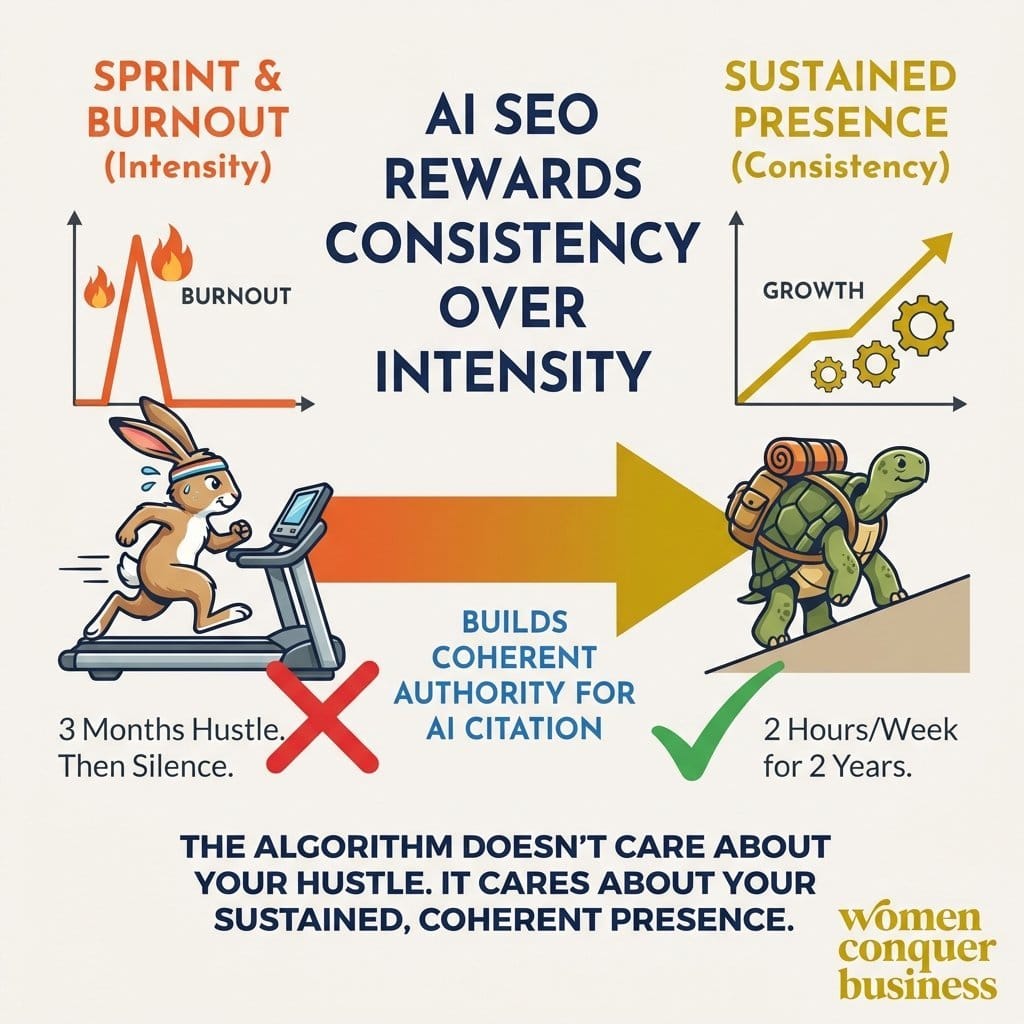
AI SEO / GEO rewards consistency over intensity. A solopreneur who spends two hours per week on authority-building for two years will outrank someone who sprints for three months and burns out. The algorithm doesn't care about your hustle. It cares about your sustained, coherent presence.
If you're in a season where capacity is genuinely limited (health challenges, caregiving, business pivots), you can focus solely on your About page and pause everything else. That foundation will be there when you're ready to build on it.
And if you want accountability and support from other solopreneurs doing this work alongside you, a community of peers can make the difference between following through and fizzling out.
Marketing should support your business and your life. Not consume them.
The Ethical Case for AI Visibility
Most guides frame GEO as a competition: "Get mentioned before your competitors do!" "Dominate AI search!" "Win the visibility war!"
I want to offer a different frame. One that aligns with how I believe marketing should work.
AI Visibility as an Ethical Obligation
When someone asks ChatGPT for help, the AI synthesizes an answer from its training data. If that data is dominated by hustle-culture gurus and predatory tactics, that's what gets recommended.
The person asking gets advice that could genuinely harm them. You building AI visibility isn't good for your business alone. It's good for the ecosystem.
On days when the technical work feels tedious, remember: you're not optimizing for search alone. You're ensuring that when someone needs help, they find someone trustworthy.
The Long Game Is the Only Game
Bro-marketing thrives on short-term tactics: manufactured urgency, fake scarcity, shame-based selling. Those tactics can generate quick visibility, but they poison the well. They train AI systems on manipulative patterns. They erode trust in the entire category.
The ethical marketing approach I teach, and the one this guide supports, is fundamentally different. It prioritizes resonance over reach. Depth over volume. Trust over transactions.
That approach takes longer. But it builds something real: a reputation the algorithm can verify, a body of work that demonstrates genuine expertise, and a business that doesn't require constant hustle to maintain.
The AI systems of the future will get better at detecting manipulation. They'll down-weight the manufactured signals and up-weight the authentic ones. Building your visibility on a foundation of genuine value is both ethical and strategic.
The businesses optimizing for shortcuts will need to start over when the algorithm updates.
The businesses optimizing for truth will not.
Connecting the Dots: AI-Driven Search & Humans
AI visibility and human connection aren't in tension. They're aligned. The work that makes you more citable to machines (clarity, consistency, evidence, expertise) is the same work that makes you more credible to clients.
You don't have to choose between "optimizing for robots" and "being authentically helpful."
Done right, they're the same thing.
I'm genuinely optimistic about where search is heading. The manipulators are losing their edge. The educators, the experts, the people doing real work: we're gaining ground.
Build your authority honestly. The algorithm is catching up to what should have mattered all along.
The Future Is Semantic (And That's Good News)
Getting your business mentioned by ChatGPT means teaching machines who you are with enough clarity and consistency that they can confidently recommend you.
The path is simpler than the noise suggests: build your Entity Home first. Implement basic schema to speak the machine's language. Structure your content for extraction. Create original data that forces citation.
And do it all at a pace your capacity can sustain.
Most solopreneurs won't do this work. They'll keep chasing content volume, wondering why visibility doesn't follow.
That's your advantage. Not because you're hustling harder, but because you're building smarter.
The shift from SEO strategies to GEO rewards exactly what ethical marketing has always prioritized: genuine expertise, clear communication, trustworthy information. The strategies that build AI visibility are the same ones that build human trust.
There's no conflict. There's alignment.
Your next step? Audit your About page this week. Apply the Entity Home principles. That single action creates more authority signal than a month of random content.
If the technical implementation feels overwhelming, that's what marketing coaching exists for: getting expert guidance without pretending you need to figure everything out alone.
You don't need to dominate AI search. You need to exist in it clearly, consistently, and credibly.
The machines are learning who to trust.
Make sure they learn about you.
Strengthen Your Entity Signals (Without Burning Hours)
If this guide made you realize your business needs stronger online citations, consistent listings, and clearer entity signals for AI and search ... start with a Local SEO tune‑up.
My Local SEO Service helps you:
• Fix inconsistent directory listings
• Build out the citations AI tools trust
• Strengthen your Knowledge Graph signals
• Set up the structured data Google (and ChatGPT) read
• Increase visibility without hustling harder
Frequently Asked Questions
How do I rank #1 on ChatGPT and other AI results?
You don't "rank" on ChatGPT the way you rank on Google. AI systems don't produce a list of 10 results, they generate answers and sometimes cite sources. Your goal is to become a source the AI trusts enough to mention. That means building clear entity signals (who you are, what you do, who you serve), implementing schema markup, and creating content with unique data or frameworks the AI can't find elsewhere. There's no #1 position to chase. There's only "cited" or "not cited."
How do I train ChatGPT to rank my company among the top results?
You can't directly train ChatGPT, its training data comes from web crawls that happen on OpenAI's schedule, not yours. What you can do is ensure your business appears clearly and consistently across authoritative sources, so future training updates include you. Build your Entity Home (a definitive About page with explicit facts), get mentioned in respected publications, and maintain consistent information across all platforms. For real-time AI search (Google's AI Overview / AI Mode, ChatGPT's Browse feature, Perplexity), focus on a content structure that makes your answers easy to extract.
How does ChatGPT rank websites and content?
ChatGPT doesn't rank websites, it predicts the most statistically likely answer based on patterns in its training data. When it "knows" about a business, it's because that business appeared frequently enough, in high-quality contexts, within the data. The model weights sources differently: a mention in a highly regarded publication (e.g., Forbes) carries more weight than a random directory listing. For browsing-enabled queries, it retrieves pages in real time and synthesizes answers from what it finds, favoring content that's clearly structured with direct answers near the top.
What's the difference between ranking on ChatGPT vs. Google?
Google retrieves documents and ranks them in a list. You compete for position 1-10. ChatGPT generates answers by synthesizing information and may cite 0-5 sources. You compete to be mentioned.
| Factor | ChatGPT | |
|---|---|---|
| Goal | Rank in top 10 | Get cited as a source |
| Optimization | Keywords + backlinks | Entity clarity + content structure |
| Success metric | Click-through rate | Brand mention + citation |
| Content style | SEO-optimized guides | Extractable, definition-rich answers |
The strategy shift: Google rewards content that matches keywords. AI systems reward content that establishes who you are with enough clarity that they trust recommending you.
How do I track my ChatGPT rankings and traffic?
This is the frustrating truth: you can't track AI citations the way you track Google rankings. There's no Search Console for ChatGPT. Your options are limited but useful:
- Manual testing: Regularly ask ChatGPT questions your ideal clients would ask and see if you're mentioned
- Brand monitoring: Tools like Mention or Google Alerts catch when your business name appears in AI-generated content republished elsewhere
- Referral traffic: Watch for traffic from chat.openai.com, perplexity.ai, or similar domains in your analytics
- Indirect signals: Increases in branded search ("Women Conquer Business") often show AI mentions driving awareness
Focus on building the foundation (Entity Home, schema, citation-worthy content) and trust that clear authority signals compound over time, even when you can't measure it.