


You used to love this business. Now you're not so sure.
Maybe it happened slowly. The excitement faded into routine, the routine into dread. Or maybe it hit all at once during a random Tuesday meeting when you caught yourself thinking, Why am I even doing this anymore?
Either way, here you are. Wondering if this feeling means something is broken, or if you're just having a rough season.
Falling out of love with your business is way more common than anyone admits. And no, it doesn't automatically mean you need to burn everything down and start over. But it DOES mean something needs to change.
This guide will help you figure out what.
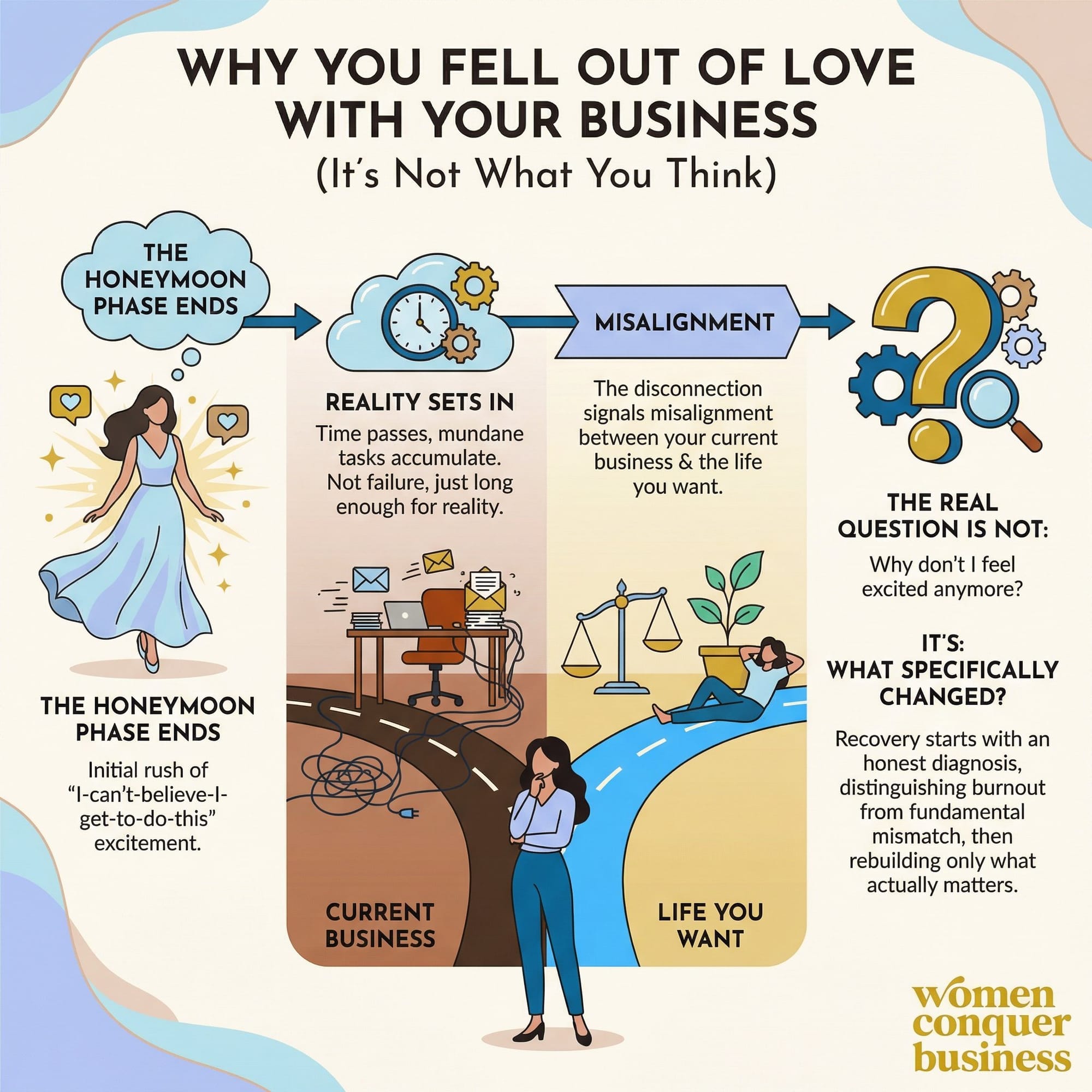
Why You Fell Out of Love With Your Business (It's Not What You Think)
Falling back in love with your business requires an honest diagnosis before action.
That disconnection you're feeling? It usually signals misalignment between your current business and the life you want. Recovery starts with distinguishing burnout from fundamental mismatch, then rebuilding only what actually matters to you.
Most advice on this topic jumps straight to "reconnect with your why" or "remember your passion." That's not bad advice, exactly. It's just incomplete.
Here's the thing: the honeymoon phase ends for every business owner. That initial rush of excitement, the I-can't-believe-I-get-to-do-this energy? It wasn't designed to last forever. Its absence doesn't mean you've failed or chosen wrong.
It means you've been at this long enough for reality to set in.
So the real question isn't why don't I feel excited anymore? It's what specifically changed?
Your Business Probably Drifted Without You Noticing
Here's what I see constantly: solopreneurs didn't consciously decide to build a business they'd resent. It happened gradually.
You said yes to a client who wasn't quite right because you needed the money. Then said yes again. Now half your client roster drains you. You added a service because someone asked for it, not because you wanted to offer it. That bookkeeping you started doing "temporarily"? That was three years ago.
Somewhere along the way, the business you're running stopped being the business you started.
You're Doing Tasks You Never Signed Up For
When you imagined running your own business, I'm guessing it didn't include troubleshooting website plugins at 10 PM. Or spending three hours writing a single Instagram caption. Or becoming an amateur accountant, tech support specialist, and social media manager all at once.
Yet here we are.
Solopreneurs wear every hat by default. And over time, the hats you hate start taking up more space than the work you actually love. That's not a passion problem. That's a structure problem.
Burnout Masquerades as "Falling Out of Love"
Sometimes what feels like disconnection is really just exhaustion in disguise.
Burnout doesn't always look like dramatic collapse. Sometimes it looks like apathy. Going through the motions. Scrolling job listings "just to see what's out there" with no real intention of applying.
This distinction matters because burnout and genuine misalignment need completely different solutions. Try to "reconnect with your passion" when you're burned out? You'll just burn out faster. Rest first. Strategy second.
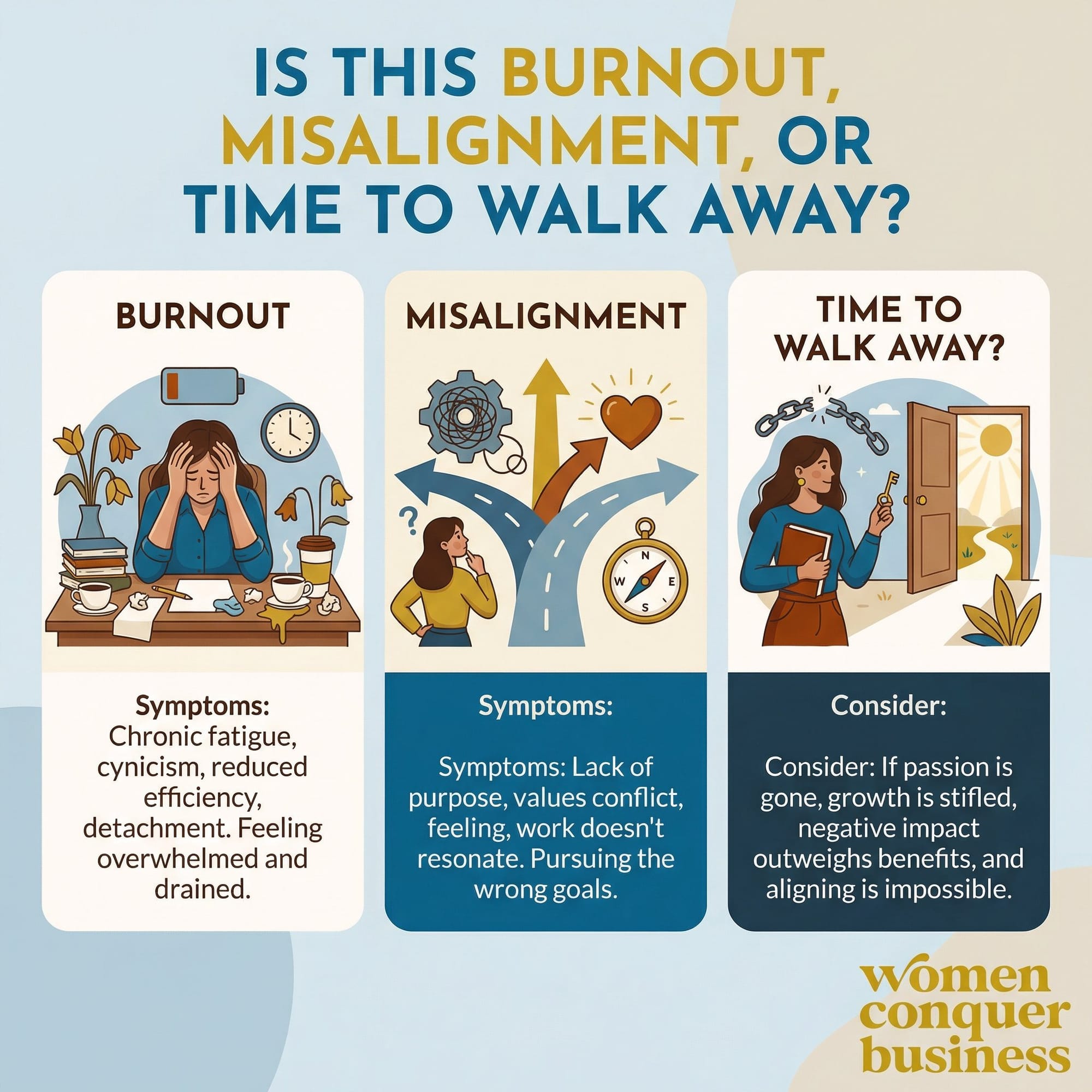
Is This Burnout, Misalignment, or Time to Walk Away?
Before you can fall back in love with your business, you need to figure out what you're actually dealing with. Not all disconnection is the same.
Here's a framework that helps.
Signs You're Dealing with Burnout
Burnout is physical and emotional exhaustion from prolonged stress. Do you feel completely depleted?
You might be burned out if:
- Rest doesn't help. You take a weekend off and feel exactly the same come Monday.
- Everything feels hard, not just work. Decisions that used to be automatic now feel impossible.
- Cynicism has crept into things you used to genuinely care about.
- Physical symptoms keep showing up: headaches, insomnia, getting sick more often than usual.
- You fantasize about escape but can't articulate what you'd escape to.
The fix for burnout isn't strategy.
It's rest, boundaries, and often professional support. Trying to reignite passion while running on empty? That's like trying to enjoy a gourmet meal when you have the flu.
Signs You're Dealing with Misalignment
Misalignment means your business structure no longer fits your life, values, or goals. The business itself might be perfectly fine... it's just not right for you anymore.
You might be misaligned if:
- Specific parts of your business drain you, but not the whole thing.
- Certain clients, services, or tasks fill you with dread while others still feel good.
- Your life circumstances shifted (kids, health, priorities) but your business structure hasn't caught up.
- You've outgrown your original vision without defining what comes next.
- The business model that worked beautifully at $50K/year is actively suffocating you at $150K/year.
Good news: misalignment is fixable without torching everything. You restructure, not rebuild.
Signs It Might Be Time to Walk Away
Sometimes the answer isn't "fall back in love." Sometimes it's "let go with grace."
This might apply if:
- Your core values have fundamentally shifted, and the business genuinely can't shift with them.
- The industry changed in ways you can't (or don't want to) adapt to.
- You've tried restructuring multiple times and still feel nothing.
- The honest answer to "would I start this business today?" is an unequivocal no.
- Staying feels like obligation rather than choice.
Walking away isn't failure. Sometimes it's the most strategic move you can make. (More on this later.)
The Sunday Night Test
Here's a quick diagnostic I use with clients:
When you think about Monday morning, what specifically triggers the dread?
- Is it everything? → Likely burnout
- Is it specific tasks, clients, or responsibilities? → Likely misalignment
- Is it the fundamental nature of what you do? → Likely mismatch
Your gut reaction points you toward the right solution.
Reality Check
| If you're experiencing... | Your next step is... |
|---|---|
| Burnout | Rest and boundaries first. Return to this article when you've had real recovery time. |
| Misalignment | Keep reading. The restructuring strategies ahead are for you. |
| Fundamental mismatch | Skip to "What If the Answer Is to Walk Away?" No shame in it. |
| Not sure yet | That's okay. Keep reading and let clarity emerge. |
Burnout Recovery Comes Before Business Strategy
Here's something that might frustrate you: if burnout is your issue, you need to stop reading strategy articles and start resting.
I know, I know. You came here for solutions. Action steps. Something to do. You want to fix this thing.
But here's the uncomfortable truth: you cannot strategy your way out of exhaustion.
I've watched too many solopreneurs try.
They read the books, take the courses, create elaborate plans for restructuring. And then nothing changes. Why? Because they're trying to renovate a house while it's actively on fire.
Why Rest Has to Come First
When you're burned out, your brain literally works differently. Decision-making suffers. Creativity tanks. Everything feels harder than it should because your cognitive resources are running on fumes.
Trying to fall back in love with your business from this state? It's like trying to enjoy a gourmet meal when you haven't slept in three days. The meal might be excellent. You just can't taste it.
The strategies coming up require energy you don't have right now. They need clear thinking, decision-making capacity, and the bandwidth to implement changes. Burnout steals all of that.
The Minimum Viable Rest
I'm not going to tell you to take a month off. For most solopreneurs, that's fantasy.
But I am going to ask: what could you drop for two weeks?
Not delegate. Not postpone. Drop entirely.
Maybe it's social media. Maybe it's that client project you've been dreading. Maybe it's the networking events you attend purely out of obligation. Maybe it's the "should" tasks that fill your calendar without moving your business forward.
Two weeks of reduced load won't cure burnout. But it can create enough breathing room to start thinking clearly again.
Delegate What You Can (Even for Solopreneurs)
"But I can't afford to hire anyone."
I hear this constantly. And sometimes it's genuinely true. But more often? It's a story we tell ourselves because delegation feels uncomfortable (or hard).
So let's do the math: What is your time worth? If you bill $150/hour but spend 10 hours a month on bookkeeping, you're effectively paying $1,500/month to do your own books. A bookkeeper costs maybe $300.
That's not saving money.
Start with one thing. The task you hate most, the one that drains your energy way out of proportion to its importance. Outsource that single thing, even if it feels extravagant.
Common first-delegation wins for solopreneurs:
- Bookkeeping and invoicing
- Social media scheduling (not strategy—just the posting part)
- Email inbox management
- Calendar and scheduling coordination
- Basic website updates
The goal is removing yourself from the tasks that deplete you without giving anything back.
Your Business Will Survive a Pause
This is the fear underneath everything, isn't it? If I slow down, the whole thing falls apart.
Maybe. But probably not.
Most solopreneur businesses have way more resilience than their owners give them credit for. Clients can wait a few extra days. The social media algorithm will survive your absence. That project deadline? Might have more flexibility than you've assumed.
What won't survive indefinitely is you running on empty.
I've watched business owners push through burnout for months, sometimes years. The business technically continues. But the owner becomes a hollow version of themselves—making worse decisions, attracting worse clients, building something they resent more with each passing day.
That's not sustainability. That's slow collapse with extra steps.
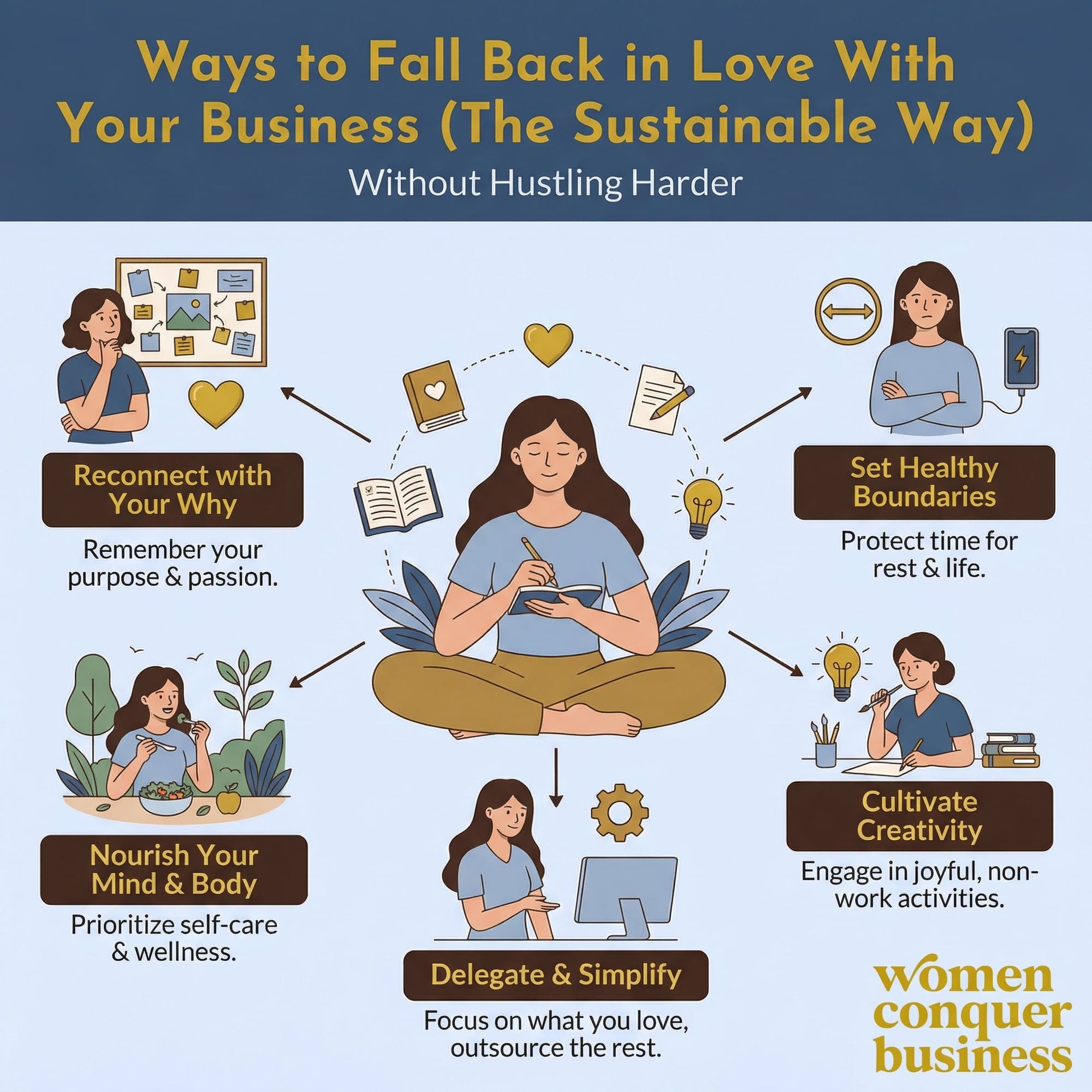
Ways to Fall Back in Love With Your Business (The Sustainable Way)
Okay. You've rested (or at least started to). You've determined that burnout isn't the whole picture—you're dealing with misalignment. And you're ready to restructure.
This is where most advice goes sideways: it tells you to "reconnect with your why" as if remembering your original motivation will magically fix structural problems.
Your why matters. But here's the thing: your why from five years ago might not be your why today. And even if it is, knowing your why doesn't automatically create a business that supports it.
What actually works is way more concrete.
Identify the 20% That Gives You Energy
Not everything in your business drains you equally. There's almost certainly a slice of your work that still feels good—that reminds you why you started, that you'd honestly do even if nobody paid you.
For most solopreneurs, this is roughly 20% of their actual work time. The rest ranges from neutral to actively soul-crushing.
Your job? Protect that 20% ruthlessly. Then expand it strategically.
This isn't about following your bliss or only doing what feels good. It's about recognizing that the energizing work is usually your highest-value work, too. That's where you're most creative, most effective, most differentiated from everyone else doing what you do.
When 80% of your time goes to draining tasks, you're not just miserable. You're actively underperforming.
Energy Audit Exercise
This might be the most useful 30 minutes you spend this month.
Step 1: List everything you do in a typical work week. Everything. Client calls, emails, content creation, bookkeeping, networking, admin—all of it.
Step 2: Mark each item:
- E = Energizes me (I genuinely feel better after doing this)
- N = Neutral (neither drains nor energizes)
- D = Drains me (I feel noticeably worse after doing this)
Step 3: Calculate your ratio. What percentage of your time actually goes to each category?
Step 4: For every "D" item, ask: Can this be eliminated entirely? Delegated? Restructured somehow?
You won't hit 100% energizing tasks—that's not the goal. But if you can shift from 20% energizing to 50% energizing within 90 days? Everything changes. Your capacity increases. Creativity returns. The business starts feeling like yours again.
Fire Your Tasks, Not Yourself
Here's a mindset shift that really helps: you don't have a passion problem. You have a task problem.
That solopreneur who "fell out of love" with her coaching business? She didn't actually fall out of love with coaching. She fell out of love with the constant content creation, the DM conversations going nowhere, the tech troubleshooting, the endless proposal writing.
The coaching itself? Still great.
When you separate the work you love from the tasks that have barnacled onto it, the path forward gets way clearer. You don't need to quit and start something new. You need to strip away what doesn't belong.
Ask yourself: If I could only keep three things I currently do, which three would they be?
That's your foundation. Build from there.
Reconnect With People Who Reignite Your Passion for the Work
"Reconnect with your why" is vague advice. Here's the specific version: have a real conversation with a client whose life you've genuinely improved.
Not a testimonial request. Not a case study interview. An actual conversation with someone who benefited from your work.
Ask them what changed. Listen to how they describe the before and after. Let yourself feel the impact you've had.
When you're disconnected from your business, you're often disconnected from the people it serves. Reconnecting with them reconnects you with purpose in a way that journaling about your "why" never will.
Small Experiments Over Dramatic Pivots
When you're misaligned, the temptation is to blow everything up. New niche. New offer. New brand. New everything.
Resist this urge.
Dramatic pivots feel decisive. They also destroy the equity you've built, confuse your existing audience, and often just trade one set of problems for another.
What works better? Small experiments.
Thinking about shifting to a different type of client? Take on one or two as a test before overhauling your entire marketing strategy.
Considering a new service offering? Pilot it with existing clients before building out a whole sales funnel.
Wondering if you'd be happier with a different business model? Run a three-month trial alongside your current work.
Experiments give you data. Data gives you confidence. Confidence lets you make changes that actually stick.
Give it Time. A Lot of Time.
Falling back in love with your business takes longer than a weekend retreat or a single coaching session.
Expect three to six months of intentional restructuring. Some changes work immediately. Others take time. You'll make adjustments along the way.
This isn't a failure of the process. It's the process working correctly.
Sustainable change is slow—which, counterintuitively, is good news. It means you don't have to figure everything out right now. Take the next small step. Evaluate. Adjust.
Your business didn't become misaligned overnight. It won't realign overnight either. But it will realign if you stay with it.
Your Marketing and Your Misery
The way you're marketing often creates the disconnection you're feeling.
Stay with me because this matters.
When your marketing feels like a performance, you attract people who want the performance. Post content that doesn't sound like you, and you build an audience that doesn't actually want you. Build your marketing strategy on tactics you hate, and every client you attract through those tactics becomes a reminder of that hatred.
I've worked with coaches who swore they'd fallen out of love with coaching. But when we dug deeper? They hadn't fallen out of love with coaching at all. They'd fallen out of love with the version of themselves they'd created to market their coaching.
The Instagram persona. The "value-packed" emails. The launches that felt manipulative. The constant visibility that left zero room for actual life.
Their business became a cage built from their own marketing choices.
Strategic Alignment Problem
I use a framework with clients called the Strategic Alignment Mountain. The concept is simple: every action in your business should connect back to your actual vision for your life.
At the summit? Your values, your desired lifestyle, your personal definition of enough.
Below that are your business goals, which should support that summit.
Below that are your projects and strategies.
At the base? Your daily tasks.
Here's the problem: most solopreneurs build this mountain upside down. They start with tactics (what's everyone else doing on social media?), choose strategies to support those tactics, set goals around the strategies, and then just... hope it all somehow leads to a life they want.
Then they wonder why they feel disconnected from their business.
When your marketing doesn't align with who you actually are, you end up building a business that requires you to be someone you're not. Every single day. Forever.
That's not a passion problem. That's an architecture problem.
Why "Hustle Harder" Advice Makes Everything Worse
Most business advice assumes you have unlimited energy and that success requires maximizing output. Post more. Launch more. Network more. Be everywhere, all the time.
This advice was mostly written by people with teams, funding, or a specific personality type that genuinely thrives on constant visibility.
For everyone else (especially women solopreneurs trying to run businesses while managing their life) this advice is actively harmful.
When you're already depleted, "do more" is the exact opposite of what you need. Force yourself to do more anyway, and you accelerate the disconnection. You build a bigger business you resent even more.
I call this the hustle trap: working harder to grow something you're not even sure you want anymore.
The alternative isn't laziness. It's strategic clarity about what actually matters, followed by sustainable action that respects your real capacity.
Capacity Is the Conversation Nobody's Having
Here's a question I ask clients that usually stops them cold:
Do you have the cognitive and emotional capacity to sustain this marketing approach for 12 more months?
Not "can you push through for a launch." Not "can you white-knuckle it for a few weeks."
Twelve months. Consistently. With the life you actually have.
If the answer is no, your strategy is already broken. Doesn't matter how effective it is on paper. Effectiveness means nothing if you can't maintain it.
Most solopreneurs are running marketing strategies designed for someone with more time, more energy, more support, or a completely different nervous system. Then they blame themselves when it all falls apart.
The business you've fallen out of love with might not need better strategy. It might need strategy that actually fits your life.
This is why I focus on marketing operations that respect capacity. Systems that run without requiring heroic effort. Approaches that compound over time instead of demanding constant reinvention.
Less exciting than a big launch? Absolutely. Also sustainable in ways that big launches simply aren't.
What If the Answer Is to Walk Away?
Let's name this.
Sometimes the answer isn't "fall back in love." Sometimes it's "let go with grace."
I get it. This isn't what you came here to read. And honestly, I hope it doesn't apply to you.
But I've watched too many solopreneurs stay in businesses they'd clearly outgrown. Not because they wanted to stay, but because walking away felt like admitting failure. Like all those years would be wasted. Like they'd be proving they couldn't hack it.
None of that is true.
Staying Isn't Noble If It's Destroying You
There's a version of perseverance that's genuinely admirable: pushing through temporary difficulty toward something you actually want.
And then there's another version—one that's basically self-harm with better branding: forcing yourself to continue something that no longer fits because you're terrified of what it means to stop.
That second version doesn't make you committed. It makes you stuck.
Exiting Doesn't Mean Failure
Walking away from a business isn't the same as failing at business.
Sometimes businesses have natural life spans.
Sometimes you outgrow what you built.
Sometimes the market shifts, your life changes, or you simply become a different person than the one who started this thing all those years ago.
Recognizing that? Making a conscious choice to move on? That's wisdom.
The skills you developed don't disappear. The relationships you built don't vanish. Every lesson you learned comes with you.
You're not starting from zero. You're starting from experience.
Options Beyond "Quit Everything"
Walking away doesn't have to mean dramatic closure, either.
You could:
- Sell the business (yes, even small service businesses have real value)
- Downsize intentionally (fewer clients, less revenue, way more life)
- Pivot gradually (evolve into something new without torching what exists)
- Pause indefinitely (some businesses can hibernate while you figure things out)
- Transfer to someone else (a team member, a colleague, even a competitor who'd benefit)
The all-or-nothing framing keeps people trapped. You have way more options than "keep suffering" or "blow it all up."
How Would It Feel to Walk Away?
If you're genuinely unsure whether to stay or go, try this:
Imagine someone offered to buy your business tomorrow for fair market value. You'd never have to think about it again. How does that feel?
Relief? You probably need to exit.
Panic? Something here still matters to you.
A mix of both? You likely need to restructure, not abandon.
Your gut reaction will tell you more than any pro/con list ever could.
Your Next Step Depends on Self Discovery
You've read through the diagnostic. You've sat with the questions. Now what?
- If burnout is your primary issue: Close this article. Rest. Not "rest while also implementing three new strategies." Actual rest. Come back when you've had real recovery time, even if it's just two weeks of reduced load.
- If misalignment is the problem: Start with the Energy Audit. Thirty minutes, maximum. Get clear on what drains you versus what energizes you. That's your foundation for everything else.
- If you're dealing with marketing-created misalignment: This is fixable, but it requires rebuilding your marketing around who you actually are, not who you think you should be online. Marketing coaching can help if you want support.
- If you suspect fundamental mismatch: Give yourself permission to explore options. Talk to someone outside your business—a friend, a therapist, a coach—about what you're actually feeling. Clarity often comes from speaking things aloud.
- If you're still not sure: That's okay. Uncertainty is information too. It usually means you need more data before deciding. Try one small experiment and see how it feels.
Falling out of love with your business isn't a character flaw or a sign you chose wrong. It's information. Information about what's working, what isn't, and what needs to change for this to feel like yours again.
The path forward depends on honest diagnosis, not motivational mantras. Burnout requires rest before strategy. Misalignment requires restructuring, not starting over. And sometimes, the bravest choice is letting go of something you've outgrown.
What separates small business owners who rediscover their spark from those who stay stuck isn't willpower or passion. It's willingness to look honestly at what's actually happening and make changes that fit their real life—not some imaginary version with unlimited time and energy.
You don't need to love every part of your business. You need enough of it to feel like yours.
Start with the energy audit. 30 minutes. One honest look at your time
That's enough for today.
FAQs: Relationship with Your Business
Is it normal to fall out of love with your business?
Completely. Research suggests about a third of entrepreneurs fall out of love with their business at some point, and nearly a quarter say it happens multiple times per year. This isn't a personal failing—it's a structural reality of long-term business ownership. The honeymoon phase ends for everyone.
How do I know if I'm burned out or just having a bad month?
Burnout persists after rest and bleeds into multiple areas of your life. A bad month actually improves after a vacation or a few decent nights of sleep. If two weeks of genuinely reduced workload doesn't shift how you feel, you're probably dealing with burnout rather than a temporary slump.
Can I fix my business without starting completely over?
Almost always, yes. Most "fallen out of love" situations call for restructuring, not rebuilding from scratch. The key is identifying which specific parts drain you—those become your targets for elimination, delegation, or change. The core of what you do often isn't the problem at all.
What if I can't afford to take a break or hire help?
Start smaller than you think. Even pausing one draining activity for two weeks, or outsourcing a single task for a few hours monthly, can interrupt the burnout cycle. And here's the thing: the cost of not pausing—in poor decisions, lost clients, and declining health—is usually way higher than minimal support.
How long does it take to fall back in love with your business?
Expect three to six months of intentional restructuring for real change. This isn't a weekend project or a single coaching session. Sustainable transformation happens through small, consistent adjustments over time—which is actually good news. It means you don't have to figure everything out right now.
What's the difference between needing a break and needing to quit?
If rest and restructuring restore your energy for the work, you needed a break. If you've genuinely rested, made real structural changes, and still feel nothing—or if your core values have shifted away from what the business requires—it might be time to consider an exit. The "business sale" question earlier in this article can help you figure out which applies.
How do I know if my marketing is the real problem?
Ask yourself: Do you dread your own marketing activities? Do the clients you attract consistently feel like a mismatch? Do you feel like you're performing a version of yourself online that isn't really you? If you answered yes to any of these, your marketing strategy may be creating the disconnection—not your business itself.