


Marketing coach red flags indicate predatory, ineffective, or ethically questionable business coaching. These warning signs include guaranteed revenue claims, high-pressure sales tactics, and pricing opacity. Recognizing these signals allows entrepreneurs to avoid wasted investments and find strategic, experience-backed marketing coaching that respects their business capacity and sustainability goals.
At a Glance
- What it is: A strategic vetting guide to identify deceptive or poor-fit coaching services.
- Who it's for: Experienced women solopreneurs and service-based business owners.
- Time to implement: 1–2 hours for thorough coach evaluation and discovery calls.
- Typical cost: Free (Educational guide); marketing coaching services typically range from $500–$2,000/month.
- Skill level: Intermediate (Requires honest self-assessment of business needs).
- Primary outcome: Protected marketing budget and increased confidence in hiring the right strategist.
I've heard this so many times.
My colleague sat across from me, frustrated and $8,000 poorer after six months with a marketing coach who promised "transformational coaching." The coach had a online following, slick videos, and a price tag that made her wince. What the coach didn't have? Relevant experience working with businesses like hers.
After 25 years in marketing, I've seen this pattern repeat dozens of times. Business owners investing thousands in coaching relationships that go sideways. Not because coaching doesn't work, but because they hired the wrong coach for the wrong reasons at the wrong time.
Here's what makes choosing a marketing coach so tricky: unlike licensed professions, anyone can call themselves a marketing coach.
No credentials required.
No oversight.
No consumer protection.
This creates an environment where genuinely skilled coaches work alongside people whose only "expertise" is marketing that worked for them rather than true marketing expertise.
This guide walks you through seven specific red flags I've identified from working with clients who've been burned, talking to hundreds of business owners, and watching the industry evolve. You'll learn important warning signs (more than "trust your gut"), why they're problematic, and specific questions to ask before you invest.
By the end, you'll have a clear framework for evaluating potential coaches... and the confidence to walk away when something doesn't feel right.
Because sometimes? The best coaching decision is deciding not to hire one.
What Is a Marketing Coach?
A marketing coach is a professional who guides business owners through developing and implementing marketing strategies, providing accountability, strategic clarity, and skill-building rather than execution. Unlike consultants who provide solutions or agencies that execute campaigns, coaches build your capability to make effective marketing decisions independently for sustainable growth.
Marketing coaches typically work in three core areas.
- Strategy development: helping you identify your ideal customer, clarify your positioning, and create a marketing plan that actually fits your business model and capacity.
- Skill building: teaching you how to write better content, understand analytics, or navigate specific platforms.
- Accountability and momentum: keeping you consistent when motivation fades and helping you course-correct when strategies aren't working.
Marketing coaching works best when you have a business foundation in place but need guidance making strategic decisions or overcoming specific obstacles. If you're still figuring out your core offer or don't have revenue yet, you probably need foundational business consulting first. If you need someone to execute your marketing for you because you don't have time, you need marketing operations services or a marketing agency, not a coach.
Let's dive into the 7 biggest red flags to avoid as you choose the right marketing coach to help you grow your business.
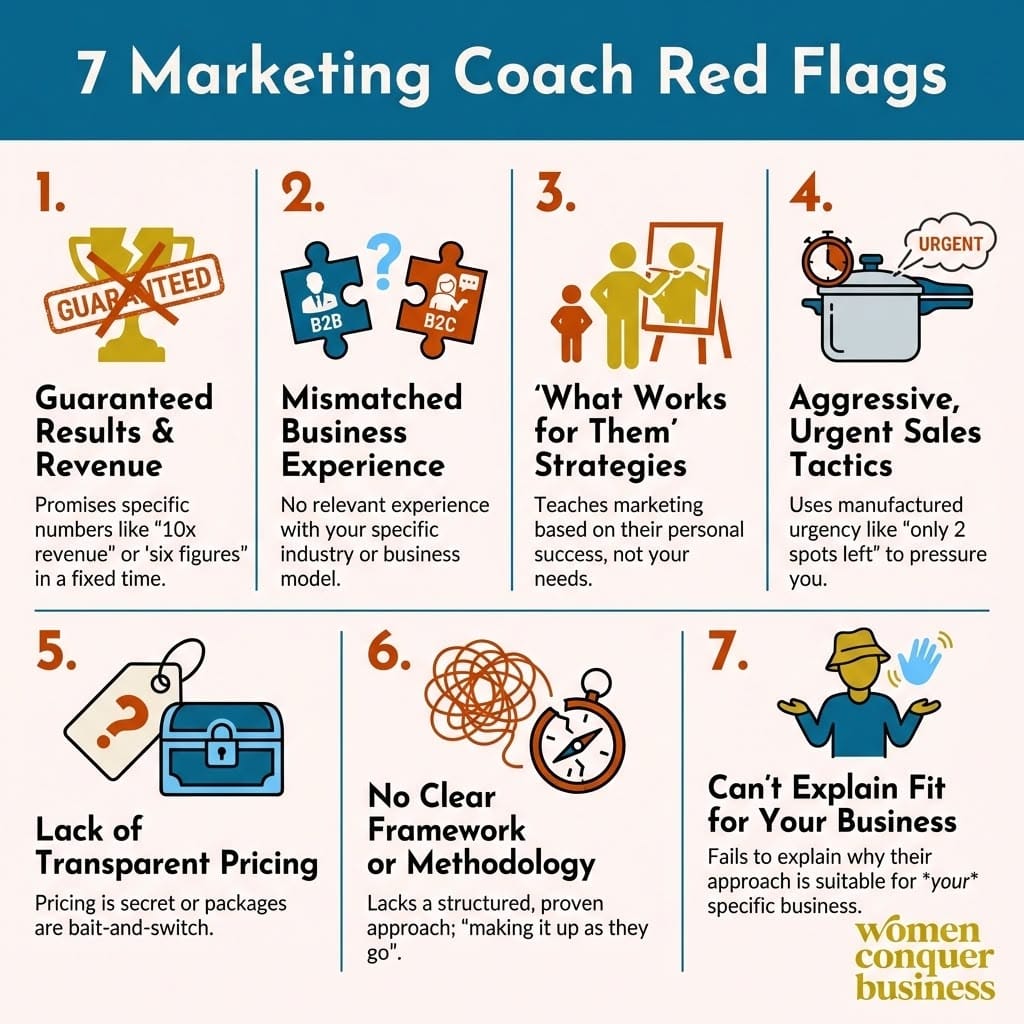
Red Flag #1: Promises, Guaranteed Results or Specific Revenue Numbers
"Work with me and make six figures in six months."
"I guarantee you'll 10x your revenue."
"My clients always see results in the first 30 days."
If a marketing coach makes promises like these, walk away.
The Federal Trade Commission requires substantiation for earnings claims, and individual outcomes depend on factors outside the coach's control: your execution, market conditions, timing, and capacity. A coach promising specific revenue numbers is ignorant of regulations or doesn't care.
Legitimate coaches talk differently: "Most clients who implement consistently see improvement in 3-6 months," or "We focus on relationship marketing that builds." They acknowledge complexity, set realistic timelines, and emphasize your role.
Pay attention to money discussions. Do they focus exclusively on revenue growth? Revenue means nothing without profit margins, sustainability, or quality of life. I've worked with business owners who tripled revenue while burning out completely.
Good coaches ask about your lifestyle goals, capacity constraints, and what success means to you beyond a number.
Red Flag #2: No Relevant Experience with Your Business Type
You may be drawn to hire a coach who's built a massive following selling digital courses to aspiring entrepreneurs. Impressive credentials, six-figure launches, great testimonials. One problem: you run a boutique consulting practice serving corporate clients through referrals and relationship building.
The coach's entire framework: webinar funnels, email marketing sequences, social media growth tactics... is not designed for your business mode.
Business models matter.
Service businesses relying on relationships, trust, and longer sales cycles need different marketing than product-based businesses optimizing for conversion rates. A coach who built their reputation in e-commerce or information products may have valuable insights, but those insights might not translate to your consulting practice, creative services, or local business.
If you select a one-size-fits-all product (similar to the digital course framework example above), make sure it fits you. For custom coaching engagements, you'll find the right coach when they can speak to relevant experience related to your specific business' unique issues or patterns.
Red Flag #3: Marketing Strategies Based on 'What Works for Them'
A significant portion of marketing coaches make most of their money teaching other people to become marketing coaches. Ugh. Not from marketing their own products or services. Not from helping service-based businesses grow.
From coaching coaches who coach coaches.
It's a credibility loop that looks legitimate on the surface. Someone takes a course, becomes a certified coach, then coaches others through the same certification program.
Their testimonials come from other coaches.
Their case studies feature coaches.
Their entire business model depends on recruiting more coaches into the ecosystem. Not quite multi-level marketing... but close, so close.
Some coaches legitimately specialize in the coaching business model. They understand the unique challenges of building a coaching practice. Things like pricing packages, structuring programs, managing client transformations. If you're building a coaching business, working with someone who specializes in that business model makes sense.
That's not what I'm talking about.
I'm talking about coaches whose only success is teaching their system to other coaches, who then teach that system to more coaches. Look at their client testimonials. If most results are "I became a six-figure coach" rather than "I grew my therapy practice" or "I doubled my consulting revenue," you're looking at circular credibility.
Why should you care? Because that coach is a one-trick pony selling you what online marketing worked for them. You deserve someone who provides a significant depth of marketing knowledge.
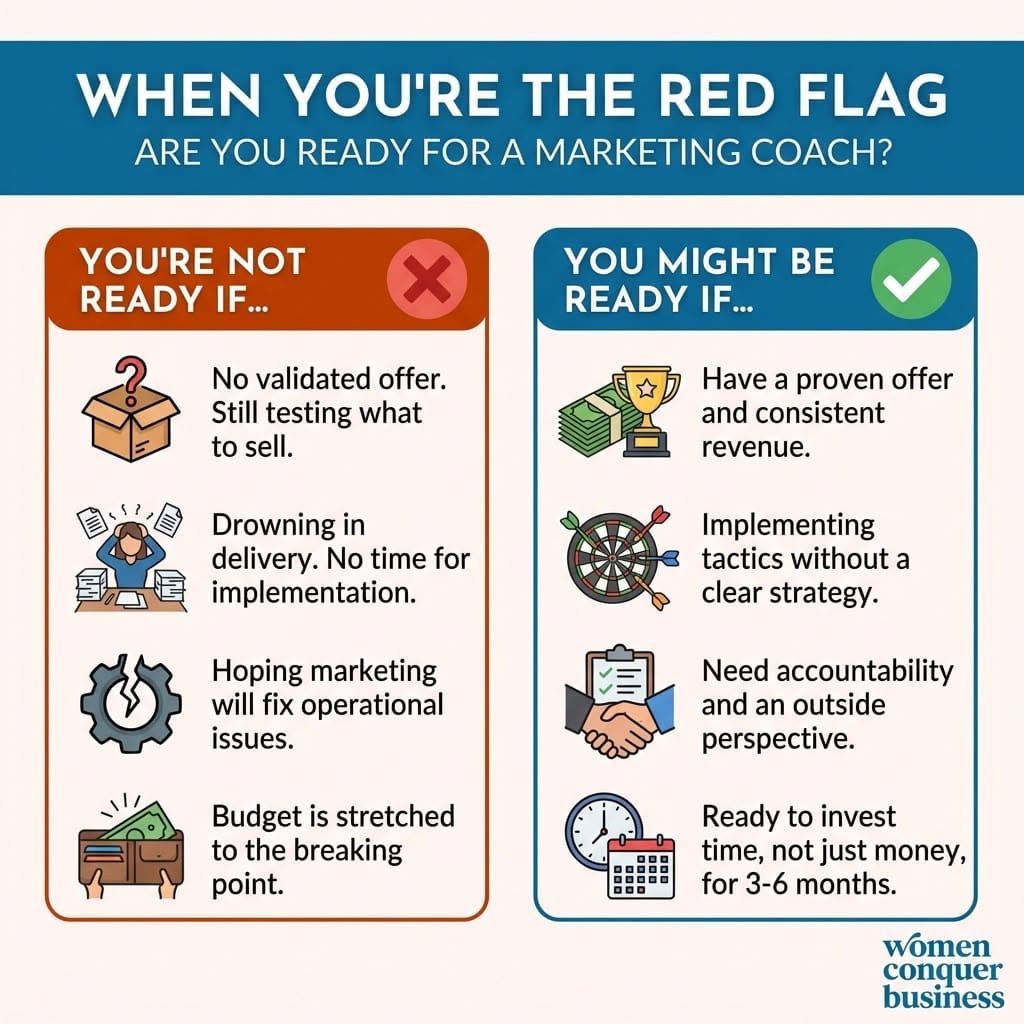
Are You Ready for a Marketing Coach? ... When You're the Red Flag
There are only so many things a marketing coach can help with. Before we go further into red flags, let's talk about whether or not choosing a digital marketing coach is a good idea for you right now.
I've watched too many business owners invest in marketing coaching when what they needed was time, systems, or a different type of support entirely.
A good coach won't take your money if you're not ready. A predatory one will convince you that coaching is exactly what you need, regardless of your situation.
You're NOT READY to find a marketing coach if...
- You don't have a validated offer yet. Coaching helps you market something that works, not figure out what to sell. If you're still experimenting with pricing or positioning, you need business development support first.
- You're drowning in delivery with no capacity for implementation. A coach gives you strategies and accountability. You still do the work. If you're at capacity with client delivery, you might need marketing operations support to handle execution, or you need to reduce client load before adding strategic initiatives.
- You're hoping coaching will fix underlying business problems. Marketing can't solve operational chaos, misaligned pricing, or burnout. If your business model isn't sustainable, marketing will just accelerate an unsustainable situation.
- Your budget is stretched to stress. According to the ICF Global Coaching Study, professional coaching packages typically range from $500-$2,000 per month for ongoing engagements, with intensive programs ranging from $3,000-$15,000+ for three to six-month commitments. If this investment would create financial anxiety or prevent covering essential expenses, the stress will undermine benefits. Marketing coaching is an investment in growth, not a desperate revenue attempt.
You MIGHT BE ready to start working with a marketing coach if...
- You have a proven offer and consistent revenue, but your marketing feels scattered. You know your stuff works, but you're inconsistent with visibility or trying to be everywhere at once. Marketing or business coaching can help you create strategic focus.
- You're implementing tactics without a clear strategy. You're posting, emailing, maybe running ads, but you're not sure why or if it's working. A coach helps you build the framework that makes tactics effective.
- You need accountability and an outside perspective. You understand marketing conceptually but struggle with follow-through. Or you're so close to your business you can't see clearly. Coaching provides structure and external viewpoint.
- You're ready to invest time, not just money. If you can commit to weekly sessions, homework, and implementing consistently for 3-6 months, coaching can create significant momentum.
Sometimes the answer is "not yet" or "something else first." The Women Conquer Business community exists partly because many business owners need group coaching with peer support and ongoing guidance before they're ready for intensive one-on-one coaching.
Red Flag #4: Aggressive Sales Tactics or Manufactured Urgency
"I only have two spots left this month." (you get it every month)
"This pricing ends tonight."
"If you don't invest now, you'll stay stuck for another year."
Pressure-based selling tactics in coaching relationships should immediately raise red flags. A coach using manufactured urgency to close a sale is showing you exactly how they approach marketing. It's not a method you want to learn or fund.
The coaching industry borrowed heavily from digital marketing's conversion playbook: scarcity, urgency, fear of missing out, pain point agitation. These tactics work for selling one-time products. They're psychologically manipulative for selling ongoing relationships built on trust.
Think about it.
A therapist who said "I only have two client spots, and if you don't book now, you'll miss your chance at healing" would rightfully be seen as unethical. But marketing coaches use nearly identical language, and it's somehow accepted because "that's marketing."
It's not. It's manipulation dressed up as a business strategy.
Here's what legitimate scarcity looks like versus manufactured urgency. Real scarcity: "I work with five ongoing clients at a time, and my next opening is in March." That's a capacity constraint. Manufactured urgency: "I'm closing enrollment at midnight tonight" when the same offer returns next month with a different deadline.
The deeper problem? If a coach uses pressure tactics to close you as a client, they'll likely keep pressuring you to buy more.... and then teach you scarcity-driven, high-pressure marketing.
You deserve a coach whose sales process models the marketing you want to do. If you value relationship building, transparency, and ethical persuasion, look for a coach who sells their services the same way.
Watch for these pressure tactics:
- Application-only programs with "we'll decide if you're a fit" framing that reverses power dynamics.
- Pain agitation without empathy ("You're leaving money on the table every day you delay").
- Bait-and-switch pricing where the advertised rate is for a stripped-down version.
- The "investment mindset" pressure that reframes legitimate budget concerns as limiting beliefs.
PS, there's nothing wrong with scarcity or urgency when it's real. Never-ending sales and shaming urgency do not build trust. Customer trust is your greatest currency. Never forget it.
Red Flag #5: Lack of Transparent Pricing (or Bait-and-Switch Package Structures)
You deserve to know what something costs before you spend an hour on a discovery call.
I list my prices. When businesses ask me if they should list their prices, my answer depends on the industry.
If a coach won't list their pricing, or lists a starting rate that bears no resemblance to what they actually charge, that's a trust issue from day one.
The coaching industry has normalized pricing opacity in ways that would be unacceptable in almost any other professional service. Imagine a lawyer who refused to discuss rates until after you'd shared all your legal troubles, or a contractor who wouldn't estimate costs until you'd committed emotionally to the project.
You'd walk away.
But coaches routinely hide pricing behind "book a call" buttons and application forms.
Some coaches claim they need to "understand your situation" before pricing. That's partially true: custom work should have custom pricing. But there's a massive difference between "I need to understand your needs to give you an accurate quote" and "I won't tell you my general rate ranges until you're invested in a sales conversation."
Here's the transparency standard I recommend: A coach should share general package ranges publicly and specific pricing within the first conversation. If their website says "$297/month" but the actual program you need costs $6,000 upfront, that's deceptive marketing.
Watch for these pricing red flags:
- Hidden upsells built into the sales process (you book for the advertised program but get told that version "doesn't include implementation support").
- Payment plans that obscure total cost ("$497/month for 12 months" sounds more manageable than "$5,964 total").
- Vague "investment" language ("Investment starts in the mid-four-figures" could mean anything from $4,000 to $7,000).
- Pricing based on "your revenue" or "your goals" rather than deliverables and value provided.
I've seen this pattern too many times: A business owner books a discovery call excited about a $3,000 package. By the end of the call, they're being pitched a $10,000 program because "the $3K version won't get you where you need to go."
Maybe that's true.
But leading with dramatically lower pricing to get people on calls is manipulative.
Red Flag #6: No Clear Framework
After 25 years in marketing, I've learned this: coaches who say "every client is different, so I create fully custom strategies" are often telling you they don't have a systematic approach to solving problems.
Custom application of a proven methodology? Excellent. Making it up as you go? Problem.
Why should you care? Because a coach that's worked with enough clients can easily identify common obstacles, effective solutions, and predictable stages of progress. They've systematized what works.
A coach without a framework is too new to have developed one or hasn't done the intellectual work to organize their knowledge.
Think about other professionals. A physical therapist has assessment protocols, treatment progressions, and recovery timelines based on thousands of similar injuries. They customize within that framework based on your specific body and goals. But the framework exists because it works.
A therapist who said, "I just wing it" wouldn't inspire confidence.
Marketing coaches should have the same systematic approach. Not a rigid template everyone follows identically, but a proven methodology they adapt to individual situations. This might be a specific strategic framework, a particular approach to audience research, or a systematic method for developing marketing consistency.
The Women Conquer Business philosophy: Every marketing action relates directly to a business goal. Marketing must be ethical. Marketing strategy before software.
A coach who leads with tools ("I'll teach you how to use this specific platform") rather than strategic thinking ("I'll help you determine which marketing approaches fit your business model and capacity") is putting tactics before strategy. The best coaches teach you how to think about marketing decisions, not just which buttons to click.
The best coaches can articulate their framework clearly before you hire them. They can explain how they help clients move from Point A to Point B, what typically happens at each stage, and how they customize within that structure.
Red Flag #7: They Can't Explain Why Their Approach Fits Your Specific Business
The final red flag is subtle but significant: you ask why their coaching approach makes sense for your business specifically, and they pivot to generic benefits instead of addressing your question.
"My system works for any business" is not an answer.
Neither is "I've helped hundreds of clients succeed."
Those statements might be true, but they dodge the real question: why does this method fit this business model at this stage?
A skilled coach can articulate the connection between their approach and your situation. They understand that a relationship-driven consulting practice requires different marketing than a product-based e-commerce business. They can explain why their timeline, framework, and focus areas align with your business and growth goals.
A coach who can't explain why their approach fits your specific situation is probably using a one-size-fits-all template. That's fine for a PDF freebie, but not what you look for in a marketing coach.
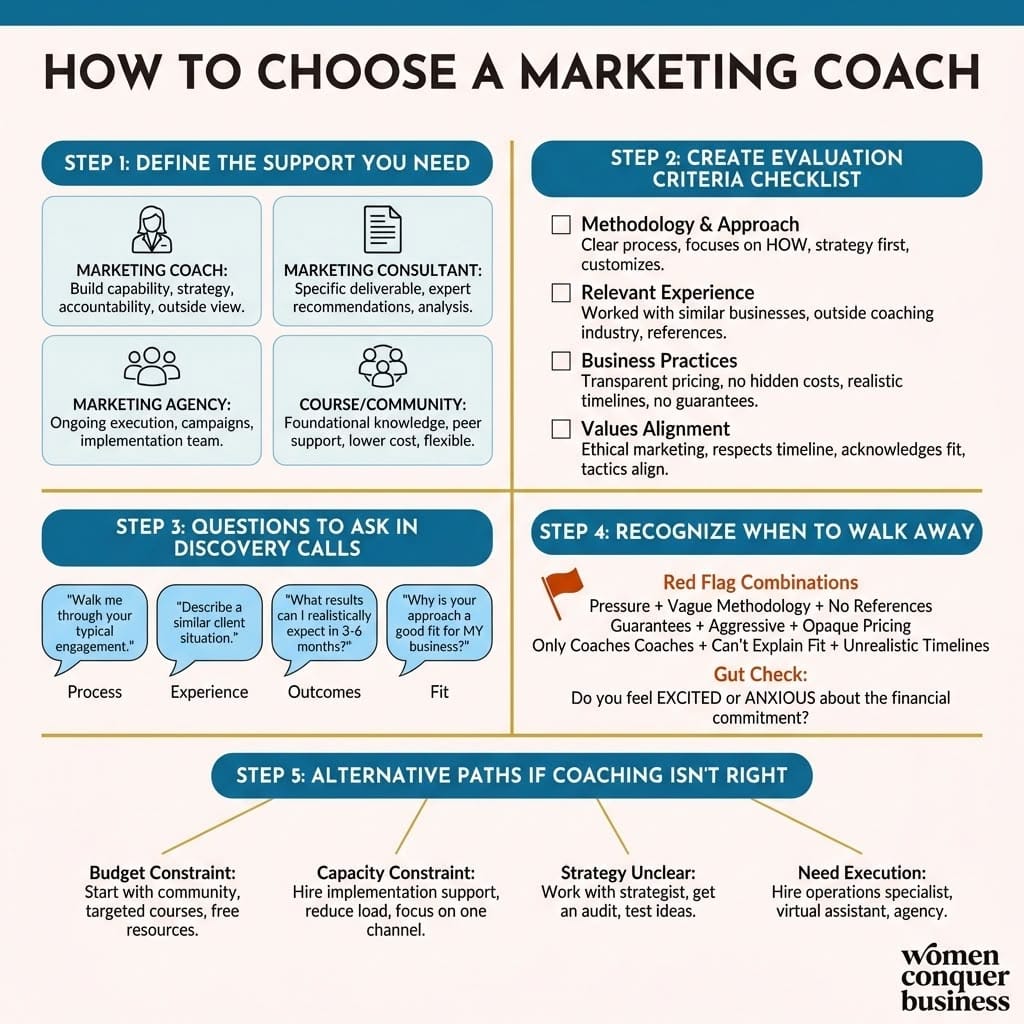
How to Choose a Marketing Coach
Now that you've assessed your readiness, and reviewed the red flags, here's a systematic approach to evaluating potential coaches and making a confident decision.
Step 1: Define the Support You Need
Before evaluating specific coaches, clarify what you're looking for. Different support serves different needs:
Marketing Coach is right when you need:
- To build your own marketing capability and confidence
- Strategic thinking and decision-making support
- Accountability to stay consistent
- Someone to help you see what you can't see from inside your business
Marketing Consultant is right when you need:
- A specific deliverable (strategy document, campaign plan, audit)
- Expert recommendations on a defined problem
- Someone to analyze and provide solutions you'll implement
Marketing Agency is right when you need:
- Ongoing execution and management
- Multi-channel campaigns you don't have capacity to run
- A team handling implementation while you focus on delivery
Course or Membership Community is right when you need:
- Foundational knowledge at your own pace
- Peer support and ongoing learning
- Lower financial investment
- Flexibility around your schedule
Understanding this distinction helps you ask better questions and recognize when a coach is selling you something that doesn't match what you actually need.
Step 2: Create Your Evaluation Criteria Checklist
Don't know where to start? Use this framework to assess every potential coach consistently:
Methodology & Approach:
- [ ] Can they articulate a clear coaching process or framework?
- [ ] Do they explain HOW they help clients progress, not just WHAT they teach?
- [ ] Does their approach emphasize strategy before tactics?
- [ ] Can they customize their methodology for different business models?
Relevant Experience:
- [ ] Have they worked with businesses similar to yours (service-based, product-based, local, online)?
- [ ] Can they speak to specific challenges your business type faces?
- [ ] Do their client results include businesses outside the coaching industry?
- [ ] Can they connect you with a client reference in a similar situation?
Business Practices:
- [ ] Is pricing transparent and disclosed upfront?
- [ ] Are there hidden costs (required courses, tools, communities)?
- [ ] Do they use realistic timelines (6-12 months for meaningful change)?
- [ ] Do they avoid guaranteed outcomes or specific revenue promises?
- [ ] Can you review contract terms before committing?
Values Alignment:
- [ ] Do they model ethical marketing in their own sales process?
- [ ] Do they respect your decision-making timeline without pressure?
- [ ] Do they acknowledge when coaching might not be the right fit?
- [ ] Do their marketing tactics align with how you want to market?
The International Coaching Federation's Core Competencies provide professional standards for coaching relationships, emphasizing clear agreements, active listening, and goal-oriented approaches. A coach operating within these standards will demonstrate structured methodology while adapting to individual needs.
Step 3: Questions to Ask in Discovery Calls
Discovery calls should help both you and the coach determine fit. Here are essential questions:
About Process & Methodology:
- "Walk me through your typical coaching engagement from start to finish."
- "What does a standard session cover, and how do you structure our work between sessions?"
- "How do you measure progress, and what happens if I'm not seeing results?"
- "What's your approach when a strategy isn't working?"
About Relevant Experience:
- "What percentage of your clients are [service-based businesses/consultants/local businesses]?"
- "Can you describe a client situation similar to mine and how you approached it?"
- "What's the longest sales cycle you've worked with?" (For relationship-driven businesses)
- "Can I speak with a client who runs a business similar to mine?"
About Expectations & Outcomes:
- "What results can I realistically expect in three months? Six months?"
- "What factors outside our sessions will most impact my results?"
- "Can you share an example of a client who didn't get results, and why?"
- "What's required of me between sessions for this to work?"
About Fit & Alignment:
- "Based on what you know about my business, why is your approach a good fit?"
- "What aspects of your approach would you emphasize or de-emphasize for my situation?"
- "Are there situations where you'd recommend I work with someone else instead?"
Research on coaching effectiveness shows that meaningful behavior change and business improvements typically require six to twelve months of consistent engagement, not quick fixes. A coach who promises rapid transformation or guaranteed outcomes isn't operating based on how coaching actually works.
Step 4: Recognize When You Should Walk Away
Even after going through evaluation, sometimes the answer is "no" or "not this coach." Trust your instincts when you notice:
Red flag combinations:
- Pressure to decide immediately + vague methodology + no client references
- Revenue guarantees + aggressive sales tactics + pricing opacity
- Only coaches other coaches + can't explain fit for your business + unrealistic timelines
Gut check questions:
- Do you feel excited about working together, or anxious about the financial commitment?
- Do you feel respected in the evaluation process, or manipulated?
- Can you imagine implementing their approach, or does it feel overwhelming?
- Would you be comfortable telling this coach "this isn't working" if needed?
Step 5: Alternative Paths If Coaching Isn't Right
If you determine coaching isn't the right fit right now, you have options:
If budget is the constraint:
- Start with the Women Conquer Business community for group coaching and peer support
- Invest in targeted courses on specific skills you need to build
- Use free resources and implement consistently before hiring support
If capacity is the constraint:
- Hire implementation support to execute your existing ideas
- Reduce your client load before adding strategic work
- Focus on one marketing channel consistently rather than trying to do everything
If strategy is unclear:
- Work with a marketing strategist for a one-time strategy session
- Get a marketing audit to identify your highest-leverage opportunities
- Test your ideas at small scale before investing in coaching
If you need execution, not strategy:
- Hire a marketing operations specialist to implement systems
- Work with a virtual assistant who can execute marketing tasks
- Partner with an agency for campaign execution
The right support at the right time creates momentum. The wrong support (or support before you're ready) creates frustration and wasted investment.
Choosing a Marketing Coach Who Serves You
The best indicator of coaching success isn't the coach's Instagram following, their income claims, or how many people they've "transformed." It's whether the coach's knowledge, values, and approach align with your business model, your capacity, and your definition of success.
The seven red flags we've covered: guaranteed results, irrelevant experience, circular credibility, predatory sales tactics, pricing opacity, missing methodology, and poor fit explanation all point to coaches who prioritize selling their services over serving your needs.
There are thousands of marketing professionals who are also excellent coaches:
- They're transparent about pricing, realistic about outcomes, and honest about whether they're the right fit.
- They have systematic approaches refined through experience.
- They model ethical marketing in their own sales process.
- They give you time to think, respect your capacity, and sometimes tell you "not yet" when coaching isn't what you need.
- Your job when evaluating marketing coaches isn't to find the most impressive or the most convincing.
When it's time to find the right marketing coach it requires asking hard questions, trusting your instincts when something feels off, and being willing to walk away from coaches who pressure, manipulate, or make promises they can't ethically guarantee.
If you're looking for support that emphasizes sustainable marketing strategies over hustle culture tactics, we'd love to talk. But whether you work with us, another coach, or decide to build your marketing capabilities through community and self-directed learning, make sure whoever you work with passes these tests.
FAQs: What to Look for in a Marketing Coach
What questions should I ask about expected results and timelines?
Start with:
- "What results can I realistically expect in the first three months?"
- "What factors outside our coaching sessions will impact my results?"
- "Can you share examples of clients who didn't get results, and why?"
A coach who gets defensive about these questions isn't someone you want to work with. Research shows that meaningful coaching outcomes typically develop over six to twelve months of consistent implementation, not weeks. Legitimate coaches set realistic timelines and emphasize your role in achieving results.
How do I evaluate if a coach has relevant experience for my business type?
Ask:
- "What percentage of your clients run businesses similar to mine?"
- "Can you walk me through how relationship-based marketing differs from audience-building strategies?"
- For service-based businesses specifically, ask: "What's the longest client sales cycle you've worked with?"
Be wary of coaches who claim their strategies work for "any business" or dismiss your concerns about industry differences.
How can I tell if sales tactics are legitimate urgency or manipulation?
Ask yourself:
- "Am I feeling excited or anxious about this decision?"
- "Did they give me adequate time to consider without pressure?"
- "Do I feel respected in this sales process, or manipulated?"
Trust yourself: if the sales process feels icky, the coaching relationship will likely feel the same.
What specific pricing questions should I ask upfront?
Be direct:
- "What are your package options and total costs?"
- "Are there any additional expenses beyond the coaching fee?"
- "What's included at each price point, and what requires upgrading?"
If you can't get straight answers to these questions, you already know what working together will be like. According to ICF industry benchmarks, professional coaching typically ranges from $200-$600 per hour for individual sessions, with monthly packages from $500-$2,000 and comprehensive programs from $3,000-$15,000+ depending on duration and access level.
How do I evaluate a coach's methodology or framework?
Ask:
- "What's your coaching method or framework?"
- "Can you walk me through the typical phases of working together?"
- "What tools or assessments do you use, and why those specifically?"
- "How do you customize your approach while maintaining a proven system?"
If the coach can't articulate a logical approach, they're asking you to pay for them to figure out how to help you.
How can I determine if a coach's approach fits my business?
Ask:
- "Based on what you know about my business, why is your approach a good fit?"
- "What aspects of your approach would we emphasize or de-emphasize for my situation?"
- Request: "Can you give me an example of how you've customized your approach for a similar business?"
If the answers feel generic or the coach gets impatient with your questions about fit, you have your answer about whether this is the right match.